
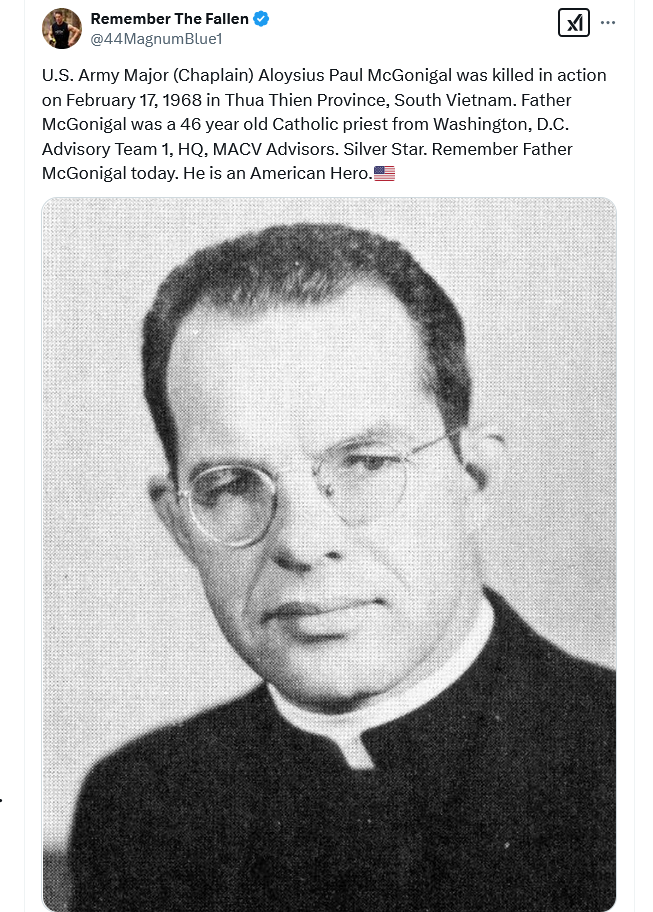
Aloysius Paul McGonigal was born to a large, twelve kids, Catholic family on November 8, 1921, the feast of the Four Crowned Martyrs. Even before elementary school he knew that he wanted to be a priest. During World War II he served in the Coast Guard. He was ordained into the priesthood in 1953. A Jesuit, he served as a Catholic Chaplain in the Army in 1961-1963 and joined the Army again in 1966 as a Chaplain. In 1967 he was assigned to the US Advisory Compound in Hue, South Vietnam. At the start of the Tet Offensive in January of 1968 he was in the north of South Vietnam when Viet Cong troops took over Hue.
Attaching himself to a South Vietnamese Airborne unit he made his way back to Hue. He received orders to stay safely in the compound and after southern Hue was secure to report to Da Nang for a desk job. Ignoring his orders he tended to American troops in the battle. Pestering the commander of the 1st Battalion, 5th Marines, who were without a Chaplain, he finally got permission to fill that role, and went into combat with the Marines. His Silver Star citation tells the rest:
SYNOPSIS: The President of the United States of America, authorized by Act of Congress July 9, 1918, takes pride in presenting the Silver Star (Posthumously) to Major (Chaplain’s Corps) Aloysius Paul McGonigal (ASN: 0-4070348), United States Army, for gallantry in action involving close combat against an armed hostile force in the Republic of Vietnam. Chaplain McGonigal distinguished himself by exceptionally valorous actions from 15 to 17 February 1968, while serving as Chaplain with Advisory Team 1, Military Assistance Command, Vietnam, on a combat mission in the Republic of Vietnam. During the battle for Hue City, Chaplain McGonigal learned that the Marines of the 1st Battalion, 5th Marine Regiment, were without a chaplain, and would be tasked with crossing the river under heavy fire to storm the walls of the enemy-controlled Citadel. After obtaining permission to join these Marines, he went into battle with them for three days of intense urban warfare, consoling the wounded and administering Last Rites to the dying. Chaplain McGonigal’s extraordinary heroism in close combat against an enemy force is in keeping with the highest traditions of the military service and reflect great credit upon himself and the United States Army.
Major Robert Thompson, commander of the 1st Battalion, 5th Marines wrote a letter about Father Al to the Philadelphia Daily News which was published on March 20, 1968:
“In the few short days that we spent with him inside the Hue Citadel, I found him to be a man of unshakeable faith and unbelievable courage. Father McGonigal spent every day with the assault companies administering the dead and wounded and giving spirit to every Marine who saw him. Without regard to his own personal safety, he continually exposed himself to intense hostile fire to do what he strongly felt was his duty to his God and his Country. Even though he was an Army chaplain, we feel that he belongs to us. The members of the 1st Battalion, 5th Marines who fought in the walled city of Hue, will never forget Father McGonigal, and I’m sure that we will be just a little stronger for having known him.”
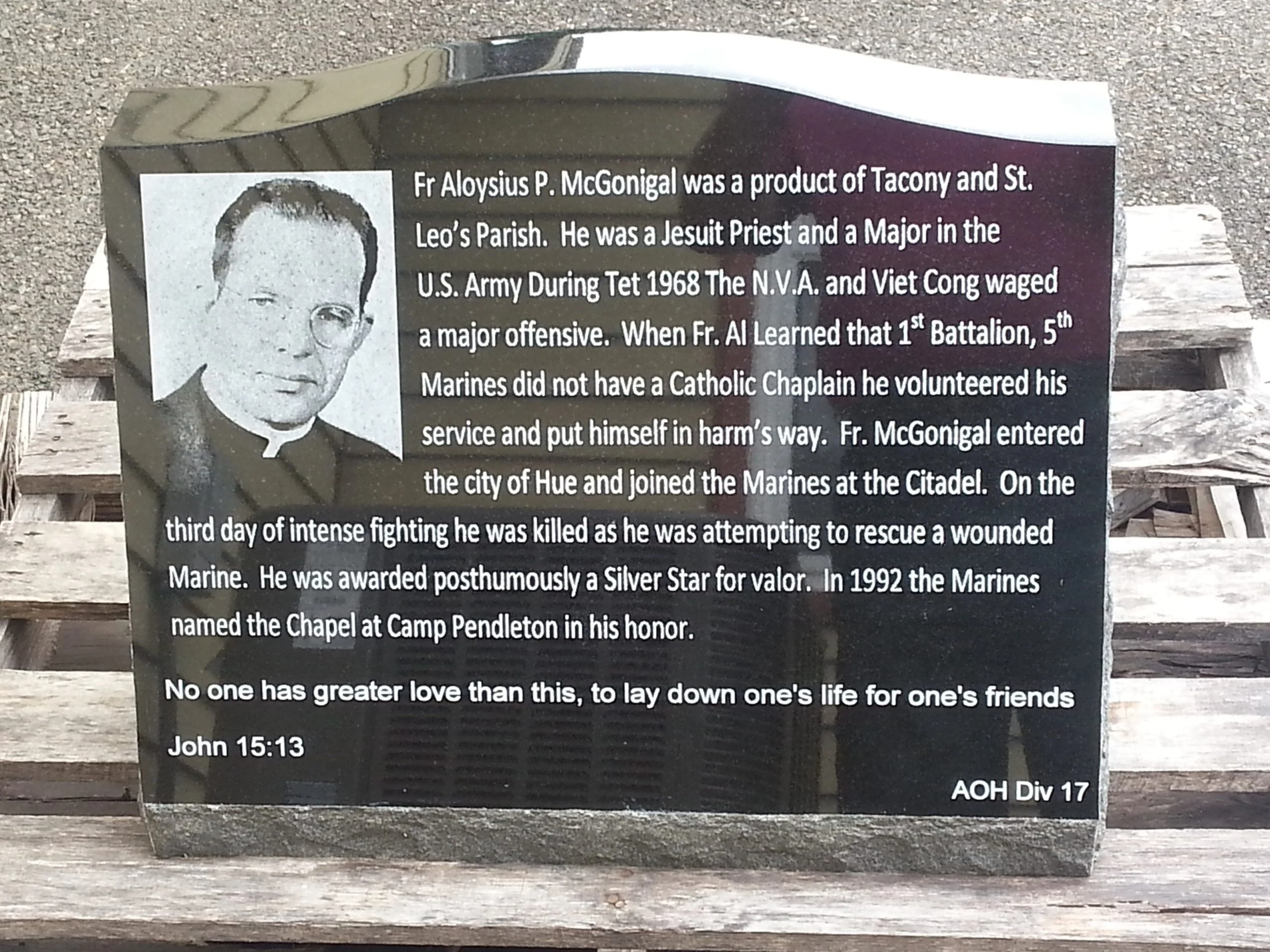


Aloysius Paul McGonigal joined the ranks of Vincent Capodanno in heaven.