
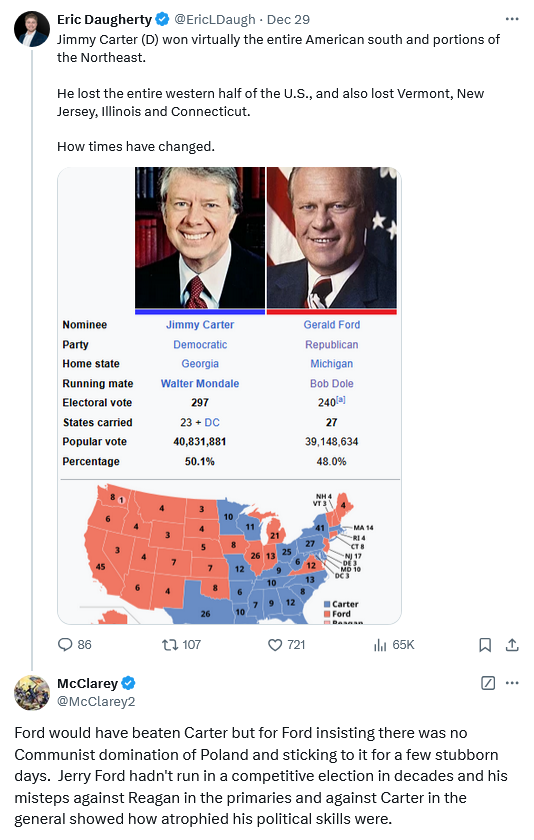
1976 was the first Presidential election I was able to vote in. I was an enthusiast for Reagan in the primaries, and it was remarkable how close he came to toppling Ford. Ford picked Bob Dole for his running mate, Dole adding nothing to the ticket other than a dour attitude and ensuring the Republicans would have Kansas all sewn up. To give Ford his due, he closed quite a deficit in the polls, although I think that was mostly due to the fumbles of Carter, his Playboy interview being only the worst of many indications that he was not a great campaigner. Of course Ford said, “Hold my beer”, to Carter as Ford “liberated” Poland and the rest of Eastern Europe. It played into the stereotype that Ford was none too bright and his stubborn refusal to admit he had misspoken for a few days made it so much worse. I was taking a class from the late Professor Betty Glad at the time, who was the expert on Carter, so I assumed that Carter would replicate on a national scale his constant warfare with the Georgia legislature, which then was almost entirely Democrat.
In hindsight it was probably good for the country that Carter won, since it set up the Reagan years. (Ford’s attempt at the Convention in 1980 to be a co-President if he agreed to be nominated as Vice-President showed that Ford and political reality were no longer on speaking terms.) Reagan remade the Republican party in his image, while Ford, a perfectly honorable man in most ways, was an avatar of a GOP that had gotten very used to being Avis to the Democrat Hertz.


In 1976, you still in both parties had blocs of delegates who had been slated by party insiders making use of procedures opaque to the general public. In New York, to take one example, there were no caucuses and there were competitive primaries only on the Democratic side. Ford’s plurality amounted to about 4% of the convention delegates; I suspect if you conducted a thorough audit, you’d discover that the plurality was attributable to boss-slated delegates. New York’s delegation that year was a boss-slated delegation run by Richard Rosenbaum; Ford had a 110 vote plurality in that delegation, which accounted for 90% of the 117 vote plurality he had at the convention.
==
See Wm. Schneider on the electoral advantage to be derived from your VP pick. Your single best guess is that it will net you 2% of the ballots in the VP candidate’s home state. If electoral advantage is your object, best to pick someone who can help in a closely-divided state. In 1976, the close states with a large EV count were Ohio and Texas. Also, per Schneider, the risk is on the downside; you want a VP candidate who will not be an unpalatable distraction (see Geraldine Ferraro).
==
Per Ron Nessen, Ford’s priorities in selecting a VP candidate were not electoral advantage, but posited governing skills, programmatic views, and talents as a campaigner. (Carter’s pick seemed to be an olive-branch to Washington insiders and union meatheads). The implication of that was that Ford, a career legislator, valued familiarity with Congress over executive experience (of which Dole had none and of which he had none prior to 1974).
==
The trouble you had with Ford and Dole was that they were in politics because it was (to them) a more agreeable way of making a living than practicing law. They had certain orientations and dispositions and no interest in progtrash social engineering projects, but did not have the tools to form an affirmative program apart from making petty adjustments in the accumulated corpus of what congressional committees had approved over the years. Reagan managed to recruit people who shared his objects, rather than just finding places for people in certain social networks (who would then be marinated in the viewpoint of the permanent government). Ford was quite impressed with Carla Hills (who also had a position with papa Bush). See his (amiable) remarks about her. Oh, what an advocate for her department she was. That’s not who you want in a Republican administration with serious objects.
Reagan nearly defeated Ford. I watched the GOP convention in 1976 and was fascinated by it. Ford’s comments about the Soviet bloc were indeed stupid. My parents were Democrats who disliked Nixon intently. I allowed my parents’ views to convince my self that a Democrat controlled government would make things better, but the opposite occurred. Carter was a terrible president and I don’t think he ever got over losing so badly to Reagan.
What caught my eye on that post was the distribution of electoral votes. A few examples of then vs now:
FL 17 – 30
CA 45 – 54 (down 1 from their high in the 2000 & 2010 Census)
NY 41 – 28
TX 26 – 40
IL 26 – 19
Mmmm… In retrospect, Ford’s comments hold more weight than we might expect. In retrospect. A few Clancy novels from the 80s or 90s demonstrates the point: Romanians, Polish, and others DID view themselves as sovereign nations, not under Soviet domination. …Behind closed doors.
‘Course there’s the rub. I came across those novels after 1990. Had I heard these comments in 1976, I likely would have thought Ford mad.
He could almost as easily have stated that we weren’t having a Cold War.
Ironically, the United Nations contributed to this problem. Officially, the UN aimed to promote international tranquility and peace, communication. However, both Soviet and American delegates set on the Security Council; the Soviets certainly treated the Soviet bloc as precisely that.
As…visionary…and optimistic as Ford perhaps intended being, …the average American had no real cause to believe him. Not when you have the major networks depicting Vietnam being over-run by communist rule that year.
That was a major “oops” on Ford’s part.
[…] We Don’t Give Ourselves Enough Credit – D. McClarey, J.D., at The American CatholicRemembrance of Elections Past – Donald R. McClarey, J.D., at The American CatholicBiden’s Time Has Finally Come! – […]