
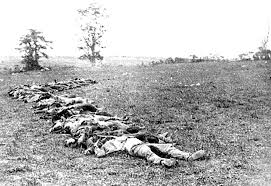
One hundred and sixty-one years since Lincoln delivered the Gettysburg Address. Forty-two years since the Blue and the Gray miniseries was broadcast on November 14, 16 and 17 in 1982 on CBS. I like the above sequence because it demonstrates that Lincoln was there to dedicate a cemetery. Few things are more hideous than a battle field bestrewn with dead men. Around eight thousand men were killed outright at Gettysburg. Several thousand wounded died in the weeks following. The logistics of burying all these men was immense, the burials too often done with little ceremony. By the time the Gettysburg Address was delivered, the dead would have been buried in new graves and the scars to the land would have been fresh. Lincoln was directly confronted with the ugly reality of war when he got up to speak.
The rendition of the Gettysburg Address by actor Gregory Peck is workmanlike, although Peck gives Lincoln a weird accent, almost an Irish brogue. Lincoln would have had a rural Hoosier accent from having grown up in rural Indiana, an accent I am well familiar with, having grown up with it along the Illinois-Indiana border. His strong accent was noted by many of his contemporaries who were not from the Midwest. (In Lincoln’s time the Midwest was the West, and the West was the Far West.) I like the way at the end of the Address there is no immediate applause, as happened historically with Lincoln’s audience being surprised, and probably disappointed, by the brevity of his remarks.
One feature of the speech often overlooked is what Lincoln meant by the fallen having hallowed the ground. Lincoln had the Bible in his bones and he knew that the only way anything is consecrated is through the shedding of blood in a blood sacrifice:
“Four score and seven years ago our fathers brought forth on this continent, a new nation, conceived in Liberty, and dedicated to the proposition that all men are created equal.
Now we are engaged in a great civil war, testing whether that nation, or any nation so conceived and dedicated, can long endure. We are met on a great battle-field of that war. We have come to dedicate a portion of that field, as a final resting place for those who here gave their lives that that nation might live. It is altogether fitting and proper that we should do this.
But, in a larger sense, we can not dedicate — we can not consecrate — we can not hallow — this ground. The brave men, living and dead, who struggled here, have consecrated it, far above our poor power to add or detract. The world will little note, nor long remember what we say here, but it can never forget what they did here. It is for us the living, rather, to be dedicated here to the unfinished work which they who fought here have thus far so nobly advanced. It is rather for us to be here dedicated to the great task remaining before us — that from these honored dead we take increased devotion to that cause for which they gave the last full measure of devotion — that we here highly resolve that these dead shall not have died in vain — that this nation, under God, shall have a new birth of freedom — and that government of the people, by the people, for the people, shall not perish from the earth.”
Lincoln would have been disappointed that his words have been remembered but that the deeds of the men at Gettysburg who did the fighting and the dying have largely, but not completely, fallen into historical oblivion.


Why should I care about Gettysburg?
I learned in my college history seminar that the Civil War was orchestrated by Zionist capitalists in the North who intended to subjugate a racist South and use their resources to subjugate brown and indigenous people in a colonizing programme of the corrupt American patriarchy while suppressing the emerging proletariat in the North.
/// Parody ends here ///
It would be supremely inconvenient to remember that one of the mainsprings of the Civil War was to free the slaves. As such, Gettysburg and the war of which it is a fulcrum point are ushered out of public discourse, or bizarrely recast as proof of America’s enduring racism.
Even if you adopt the lie that every Southern man on that field was some kind of Klansman, how do you explain the Northern side?
The late Bob Leckie served as a Marine machine gunner in the Pacific. He wrote a series of books on the wars of America that are highly worth reading, His book on our Civil War was entitled None Died in Vain. Union and Confederate vets were holding joint reunions by the 1880s. Vets from the other side who just happened to show up were treated as honored guests, the soldiers on both sides having a bond that civilians could never know. The Civil War and its aftermath could have torn this country apart permanently. Instead it became a source of national pride for both sides. We need to get back to that. The great lesson of the Civil War is that we are one people.
Wait for the ending:
https://www.youtube.com/watch?v=RAYbLdpghRA
Outstanding, Mr. Don!
Long after the fighting is over, there does indeed remain a strange bond even between adversaries. Something similar seemed to happen after Vietnam: U.S veterans who traveled there were not embittered but seemed to find a kind of completion in meeting some of their old adversaries.
Personally, thinking about the Civil War–the “Lost Cause,” the motives and justifications, etc., etc.–more than anything else I experience pity, pietas, of that terrible ordeal.
I wonder if my forebears (Confederate war fighters) felt the same. I suspect they did.
There is no other legend quite like the legend of the Confederate fighting man. He reached the end of his haunted road long ago. He fought for a star-crossed cause and in the end he was beaten, but as he carried his slashed red battle flag into the dusky twilight of the Lost Cause he marched straight into a legend that will live as long as the American people care to remember anything about the American past. – Bruce Catton”