
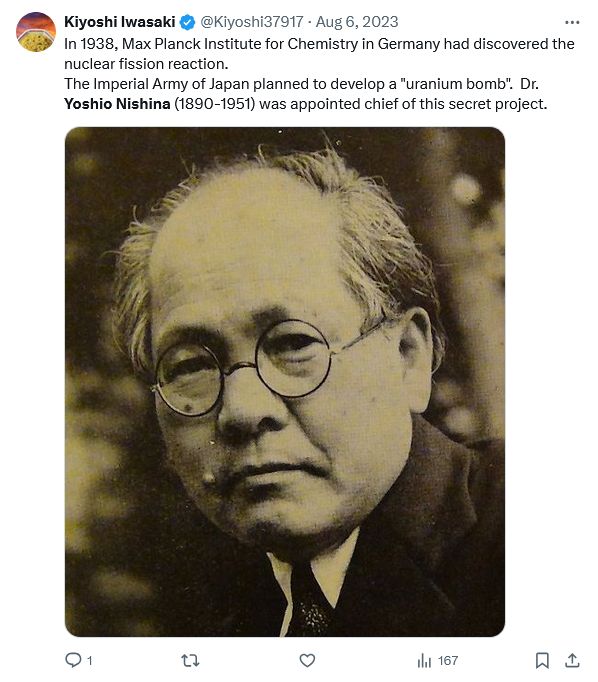
Most Americans are unaware that during World War II Japan had two programs seeking to build an atomic bomb.
In 1939 Dr. Yoshio Nishina, a Japanese nuclear physicist, recognized the potential of the then theoretical atomic bomb. ( In 1934 Professor Hikosaka Tadayoshi theorized about such a bomb.) In 1940 he spoke with Lieutenant-General Takeo Yasuda, director of the Army Aeronautical Department’s Technical Research Institute, about the potential of an atomic bomb. The Japanese Army began its program to develop an atomic bomb in April 1941.
Meantime, the Japanese Navy began its own program creating the Committee on Research in the Application of Nuclear Physics chaired by Dr. Nishina in 1942. The Navy’s project ended in 1943 when the Committee reported that while such a bomb was feasible it predicted that it would be difficult for even the United States, with all its resources, to harness the power of the Atom in time to have an impact on the War.
However, the Navy dropping out had no effect on the Army’s program which continued on to the end of the War, hampered both by lack of materials and by ever heavier US bombing. How far the Japanese got is open to speculation as the project was veiled in the deepest secrecy during the War, and most documents pertaining to it were destroyed by the Japanese prior to the Surrender.
There have been persistent rumors since World War II that the Japanese tested a nuclear device prior to the end of the War, either on an uninhabited island off what is now North Korea, or near Konan in what is now North Korea on August 12, 1945. The documentation is currently lacking to substantiate those claims. What is certain however, is that the Japanese had an ongoing atomic bomb project at the end of the War. Given enough time, I think it is foolhardy to think that one of the more inventive nations on Earth would not have found their way around road blocks and managed to have constructed an atomic bomb. The development of the atomic bomb during World War II was indeed a race, and not just against the Germans.


This doesn’t mean anything. Only heterosexual, tax-paying, white men are capable of doing evil.
One of the many, many interesting things about Takashi Nagai’s “The Bells of Nagasaki” is that he and some of his surviving physicist colleagues correctly speculated that the attack was atomic in nature on August 9. Apparently, nuclear weaponry was considered plausible by a large number of scientists.
This extract from the Tonizo Dossier may be of interest..
Meeting on Uranium research at the Nishina laboratory. 6th July 1943.
Attendance: Dr. Nishina, Gen. Nobu-uji, Ishida ( gishi / engineer ?)
From page 4 of 5.
Dr. Nishina; The minimum mass of uranium 235 is about 10Kg and is determined by the balance between the neutrons generated by fission and those lost though the surface. If too many are lost then there will be no sustained chain reaction. Though this critical mass is about 10 Kg, it will not make a bomb, there needs to be extra, assume an extra 10 Kg (1).
Gen. Nobu-uji asks if this extra will also under go fission. Nishina says, no, only a portion will undergo fission, the rest will be lost in the explosion (2). At present it is not within our capability to implement such a device.
There are other reasons why a bomb is not practical and therefore not recommended ( fu-tokusaku. In order to achieve the largest possible explosion, the bomb needs to be held ( hoji ) together for 1/30 to 1/20 [micro]* second and to achieve this it requires a large and heavy tamper or reflector (3). The weight would be enormous ( jindai ), therefore it is considered impractical and as a bomb not suitable ( tekito narazaru ).
Footnote;
(1) Modern nuclear parameters yield a critical mass for U235 of about 17 Kg with a substantial reflector. The Hiroshima bomb used 80% U235 and was about 2.8 critical masses.
(2) Only about 700 grams of U235 out of 64 Kg underwent fission at Hiroshima., the rest being lost in the explosion.
(3) Due to the exponential increase of the fission process, 99.5% of the energy is released in the last 4.6 fission periods. At about 10 nano-seconds per period this is 46 nano-seconds or approx. 1/25 micro-second. During this period the energy released must overcome the inertia of the tamper holding ( hoji suru ) the device together.
* The word micro is missing from the text, micro-second = haku man bun no ichi byo.
In Germany at about the same time, Heisenberg talked of the critical mass of U235 as having a radius 54 cm and weighing 10 tons.
The dividing line between success and failure is perhaps not as obvious as it may appear.
Even America had a problem with making weapons-grade uranium in quantity. We only had enough to build the Hiroshima Little Boy gun bomb. Plutonium was able to be produced in greater quantity, but its fission characteristics made it unsuitable for use in a gun design like Little Boy. That is why they went to the implosion design used in the Nagasaki Fat Man bomb. The gun design of the Little Boy was simple enough that people didn’t think that it needed testing before deployment. The complexity of the implosion plutonium bomb required testing at the Trinity test site. The implosion bomb was hand assembled. Mass producible bombs didn’t come until after the war. Maybe the selection of uranium by Japan was what made them think that America couldn’t produce very many bombs.
*
The Germans involved with the German bomb project were afraid that if Hitler took an interest in the program and it didn’t produce results that it would result in dire consequences for people working on the bomb. The estimated time to develop the bomb was one factor in this view. I think that Hitler was more interested in weapons with near term results.
Interesting discussion on weapon design. You need critical mass, critical geometry, and sufficient enrichment. And only certain isotopes are readily fissile: U-233 made from Th-232 breeding, U-235 acquired by enrichment of natural uranium, and Pu-239 made from U-238 breeding. I always thought that > 90% enrichment U-235 was needed but Martin Page referenced 80% enrichment. I would think such a bomb would fissile out on detonation without explosion fission from prompt neutrons.
BTW, almost all fission bombs are made with U-235 or Pu-239. I am aware of no U-233 bombs (the Th-232 breeding process is more difficult). Today’s bombs are thermonuclear or fusion boosted fission bombs. In the first, a fission explosion implodes deuterium-lithium to cause fusion. In fusion boosted fission bomb, extra neutrons from deuterium-lithium fusion are used to fission remaining U-235 or Pu-239. Designs of course are military secrets.
You need a breeder reactor to produce Pu-239 from U-238. U-238 absorbs a neutron and goes to U-239 which beta minus decays to Np-239 which beta minus decays to Pu-239 (2.35 day half life). The bad thing about this process is if Np-239 absorbs a neutron before decay; then it goes to Np-240 which decays to non-fissile Pu-240. The first few North Korean bombs were of that variety and fizziled out due to too much Pu-240 (we think).
Same with Th-232. When it absorbs a neutron it becomes Th-233 which beta minus decays to Pa-233 which again beta minus decays to U-233 which is fissile. But Pa-233 has a sufficietly long half life (27 days) that sometimes it absorbs a neutron to become Pa-234 which decays to U-234 which is an alpha emitter (a small amount can undergo spontaneous fission).
This is why current breeder reactor designs are molten salt with continuous chemical processing to extract Np-239 and Pa-233 (depending on selected fertile fuel choice) before neutron absorption can occur. I am not too keen about using sodium cooled or lead-bismuth cooled reactor for this.
Enrichment of U-235 from naturally occurring uranium (99.3 % U-238 and 0.7% U-235) to > 90% weapons grade for a bomb avoids all the difficulties above, but is itself an energy-intensive and difficult process with its own problems. There is only a slight mass difference between U-235 and U-238. Centrifuges rely on this mass difference to extract U-235, but it takes a long time and a lot of electricity. That’s why North Korea went with Pu-239. They had a mini-RBMK reactor (I think) and used that to get their Pu-239.
Yes, and the Nazis were into it as well. Thank God for Einstein who sent a letter to the President before the US entered the war.
Thanks Nazis for causing your best physicists to flee Germany!