
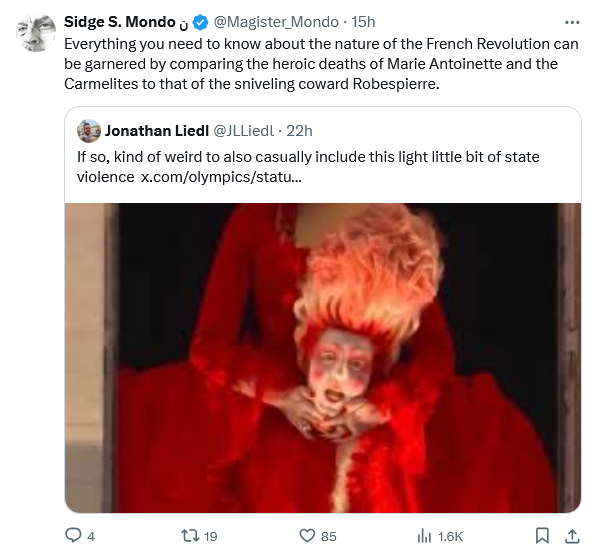
The French Revolution had the effect of lessening anti-Catholicism in England. The English admired the courage with which many Catholics fought against the Revolutionaries in France and tolerance was extended to French Catholic refugees in England. This was a great change as all the French had traditionally been regarded as the mortal enemies of the English. Edmund Burke began to change this traditional attitude with his Reflections on the Revolution in France. Here are his comments on Marie Antoinette:
“It is now sixteen or seventeen years since I saw the queen of France, then the dauphiness, at Versailles; and surely never lighted on this orb, which she hardly seemed to touch, a more delightful vision. I saw her just above the horizon, decorating and cheering the elevated sphere she had just begun to move in, glittering like the morning star full of life and splendor and joy. 0h, what a revolution! and what a heart must I have, to contemplate without emotion that elevation and that fall! Little did I dream, when she added titles of veneration to those of enthusiastic, distant, respectful love, that she should ever be obliged to carry the sharp antidote against disgrace concealed in that bosom; little did I dream that I should have lived to see such disasters fallen upon her, in a nation of gallant men, in a nation of men of honor, and of cavaliers! I thought ten thousand swords must have leaped from their scabbards, to avenge even a look that threatened her with insult.
But the age of chivalry is gone; that of sophisters, economists, and calculators has succeeded, and the glory of Europe is extinguished forever. Never, never more, shall we behold that generous loyalty to rank and sex, that proud submission, that dignified obedience, that subordination of the heart, which kept alive, even in servitude itself, the spirit of an exalted freedom! The unbought grace of life, the cheap defense of nations, the nurse of manly sentiment and heroic enterprise is gone. It is gone, that sensibility of principle, that chastity of honor, which felt a stain like a wound, which inspired courage whilst it mitigated ferocity, which ennobled whatever it touched, and under which vice itself lost half its evil, by losing all its grossness.”
Marie Antoinette was worthy of this accolade. She went to her death through a screaming blood mad mob with calmness and dignity, back straight, head erect, every inch a queen. She showed no fear, in stark contrast to many of those who caused her legal murder and who would later go to their own deaths giving every sign of abject terror. Here is a translation of the text of her last letter:
16th October, 4.30 A.M.
It is to you, my sister, that I write for the last time. I have just been condemned, not to a shameful death, for such is only for criminals, but to go and rejoin your brother. Innocent like him, I hope to show the same firmness in my last moments. I am calm, as one is when one’s conscience reproaches one with nothing. I feel profound sorrow in leaving my poor children: you know that I only lived for them and for you, my good and tender sister. You who out of love have sacrificed everything to be with us, in what a position do I leave you! I have learned from the proceedings at my trial that my daughter was separated from you. Alas! poor child; I do not venture to write to her; she would not receive my letter. I do not even know whether this will reach you. Do you receive my blessing for both of them. I hope that one day when they are older they may be able to rejoin you, and to enjoy to the full your tender care. Let them both think of the lesson which I have never ceased to impress upon them, that the principles and the exact performance of their duties are the chief foundation of life; and then mutual affection and confidence in one another will constitute its happiness. Let my daughter feel that at her age she ought always to aid her brother by the advice which her greater experience and her affection may inspire her to give him. And let my son in his turn render to his sister all the care and all the services which affection can inspire. Let them, in short, both feel that, in whatever positions they may be placed, they will never be truly happy but through their union. Let them follow our example. In our own misfortunes how much comfort has our affection for one another afforded us! And, in times of happiness, we have enjoyed that doubly from being able to share it with a friend; and where can one find friends more tender and more united than in one’s own family? Let my son never forget the last words of his father, which I repeat emphatically; let him never seek to avenge our deaths.
I have to speak to you of one thing which is very painful to my heart, I know how much pain the child must have caused you. Forgive him, my dear sister; think of his age, and how easy it is to make a child say whatever one wishes, especially when he does not understand it. It will come to pass one day, I hope, that he will better feel the value of your kindness and of your tender affection for both of them. It remains to confide to you my last thoughts. I should have wished to write them at the beginning of my trial; but, besides that they did not leave me any means of writing, events have passed so rapidly that I really have not had time.
I die in the Catholic Apostolic and Roman religion, that of my fathers, that in which I was brought up, and which I have always professed. Having no spiritual consolation to look for, not even knowing whether there are still in this place any priests of that religion (and indeed the place where I am would expose them to too much danger if they were to enter it but once), I sincerely implore pardon of God for all the faults which I may have committed during my life. I trust that, in His goodness, He will mercifully accept my last prayers, as well as those which I have for a long time addressed to Him, to receive my soul into His mercy. I beg pardon of all whom I know, and especially of you, my sister, for all the vexations which, without intending it, I may have caused you. I pardon all my enemies the evils that they have done me. I bid farewell to my aunts and to all my brothers and sisters. I had friends. The idea of being forever separated from them and from all their troubles is one of the greatest sorrows that I suffer in dying. Let them at least know that to my latest moment I thought of them.
Farewell, my good and tender sister. May this letter reach you. Think always of me; I embrace you with all my heart, as I do my poor dear children. My God, how heart-rending it is to leave them forever! Farewell! farewell! I must now occupy myself with my spiritual duties, as I am not free in my actions. Perhaps they will bring me a priest; but I here protest that I will not say a word to him, but that I will treat him as a total stranger.
Near the end of The Terror a group of Carmelite nuns gave a master course on how to die well:
On 17 July we commemorate the 16 Blessed Carmelite martyrs of Compiègne, Mother Teresa of St Augustine and Companions, who were executed on 17 July 1794 during the French Revolution.
The Sisters had refused to comply with the Civil Constitution of the Clergy, a law passed in 1790, which subordinated the Catholic Church to the revolutionary government, confiscated all Church land and banned religious orders. The Carmelites of Compiègne resisted the suppression of their monastery and so were arrested in June 1794 and imprisoned at the former Visitation convent of Compiègne, where they offered themselves daily for the peace of France and the Church. On 17 July they were tried in Paris, convicted of treason and sentenced to death by guillotine. Providentially, they were wearing their outlawed religious habits, since their only secular clothes were being washed on the day of the trial.
The Sisters were then transported in tumbrels among a group of 40 condemned prisoners to the place of execution at the Place du Trône, Paris. On the journey, the Sisters chanted the combined Offices of Vespers and Compline. This included the Miserere, the penitential Psalm 50: “Have mercy on me, O God, in your kindness…” and concluded with the Salve Regina. Eyewitness accounts report that the usually hostile crowds along the route were strangely silent.
On reaching the place of execution, Mother Teresa intoned the Te Deum, and then the Veni Creator Spiritus. Then all of the Sisters renewed their vows and Sr Constance, the youngest and still a novice, joined in, thus making Profession before mounting the scaffold. Sr Constance was the first to die, after kneeling for the blessing of her Prioress, and kissing a small staute of Our Lady. As she approached the guillotine, she intonedLaudate Dominum Omnes Gentes(Psalm 117) : “O praise the Lord, all you nations; acclaim him all you peoples. Strong is his love for us; he is faithful for ever.” This was taken up by all the Sisters, who continued to sing, with diminishing voices, until all had died. Usually executions were accompanied by shouting and cheers but there was only silence.
Sr Constance waved aside the executioner and his two assistants and approached the guillotine unaided. It is likely that the executions continued in order of religious profession. We know that Mother Teresa was the last. The 78 year old Sr Mary of Jesus Crucified was heard to say to the executioners “I forgive you, my friends. I forgive you with all that longing of heart with which I would that God forgive me!” The bodies of the Carmelites were buried in a Mass grave.
Many believe that the sacrifice of Mother Teresa of St Augustine and her community brought about the end of the ‘Reign of Terror’, which happened just 10 days later on 27thJuly 1794. Their story has captured the popular imagination, inspiring a novella by Gertrud von le Fort, a play by Georges Bernanos and an opera by Francis Poulenc. They were beatified by Pope St Pius X on 27 May 1906.
Go here to read the rest. When my maternal Grandmother lay dying, she was asked by a priest if she was afraid to die. She responded, “No Father. My bags are packed.”. To a believing Christian this life is merely a portal to the next. May we always have our bags packed for the ultimate great adventure.


Yes. Bags packed and lamps full of oil.
The French still have a schizophrenic attitude toward the revolution in trying to separate Bastille Day from the Terror when both are joined at the hip. My personal opinion is that this accounts for wide swings in national and international politics. Royal rule, Paris commune along with religious fervor and secularization, De Gaulle and Petain, etc. The local French restaurant simply celebrates a National Day in July with a rather high priced offering.
Still the “misinformation” about that Revolution persists.
Very hard to straighten it out.
Thank you for this article
I always find it ironic that a decade after the French beheaded a king they were crowning an emperor.
Another heroic death: Charles I of England at the hands of the Puritans.
As Napoleon said, he didn’t steal a crown but found it lying in the gutter and picked it up with his sword.
As for Charles I, I like the tale that Cromwell visited the King’s coffin at night and muttered, “Cruel Necessity.”
Trianon, authored by Elena Maria Vidal, is the story of Marie Antoinette and King Louis XVI. A review: ” In this work of historical fiction, all of the characters were actual people The incidents, situations and conversations are based on reality. It is the story of the martyred King Louis XVI and his Queen, Antoinette. The fruit of years of research, the book corrects many of the popular misconceptions of the royal couple, which secular and modernist historians have tried so hard to promote. Louis and Antoinette can only be truly understood in view of the Catholic teachings to which they adhered and within the context of the sacrament of matrimony. It was the graces of this sacramental life that gave them the strength to remain loyal to the Church, and to each other, in the face of crushing disappointments, innumerable humiliations, personal and national tragedy, and death itself. Theirs is not a conventional love story; indeed it is more than a love story. The fortitude they each displayed at the very gates of hell is a source of inspiration for all Christians who live in troubled times.”
The Scarlet Pimpernal by Baroness D’ Orzy is total fiction but I would like to think that there really was a secret group of British aristocrats that were able to rescue French Catholics from the guillotine.
If it’s any indication how they reacted when Notre Dame suffered the fire incident, the French are very sentimental and patriotic and protective towards their landmarks and icons and history. Which is weird considering the mainstream attitude is that religion, Christianity in particular, is not for the evolved mind. I have feeling they know it’s a privilege to have that attitude because of the fact that France has a long Catholic legacy which they know they will never shake.
[…] Abortion Makes Men ‘More Free,’ Pete Buttigieg Says – National Catholic Register6. Courage and Faith: Marie Antoinette – Donald R. McClarey, J.D., at The American Catholic7. How Long O’ Lord? – Matthew […]