
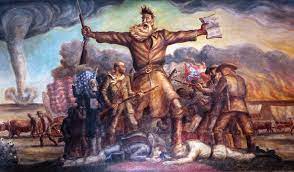
Any understanding of this nation has to be based, and I mean really based, on an understanding of the Civil War. I believe that firmly. It defined us. The Revolution did what it did. Our involvement in European wars, beginning with the First World War, did what it did. But the Civil War defined us as what we are and it opened us to being what we became, good and bad things. And it is very necessary, if you are going to understand the American character in the twentieth century, to learn about this enormous catastrophe of the mid-nineteenth century. It was the crossroads of our being, and it was a hell of a crossroads.
Shelby Foote
An episode of an excellent series on YouTube, the Civil War in Four Minutes, the above video takes a look at the differing interpretations of the War by Americans. The Civil War is, of course, an immense event in American history, perhaps the immense event in American history. Most Americans I think do not understand how huge it is, simply because we think we are familiar with it, and because we are still too close to it in time for us to gain the historical perspective to judge. The many, many differing interepretations of it: a glorious war for human liberty, a valiant defense of States’ Rights, the war against the Rebellion, the Second American Revolution, a needless conflict, etc, often say more about the times when the interpretations are made, than they do the Civil War itself. Almost my entire life I have been studying the conflict. However, the scholarly necromancy that we perform in historical texts can, at best, only put before our eyes pale shadows of what the War was like for the men and women on both sides who lived the triumphs and tragedies of a conflict so vast as to perhaps dwarf all our other historical experiences as a people. Sadly, perhaps this scene from the John Adams miniseries sums up the daunting, if not futile, task of presenting to succeeding generations the reality of an event as historically significant as the Civil War:


“simply because we think we are familiar with it, ”
Most people today, have no sense of history. At all. They may know there was a war and slavery, but that’s about it.
I’ve had conversations with my coworkers in their 20s and 30s. No knowledge of any wars in the 20th century. They know Nazis are bad.
Most movies over 20 years old they haven”t seen. Many cultural celebrities they not heard of because they haven’t seen those same movies. I’ve brought up people and things before thinking that they will know them and they don’t. The last time that happened it was Mel Gibson. They didn’t know who he was or any of his movies. Another time it was Mao. They had no idea who he was or what he did so they didn’t understand why I objected to coffee mugs with his face on them. I had to explain it to them and direct them to look it up. The mugs were thrown out.
They don’t read books either.
Everyone seems to be in the perpetual now. No sense of history. This lack of knowledge and ability to think will most certainly doom the next 100 years to great bloodshed. They Great Covit Hoax, the compelled wearing of useless mask and “socal distancing”, etc. clearly illustrate the lack of critical judgment that could have been stopped by knowledge of past events.
If I may be permitted to oversimplify our history:
The Revolution was merely the Prologue, the question if you will, to the Civil War, its answer. There were no tensions or unresolved disputes at the beginning that were not current by the time of the Late Unpleasantness. They still reverberate today in some form.
The Third Act, so to speak, would have to be the entry into World War II and its aftermath, the cementing of the federal government’s power. Certainly, the consolidation of power in Washington didn’t begin then, but it seems to me that there was no turning back once we embarked on that adventure (or misadventure).