
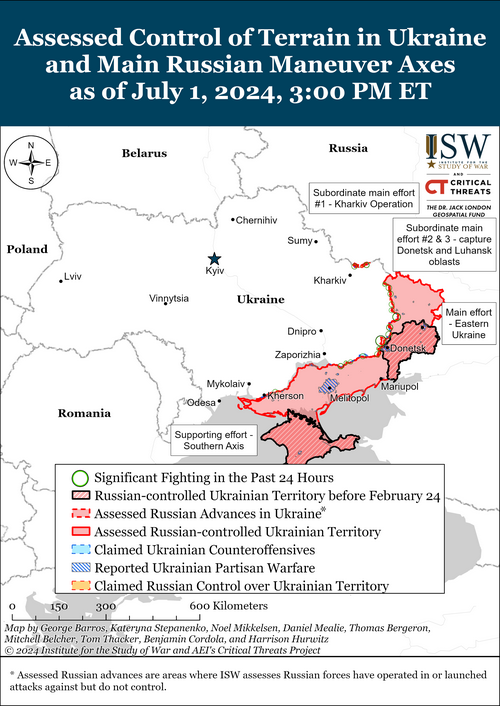
From The Institute for the Study of War:
Russian Offensive Campaign Assessment, July 1, 2024
Nicole Wolkov, Christina Harward, Angelica Evans, Karolina Hird, and Frederick W. Kagan
July 1, 2024, 5pm ET
Click here to see ISW’s interactive map of the Russian invasion of Ukraine. This map is updated daily alongside the static maps present in this report.
Click here to see ISW’s 3D control of terrain topographic map of Ukraine. Use of a computer (not a mobile device) is strongly recommended for using this data-heavy tool.
Click here to access ISW’s archive of interactive time-lapse maps of the Russian invasion of Ukraine. These maps complement the static control-of-terrain map that ISW produces daily by showing a dynamic frontline. ISW will update this time-lapse map archive monthly.
Note: The data cut-off for this product was 12:15pm ET on July 1. ISW will cover subsequent reports in the July 2 Russian Offensive Campaign Assessment.
Russian Ministry of Internal Affairs (MVD) Head Vladimir Kolokoltsev boasted that Russian authorities have increased detentions and prosecutions related to illegal migration into Russia while calling for intensified Russian government crackdowns against illegal migration. Kolokoltsev claimed on July 1 at a Russian government meeting on crime prevention that the MVD has detected over double the number of crimes related to organizing illegal migration and have prosecuted roughly a quarter more individuals who were illegally in Russia, presumably in comparison with 2023.[1] Kolokoltsev also claimed that the number of “serious” and “especially serious” crimes committed by foreigners in Russia decreased by 7.6 percent in 2024 in comparison to 2023. Kolokoltsev also noted that select crimes that foreigners have committed in Russia have increased interethnic tension in Russia. Kolokoltsev characterized Russia’s fight against illegal migration as “strategically important” and called for joint efforts to resolve migration issues, likely referring to coordinated efforts between multiple Russian state security organs.
Russian milbloggers criticized Kolokoltsev’s statistics and claimed that the reported reduction in crimes committed by foreign citizens in Russia is a result of Russian authorities’ decision to grant Russian citizenship to migrants — not actual decreases in migrant crime.[2] One milblogger insinuated that Kolokoltsev was directly attempting to defy Russian Investigative Committee Head Alexander Bastrykin, who claimed on July 27 that migrant crime is spreading across Russia and that migrants committed an increased percentage of “especially serious” and “extremist” crimes in Russia in 2023.[3] Russian ultranationalists have routinely criticized the Russian government’s policy of giving migrants Russian citizenship, although some Russian milbloggers and some State Duma members have previously justified Russia’s ongoing coercive crypto-mobilization efforts, which disproportionally target migrants, by claiming that migrants who receive Russian citizenship must fight in Ukraine to “earn” their Russian citizenship and that migrants who fight in Ukraine will receive Russian citizenship.[4] Significant Russian ultranationalist efforts to stop the Russian government from giving Russian citizenship to migrants and other “compatriots abroad” (which Russia loosely defines as ethnic Russians and Russian-speakers living outside of Russia) may hinder Russia’s ongoing weaponization of passportization to generate military manpower, offset domestic labor shortages, and set informational conditions to justify potential hybrid operations against other countries with Russian and Russian-speaking populations.[5]
Russia assumed its one-month-long rotating presidency of the United Nations Security Council (UNSC) on July 1 for the first time since April 2023 and will likely use this position as a power projection base within the international system as it historically has.[6] Russian Foreign Minister Sergei Lavrov will chair UNSC debates on July 16 and 17.[7] ISW assessed during Russia’s April 2023 presidency that Russia exploited its UNSC presidency to further several narratives regarding Russia’s desired sway in the international system and has previously noted that Russia uses its UNSC veto power as a base of power projection.[8] Several high-ranking Russian officials have recently launched several information operations meant to deflect responsibility for well-documented Russian violations of international law committed in Ukraine, likely to set conditions for the upcoming UNSC presidency.[9]
South Korea’s Ministry of Unification announced on July 1 that North Korean state TV channel Korean Central TV switched to transmitting broadcasts via Russian satellites instead of Chinese satellites, reportedly affecting South Korea’s ability to monitor North Korean state TV.[10] South Korean media and North Korean monitoring organizations reported on July 1 that they suddenly stopped receiving Korean Central TV broadcasts, and South Korean’s Ministry of Unification later announced that North Korea stopped transmitting broadcasts through Chinese satellites and that the reception from the Russian satellites is restricted in some areas of South Korea.[11] South Korean state broadcaster KBS reported that signals from the Russian satellites overlap with certain domestic frequency banks, making the signals difficult to receive in South Korea.[12] North Korea monitoring organization North Korea Tech stated on July 1 that North Korea is using Russia’s Express-103 satellite, which transmits to a significantly smaller area of the world (reportedly excluding most of Asia, Europe, and Africa) compared to the Chinese Chinasat-12 satellite that North Korea previously used for its broadcasts.[13] It is unclear if North Korea is temporarily switching its broadcasts to Russian satellites or if the change is more permanent; however, it is notable that the Kremlin may be aiding North Korean efforts to conceal information from South Korea and other Western allies.
Hungary assumed the six-month rotating presidency of the European Union (EU) Council on July 1.[14] The EU Council presidencies work in “trios” every 18 months that set long-term goals and prepare a common agenda for the EU Council.[15] Hungary is currently a part of the “trio” that includes Spain, which held the presidency from July 2023 to December 2023, and Belgium, which held the presidency from January 2024 to June 2024. The Spanish–Belgian–Hungarian trio set its 18-month program in July 2023, which expressed commitment to “helping the rest of the world cope with the consequences of Russia’s war and contributing to the coordination of long-term financial support for the reconstruction of Ukraine.”[16] Each presidency also sets its own six-month priorities, and Hungary’s seven focus areas include reinforcing the EU’s defense policy, making the EU enlargement policy consistent and merit-based, stemming illegal migration, promoting farmer-oriented EU agricultural policy, and addressing the EU’s demographic challenges.[17]
Key Takeaways:
- Russian Ministry of Internal Affairs (MVD) Head Vladimir Kolokoltsev boasted that Russian authorities have increased detentions and prosecutions related to illegal migration into Russia while calling for intensified Russian government crackdowns against illegal migration.
- Russia assumed its one-month-long rotating presidency of the United Nations Security Council (UNSC) on July 1 for the first time since April 2023 and will likely use this position as a power projection base within the international system as it historically has.
- South Korea’s Ministry of Unification announced on July 1 that North Korean state TV channel Korean Central TV switched to transmitting broadcasts via Russian satellites instead of Chinese satellites, reportedly affecting South Korea’s ability to monitor North Korean state TV.
- Hungary assumed the six-month rotating presidency of the European Union (EU) Council on July 1.
- Ukrainian forces recently advanced near Kreminna, and Russian forces recently advanced near Avdiivka.
- The Russian information space continues to discuss the mistreatment of wounded and disabled Russian servicemembers in Ukraine.
Go here to read the rest. The war news dries up as both sides lick their wounds and wonder what Trump will do after he takes office. That is now the large X factor in this conflict.


News item on Bloomberg this AM. Russian oil tanker loadings are up indicating they seem to have no problems finding markets for their oil. Saudi loadings are down because of increased domestic use as they proceed with increased industrialization of their economy.