
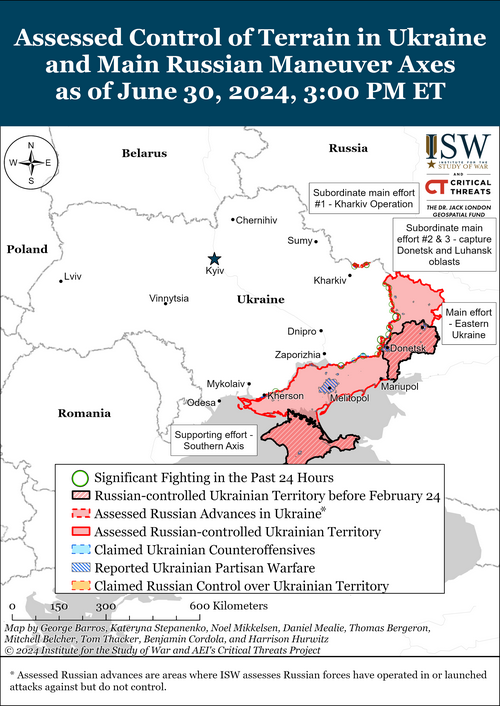
From The Institute for the Study of War:
Russian Offensive Campaign Assessment, June 30, 2024
Riley Bailey, Christina Harward, Nicole Wolkov, Angelica Evans, and Frederick W. Kagan
June 30, 2024, 6:50pm ET
Click here to see ISW’s interactive map of the Russian invasion of Ukraine. This map is updated daily alongside the static maps present in this report.
Click here to see ISW’s 3D control of terrain topographic map of Ukraine. Use of a computer (not a mobile device) is strongly recommended for using this data-heavy tool.
Click here to access ISW’s archive of interactive time-lapse maps of the Russian invasion of Ukraine. These maps complement the static control-of-terrain map that ISW produces daily by showing a dynamic frontline. ISW will update this time-lapse map archive monthly.
Note: The data cut-off for this product was 11:45 am ET on June 29. ISW will cover subsequent reports in the July 1 Russian Offensive Campaign Assessment.
Russian President Vladimir Putin’s theory of victory that Russia will be able to make creeping advances in Ukraine indefinitely will incentivize Putin to protract the war and harden Putin’s commitment to destroying Ukrainian statehood. The West must hasten to provide Ukraine the support it needs to conduct counteroffensive operations to invalidate Putin’s theory of victory and avoid protracting the war more than necessary to secure a peace acceptable to Ukraine and its partners. Ukrainian President Volodymyr Zelensky stated in an interview with the Philadelphia Inquirer published on June 30 that he fears that the West is afraid of pushing for full Ukrainian victory due to Western concerns about Russian stability and that this fear has allowed Putin to pursue the seizure of as much Ukrainian territory as possible.[1] Zelensky warned that every Russian advance strengthens Russia’s bargaining power and that Putin can choose to try to leverage this bargaining power at opportune moments to pursue a ceasefire that would allow Russia to prepare for future aggression against Ukraine.[2]
Putin has articulated a theory of victory that assumes that Russian forces will be able to continue gradual creeping advances indefinitely, prevent Ukraine from conducting successful operationally significant counteroffensive operations, and win a war of attrition against Ukrainian forces.[3] The Russian military command is currently prioritizing consistent offensive operations that achieve gradual tactical gains over conducting a large-scale discrete offensive operation that aims to make operationally significant gains through rapid maneuver.[4] Putin and the Russian military command likely view creeping offensive operations as a more guaranteed approach to making gains in Ukraine than larger mobile offensives and appear to be accepting the reality that Russian forces may have to pursue individual operationally significant objectives over the course of many months if not years.[5] Putin has recently demanded that Ukraine cede all of occupied Kherson, Zaporizhia, Donetsk, and Luhansk oblasts as well as the parts of those four oblasts that Ukraine currently controls.[6] A protracted war favors Putin’s calculus since he likely assesses that Russia will be able to hold any ground it takes and that Russian forces will be more likely to achieve his current stated territorial objectives the longer the war progresses. Putin and the Kremlin have intentionally set no limits to their objectives of conquest in Ukraine and have suggested repeatedly that areas outside of Kherson, Zaporizhia, Donetsk, and Luhansk oblasts are part of Russia.[7] Protracted war will likely incentivize Putin to explicitly set new territorial objectives as long as he assesses that Ukrainian forces can neither stop his advances nor conduct meaningful counteroffensives.
Putin retains his objective of entirely destroying Ukrainian statehood and identity, and all his objectives for territorial conquest in Ukraine are a means to this end.[8] Putin likely hopes that creeping Russian advances in Ukraine will convince the West that Ukrainian victory is unattainable and that concessions on Ukrainian territorial integrity and sovereignty are preferable to Ukrainian defeat.[9] Putin is currently unwilling to accept anything short of full Ukrainian capitulation, however, as his remarks and demands consistently show, and he will see any negotiated ceasefire agreement as a mechanism for Russia to prepare for renewed offensive operations in the future to achieve his overall aims. A negotiated ceasefire that further establishes a precedent for violating Ukrainian territorial integrity and sovereignty beyond the precedent already established by the Minsk Accords following Russia’s seizure of Crimea and parts of Luhansk and Donetsk in 2014 will strengthen Russia’s position to pursue the full eradication of Ukrainian statehood at a later date. This ceasefire would provide Russia a respite in the war to reconstitute and expand its forces and to further mobilize its defense industrial base (DIB) for future aggression.[10] Putin and the Russian military command likely hope that a ceasefire will allow Russia to launch a future stage of the war with a military more capable of pursuing operationally significant advances. Putin is not yet interested in a ceasefire, however, as he appears to continue to assess that he can achieve his aims by force. He might become more open to a ceasefire if that condition changes, but a negotiated ceasefire on Putin’s terms would amount to Ukrainian and Western capitulation. Neither of these courses of action are consistent with the survival of an independent Ukrainian state or the Ukrainian people, nor are they compatible with NATO’s vital security interests.
Ukraine’s partners can help Ukraine reduce Putin’s willingness to continue to wage endless war in pursuit of Ukraine’s destruction by helping Ukraine conduct significant counteroffensive operations that liberate Ukrainian territory and invalidate Putin’s assumptions about what Russia can achieve in Ukraine by force. Putin’s current theory of victory rests on Russia’s ability to outlast and overcome pledged Western security assistance to Ukraine and Ukrainian efforts to mobilize more of its economy and population for the war effort.[11] Putin and the Russian military command are increasingly viewing the retention of the theater-wide initiative as a strategic imperative and will continue to leverage the initiative to try to force Ukraine to commit manpower and materiel to current defensive operations and to prevent Ukraine from accumulating the personnel and resources Ukraine needs to contest the initiative.[12] Putin’s theory of victory rests on the assessment that Ukraine lacks the capability to liberate operationally significant territory — Russia’s creeping advances hold no operational significance if Ukraine can undo those gains more rapidly when Ukraine regains the battlefield- or theater-wide initiative. Western security assistance and Ukrainian force generation efforts that allow Ukraine to contest the initiative are thus crucial to changing Putin’s calculus, and it is unlikely that Putin will change his assessment regarding the feasibility of destroying Ukraine without further significant Russian defeats. Western security assistance that provides Ukrainian forces with the necessary equipment and weapons at the scale, timing, and regularity that Ukrainian forces require for operations that liberate significant swaths of occupied Ukraine remains the only likely path for reducing Putin’s current commitment to destroying Ukrainian statehood and identity regardless of time or cost.
Ukraine is also pursuing diplomatic conditions to support an end-state to the war that would prevent Russia from inflicting a defeat that could set conditions for future aggression. Switzerland hosted the Ukrainian-initiated Global Peace Summit on June 15, which aimed to create a global consensus on negotiations about the war in Ukraine so that Ukraine and its international partners can give a joint peace plan to a Russian representative at a subsequent peace summit once Putin is willing to negotiate on terms other than total Ukrainian capitulation.[13] Ukraine aims to establish a basis for negotiations that will prevent Russia from convincing other countries to support concessions that would allow Russia to pursue Ukraine’s destruction at a later date.
The Russian military command appears to be separating some limited elements of airborne (VDV) units and formations into smaller components across different sectors of the front, and the Russian military command may still view VDV units as relatively elite, at least compared with other Russian units and formations. The Russian Ministry of Defense (MoD) claimed on June 30 that elements of the 106th Airborne (VDV) Division’s 137th VDV Regiment are operating in the Kherson direction, while ISW has observed widespread reports as recently as June 29 claiming that elements of the 137th VDV Regiment are operating in the Siversk direction.[14] A Russian source claimed in late May 2024 that elements of the 98th VDV Division’s 217th VDV Regiment were operating in a border area of Kursk Oblast.[15] ISW observed reports that elements of the 217th VDV Regiment were also operating near Chasiv Yar in late May 2024, and elements of the 217th VDV Regiment reportedly continue to operate near Chasiv Yar as of June 28.[16] Elements of the 83rd VDV Brigade have reportedly been operating within Vovchansk since at least the beginning of June 2024, and ISW most recently observed reports on June 11 that elements of the 83rd Brigade were also operating near Chasiv Yar.[17] A Russian milblogger claimed on May 1 that the Russian command decided to transfer elements of the 76th VDV Division to Krynky, Kherson Oblast, and ISW observed reports that squad-sized elements of the 76th VDV Division were operating in the Kherson direction in late May 2024 and mid-June 2024.[18] ISW has yet to observe confirmation of a more significant redeployment of the 76th VDV Division. Ukrainian military observer Kostyantyn Mashovets also stated on May 5 that a battalion of the 76th VDV Division’s 104th VDV Regiment was operating in Kursk Oblast.[19]
This deployment of limited elements of the same VDV units and formations across diverging axes and distances is at odds with standard military practice. Elements of individual Russian VDV brigades and regiments have been deployed to the areas of responsibility of more than one grouping of forces, decisions that only Russian theater commander Chief of the Russian General Staff Army General Valery Gerasimov or possibly VDV Commander Colonel General Mikhail Teplinsky could likely have made. ISW has previously assessed that Russian forces have heavily degraded the once-elite VDV units and are employing them in attritional ground assaults and counterattacks regardless of their designated functions and elite capabilities – essentially transforming the VDV into motorized rifle units.[20] The Russian military command, however, may still assess VDV units to be of higher quality, particularly if these VDV units have retained some of the generally higher quality officer cadre with which they started the war. The decision to break up VDV regiments and brigades suggests that the Russian military command is willing to forego using VDV units and formations to pursue their own coherent offensive operations in select sectors of the front. The Russian military command may instead hope that the presence of supposedly more elite VDV units in various sectors will improve the relative combat effectiveness of other nearby lower-quality units and therefore marginally improve combat effectiveness throughout the frontline. It remains unclear why Russian forces are deploying VDV elements in this way, however, and ISW offers these possible explanations with low confidence. ISW will continue to closely track how Russian forces employ these limited redeployed VDV elements in ongoing offensive operations.
Ukrainian forces reportedly struck the Novolipetsk Metallurgical Plant (NLMK) in Lipetsk Oblast on June 30. Russian media outlet Baza reported on June 30 that seven Ukrainian drones and their debris struck the plant and damaged an oxygen separation unit and caused a fire in a garage on the plant’s territory on the morning of June 30.[21] Lipetsk Oblast Governor Igor Artamonov stated that Russian air defenses downed nine drones over Lipetsk’s industrial zone and that debris from one drone struck the roof of a residential building.[22] NLMK representatives claimed that Ukrainian drones targeted the plant but downplayed the impact of the strike, calling the strike “meaningless.”[23] The June 30 strike appears to be the fifth strike against NLMK following strikes against the plant on June 17 and in February, April, and May 2024.[24] NLMK claims to be Russia’s largest producer of steel and high value-added steel products.[25]
Dagestan Republic Head Sergei Melikov publicly sided with Chechen Republic Head Ramzan Kadyrov in a recent debate between Kadyrov and Russian Investigative Commitee Head Alexander Bastrykin about responses to religious extremism in Russia amid growing ethnic and religious tension in Russia. Bastrykin claimed on June 29, referencing the June 23 terrorist attacks in Dagestan, that “Islamist terrorists” were “able to carry their banner of Islamic terror” into Russia and called on the State Duma to respond to this threat.[26] Kadyrov swiftly responded to Bastrykin on June 29 and urged him and other Russian officials to avoid characterizing all Muslims as terrorists as such statements could jeopardize Russia’s unity and stability.[27] ISW assessed that it is significant that Kadyrov, who often presents himself as a representative of Russia’s Muslim minority, was willing to openly criticize Bastrykin, a senior Kremlin official who has positioned himself as a prominent figure in Russia’s ultranationalist movement.[28] Melikov expressed “absolute solidarity” with Kadyrov on June 30 and claimed that unspecified “outside observers” continue to accuse Dagestanis of radicalism and equate all Muslims with criminals.[29] Melikov called such statements dangerous and noted that some high-ranking individuals appear to be deliberately attempting to escalate the situation, likely referencing Bastrykin’s statement. Melikov’s decision to publicly side with Kadyrov in a debate with Bastrykin emphasizes the increasing divide between Russian officials attempting to maintain a veneer of multiethnic and multi-religious stability and unity in Russia and other Russian officials who support Russia’s ultranationalist movement. Russian President Vladimir Putin may weigh in on Kadyrov’s and Bastrykin’s debate in hopes of quelling concerns among Russians about potential Islamist terrorist threats and stopping a potential conflict between Bastrykin and Kadyrov before it expands to other senior Russian officials.
Russian law enforcement reportedly detained Gadzhimurad Atayev (also known as Khanov), the man whom Russian ultranationalists recently accused of harassing a Russian doctor in Dagestan who refused to see a patient who would not remove her niqab (a long garment worn by some Muslim women to cover their entire body and face, excluding their eyes).[30] Radio Free Europe/Radio Liberty (RFE/RL) reported in October 2015 that German authorities arrested a Dagestani imam known as “Gadzhimurad K.” and “Murad Atajev” in Berlin on suspicion of recruiting Islamic State (IS) militants.[31] RFE/RL reported that Atayev ran pro-IS social media accounts and characterized him as a “well-known figure in the Russian-language pro-jihadi world.” Russian outlets claimed that Atayev works as an assistant to a Buynaksk City official and promotes “[Muslim] religious-traditional values” on social media.[32] Atayev’s detention only occurred after Russian ultranationalists expressed public outrage against him to the point where Bastrykin commented on the issue, suggesting that Russian authorities detained Atayev in response to ultranationalist outrage – not his alleged IS affiliations – despite likely knowing about his Islamist extremist tendencies beforehand.
Military and civilian flights continue to experience GPS interference over Europe and the Middle East, highlighting the role of long-term GPS jamming in ongoing and future conflicts. The Telegraph, citing flight tracker data, reported on June 30 that hundreds of the United Kingdom (UK) Royal Air Force’s (RAF) 1,467 total transport and surveillance flights between January and April 2024 experienced GPS interference.[33] The Telegraph reported that roughly 28 percent (142 of 504) of RAF transport and surveillance flights over Eastern Europe, 16 percent of flights over northwestern Europe, and 45 percent of flights over the Middle East experienced GPS jamming in the first four months of 2024. UK Defense Secretary Grant Shapps and an unnamed defense source attributed the GPS jamming to Russian actors, but The Telegraph noted that some of the GPS jamming signals in the Middle East may be originating in Israel in addition to Russian military installations in Syria. ISW has observed high levels of GPS jamming over Poland and the Baltic region since late 2023, which some analysts and experts have attributed to Russian electronic warfare (EW) activity near Kaliningrad and St. Petersburg.[34] The Resilient Navigation and Timing Foundation (RNTF), a nonprofit advocating for improved GPS security, responded on June 19 to recent reports of the first confirmed instance of GPS jamming on a commercial trans-Atlantic flight route and stated that an aircraft’s GPS receiver cannot always recover on its own after experiencing jamming and may operate in “degraded mode” until a pilot or technician fixes the receiver.[35] RNTF assessed that an aircraft flying the commercial trans-Atlantic route during the reported jamming instance may have previously flown from the Baltic Region or Middle East where jamming is more prevalent and been experiencing ongoing issues with its GPS receiver due to previous exposure. ISW has observed no reports that Russian actors are attempting to jam GPS over western Europe or the Atlantic Ocean. GPS-guided systems will likely become increasingly unreliable over war zones as long-range jamming against prominent GPS-guided weapons and systems becomes more normal.
Key Takeaways:
- Russian President Vladimir Putin’s theory of victory that Russia will be able to make creeping advances in Ukraine indefinitely will incentivize Putin to protract the war and harden Putin’s commitment to destroying Ukrainian statehood. The West must hasten to provide Ukraine the support it needs to conduct counteroffensive operations to invalidate Putin’s theory of victory and avoid protracting the war more than necessary to secure a peace acceptable to Ukraine and its partners.
- Putin retains his objective of entirely destroying Ukrainian statehood and identity, and all his objectives for territorial conquest in Ukraine are a means to this end.
- The Russian military command appears to be separating some limited elements of airborne (VDV) units and formations into smaller components across different sectors of the front, and the Russian military command may still view VDV units as relatively elite, at least compared with other Russian units and formations.
- Ukrainian forces reportedly struck the Novolipetsk Metallurgical Plant (NLMK) in Lipetsk Oblast on June 30.
- Dagestan Republic Head Sergei Melikov publicly sided with Chechen Republic Head Ramzan Kadyrov in a recent debate between Kadyrov and Russian Investigative Commitee Head Alexander Bastrykin about responses to religious extremism in Russia amid growing ethnic and religious tension in Russia.
- Military and civilian flights continue to experience GPS interference over Europe and the Middle East, highlighting the role of long-term GPS jamming in ongoing and future conflicts.
- Ukrainian forces recently regained lost positions near Kreminna, and Russian forces recently advanced near Lyptsi, Vovchansk, Kupyansk, and Avdiivka.
- A Russian milblogger claimed on June 29 that Russian military commanders sent about 50 wounded soldiers of the 26th Tank Regiment (47th Tank Division, 1st Guards Tank Army, Moscow Military District [MMD]), who are on leave awaiting medical treatments, to the front against doctors’ instructions.
Go here to read the rest. The idea that the Ukrainian military would be rearing to undertake counteroffensives if only more Western money and equipment was available is risible. Ukraine, as they learned last year, lacks the manpower and the military skill, to make meaningful counteroffensives against prepared Russian defenses. Of course neither can the Russians. Stalemate.

