
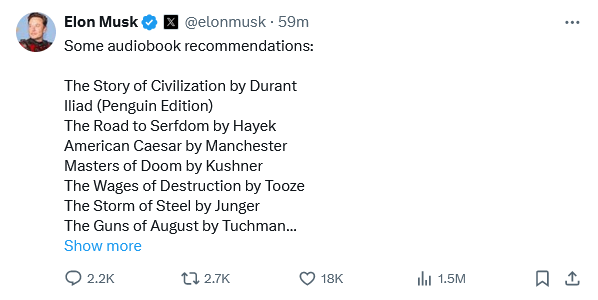
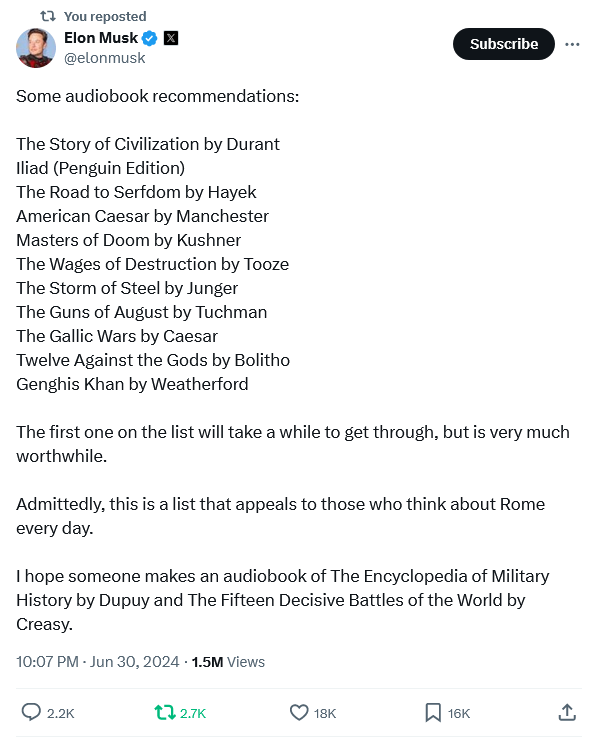
I was struck by how many of his listed suggestions I have read and enjoyed. Some comments:
American historians Will and Ariel Durant wrote over forty years (1935-1975) the eleven volume Story of Civilization. In limpid prose they told the story of the civilizations of man up through the time of Napoleon. The volumes have a prized place in my library. The work, which in its day sold an astounding two million sets, has of late fallen out of favor, as contemporary history too often is barely literate politicized junk, and the patience to read lengthy works is growing scarcer among moderns. As I hope and long for better times, I enjoy re-reading these volumes. I am reading it backward currently, like witches say their prayers. I am currently on the Renaissance volume.
I read Illiad for the first time when I was in grade school. At that time I wondered what the fuss was about. Later readings and historical knowledge showed me how the Greeks modeled themselves on the portrayals of Greeks in the Illiad and the Odyssey, few works of imagination having such an impact on a culture.
Road to Serfdom came my way in college and confirmed my hatred for socialism and all central planning.
American Caesar I read when it first came out. A liberal academic, at least till campus unrest caused him to move right, and World War II Marine, Manchester’s study of MacArthur remains unequaled. Big Mac’s personality tends to overshadow his deeds, which is a pity, because in many ways MacArthur was a 20th century man out of time. He wrote like the 19th century he was born in, and many of his ideas and policies would fit right into the 21rst century. A great book for a giant of a man.
Haven’t read the Kushner volume.
The Wages of Destruction by Tooze is in my library although I haven’t read it yet. His thesis is that a major weakness of the Third Reich is the fecklessness with which the Nazi Brass managed the economy of Germany and the states they conquered.
The Storm of Steel by Ernst Junger I first read about 15 years ago. A decorated German combat vet of World War I, Junger enjoyed his harrowing service, wounded fourteen times, and found meaning for his life in the war, and which he tried to convey in his memoir of the trenches in The Storm of Steel. Deeply reactionary in his politics, he loathed the Nazis when they came to power. He died at the age of 102 in 1998, converting to Catholicism a year before his death.
The Guns of August I read in Junior High. Barbara Tuchman was an amateur historian who had a great talent for writing readable history. Her look at the beginnings of World War I, The Guns of August, is a good starting place for those who wish to understand that conflict that shaped the history of the young century.
The Gallic Wars I first read in Junior High. This stroll through the mind of a military genius is not to be missed. Of course Caesar is the hero of the book written by Caesar, but Romans rarely looked upon modesty as a virtue.
Twelve Against the Gods, was very popular in its day when it was published in 1929. A breezy look at the lives of twelve adventurers from Alexander to Wilson, the author wrote with style and historical insight. Highly recommended. I encountered this work in high school and I was immediately entranced.
The Weatherford bio on Genghis I have not read.
The Fifteen Decisive Battles by Creasy I first read in junior high. The scholarship was dated when he wrote in the 19th century, but the style and the concept endure.
Dupuy’s Encyclopedia has an honored place in my library. He frequently is in error as to details, but his big picture takes on conflict across the ages is usually spot on.


Thanks for the recommendations.
I am saddened to see how remiss I am in my reading. I will endeavor to remedy that fact. That said, I greatly enjoyed the Iliad as an audio book. As a work of oral history, it is meant to be heard.
Junger is a fascinating character. His “Forest Rebel” look at totalitarianism is worth repeated reading, and his novella “On The Marble Cliffs” is also interesting. It is clearly anti-Nazi (albeit clothed in abstractions), but he got it published under the noses of Hitler’s censors.
A man with a profound life of the mind, and a deep love of the mystical/artistic parts of the human mind: beauty, religion, poetry, myth and fable. He believed that the best parts of the human soul can be a fortress of hope and endurance.
I still chuckle at his late conversion. “Well, you always were a smart man, Ernst.”