
From The Institute for the Study of War:
Russian Offensive Campaign Assessment, June 23, 2024
Karolina Hird, Nicole Wolkov, Angelica Evans, Kateryna Stepanenko, and George Barros
June 23, 2024, 8:30pm ET
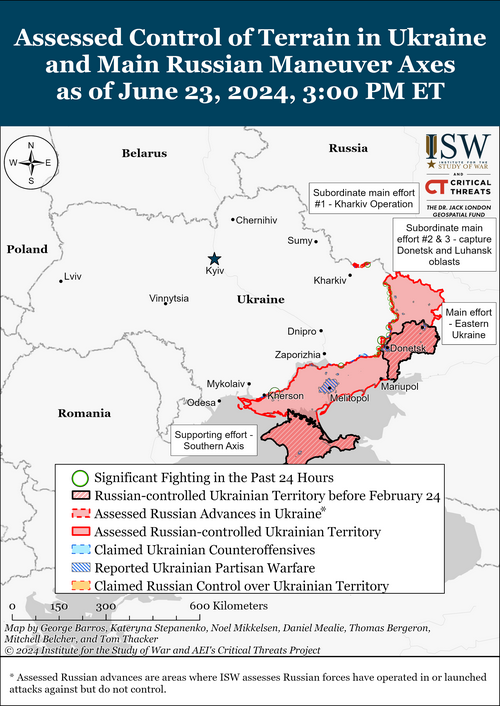
Click here to see ISW’s interactive map of the Russian invasion of Ukraine. This map is updated daily alongside the static maps present in this report.
Click here to see ISW’s 3D control of terrain topographic map of Ukraine. Use of a computer (not a mobile device) is strongly recommended for using this data-heavy tool.
Click here to access ISW’s archive of interactive time-lapse maps of the Russian invasion of Ukraine. These maps complement the static control-of-terrain map that ISW produces daily by showing a dynamic frontline. ISW will update this time-lapse map archive monthly.
Note: The data cut-off for this product was 1:35pm ET on June 23. ISW will cover subsequent reports in the June 24 Russian Offensive Campaign Assessment.
The Islamic State (IS) Northern Caucasus branch, Wilayat Kavkaz, likely conducted a complex and coordinated attack against churches, synagogues, and law enforcement structures in the Republic of Dagestan on June 23.[1] Dagestan’s Ministry of Internal Affairs reported that unknown actors opened fire on a Russian Orthodox church and a synagogue in Derbent at approximately 1800 local time and then reported within the same hour that another group of unknown actors opened fire on a traffic police post in Makhachkala (120 kilometers north of Derbent).[2] There are also reports of a fire at a synagogue in Makhachkala, although Russian official sources have not confirmed a second synagogue attack.[3] Dagestan announced a counter-terrorism regime following the start of the attacks, and Russian law enforcement killed five of the assailants and wounded six.[4] Social media footage shows Russian law enforcement detaining two suspects on a public beach in Makhachkala after they seemingly fled the scene of the shooting.[5] Russian media reported that seven law enforcement officials, a priest, and a church guard died in the attacks and 25 more individuals have been injured.[6] The Russian National Anti-Terrorism Committee announced the end of the counterterrorism operation in Derbent after the deaths of two suspects but small arms fire exchanges continued in Makhachkala as of 2300 local time on June 23.[7] The Baza Telegram channel claimed that two of the Makhachkala attackers identified as Osman and Adil Omarov, both of whom Russian law enforcement killed, were the sons of Sergokalinsky district head Magomed Omarov.[8] Russian Telegram channels are circulating footage reportedly filmed by Osman Omarov of the Makhachkala synagogue attack.[9] Baza reported that Russian law enforcement has also detained Magomed Omarov and are searching his home. Russian news agency Interfax claimed that Omarov’s nephew also took part in the attack and Russian law enforcement killed him.[10]
The Russian branch of IS-K’s Al-Azaim Media posted a statement on June 23 following the attack praising “their brothers from the Caucasus” for demonstrating what they were capable of.[11] Al-Azaim did not claim credit for the attack itself, notably, and the reference to the Caucasus strongly suggests that Wilayat Kavkaz is responsible for the attack. The Shanghai Cooperation Organization’s (SCO) Regional Anti-Terrorist Structure specifically warned that Wilayat Kavkaz became more active following the March 22 IS-K Crocus City Hall attack and has escalated recruitment appeals in the Northern Caucasus since April 2024.[12] Russian authorities have attempted a lackluster counterterrorism operation in the North Caucasus since March 2024 in order to combat growing IS and Wilayat Kavkaz influence but have largely focused their post-Crocus Hall response on baselessly blaming Ukraine and NATO for the attack.[13] Some Russian officials are already baselessly claiming that Ukraine and NATO are involved in the June 23 attack, emphasizing that Russia’s current counterterrorism approach is likely to remain tied up in rhetorical posturing against Ukraine and the West as opposed to identifying and neutralizing IS threats within Russia itself.[14] Russia’s increasingly tense relationship with its Muslim minority population, especially in the Caucasus, will likely continue to provide Wilayat Kazkaz and other extremist groups with a valuable recruitment base.[15]
The Russian Ministry of Defense (MoD) accused Ukrainian forces of conducting a short-range ATACMS strike against occupied Sevastopol on June 23. The Russian MoD claimed on June 23 that Ukrainian forces launched five ATACMS missiles armed with cluster munitions against Sevastopol and that Russian forces intercepted four missiles.[16] The Russian MoD claimed that the impact from a Russian air defense interceptor caused one missile to deviate from its flight path and detonate.[17] The Russian MoD later blamed the United States for civilian casualties in Sevastopol given that the ATACMS are a US-provided system, despite acknowledging that a Russian air defense interceptor caused the missile to deviate from its flight path and detonate. A Crimea-focused Russian milblogger posted footage on the night of June 23 purportedly showing explosions near Yevpatoria and Vityne and claimed that there were explosions near Chornomorske and Mizhvodne.[18] Ukrainian outlet Suspilne Krym reported that its sources also reported explosions in Yevpatoria.[19] Footage published on June 23 purportedly shows civilians on a beach in Sevastopol during and after the missile strike deviated.[20] Russian sources claimed that cluster munitions landed on civilians near a beach in Uchuyevka Park in northern Sevastopol.[21] Sevastopol occupation governor Mikhail Razvozhaev claimed that the strike killed four people and injured 151 people.[22] Ukrainian military officials did not confirm or deny launching strikes against Sevastopol. Ukrainian Mariupol Mayoral Advisor Petro Andryushchenko stated that Ukraine needs to obtain special permission to use ATACMS with cluster munitions from Western partners and claimed that the Russian occupation government is at fault for civilian casualties because it had failed to warn civilians before Russian air defense systems shot down unspecified missiles over their heads.[23] ISW cannot independently verify if Ukrainian forces used ATACMS missiles armed with cluster munitions. The Russian MoD’s blaming of the United States for civilian causalities is an attempt to deter the United States from providing further security assistance to Ukraine.
Russian milbloggers widely criticized the Russian MoD and Russia’s occupation authorities in Crimea for failing to prevent the strike and sufficiently protect Russian civilians. Russian sources criticized Russian authorities for not using air raid sirens to alert civilians to seek shelter.[24] Several Russian milbloggers criticized Russian authorities for failing to detect and destroy all the missiles before they approached Sevastopol and for failing to build reinforced shelters within walking distance of the beach, specifically comparing the lack of shelters near this beach in contrast to Russia’s efforts to build shelters in Belgorod Oblast near the international border with Ukraine.[25] Footage and imagery indicate that Russian forces have been stationing military equipment in civilian areas in Crimea since the start of Russia’s full-scale invasion of Ukraine. Russian authorities have irresponsibly encouraged Russian tourism to occupied Crimea during wartime while the Russian military continues to leverage the occupied peninsula as a rear staging area.[26] The Russian military likely purposefully stations legitimate military targets nearby civilian areas in Crimea in an effort to deter Ukrainian strikes. Russian forces have been recorded leveraging the Zaporizhzhia Nuclear Power Plant and schools in occupied mainland Ukraine to shield Russian military equipment.[27] Russia is likely violating its own regulations on the application of International Humanitarian Law, which states that “the military command shall avoid deploying military objectives in densely populated areas or in their vicinity.”[28]
Ukrainian forces struck a Russian motorized rifle regiment command post in Nekhoteevka, Belgorod Oblast. The Ukrainian General Staff reported on June 23 that Ukrainian Air Force elements and other Ukrainian units conducted the strike on an unspecified date (likely recently) and caused secondary explosions at the target site.[29] Ukrainian military correspondents shared footage of the strike on June 23.[30] Nekhoteevka is notably directly on the Russia-Ukraine border about 15 kilometers away from the current front line of troops in northern Kharkiv Oblast, so this command post was likely involved in overseeing ongoing Russian offensive operations north of Kharkiv City in some capacity.
Recent drone footage showing a Russian soldier executing a wounded fellow servicemember exemplifies the brutal culture that is pervasive within the Russian Armed Forces.[31] The footage shows one Russian soldier wounded by a first-person view (FPV) drone strike, and the other soldier executing the wounded soldier at point blank range instead of attempting to check the soldier’s injury, attempting treatment, taking his identification tags, or attempting a casualty evacuation. The attempted or deliberate killing of a fellow soldier is unprofessional, and ISW has observed instances of Russian fragging (the deliberate killing of supervisors) and other anecdotes demonstrative of a callous disregard for the lives of Russia’s own soldiers throughout the war thus far, both within Russia and amongst Russian troops on the battlefield.[32] Fragging is generally indicative of extremely poor discipline amongst troops, a disconnect between tactical level commanders and their subordinates, as well as a blatant disregard for human life. A Russian milblogger similarly reported on June 22 that commanders of various Donetsk People’s Republic (DNR) units are severely mistreating their wounded subordinates and alleged that the 1st DNR Slavic Brigade (1st DNR Army Corps) is holding its own wounded personnel in prison-like conditions in Donetsk City, instead of providing them with the treatment that they require.[33] Both the fragging incident and the milblogger claims against the DNR command are indicative of a very poor culture within the Russian military, particularly the command’s disregard for their subordinates and a generally low level of discipline.
South Korea has adopted a firm approach against Russia in the wake of recently intensified Russo-North Korean cooperation, suggesting that Russian efforts to threaten Seoul into withholding aid from Ukraine have failed. South Korean National Security Director Chang Ho-jin reiterated on June 23 that the type of military support that South Korea will provide to Ukraine is contingent on the depth and evolution of Russian military cooperation with North Korea.[34] Chang previously stated on June 20 that the June 19 Russia-North Korea strategic partnership agreement had encouraged South Korea to change its long-standing policy prohibiting the transfer of arms to Ukraine, and South Korea’s Yonhap News Agency reported on June 21 that South Korea is now considering sending 155mm artillery shells and unspecified air defense systems to Ukraine.[35] Russian President Vladimir Putin notably attempted to threaten South Korea on June 20, stating that Seoul would be making “a very big mistake” if it decided to supply arms to Ukraine.[36] Russian diplomatic officials have tried to retaliate against Seoul’s statement about providing aid to Ukraine and claimed that it is “blackmail” against Russia.[37] The Washington Post reported on June 22, citing data obtained by US think tank Center for Advanced Defense Studies (C4ADS), that North Korea delivered over 74,000 metric tons of explosives to Russia — equivalent to about 1.6 million artillery shells — between August 2023 and January 2024.[38] The Washington Post reported that these North Korean shipments arrived at 16 sites in Russia, 12 of which were close to known ammunition storage facilities.
The Russian Federal Security Service (FSB) detained two former senior employees of the Wagner Group-affiliated Patriot media holding on the eve of the one-year anniversary of the Wagner mutiny. Russian media outlets and insider sources reported that the FSB detained former manager of the Patriot media holding Ilya Gorbunov on June 21 and 22, and editor-in-chief of the St. Petersburg-based online publication Konkretno.ru Kirill Metelev on June 19.[39] Russian insider sources claimed that Gorbunov previously headed the “Troll Factory” belonging to deceased Wagner financier Yevgeny Prigozhin and was responsible for promoting the Wagner mutiny online on June 23 and 24, 2023.[40] Metelev was reportedly a contractor of the Patriot media holding and was responsible for posting defamatory statements online, specifically attacking Prigozhin’s stated enemy St. Petersburg Governor Alexander Beglov.[41] Russian state media attempted to portray these arrests as unrelated to the anniversary of the Wagner mutiny, and Kremlin-run media outlet Izvestia cited an unnamed source in the Russian security structure as saying that these arrests “had nothing to do with Prigozhin.”[42] St. Petersburg local outlet Fontanka reported that Gorbunov and Matelev were detained on the charges of extortion and blackmail for demanding money from a former St. Petersburg TV channel general director Alexander Malkevich.[43] Prigozhin reportedly dissolved Patriot media holding on June 30, 2023.[44]
Key Takeaways:
- The Islamic State (IS) Northern Caucasus branch Wilayat Kavkaz likely conducted a complex and coordinated attack against churches, synagogues, and law enforcement structures in the Republic of Dagestan on June 23.
- The Russian Ministry of Defense (MoD) accused Ukrainian forces of conducting a short-range ATACMS strike against occupied Sevastopol on June 23. Russian milbloggers widely criticized the Russian MoD and Russia’s occupation authorities in Crimea for failing to prevent the strike and sufficiently protect Russian civilians.
- Ukrainian forces struck a Russian motorized rifle regiment command post in Nekhoteevka, Belgorod Oblast.
- Recent drone footage showing a Russian soldier executing a wounded fellow servicemember exemplifies the brutal culture that is pervasive within the Russian Armed Forces.
- South Korea has adopted a firm approach against Russia in the wake of recently intensified Russo-North Korean cooperation, suggesting that Russian efforts to threaten Seoul into withholding aid from Ukraine have failed.
- The Russian Federal Security Service (FSB) detained two former senior employees of the Wagner Group-affiliated Patriot media holding on the eve of the one-year anniversary of the Wagner mutiny.
- Russian forces recently seized Shumy and advanced near Donetsk City and Robotyne.
- Russian President Vladimir Putin signed a law on June 22 officially transferring the Cossack Cadet Corps and the Russian Naval Cadet Corps to the jurisdiction of the Russian Ministry of Defense (MoD).
Go here to read the rest. The terrorist attacks in Dagestan by ISIS underline again that the Russians are fighting the wrong war against the wrong foe.

