
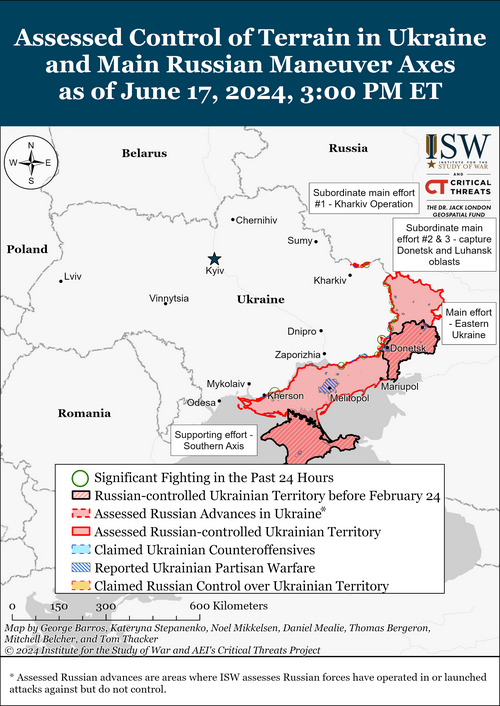
From The Institute for the Study of War:
Russian Offensive Campaign Assessment, June 17, 2024
Kateryna Stepanenko, Christina Harward, Nicole Wolkov, Grace Mappes, and George Barros
June 17, 2024, 8:30pm ET
Click here to see ISW’s interactive map of the Russian invasion of Ukraine. This map is updated daily alongside the static maps present in this report.
Click here to see ISW’s 3D control of terrain topographic map of Ukraine. Use of a computer (not a mobile device) is strongly recommended for using this data-heavy tool.
Click here to access ISW’s archive of interactive time-lapse maps of the Russian invasion of Ukraine. These maps complement the static control-of-terrain map that ISW produces daily by showing a dynamic frontline. ISW will update this time-lapse map archive monthly.
Note: The data cut-off for this product was 1:30pm ET on June 17. ISW will cover subsequent reports in the June 18 Russian Offensive Campaign Assessment.
NATO Secretary General Jens Stoltenberg stated that NATO may take steps to enhance NATO’s nuclear deterrence, eliciting varying responses from senior Kremlin officials. The Telegraph reported on June 16 that Stoltenberg stated that NATO states are discussing removing an unspecified number of nuclear missiles from storage and placing them on heightened readiness levels due to the growing threat from Russia and the People’s Republic of China (PRC).[1] Stoltenberg stated that “transparency helps to communicate the direct message that… [NATO] is a nuclear alliance.” Russian Foreign Intelligence Service (SVR) Director Sergei Naryshkin reacted in a level-headed manner and characterized Stoltenberg’s statements about taking nuclear missiles out of storage as “exercises,” stating that he understands that Stoltenberg’s statement aims to scare Russia but “on the other hand, exercises are conducted regularly and should be conducted regularly.”[2] Naryshkin stated that there is no “special significance” to Stoltenberg’s statement and that Russia “must take it calmly.” Kremlin Spokesperson Dmitry Peskov, on the other hand, claimed that Stoltenberg’s statement is “nothing more than another escalation of tension.”[3] Naryshkin’s characterization of NATO’s efforts to increase its nuclear transparency as insignificant “exercises” is notably different than Peskov’s claims that this is part of NATO’s alleged ongoing escalation. Naryshkin has expressed opinions that strayed from the Kremlin narratives previously, most notably when Russian President Vladimir Putin publicly chastised Naryshkin to firmly support Russia’s recognition of the Donetsk and Luhansk People’s Republics on February 21, 2022, three days before the start of Russia’s full-scale invasion.[4]
Russian President Vladimir Putin dismissed four deputy defense ministers and replaced them with a “close relative,” the son of a former Russian prime minister, and an economist on June 17 in an ongoing purge of officials in the Russian Ministry of Defense (MoD).[5] Putin dismissed deputy defense ministers Nikolai Pankov, Ruslan Tsalikov, Tatiana Shevtsova, and Army General Pavel Popov, replacing them with deputy defense ministers Anna Tsivileva and Pavel Fradkov and First Deputy Defense Minister Leonid Gornin.[6] Tsivileva is Putin’s first cousin once removed (“niece”), wife of the recently appointed Energy Minister Sergei Tsivilev, and the Chairperson of the Kremlin-initiated ”Defenders of the Fatherland” Foundation.[7] Tsivileva was also previously part of the Council on Issues of Trusteeship in the Social Sphere under the Russian Government in 2019.[8] The Russian MoD specified that Tsivileva will oversee social and housing support for the Russian Armed Forces as deputy defense minister.[9] Fradkov is the son of former Russian Prime Minister and longest serving Director of Russia’s Foreign Intelligence Service (SVR) Mikhail Fradkov.[10] Pavel Fradkov served as the First Deputy Administrator of the Presidential Administration since 2021, Deputy Head of the Federal Agency for State Property Management (Rosimushchestvo) from 2012 to 2015, and at the Russian Ministry of Foreign Affairs’ (MFA) Department of Pan-European Cooperation from 2005 to 2012.[11] Fradkov’s brother Pyotr Fradkov is the Chairperson of the Russian state-owned Promsvyazbank and recently met with Kremlin-affiliated governor of the pro-Russian Moldovan autonomous region of Gagauzia, Yevgenia Gutsul, on April 9, possibly as part of Kremlin’s efforts to destabilize Moldova.[12] The Russian MoD reported that Fradkov will oversee property management issues, land resources, construction of MoD facilities, and the national economy.[13] Gornin served as the First Deputy Minister of Finance since May 2018, Deputy Minister of Finance from 2012 to 2018, and Minister of Finance and Tax Policy of Novosibirsk Oblast from 2010 to 2011.[14] The Russian MoD specified that Gornin will be responsible for the MoD’s budget policy and will oversee financial support for the Russian Armed Forces.[15] Gornin will also work on increasing the transparency of financial flows and ensuring the effective spending of budget funds. Putin also signed a bill on June 17 that increased the number of Russian deputy defense minister positions from 11 to 12.[16]
Tsivileva’s, Fradkov’s, and Gornin’s appointments support Putin’s recent efforts to introduce his relatives and the children of other senior Russian officials to the Russian public and to install economic advisors to the MoD to improve the wartime economy. Both Tsivileva and Fradkov reportedly participated in the St. Petersburg International Economic Forum (SPIEF) alongside Putin’s daughters and the children of other senior officials on June 6 and 7.[17] ISW assessed on June 7 that Putin attempted to introduce his children and the children of officials in his close circle to the public, likely to set conditions for them to eventually assume high-profile and powerful roles in the Russian government.[18] Tsivileva also notably met with Putin on June 1 to discuss state financial support for combatants who had fought in Ukraine as part of private military companies (PMCs).[19] Putin also has been increasingly appointing economists to take senior positions at the Russian MoD and notably replaced Defense Minister Sergei Shoigu on May 12 with former First Deputy Prime Minister Andrei Belousov who is an economist by trade.[20] Putin also replaced former Russian Deputy Defense Minister Colonel General Yury Sadovenko with former Deputy Economic Minister and Federation Council Accounts Chamber Auditor Oleg Savelyev on May 20.[21] These appointments suggest that Putin is prioritizing the appointment of officials whom he deems to be loyal to the regime and economists to improve Russia’s defense industrial base (DIB). Putin also may be attempting to groom possible successors to his regime from the pool of his children and relatives and children of other senior officials.
Russian milbloggers largely focused on celebrating the dismissal of Pankov, Tsalikov, Shevtsova, and Popov and largely overlooked the apparent nepotism that benefited two of the new deputy defense ministers.[22] Russian milbloggers welcomed new MoD appointments, stating that Putin finally removed officials that thought of themselves as untouchable.[23] Russian milbloggers also claimed that these dismissals are a step in the right direction to resolve corruption in the Russian MoD and improve the defense industrial base (DIB).[24] Russian milbloggers specifically focused on the news of Tsalikov’s dismissal, citing his poor management of the Russian MoD’s information policies and official coverage of Russia’s full-scale invasion of Ukraine.[25] Some milbloggers implied that Tsalikov had conflicts with Russian milbloggers who criticized the Russian MoD.[26] A Wagner Group-affiliated milblogger claimed that the Kremlin stopped considering Tsalikov as Shoigu’s replacement in 2022 after Putin received a memo from unnamed state security agencies about Tsalikov’s corruption.[27] The Wagner-affiliated milblogger added that Shevtsova was the subject of numerous independent investigations, including one into how former Deputy Minister of Finance Tatyana Nesterenko and former Head of the Federal Treasury Roman Artyukhin sang songs that mocked the Russian army and soldiers at Shevtsova’s birthday celebration. The Wagner-affiliated milblogger concluded that he was disappointed that Putin did not dismiss Deputy Defense Minister Alexey Krivoruchko, who is a leading figure in many independent anti-corruption investigations, over his corruption schemes involving the Russian joint-stock arms manufacturing company Kalashnikov Concern. Some Russian political bloggers drew parallels between the appointments of deputy defense ministers under Belousov and former Russian Defense Minister Anatoliy Serdyukov, who also had an economic background as the Minister of the Russian Tax Service from 2004 to 2007.[28] Russian political bloggers noted that Serdyukov appointed officials from the Russian Federal Tax Service, whereas Belousov is appointing officials from the Russian ministries of finance and economic development and from among Putin’s friends and family.[29]
A Russian state media outlet manipulated an interview with International Atomic Energy Agency (IAEA) Director General Rafael Mariano Grossi to blame Ukraine for strikes against the Russian-occupied Zaporizhzhia Nuclear Power Plant (ZNPP) in an attempt to legitimize Russia’s illegal occupation of Ukraine. Grossi stated on June 15 that he would not attend the June 16–17 Global Peace Summit in Switzerland so as to not “mix political considerations with [the IAEA’s] technical job,” but gave an interview to Kremlin outlet Izvestia which was published on June 17.[30] Grossi told Izvestia that unspecified actors have attacked IAEA inspectors and experts at the ZNPP and have violated or compromised the IAEA’s pillars for ensuring the plant’s safe operation.[31] Grossi stated that there have been unattributed drone strikes against the ZNPP and that the IAEA is unable to identify the perpetrators as it is difficult to identify the drones’ departure points or deduce the origins of drones based on debris. Grossi spoke about strikes on the ZNPP on April 7 but notably did not specify if the IAEA assessed that these were Ukrainian or Russian strikes. Izvestia, however, inserted an editorial note claiming that Ukrainian forces conducted the “unprecedented” strikes on the ZNPP on April 7 to directly claim that Grossi was discussing Ukrainian strikes against the ZNPP. The IAEA notably refrained from attributing responsibility for the April 7 strikes at the time.[32] Izvestia’s exploitation of Grossi’s interview, throughout which Grossi explicitly highlighted that the IAEA cannot identify the origin of strikes on the ZNPP, is part of ongoing Russian efforts to use Russia’s physical control over the ZNPP to force the IAEA to meet with Russian officials to legitimize Russia’s occupation of the ZNPP, and by extension, Russia’s occupation of Ukrainian territory.[33]
Ukraine’s Western partners continue efforts to train more Ukrainian pilots on Western-provided F-16 fighter jets. French outlet Le Monde reported on June 17 that the French Air and Space Force committed to training 26 Ukrainian military pilots from 2024 to 2026.[34] Le Monde stated that the French Air and Space Force is currently training 10 Ukrainian pilots on Alpha Jet trainers using avionics similar to F-16s. Agence-France-Presse (AFP) reported on June 17 that the Ukrainian pilots are participating in an accelerated six-month training program.[35] Politico reported on June 6 that US Air Force Spokesperson Laurel Falls stated that the US National Guard plans to train 12 Ukrainian pilots on F-16s by the end of September 2024.[36] Denmark reported in August 2023 that Denmark had started training eight Ukrainian pilots on F-16s.[37]
The Kremlin confirmed on June 17 that Russian President Vladimir Putin will visit North Korea on an official state visit on June 18 and 19.[38] Russian Ambassador to North Korea Alexander Matsegora recently stated that Putin will visit North Korea, and another Russian diplomatic source stated that Putin would visit in the coming weeks around his visit to Vietnam.[39] Putin has not visited North Korea since 2000.[40] The Kremlin reported that Putin will also visit Hanoi, Vietnam on June 19 and 20 and will discuss the prospects for developing a strategic partnership in trade, economic, scientific, technological, and humanitarian relations.[41]
Key Takeaways:
- NATO Secretary General Jens Stoltenberg stated that NATO may take steps to enhance NATO’s nuclear deterrence, eliciting varying responses from senior Kremlin officials.
- Russian President Vladimir Putin dismissed four deputy defense ministers and replaced them with a “close relative,” the son of a former Russian prime minister, and an economist on June 17 in an ongoing purge of officials in the Russian Ministry of Defense (MoD).
- Tsivileva’s, Fradkov’s, and Gornin’s appointments support Putin’s recent efforts to introduce his relatives and the children of other senior Russian officials to the Russian public and to install economic advisors to the MoD to improve the wartime economy.
- Russian milbloggers largely focused on celebrating the dismissal of Pankov, Tsalikov, Shevtsova, and Popov and largely overlooked the apparent nepotism that benefited two of the new deputy defense ministers.
- A Russian state media outlet manipulated an interview with International Atomic Energy Agency (IAEA) Director General Rafael Mariano Grossi to blame Ukraine for strikes against the Russian-occupied Zaporizhzhia Nuclear Power Plant (ZNPP) in an attempt to legitimize Russia’s illegal occupation of Ukraine.
- Ukraine’s Western partners continue efforts to train more Ukrainian pilots on Western-provided F-16 fighter jets.
- The Kremlin confirmed on June 17 that Russian President Vladimir Putin will visit North Korea on an official state visit on June 18 and 19.
- Russian forces recently advanced near Siversk, Chasiv Yar, and Avdiivka.
- Russia is reportedly experiencing issues with producing artillery shells and select artillery systems.
Go here to read the rest. Nuclear saber rattling by NATO functionaries would be alarming if one were not aware that dragons are more likely to get involved in the Ukraine War than nukes.

