
From The Institute for the Study of War:
Russian Offensive Campaign Assessment, June 14, 2024
Angelica Evans, Christina Harward, Kateryna Stepanenko, Nicole Wolkov, and George Barros
June 14, 2024, 10pm ET
Click here to see ISW’s interactive map of the Russian invasion of Ukraine. This map is updated daily alongside the static maps present in this report.
Click here to see ISW’s 3D control of terrain topographic map of Ukraine. Use of a computer (not a mobile device) is strongly recommended for using this data-heavy tool.
Click here to access ISW’s archive of interactive time-lapse maps of the Russian invasion of Ukraine. These maps complement the static control-of-terrain map that ISW produces daily by showing a dynamic frontline. ISW will update this time-lapse map archive monthly.
Note: The data cut-off for this product was 2pm ET on June 14. ISW will cover subsequent reports in the June 15 Russian Offensive Campaign Assessment.
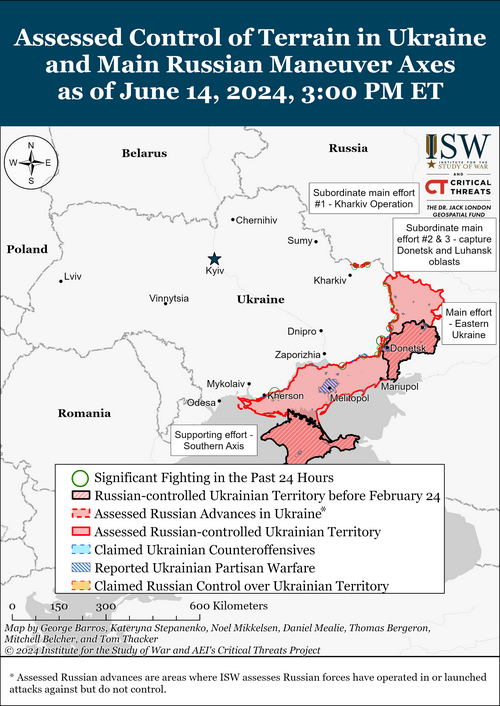
Russian President Vladimir Putin outlined his uncompromising demands for Ukraine’s capitulation as a prerequisite for “peace” negotiations in Ukraine, including the recognition of Russia’s illegal annexation of occupied and Ukrainian-controlled territory in eastern and southern Ukraine, in an attempt to undermine the June 15-16 Global Peace Summit in Switzerland. Putin stated during a speech at the Russian Ministry of Foreign Affairs (MFA) on June 14 that Ukrainian forces must begin to “completely withdraw” from Ukrainian-controlled territory in Donetsk, Luhansk, Zaporizhia, and Kherson oblasts (which the Kremlin illegally declared as annexed in September 2022) and that Ukraine officially abandons its goal to join NATO before Russia can agree to a ceasefire and peace negotiations.[1] Putin stated that Russia is prepared to begin negotiations with Ukraine as soon as Ukraine agrees to withdraw from the entirety of Donetsk, Luhansk, Zaporizhia, and Kherson oblasts (which is in total 18 percent of Ukraine’s territory). Russian forces currently occupy 75 percent of the total area of Donetsk, Luhansk, Zaporizhia, and Kherson oblasts, and Putin is effectively demanding that Ukraine cede 40 percent of Donetsk Oblast, 25 percent of Kherson Oblast, 25 percent of Zaporizhia oblasts, and one percent of Luhansk Oblast that Russian forces do not control, including the provincial capitals Zaporizhia City and Kherson City. Putin’s demands require Ukraine to surrender the strategic provincial capitals of Zaporizhia City and Kherson City for no good reason. Russian forces fled Kherson City in November 2022. Putin unconvincingly claimed that Russian forces will “immediately” enforce the ceasefire and will guarantee the “unhindered and safe” withdrawal of Ukrainian forces from the four oblasts, a promise that rings particularly hollow following months of Russian war crimes against Ukrainian civilians and prisoners of war (POWs), and numerous Russian violations of the Minsk Accords ceasefire between 2015 and 2022.[2] Putin demanded that the international community recognize the four illegally annexed and occupied oblasts as part of Russia and lift all Western sanctions against Russia in the event of a peaceful resolution to Russia’s invasion of Ukraine, a demand which will irrevocably damage the principle of state sovereignty and the inviolability of international borders.
Putin also reiterated his previous conditions for “peace,” namely that Ukraine must agree to full demilitarization and “denazification” (the toppling of the current Ukrainian government and its replacement with pro-Russian proxies) and abandon its aspirations to join any external security blocs.[3] Putin claimed that Ukraine must come to these decisions independently and not on the orders of its “Western masters” and reiterated a series of claims insinuating that the West controls Ukraine and that Ukraine is not a sovereign country. Putin claimed that it would be “impossible” for any peace format without Russian participation to resolve the war in Ukraine and that the Western and Ukrainian policies against negotiating with Russia are “idiotic.”
Putin’s demands continue to reflect his long-demanded ultimatums that are based on presuppositions that deny the existence of an independent and sovereign Ukraine and that seek to seduce the West to preemptively compromise on Ukraine’s sovereignty and territorial integrity.[4] Ukrainian President Volodymyr Zelensky stated on June 14 that Putin has put forth similar ultimatums and that Putin has no intention to stop attacking Ukraine.[5] NATO Secretary General Jens Stoltenberg said that Russia, not Ukraine, must withdraw its forces from Ukrainian territory and that Putin’s ultimatums are a signal that Russia has not abandoned its military objectives in Ukraine.[6] Several prominent Russian milbloggers also stated that Putin’s demands are unachievable and resemble an ultimatum to the West, and this speech rings similar to the absurd ultimatums Putin delivered to the US and NATO in December 2021 as part of a diplomatic rouse to buy time as Putin prepared to invade Ukraine and seize Kyiv.[7] Russian Foreign Minister Sergei Lavrov and Kremlin Spokesperson Dmitry Peskov denied interpretations that Putin’s June 14 speech was another ultimatum.[8] ISW continues to assess that the Kremlin is not interested in good faith negotiations with Ukraine and only feigns its interest in negotiations as part of a wider informational effort intended to convince the West to preemptively make concessions that violate Ukraine’s sovereignty.[9]
Russia is also attempting to sabotage the peace summit in Switzerland via cyberattacks. Swiss news agencies, citing the Swiss National Cyber Security Center’s data, reported an increase in cyberattacks on June 13 against several Swiss government websites and organizations that will participate in the peace summit.[10] The Swiss National Cyber Security Center did not rule out the possibility of similar attacks during the peace summit. Swiss media reported on June 14 that a Russian hacker group claimed responsibility for distributed denial of service (DDoS) cyberattacks on Swiss internet infrastructure and threatened that there would be additional cyberattacks.[11]
Putin proposed to establish an alternative Eurasian and world security system with support from People’s Republic of China (PRC) President Xi Jinping, likely to undermine NATO. Putin claimed that the world is witnessing the “collapse of the Euro-Atlantic security system” and claimed that Western “schemes for security and prosperity in Europe” do not work. Putin outlined a five-step proposal on instituting a new “system of bilateral and multilateral guarantees of collective security in Eurasia” and claimed that he had already tasked the Russian MFA with establishing a dialogue with all of Russia’s potential participants of this new security order. Putin claimed that Xi had reportedly stated that the Russian proposal to create a Eurasian security system complements the basic principles of the PRC’s “initiative in the field of global security” during Putin’s recent visit to the PRC in May 2024. Putin stated that Russia will invite European and NATO countries to participate in this Eurasian security system and argued that Europe must move away from the “military presence of external powers” – implying that Europe needs to abandon NATO and the principles of the North Atlantic Treaty. Putin’s explanation of the Eurasian security system appeared to be rather vague but consistent with his long-term strategic goal of disbanding Western unity, disbanding NATO from within, and destroying the current world order. Putin continues attempts to attack and undermine NATO members despite his overtures designed to attract NATO members to join the Russian alternative for “collective Eurasian security.” Stoltenberg stated on June 14 that Russia increased its sabotage operations, cyberattacks, and other hostile actions against NATO in recent weeks.[12]
The Kremlin has frequently timed the intensification of its information operations, including negotiations, to coincide with major policy debates in the West in order to influence Western decision-making.[13] Putin’s June 14 speech is aimed at misleading the international community and undermining foreign participation in the upcoming peace summit, and several Russian milbloggers noted that Putin’s speech coincided with the eve of the Ukrainian-led peace summit. The purposeful intensification of Kremlin rhetoric is part of Russia’s reflexive control campaign that aims to push the West to self-deter and adopt policies that are in Russia’s interests.[14] Putin’s June 14 statements are the latest in Kremlin efforts to manipulate the West, and Putin likely timed his speech to coincide with several key events and discussions in the West. Putin likely aims to weaken Western unity in supporting Ukraine on the eve of the June 15-16 Global Peace Summit and following the June 13 Group of Seven (G7) and Ukraine Defense Contract Group meetings.[15] Putin may also be attempting to influence ongoing Western policy discussions about seizing Russian frozen assets, deploying Western training partners to Ukraine, and/or permissions for Ukraine to use Western-provided weapons to strike Russian military targets further into Russian territory.[16] Putin may also be attempting to prevent further Western sanctions against Russia following the imposition of new American and British sanctions against Russia on June 13.[17]
Russian President Vladimir Putin and Deputy Chairman of the Russian Security Council Dmitry Medvedev continued to rail against Western colonialism while ignoring Russia’s imperial history and contemporary Russian imperialist aspirations to dominate Russia’s neighbors in eastern Europe, the Caucasus, and Central Asia. Putin claimed during his speech at the Russian Foreign Ministry (MFA) on June 14 that the US is working to spread American ideology and “maintain its imperial status” by any means necessary.[18] Medvedev claimed in an op-ed published in the official Russian government newspaper Rossiyskaya Gazeta on June 14 that Russia’s ruling United Russia party founded the “For the Freedom of Nations” anti-neocolonial movement to help rid the world of Western neocolonialism.[19] Medvedev claimed that the United States, France, United Kingdom (UK), and Italy are actively perpetuating the legacies of colonialism, including in countries along Russia’s borders, and that the United Nations (UN) should create a database of colonial and neocolonial crimes to prosecute colonial powers. Medvedev claimed that only “fully sovereign countries” with independence in their external and internal affairs will be able to counter Western neocolonialism and that the “For the Freedom of Nations” movement is ready to work with the BRICS and the Shanghai Cooperation Organization (SCO) to counter neocolonialism. Medvedev claimed that the “For the Freedom of Nations” movement aims to establish political, economic, and cultural ties between the supposed Russian-led “world majority” (a group of countries including post-Soviet and non-Western states that Russia intends to rally against the West as the basis for its future world order) and establish joint opposition against neocolonialism and neo-Nazism. Medvedev noted that the “For the Freedom of Nations” movement will meet in Vladivostok later in June to discuss “practical ways” to implement its vision. Putin and Medvedev notably ignored the Russian Empire’s and Soviet Union’s legacies of colonizing and Russifying their neighboring nations and Russia’s modern campaigns to assert Russian dominance over Ukraine, Belarus, Georgia, Moldova, Armenia, and Central Asia.
Medvedev also promoted Kremlin information operations that aim to exploit Moldovan identity politics in order to disrupt Moldova’s European Union (EU) accession by destabilizing Moldovan society. Medvedev claimed that Moldovan President Maia Sandu’s efforts to move Moldova towards EU accession are leading Moldova into “neocolonial slavery,” insinuating that EU accession would have a negative impact on Moldovans and is unpopular among Moldovans.[20] Recent polls notably indicate, however, that a majority of around 56 to 64 percent of Moldovans support Moldova’s EU integration.[21] Medvedev also promoted Kremlin narratives that target Moldovan-Romanian relations, claiming that Moldova will likely turn into the “northeastern outskirts of Romania” if it joins the EU and that Romanian authorities would repress and forcibly Romanianize the Moldovan population in the future.[22] Medvedev claimed that Romania ”occupied” Bessarabia (a historical region in Moldova and southwestern Ukraine) from 1918-1940 and 1941-1944 but failed to mention how the Soviet Union laid claims to Bessarabia under the Molotov-Ribbentrop Pact with Nazi Germany and coerced Romania to cede Bessarabian territory to the Soviet Union in 1940.[23] Russian MFA Spokesperson Maria Zakharova similarly claimed on May 9 that the Moldovan government is replacing the Moldovan language with the Romanian language to invoke historical animus that some Moldavans harbor towards Romania with the goal of destabilizing Moldovan society.[24] Kremlin rhetoric about a unique Moldovan identity notably differs from Kremlin information operations alleging that Ukraine lacks a unique language, culture, identity, and history from Russia.[25] Kremlin narratives about Moldovan identity aim to target members of the Moldovan population who identify as Moldovan and may fear that Moldova’s Western integration would lead to unification with Romania.
Putin and Medvedev’s Russian information operations are the latest in the Kremlin’s ongoing efforts to destabilize Moldovan society and prevent Moldova’s accession to the EU.[26] Moldovan General Police Inspectorate Head Viorel Cernauteanu stated on June 13 that Moldovan authorities estimate that Russia is spending at least two million dollars per month to fund affiliates of US-sanctioned, Kremlin-affiliated Moldovan opposition politician Ilan Shor who aim to destabilize Moldova.[27] Cernauteanu stated that the Kremlin is spending part of this money to pay off the debts that Shor affiliates accrued during the Fall 2023 elections and protests. Cernauteanu also stated that the Kremlin funnels money into Moldova using “carriers” (likely referring to smugglers) who receive about $150-$200 for carrying large amounts of money. Cernauteanu noted that some of the smugglers are cooperating with Moldovan investigators.[28] Shor and his affiliates reportedly paid demonstrators to protest against Sandu and engaged in voter bribery during Moldova’s regional elections in 2022 and 2023.[29] Moldovan authorities confiscated over one million dollars from Kremlin-linked Moldovan opposition politicians at the Chisinau airport on the night of April 22 to 23.[30]
Medvedev also threatened Armenia on the eve of Armenian Security Council Secretary Armen Grigoryan’s attendance at the June 15-16 Global Peace Summit in Switzerland. Grigoryan announced on June 14 that he would participate in the peace summit but did not state whether other senior Armenian officials would attend.[31] Radio Free Europe/Radio Liberty’s Armenian service Radio Azatutyun reported that the Russian Ministry of Foreign Affairs (MFA) previously condemned Grigoryan’s participation in a Ukrainian-initiated multilateral peace forum in Malta in October 2023.[32] Medvedev accused the US, European Union (EU), and NATO of attempting to sever the “centuries-old friendship” between Armenia and Russia and called agreements with such Western institutions “neocolonial mousetraps” in an article published on June 14 in official Russian government outlet Rossiyskaya Gazeta.[33] Medvedev insinuated that Armenian efforts to join the EU will fail and result in a similar outcome as the current situation in Ukraine. Armenia’s decision to send a senior representative to a Ukrainian-initiated peace summit follows Armenian Prime Minister Nikol Pashinyan’s announcement that Armenia “will decide when to leave” the Russia-led Collective Security Treaty Organization (CSTO) and accusation that Russia indirectly and Belarus directly helped Azerbaijan to prepare for the 2020 Nagorno-Karabakh War further highlights the deteriorating Russian-Armenian relations.[34] Russian officials have since responded to Pashinyan’s statements with increasingly hostile statements.[35] Politico reported on June 13, citing leaked documents, that Belarus provided Azerbaijan with artillery equipment, electronic warfare (EW) systems, and drones between 2018 and 2022 that Azerbaijan reportedly used in recent conflicts in Nagorno-Karabakh and against Armenia.[36]
An unnamed senior US Department of Defense official reportedly said that the Biden Administration has no imminent plans to lift restrictions prohibiting Ukrainian forces from striking military targets in Russia’s operational and deep rear areas in Russian territory with US-provided weapons.[37] Politico reported on June 13 that the senior official said that there is a “constant conversation and reassessment” of US policy restricting deeper Ukrainian strikes into Russian territory and that no decision is final, but that there is no “impending” policy change. ISW assesses that the Biden Administration’s limited policy change permitting Ukraine to use US-provided weapons to strike some Russian military targets in a small area within Russian territory has reduced the size of Russia’s ground sanctuary by only 16 percent at maximum.[38] ISW assesses that the West maintains the ability to substantially disrupt Russian operations at scale by allowing Ukraine to use Western-provided weapons to strike Russia’s operational rear and deep rear areas in Russian territory.[39]
Ukrainian forces conducted a large series of drone strikes against Russia on the night of June 13 to 14. Geolocated imagery collected on June 14 shows damage from a Ukrainian drone strike against the Morozovsk Airbase in Rostov Oblast and indicates that Ukrainian forces struck an electrical substation and an aircraft hangar at the base.[40] Additional footage and photos show an explosion and smoke plume over the Morozovsk Airbase and Rostov-on-Don, and the Russian Ministry of Defense (MoD) reported that Russian air defenses destroyed 70 drones over Rostov Oblast and several drones over Voronezh and Kursk oblasts.[41] Voronezh Oblast Governor Aleksandr Gusev stated that debris from downed Ukrainian drones damaged fuel tanks at an oil depot in the oblast.[42]
Key Takeaways:
- Russian President Vladimir Putin outlined his uncompromising demands for Ukraine’s capitulation as a prerequisite for “peace” negotiations in Ukraine, including the recognition of Russia’s illegal annexation of occupied and Ukrainian-controlled territory in eastern and southern Ukraine, in an attempt to undermine the June 15-16 Global Peace Summit in Switzerland.
- Putin proposed to establish an alternative Eurasian and world security system with support from People’s Republic of China (PRC) President Xi Jinping, likely to undermine NATO.
- The Kremlin has frequently timed the intensification of its information operations, including negotiations, to coincide with major policy debates in the West in order to influence Western decision-making.
- Russian President Vladimir Putin and Deputy Chairman of the Russian Security Council Dmitry Medvedev continued to rail against Western colonialism while ignoring Russia’s imperial history and contemporary Russian imperialist aspirations to dominate Russia’s neighbors in eastern Europe, the Caucasus, and Central Asia.
- Medvedev also promoted Kremlin information operations that aim to exploit Moldovan identity politics in order to disrupt Moldova’s European Union (EU) accession by destabilizing Moldovan society.
- Medvedev also threatened Armenia on the eve of Armenian Security Council Secretary Armen Grigoryan’s attendance at the June 15-16 Global Peace Summit in Switzerland.
- An unnamed senior US Department of Defense official reportedly said that the Biden Administration has no imminent plans to lift restrictions prohibiting Ukrainian forces from striking military targets in Russia’s operational and deep rear areas in Russian territory with US-provided weapons.
- Ukrainian forces conducted a large series of drone strikes against Russia on the night of June 13 to 14.
- Russian forces recently made confirmed advances near Avdiivka and Donetsk City.
- Russian President Vladimir Putin stated on June 14 that there are currently almost 700,000 Russian personnel in the “special military operation zone,” which includes both occupied Ukraine and areas within Russia bordering Ukraine, during the meeting with participants of the “Time of Heroes” program.
Go here to read the rest. Fearless Leader has no intention of negotiating an end to the Ukrainian War. His comment about 700k troops in Ukraine or in Russian adjacent areas underlines that Putin lacks the military strength to do more than hold on to what he currently has.

