
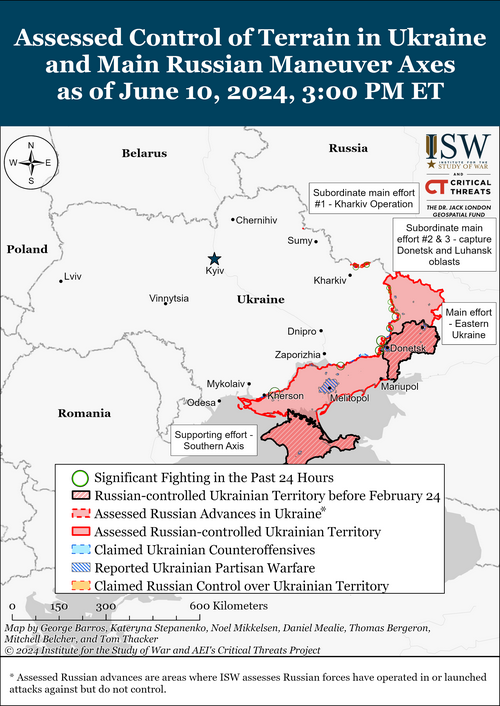
From The Institute for the Study of War:
Russian Offensive Campaign Assessment, June 10, 2024
Grace Mappes, Nicole Wolkov, Christina Harward, Karolina Hird, Kateryna Stepanenko, and George Barros
June 10, 2024, 8:10pm ET
Click here to see ISW’s interactive map of the Russian invasion of Ukraine. This map is updated daily alongside the static maps present in this report.
Click here to see ISW’s 3D control of terrain topographic map of Ukraine. Use of a computer (not a mobile device) is strongly recommended for using this data-heavy tool.
Click here to access ISW’s archive of interactive time-lapse maps of the Russian invasion of Ukraine. These maps complement the static control-of-terrain map that ISW produces daily by showing a dynamic frontline. ISW will update this time-lapse map archive monthly.
Note: The data cut-off for this product was 1:45pm ET on June 10. ISW will cover subsequent reports in the June 11 Russian Offensive Campaign Assessment.
Ukrainian forces conducted a strike against Russian air defense assets in occupied Crimea overnight on June 9 to 10, likely with ATACMS. The Ukrainian General Staff reported on June 10 that Ukrainian forces struck a Russian S-400 air defense battery near occupied Dzhankoi and two S-300 batteries near occupied Chornomorske and Yevpatoria.[1] The Ukrainian General Staff reported that Ukrainian strikes hit the radar stations of each battery and caused secondary ammunition detonations and that Russian air defenses did not intercept any of the Ukrainian missiles. Russian opposition outlet Astra reported that Ukrainian forces launched at least 10 ATACMS missiles and that each targeted air defense installation was an element of the Russian 31st Air Defense Division (4th Guards Air Force and Air Defense Army, Southern Military District [SMD] and Russian Aerospace Forces [VKS]).[2] Russian milbloggers claimed that Russian air defenses intercepted multiple Ukrainian ATACMS missiles overnight but largely did not report that any of the missiles hit their targets, and the Russian Ministry of Defense (MoD) has not commented on the strikes as of the time of this publication.[3] ISW has not observed visual confirmation of the extent of damages from the Ukrainian strikes. Radio Free Europe/Radio Liberty’s Schemes project published satellite imagery of burn marks at a Russian military object near a railway junction in Dzhankoi but noted that the imagery’s resolution is too low to determine specific damage.[4] A Russian milblogger who focuses on Russian air and air defense and has been largely critical of the Russian MoD criticized the Russian MoD in response to the strikes, claiming that Russian officers are falsely reporting no losses to their superiors despite actually suffering heavy losses.[5]
Ukrainian strikes against Russian military and logistics assets in connection to the United States’ partial removal of Russian sanctuary in Belgorod Oblast may have compelled Russian forces to change their deployment and transport patterns. The Crimea-based Atesh Ukrainian partisan movement reported on June 10 that Russian forces recently redeployed air defense systems from occupied Crimea to Belgorod Oblast and that Russian air defenses are not completely covering Crimea as a result.[6] Footage dated June 8 shows that Russia has begun transporting fuel across the Kerch Strait across the railway bridge.[7] Ukrainian Southern Operational Command Spokesperson Captain Third Rank Dmytro Pletenchuk stated on April 29 that Russian authorities have not transported fuel across the Kerch Strait railway bridge since March 2024 due to the threat of a Ukrainian strike against the bridge as a fuel transport crossed, which could ignite and possibly destroy the bridge.[8] Ukrainian military–focused news outlet Militarnyi assessed on June 10 that Ukrainian strikes against railway barges across the Kerch Strait on May 30 prompted Russian authorities to begin transporting fuel across the railway bridge again.[9] It is unclear whether Russian authorities will continue to use the Kerch Strait railway bridge for fuel and logistics transport to occupied Crimea in the near to medium term. Doing so would likely alleviate some logistics constraints as Russia struggles to compensate for lost ferries across the strait but would leave the Kerch Strait bridge increasingly vulnerable to Ukrainian strikes, particularly if Russian air defense coverage of Crimea is degraded as Atesh reported.
Ukraine’s Southern Operational Command Spokesperson Captain Third Rank Dmytro Pletenchuk denied on June 10 a Sky News report that Ukrainian forces struck a Russian Ropucha-class landing ship in the Sea of Azov on the night of June 8 to 9.[10] Pletenchuk also stated that there are three large Russian amphibious assault ships and three Buyan-M-class corvettes in the Sea of Azov as of May 10.[11] Sky News reported on June 9, citing a Ukrainian military source, that Ukrainian forces sunk or damaged a Russian Ropucha-class landing ship that Russian forces had recently moved from the Black Sea to the Sea of Azov, which ISW amplified.[12]
New Russian Defense Minister Andrei Belousov met with a select group of Russian milbloggers and military commentators on June 10, suggesting that the Kremlin seeks to partially use Belousov’s replacement of widely unpopular former Defense Minister Sergei Shoigu to build bridges and cultivate ties with a broader milblogger community via a cadre of coopted and loyal military commentators. Russian state news agencies TASS and RIA Novosti reported on June 10 that Belousov met with several military correspondents (also known as voyenkory or milbloggers) covering the war in Ukraine and claimed that the conversation was “frank and constructive.”[13] TASS and RIA noted that Belousov hopes to hold such meetings regularly. Russian insider sources and milbloggers claimed in late May and early June that Belousov was planning to meet with select milbloggers, and some of the more critical milbloggers criticized Belousov for reportedly not inviting them to the meeting.[14] Russian media confirmed on June 10 that several prominent and generally Kremlin-aligned milbloggers attended Belousov’s meeting, including head of the WarGonzo social media military project Semyon Pegov, Komsomolskaya Pravda military correspondent and Kremlin-appointed member of the Human Rights Council Alexander Kots; Zvezda military correspondent Anatoly Brodkin; Russia Today (RT) military correspondent Murad Gazdiev, Readovka correspondent Maxim Dolgov, and others.[15] Gazdiev claimed on his personal Telegram channel on June 10 that the milbloggers delivered good and bad news from the front to Belousov and promised unspecified “huge changes.”[16]
The Kremlin likely attempted to falsely portray Belousov as more attentive to milbloggers’ criticisms than his predecessor in an effort to co-opt a larger non-Kremlin affiliated milblogger community. The Kremlin and Shoigu previously appeared at odds over milblogger reproachment—Russian President Vladimir Putin met with select milbloggers in July 2022 and June 2023 to discuss the situation on the frontline in Ukraine, while the Russian MoD continuously tried to crack down against critical milbloggers, who often used Shoigu as an informational scapegoat for Russian operational failures in Ukraine.[17] The Kremlin has long endeavored to coopt milbloggers, especially those critical of the Russian military leadership, in an effort to control the information space, as ISW previously assessed.[18] Belousov’s meeting represents MoD outreach to several milbloggers who have had the Kremlin’s favor for some time now and likely intended to court this group of commentators and ensure their continued loyalty to a new MoD under Belousov. Belousov’s milblogger outreach is more likely to be a performative attempt to secure their loyalty than introduce systemic changes within the Russian MoD, as several Russian milbloggers who were not invited to the meeting previously noted.[19] Both the Kremlin and the Russian MoD have a vested interest in appearing open to dialogue with milbloggers, who represent a major pro-war constituency, and the Kremlin is likely aiming to portray Belousov as more cognizant of this fact than his predecessor.
Officials from Russia, Iran, and the People’s Republic of China (PRC) held bilateral meetings on the sidelines of the BRICS foreign ministers meeting in Nizhny Novgorod on June 10. Russian Foreign Minister Sergei Lavrov spoke at the BRICS meeting and highlighted the organization’s recent expansion.[20] Lavrov reiterated standard Kremlin narratives about how the Western rules-based order is detrimental to other states and about the supposed merits of the creation of a multipolar world. Lavrov claimed that the “winds of change” are driving BRICS forward. Lavrov met with officials from Brazil, South Africa, Ethiopia, Laos, Thailand, Sri Lanka, Kazakhstan, Saudi Arabia, and Egypt during the BRICS event as well.[21]
Lavrov met with Chinese Foreign Minister Wang Yi on the sidelines of the BRICS meeting on June 10. The Russian Ministry of Foreign Affairs (MFA) and Chinese MFA both stated that Lavrov and Wang discussed diplomatic coordination in international organizations such as the United Nations Security Council (UNSC).[22] The Chinese MFA stated that developing Russo-Chinese relations are a “strategic choice” by both parties and that Lavrov and Wang “exchanged views” on the war in Ukrainian war.”[23] The Russian MFA labeled the Russo-Chinese relationship as a “strategic partnership” and stated that Lavrov thanked Wang for the PRC’s “balanced” line on the war in Ukraine and for not sending a representative to the June 15-16 Ukrainian peace summit in Switzerland.[24] The Russian MFA also stated that Lavrov and Wang discussed stability in the Asia-Pacific region, where they accused the US of allegedly creating anti-Russian and anti-Chinese military-political structures.[25] Lavrov also met with acting Iranian Foreign Affairs Minister Ali Bagheri Kani on June 10 and discussed efforts to form a Russo-Iranian “strategic partnership” and create a new comprehensive intergovernmental agreement.[26] Kremlin newswire TASS reported that Kani stated that Iran “sees enormous potential for expanding and strengthening [Russo-Iranian] interaction.”[27] Kani and Wang also met on June 10 and reportedly discussed increasing cooperation.[28] Russian outlet Vedomosti reported on June 9 that Russian Ambassador to North Korea Alexander Matsegora stated that Russian President Vladimir Putin will visit North Korea, and an unspecified diplomatic source reportedly stated that the visit will occur in the coming weeks after Putin visits Vietnam.[29] ISW continues to assess that Russia, the PRC, Iran, North Korea, and Belarus are deepening their multilateral partnerships in order to confront the West.[30]
The Armenian National Assembly will likely hold an emergency session by June 17 during which the Armenian opposition parties will demand Armenian Prime Minister Nikol Pashinyan’s and his cabinet’s resignation. Radio Free Europe/Radio Liberty’s Armenian Service Radio Azatutyun reported on June 10 that 33 members of the Armenian opposition factions “Armenian Alliance” and “I Have Honor” supported convening an emergency session of the National Assembly to discuss passing a resolution calling for Pashinyan’s and his cabinet’s resignation and the formation of a new government.[31] The opposition factions blame Pashinyan for what they see as failures to defend and secure the territorial integrity and borders of Armenia.[32] Radio Azatutyun noted that Armenian law stipulates that the National Assembly needs the support of 27 members of the 107-seat National Assembly to call an emergency session.[33] Pashinyan’s Civil Contract Party’s National Assembly leader Hayk Konjoryan stated that Civil Contract National Assembly members will not participate in the June 17 emergency session.[34]
The US Department of State announced on June 10 that the US and Poland jointly launched the Ukraine Communications Group (UCG) in Warsaw to counter Russian disinformation by offering fact-based reporting about the war in Ukraine.[35] Representatives of unspecified countries will reportedly collaborate with the UCG. The US Department of State emphasized that Russia often uses false narratives to obfuscate its war aims and try to fracture worldwide solidarity with Ukraine.
Finnish authorities reported that a Russian military aircraft temporarily violated Finnish airspace on June 10 amid continued Russian efforts to undermine Finnish sovereignty. The Finnish Ministry of Defense (MoD) reported that it is investigating an incident in which an unspecified Russian military aircraft flew roughly 2.5 kilometers deep into Finnish airspace over the Gulf of Finland for two minutes on the morning of June 10.[36] The Russian MoD has not responded to the Finnish report as of this publication but claimed on June 10 that Russian Tu-95MS missile carriers and Tu-22M3 bombers conducted flights over neutral waters of the Baltic, Barents, and Norwegian seas.[37] This reported incursion likely forwards the ongoing Kremlin effort to undermine Finnish sovereignty and territorial integrity. The Russian MoD proposed on May 21 that the Russian government should reassess Russia’s maritime borders in the Gulf of Finland, which some Western officials have warned may be part of an effort to revise maritime zones in the Baltic Sea.[38] The Kremlin has also been running a number of information operations aimed at portraying Finland as an enemy to Russia and Russians, ultimately setting information conditions to justify potential future aggression against Finland.[39]
Key Takeaways:
- Ukrainian forces conducted a strike against Russian air defense assets in occupied Crimea overnight on June 9 to 10, likely with ATACMS.
- Ukraine’s Southern Operational Command Spokesperson Captain Third Rank Dmytro Pletenchuk denied on June 10 a Sky News report that Ukrainian forces struck a Russian Ropucha-class landing ship in the Sea of Azov on the night of June 8 to 9.
- New Russian Defense Minister Andrei Belousov met with a select group of Russian milbloggers and military commentators on June 10, suggesting that the Kremlin seeks to partially use Belousov’s replacement of widely unpopular former Defense Minister Sergei Shoigu to build bridges and cultivate ties with a broader milblogger community via a cadre of coopted and loyal military commentators.
- Officials from Russia, Iran, and the People’s Republic of China (PRC) held bilateral meetings on the sidelines of the BRICS foreign ministers meeting in Nizhny Novgorod on June 10.
- The Armenian National Assembly will likely hold an emergency session by June 17 during which the Armenian opposition parties will demand Armenian Prime Minister Nikol Pashinyan’s and his cabinet’s resignation.
- The US Department of State announced on June 10 that the US and Poland jointly launched the Ukraine Communications Group (UCG) in Warsaw to counter Russian disinformation by offering fact-based reporting about the war in Ukraine.
- Finnish authorities reported that a Russian military aircraft temporarily violated Finnish airspace on June 10 amid continued Russian efforts to undermine Finnish sovereignty.
- Russian forces recently advanced southwest of Donetsk City and in the Donetsk-Zaporizhia Oblast border area.
- Russian Defense Minister Andrey Belousov appears to be focusing on healthcare programs for Russian servicemembers in his new role.
Go here to read the rest. The Russians have always been rather cavalier about violating air space. However, not there are plenty of autonomous air defense systems that make that game more risky than in the past. I recall a book I read about the beginnings of World War I. I recall the name of one of the chapters: Dancing on the Precipice.

