
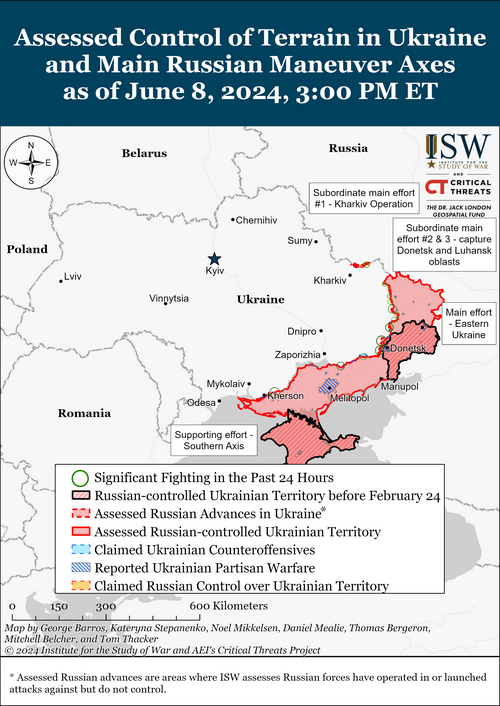
From The Institute for the Study of War:
Russian Offensive Campaign Assessment, June 8, 2024
Christina Harward, Riley Bailey, Grace Mappes, Kateryna Stepanenko, and George Barros
June 8, 2024, 7:30pm ET
Click here to see ISW’s interactive map of the Russian invasion of Ukraine. This map is updated daily alongside the static maps present in this report.
Click here to see ISW’s 3D control of terrain topographic map of Ukraine. Use of a computer (not a mobile device) is strongly recommended for using this data-heavy tool.
Click here to access ISW’s archive of interactive time-lapse maps of the Russian invasion of Ukraine. These maps complement the static control-of-terrain map that ISW produces daily by showing a dynamic frontline. ISW will update this time-lapse map archive monthly.
Note: The data cut-off for this product was 1:15pm ET on June 8. ISW will cover subsequent reports in the June 8 Russian Offensive Campaign Assessment.
The Russian military command is reportedly transferring an unspecified number of forces to the Ukrainian-Russian border area near Kharkiv Oblast, but it is unclear if the Russian military command plans to immediately commit these redeployed forces to combat or use them to reinforce the Northern Grouping of Forces to bring it closer to its reported planned end strength. Chechen Akhmat Spetsnaz Commander Apty Alaudinov claimed in an interview with Russian state media outlet RT on June 8 that Russian authorities decided to transfer elements of the Akhmat Spetsnaz to the Kharkiv direction from unspecified areas at the end of May 2024.[1] Alaudinov claimed that the “Kashtan” detachment, formerly known as Akhmat “Kamerton” detachment and renamed after its new commander, is operating in the Kharkiv direction. Ukrainian Khortytsia Group of Forces Spokesperson Lieutenant Colonel Nazar Voloshyn stated on June 8 that Akhmat forces are serving as blocking units – specialized disciplinary units that fire upon friendly forces if they engage in an unauthorized retreat – in the international border area, and it is possible that the Russian military command transferred Akhmat forces to the area solely for this purpose and not to conduct offensive operations.[2] Voloshyn also stated that the Russian military command is increasing the Russian force grouping near the border area by transferring elements of unspecified regiments and brigades from other sectors of the front, including from occupied Kherson Oblast. Voloshyn stated that the Russian military command intends to commit unspecified airborne (VDV) elements and additional elements of the 11th and 44th Army Corps (both of the Leningrad Military District [LMD]) to offensive operations in unspecified areas of the border area. Elements of the 11th and 44th Army Corps have been conducting offensive operations in northern Kharkiv Oblast, and a battalion of the 98th VDV Division is reportedly operating in a border area in Kursk Oblast.[3] The Ukrainian Resistance Center stated on June 8 that the Russian military command is redeploying unspecified units and drone operators from the Kherson direction to the Kharkiv direction.[4] Russian forces reportedly had roughly 35,000 personnel in the international border area as a part of the Northern Grouping of Forces when they started offensive operations on May 10, whereas Ukrainian sources have indicated that the Russian military initially sought to concentrate at least 50,000 to 70,000 personnel in the international border area as of early May.[5] It is unclear whether Russian forces have altered the planned end strength of the Northern Grouping of Forces since launching the offensive operation into northern Kharkiv Oblast on May 10. A Russian milblogger claimed on June 6 that the Russian military command has only committed about 15,000 personnel to the offensive operation in northern Kharkiv Oblast.[6]
Ukrainian military observer Kostyantyn Mashovets noted on June 8 that a fraction of the reported 30,000 personnel that Russia generates each month arrives at the front as combat force replacements and reinforcements and that Russian force generation efforts have allowed Russian forces to establish only limited operational and strategic reserves. Mashovets stated that on average each Russian operational grouping of forces receives between 1,000 to 1,500 combat personnel as replacements or reinforcements every month and may receive 2,000 if the grouping is responsible for intensified offensive operations.[7] There are six operational Russian grouping of forces operating within and near Ukraine, meaning that Mashovets is suggesting that Russian forces receive a total of 6,000 to 12,000 new combat personnel each month.[8] This figure is not incongruent with Ukrainian and Russian reports from January and April 2024 that Russia recruits 30,000 new personnel per month since a large number of these new personnel will fulfill combat support and combat service support roles or later assume combat arms roles following training.[9] Russian President Vladimir Putin stated on June 7 that Russia has recruited 160,000 new personnel so far in 2024, a figure fairly consistent with reports that the Russian military recruits about 30,000 personnel a month.[10] Russian forces have leveraged their possession of the theater-wide initiative to determine a tempo of fighting in Ukraine in recent months that appears to generate casualties roughly equal to or slightly less than the rate of newly generated forces.[11] This careful balance between Russian casualties and newly generated forces requires that Russian forces not significantly intensify offensive operations for a prolonged period of time, however. This balance becomes even more narrow when considering losses and new force generation for just Russian combat personnel.[12] ISW has observed a “pulsing” of Russian offensive operations along the front in recent months, wherein Russian forces alternate between intensified assaults and a lower operational tempo to replenish losses.[13] The availability of new combat personnel is likely one of several determining factors for when Russian forces decide to alternate between intensified offensive operations.
Mashovets stated that Russian forces have accumulated at most 60,000 personnel in operational and strategic reserves over the past six to eight months (roughly from October 2023 to June 2024).[14] Russian forces have likely not properly trained or equipped these reserves, which they have previously used largely as manpower pools for restaffing and reinforcing committed units conducting grinding, infantry-heavy assaults with occasional limited mechanized assaults.[15] ISW continues to assess that planned Russian operational- and strategic-level reserves are unlikely to be ready to act as a first-echelon penetration force or as a second-echelon exploitation force capable of conducting effective large-scale combined arms assaults.[16] These reported limited operational- and strategic-level Russian reserves likely will be insufficient to support simultaneous large-scale offensive efforts in several directions. The Russian military command will likely have to choose one main effort during its expected summer offensive effort, if it intends for these reserves to sustain a large-scale offensive operation.
Ukrainian forces conducted a drone strike against a Russian military airfield in the North Ossetia-Alania Republic on the night of June 7 to 8. Ukrainian outlet Suspilne reported on June 8 that its sources in the Ukrainian special services stated that Ukraine’s Main Military Intelligence Directorate (GUR) conducted a drone strike against an airfield in North Ossetia on the night of June 7 to 8.[17] Geolocated footage published on June 8 shows a drone targeting the Mozdok Airbase followed by a rising smoke plume.[18] North Ossetia-Alania Republic Head Sergei Menyaylo claimed that Russian forces shot down three drones targeting a military airfield in Mozdok and that unspecified objects sustained minor damage and caught fire.[19] The Russian Ministry of Defense (MoD) claimed that Russian forces destroyed a drone over the North Ossetia-Alania Republic on the morning of June 8.[20] A Russian milblogger amplified footage of Russian forces reportedly shooting down a drone near oil infrastructure in Nogai Raion, Republic of Dagestan, but ISW has not observed further evidence of Ukrainian drone strikes in the area.[21] One Russian milblogger, however, claimed that a number of sources “erroneously” reported the strike near the Mozdok airfield as a strike against the oil field in Nogai Raion.[22]
Russian strikes have caused widespread damage to Ukraine’s energy grid, and Ukraine will continue to face serious constraints on power generation capacity. Ukrainian Prime Minister Denys Shmyhal stated on June 7 that only 27 percent of large Ukrainian thermal power plants (TPPs) are operational and that Russian missile and drone strikes damaged or destroyed the other 73 percent.[23] Shmyhal stated that recent Russian strikes have knocked out 9.2 gigawatts of Ukrainian generation capacity and stated that this is half of the generation capacity that Ukraine used in Winter 2023-2024.[24] The Financial Times (FT) reported on June 5 that Russia has knocked out or captured over half of Ukraine’s generation capacity, bringing Ukrainian energy production to below 20 gigawatts from 55 gigawatts before the start of the full-scale invasion in 2022.[25] Shmyhal stated that Russian forces have destroyed 42 power generators and damaged 20 hydropower generators at Ukrainian energy generation facilities.[26] Shmyhal emphasized that Ukraine is taking steps to relieve pressure on Ukraine’s energy grid and plans to restore as much energy generation capacity as possible before Winter 2024-2025.[27] Ukraine’s nuclear operator Energoatom stated on June 7 that it connected an additional reactor at an unspecified nuclear power plant to the energy grid.[28] The head of Ukrainian state electricity transmission operator Ukrenergo, Volodymyr Kudrytskyi, stated that this will relieve Ukrainian power constraints for the next two weeks before increased summer consumption begins.[29] Shmyhal stated that Ukraine is currently importing 1.7 gigawatts from the European Union (EU) but that the EU is able to export a maximum of 2.2 gigawatts to Ukraine.[30]
US President Joe Biden met with Ukrainian President Volodymyr Zelensky in Paris on June 7. Biden and Zelensky discussed the battlefield situation, Ukraine’s defensive capabilities, preparations to finalize a US-Ukraine bilateral security agreement, and the upcoming Ukraine peace conference in Switzerland.[31] Biden apologized for the delay in US security assistance to Ukraine and reiterated US support for Ukraine against Russian aggression.[32] Zelensky emphasized that Ukraine needs more security assistance to strengthen its defense of Kharkiv Oblast and that Ukraine needs more opportunities to strike military targets in Russia to protect against Russian aggression from across the international border.[33] ISW continues to assess that the delays in US security assistance to Ukraine have severely constrained Ukrainian defensive capabilities in recent months and emboldened Russian forces to launch and make tactically significant gains in their new offensive operation in northern Kharkiv Oblast and double down on operations elsewhere in the theater.[34]
Longtime Russian Central Bank Head Elvira Nabiullina is reportedly a balancing force among Russian President Vladimir Putin’s economic advisors despite pressure for Russian officials to unequivocally support the long-term war effort in Ukraine. Bloomberg reported on June 7 that former Russian Service for Financial Markets Head and former Central Bank Deputy Head Oleg Vyugin stated that Nabiullina has known Putin for years and has the “exclusive right” to tell Putin “what he doesn’t like” because Putin views her as straightforward and uninfluenced by corruption.[35] Bloomberg reported that Nabiullina balances against Russian Finance Minister Anton Siluanov, who advocates for Russia to shape its budget to ensure a victorious Russian war effort, and former economic aid and new Kremlin Deputy Chief of Staff Maxim Oreshkin, who portrays the Russian war as a global conflict against the West. Bloomberg cited a senior government official who stated that Nabiullina is raising concerns about the impacts of Russian labor shortages caused by the war and a “swollen” budget amid high defense spending. A leaked video published on March 2, 2022, showed Nabiullina speaking about her hyperfocus on the Russian economy after the start of the full-scale invasion of Ukraine and concern over greater domestic sacrifices.[36] Bloomberg reported that Putin has begun overruling Nabiullina in some cases but assessed that Putin is unlikely to remove her for the foreseeable future.[37] Bloomberg cited anonymous sources as saying that Putin wants to avoid dismissing personnel in a way that could be viewed as destabilizing or as being done under pressure.
Nabiullina is especially notable because she has previously mitigated the economic fallout of Putin’s geopolitical ambitions and reportedly tried to resign from her position in May 2022 in opposition to the full-scale invasion of Ukraine.[38] The Economist reported on May 31 that Nabiullina ensured the stability of the ruble after Putin’s annexation of Crimea in 2014 and that in 2022 she feared that her resignation would lead to the arrests of her deputies at the Central Bank.[39] The Economist reported that Nabiullina has largely favored regulatory market reforms but that she learned early in her career in the late 1990s and early 2000s that the Russian economy can only take so much change. The Economist noted that she has navigated accordingly as she gained power under Putin, implementing some regulatory changes within the existing Russian economic system, and has shifted her focus to minimize the economic impact of the war in Ukraine on the Russian public since February 2022. Nabiullina’s reported ability to speak candidly to Putin about the impact of the war on the Russian economy is especially significant given Putin’s recent efforts to oust any officials who have lost Putin’s favor or otherwise perceived as disloyal to Putin and his war effort.[40] Putin has recently been preoccupied with assuaging domestic concerns about Russia’s economy and has attempted to portray Russia’s economic issues positively, and he may be more willing to tolerate Nabiullina’s candor or even appreciate her honesty given her track record for stability.[41]
Ukraine’s Main Military Intelligence Directorate (GUR) and Russian opposition outlets reported that unspecified actors attempted to assassinate the former Russian occupation mayor of Kupyansk, Kharkiv Oblast, Hennadiy Matsehora in Stary Oskol, Belgorod Oblast on June 7.[42] The GUR stated that Matsehora is in critical condition at a hospital in Moscow.[43] The Ukrainian Kharkiv Oblast Prosecutor’s Office reported on May 20 that Matsehora, who was originally lawfully elected as Mayor of Kupyansk in 2020, defected and helped Russian forces in February 2022 and that Ukrainian authorities will try Mateshora in absentia for treason.[44]
Key Takeaways:
- The Russian military command is reportedly transferring an unspecified number of forces to the Ukrainian-Russian border area near Kharkiv Oblast, but it is unclear if the Russian military command plans to immediately commit these redeployed forces to combat or use them to reinforce the Northern Grouping of Forces to bring it closer to its reported planned end strength.
- Ukrainian military observer Kostyantyn Mashovets noted on June 8 that a fraction of the reported 30,000 personnel that Russia generates each month arrives at the front as combat force replacements and reinforcements and that Russian force generation efforts have allowed Russian forces to establish only limited operational and strategic reserves.
- Ukrainian forces conducted a drone strike against a Russian military airfield in the North Ossetia-Alania Republic on the night of June 7 to 8.
- Russian strikes have caused widespread damage to Ukraine’s energy grid, and Ukraine will continue to face serious constraints on power generation capacity.
- US President Joe Biden met with Ukrainian President Volodymyr Zelensky in Paris on June 7.
- Longtime Russian Central Bank Head Elvira Nabiullina is reportedly a balancing force among Russian President Vladimir Putin’s economic advisors despite pressure for Russian officials to unequivocally support the long-term war effort in Ukraine.
- Ukraine’s Main Military Intelligence Directorate (GUR) and Russian opposition outlets reported that unspecified actors attempted to assassinate the former Russian occupation mayor of Kupyansk, Kharkiv Oblast, Hennadiy Matsehora in Stary Oskol, Belgorod Oblast on June 7.
- Russian forces recently advanced north of Kharkiv City, southeast of Kupyansk, within easternmost Chasiv Yar, northwest of Avdiivka, and southwest of Donetsk City.
- Russian actors are using video appeals from Russian servicemen to refute reports of high Russian losses in northern Kharkiv Oblast.
Go here to read the rest.
From Strategy Page:
June 7, 2024: This is an update on the many ways UAVs (Unmanned aerial Vehicles) and USVs (Unmanned Surface Vessels) have unexpectedly revolutionized warfare. These systems are evidence that Combat robots have sneaked into the military, without many people in, or out of, uniform paying a lot of attention. That’s still the case, especially because the media and even many senior military and political leaders don’t fully understand the technology nor how it is implemented. One example of this confusion can be seen with the constant reference to UAVs as drones or robots. They are neither, they are simply remotely controlled aircraft, something that’s been around for over half a century. But these UAVs are being given more and more robotic (operating autonomously) capabilities. This isn’t new either, as torpedoes have had this ability for over 60 years and missiles for over 50 years.
Swarms of FPV (First Person View) UAVs are revolutionizing how wars are fought. There are few methods to defeat UAV attacks. The primary defensive measure is electronic jamming of the control signal between the UAV operator and the UAV. Jamming is of limited effectiveness because active jammers are easy targets for UAVs programmed to detect, home in on and destroy jammers. Depending on how they are programmed, UAVs will either land if jammed or return to where they were launched.
Despite those defensive measures, and the small explosive payload UAVs carry, about half the armored vehicles damaged or destroyed in Ukraine were done in by armed UAVs. Training of UAV operators is critical as it takes over a hundred hours of operating UAVs to gain a minimal skill level. Female soldiers can excel as UAV operators while mostly avoiding the battlefield risk of death or injury. Unlike pilots of combat aircraft, UAV operators are much less likely to be put out of action by death, injury, or capture. UAV operators are relatively close to the front lines and exposed to some risk, but not nearly as much as pilots. Such reduced casualties shorten the learning curve for UAV operators and make them more dangerous faster compared to infantry whose effective combat lifetime is much shorter.
UAV warfare is increasingly common and dominating some combat zones. Tactics and techniques are also evolving as Ukraine and Russia both experiment with new tactics, techniques, and UAV designs. Both nations are also increasing production of UAVs and the number of trained operators. Both Russia and Ukraine realize that UAVs provide unprecedented surveillance of the battlefield, but not all of it. That requires more UAVs and operators. One solution for this shortcoming is operator software that enables one operator to control several UAVs. The number one operator can handle simultaneously depends on operator experience. That cannot be manufactured but must be developed. Whoever can obtain the most trained operators has an advantage.
All these UAV developments make combat more dangerous for the troops on the ground. UAVs not only keep an eye on enemy troops but are always ready to go in and put them out of action, as in dead or wounded. Troops are still fighting each other on the ground, but now they have to worry about constant surveillance and attacks from the growing number of UAVs hovering over the battlefield. In addition to operators there are the UAV maintainers, who repair damaged or otherwise disabled UAVs and service those needing a battery recharge or simply a fresh battery.
Ukraine’s military has established a UAV Academy to train UAV operators in basic and advanced skills. There are courses for commanders on how best to manage and use UAVs. This is essential because now Ukrainian infantry battalions have nearly as many UAVs as troops. The American military likes to call this a force multiplier. This means a battalion with lots of UAVs is more effective, and lethal, than a battalion without so many UAVs. The Ukrainian military is the first to go so far in this direction and appear to be benefitting from the massive use of UAVs. Other nations are closely following this development and preparing to adopt what works for Ukraine. Russia is more conservative in how they deal with this, even though they are also using massive numbers of UAVs. There are already dozens of Ukrainian companies offering training for UAV operators and the Ukrainian military uses the services of these firms. In 2023 Ukraine sought to have more than 10,000 trained operators as quickly as possible. UAV operators specialize. Most learn to operate quadcopters while a large minority learn how to operate FPV UAVs, and a smaller number learn how to operate fixed wing UAVs. Ukraine has found that the most difficult operators to recruit and train are those for FPV UAVs. The Ukrainian military considers UAV operators as a separate military specialty like infantryman, artillerymen, or radar operator.
In early 2024 Ukraine created a new branch of their military, the UAV Force. This is in addition to the Ukrainian Air Force and its manned aircraft. The UAV Force does not control the UAVs Ukrainian forces use regularly but will contribute to developing new UAV models and organizing mass production for those new models that are successful. UAVs have been an unexpected development that had a huge impact on how battles in Ukraine’s current war are fought. UAVs were successful because they were cheap, easily modified, and expendable.
Early on both Russian and Ukrainian forces were using cheap, at about $500 each, quadcopter UAVs controlled by soldiers a kilometer or more away using FPV goggles to see what the day/night video camera on the UAV can see. Adding night vision at least doubles the cost for each UAV, so not all of them have that capability. Each of these UAVs carries half a kilogram of explosives, so it can instantly turn the UAV into a flying bomb that can fly into a target and detonate. This was an awesome and debilitating weapon when used in large numbers over the combat zone. If a target isn’t moving or requires more explosive power that the UAVs can supply, one of the UAV operators can call in artillery, rocket, or missile fire, or even an airstrike. Larger, fixed wing UAVs are used for long range, often over a thousand kilometers, operations against targets deep inside Russia. Since 2022 the use of UAVs by both sides has escalated and so far, several hundred thousand UAVs have been put to work providing surveillance and attack services for both sides. Ukraine plans to produce over a million UAVs in 2024. The Ukrainians consider drones another form of ammunition that is cheaper, smarter and far more effective and lethal than guided missiles or GPS guided artillery shells.
A major limitation to the expansion of UAV operations was the need for trained UAV operators. These operators need over a hundred hours of training before they are able to start operating these UAVs, and another hundred hours of actual use before they are able to make the most out of the system. These small UAVs are difficult to shoot down until they get close to the ground and the shooter is close enough, as in less than a few hundred meters, away to successfully target a UAV with a bullet or two and bring it down. Troops are rarely in position to do this, so most of these UAVs are able to complete their mission, whether it is a one-way attack or a reconnaissance and surveillance mission. The recon missions are usually survivable and enable the UAV to be reused. All these UAVs are constantly performing surveillance, which means that both sides commit enough UAVs to maintain constant surveillance over a portion of the front line, to a depth, into enemy territory, of at least a few kilometers. This massive use of FPV-armed UAVs has revolutionized warfare in Ukraine and both sides are producing as many as they can. Military observers from other countries are reporting that warfare has undergone a fundamental change because of the widespread use of UAVs in Ukraine. Many armed forces at peace are reluctant to change, despite the evidence from Ukraine that any future war will provide the more prolific user of UAVs with a significant edge in combat.
These drone have also revolutionized naval warfare. In early 2024 Ukraine built 35 Sea Baby USVs. These are made of a material that is nearly invisible to radar. Each can carry up to 850 kg of explosives. Less explosives can be carried if you want the Sea Baby to travel farther. With a full load of explosives, it can reach targets up to 1,000 kilometers distant. Top speed is 90 kilometers an hour but more economical, in terms of fuel use, cruise speed is about half the top speed. That means it would take the Sea Baby about twenty hours to travel a thousand kilometers. That is a one way trip to a target, like a naval base or any ships docked at the base which is then attacked. Sea Baby navigates using several devices including GPS, INS, and short range sensors to detect and avoid obstacles. These sensors can also be programmed to identify and attack a specific target like a ship or other naval base facility. Sea Baby can also be equipped with short range weapons like explosive rockets that can hit targets a thousand meters distant with thermobaric/fuel air warheads. When used to launch rocket attacks, the Sea Baby can escape and return to a Ukrainian base for reuse. Some Sea Baby’s are equipped with video cameras to carry out reconnaissance and surveillance missions. In this case, communications equipment must be carried to transmit video or individual digital photos back to the Ukrainian base. The Ukrainians have been very imaginative and flexible in their use of these unmanned seagoing vessels.
Ukrainian USVs have been quite successful in attacking and sinking or disabling Russian navy ships. So far there have been over a dozen attacks which resulted in damage to 12 ships and the sinking of a cruiser, two small landing ships and one missile corvette. The longest range raids have been against targets in Kerch Strait and the more distant Russian naval base at Novorossiysk.
Ukrainian USV operations in the Black Sea forced the Russian Black Sea Fleet to withdraw to the eastern shore of the Black Sea. Sevastopol was no longer a safe place to be, and Russian ships could no longer launch their Kalibr cruise missiles without moving closer to Ukrainian territory and risking attack by Ukrainian USVs. The presence and aggressive use of the USVs means that Ukraine’s grain corridor has been kept open despite Russia’s threats to interfere. Beyond symbolic significance, the corridor holds critical economic importance for Ukraine and is expected to contribute 5-7 percent to GDP growth in 2024 because of the grain shipments.
The aggressive and successful use of Ukrainian USVs against the Russian Black Sea fleet was unprecedented in the history of naval warfare. Not only were these USVs tactically successful but financially as well. For example, new frigates cost about $1.5 billion each. That much money can also pay for 5,000 such USVs. Destroyers cost twice as much. The frigates and destroyers are high seas ships and can travel all over the world. The USVs operate in coastal waters although some of the larger USVs can operate up to a thousand kilometers from where they were launched. These USVs carry video cameras and satellite-based communications systems to collect information and, in peacetime, do so without fear of attack. Severe storms are another matter, but any storm damage will be broadcast as it is happening, at least until the video cameras or communications equipment is disabled.
Go here to read the rest. The most striking feature of the current war is the domination of the air war, and the naval war, by drones. I hope our Generals and Admirals are taking notes.

