
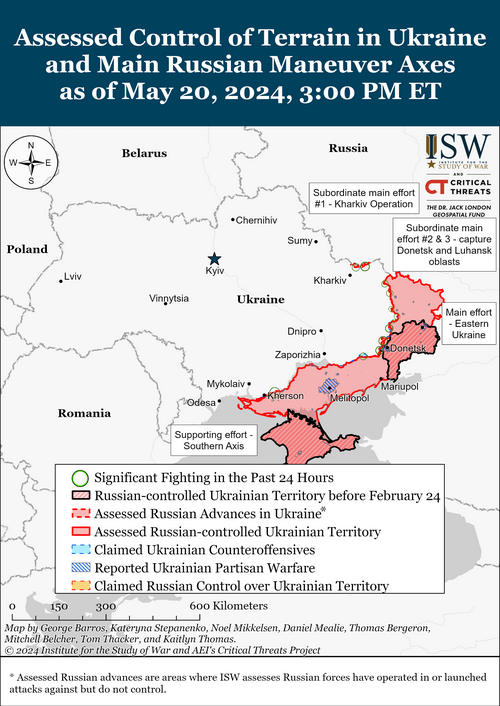
From The Institute for the Study of War:
Russian Offensive Campaign Assessment, May 20, 2024
Christina Harward, Nicole Wolkov, Kateryna Stepanenko, Grace Mappes, and Frederick W. Kagan
May 20, 2024, 8:15pm ET
Click here to see ISW’s interactive map of the Russian invasion of Ukraine. This map is updated daily alongside the static maps present in this report.
Click here to see ISW’s 3D control of terrain topographic map of Ukraine. Use of a computer (not a mobile device) is strongly recommended for using this data-heavy tool.
Click here to access ISW’s archive of interactive time-lapse maps of the Russian invasion of Ukraine. These maps complement the static control-of-terrain map that ISW produces daily by showing a dynamic frontline. ISW will update this time-lapse map archive monthly.
Note: The data cut-off for this product was 1:30pm ET on May 20. ISW will cover subsequent reports in the May 21 Russian Offensive Campaign Assessment.
Ukrainian sources indicated that Russian forces are concentrating limited, understaffed, and incohesive forces in the Sumy direction, but even such a Russian grouping of forces will be able to achieve the likely desired effect of drawing and fixing Ukrainian forces in the international border area. The deputy commander of a Ukrainian brigade operating in northern Kharkiv Oblast reported on May 20 that Russian forces, including Chechen forces, are accumulating in the Sumy direction but that the limited number of Russian personnel suggests that the Russian objective is to draw and fix Ukrainian forces to the international border area.[1] Ukrainian military observer Kostyantyn Mashovets stated on May 20 that the Russian grouping in Kursk Oblast consists of 9,000–10,000 personnel.[2] Mashovets stated that this grouping consists of up to three under-strength motorized rifle regiments (each lacking one to two battalions); eight motorized rifle, tank, and infantry battalions; and one airborne (VDV) battalion all redeployed from various units, formations, and military districts; and at least two assault detachments at the echelon of a reinforced company or an under-strength battalion.[3] Mashovets also reported on May 5 that an unspecified VDV battalion is part of the Russian grouping in Kursk Oblast, and a Russian milblogger (who has an avowed bias against the VDV and “Dnepr” Grouping of Forces Commander Colonel General Mikhail Teplinsky) claimed that the Russian 3rd VDV Battalion of the 104th VDV Regiment (76th VDV Division) is in Kursk Oblast.[4] ISW continues to assess that even limited Russian activity in other areas of the international border below the threshold of Russian offensive operations could have the effect of stretching Ukrainian forces along a wider front and that Russian forces will be able to draw and fix Ukrainian forces to this area as long as Russia threatens penetrations of other border areas beyond northern Kharkiv Oblast.[5]
Kremlin officials expressed their condolences to senior Iranian officials following the announcement of Iranian President Ebrahim Raisi’s and Foreign Affairs Minister Hossein Amir Abdollahian’s deaths on May 20. Russian President Vladimir Putin sent a condolence letter to Iranian Supreme Leader Ali Khamenei in which he called Raisi a “true friend of Russia.”[6] Putin had a telephone call with Iranian Interim President Mohammad Mokhber on May 20 and expressed condolences to Mokhber, Khamenei, and the Iranian people.[7] The Russian Ministry of Foreign Affairs (MFA) stated that Putin and Mokhber discussed their desire to further strengthen Russo-Iranian relations.[8] Russian Foreign Minister Sergei Lavrov called Raisi and Abdollahian “true friends” who were “invaluable” in strengthening Russo–Iranian cooperation.[9] Russian Security Council Secretary Sergei Shoigu stated that Russia is ready to help investigate the cause of the helicopter crash.[10] Putin instructed Head of the Russian Ministry of Emergency Situations Alexander Kurenkov on May 19 to send specialists and equipment to assist in search and rescue operations in Iran.[11]
Russian President Vladimir Putin fired Russian Deputy Defense Minister Colonel General Yury Sadovenko on May 20, replacing him with former Deputy Economic Minister and current Federation Council Accounts Chamber Auditor Oleg Savelyev.[12] Sadovenko had held his position in the Russian Ministry of Defense (MoD) since January 2013, and a Russian insider source speculated that Sadovenko may become a defendant in a criminal case for violating anti-corruption laws.[13] The insider source added that some additional Russian deputy defense ministers who worked closely with former Defense Minister Sergei Shoigu may soon resign. Russian milbloggers observed that Savelyev’s appointment is consistent with the Kremlin’s effort to improve the wartime economy, given that Savelyev has an extensive background in economics and experience in overseeing the audits of defense, national security, and law enforcement activities.[14] The milblogger added that recently appointed Russian Defense Minister Andrey Belousov is beginning to form his own team within the Russian MoD.[15] Putin likely replaced Sadovenko with Savelyev in an effort to remove Shoigu’s allies from the Russian MoD and appoint economic advisors to the agency to improve the wartime economy.
Putin also dismissed Presidential Advisor Alexandra Levitskaya on May 20, but the reason for Levitskaya’s dismissal is unclear.[16] Putin appointed Levitskaya as a presidential advisor in August 2013. Levitskaya previously served as the deputy minister of health and social development from 2007 to 2012, and the Russian Government’s first deputy chief of staff in 2012.[17] Putin transferred several presidential assistants to the presidential advisor rank on May 14 as part of changes to the presidential administration leadership.[18]
US Defense Secretary Lloyd Austin reiterated the White House’s unwillingness to approve Ukraine’s use of US-provided weapons in strikes against military targets in Russia following a meeting of the Ukraine Defense Contact Group (also known as the Ramstein format) on May 20. Austin stated that the US expects that Ukraine will “continue to use the weapons that [the US] provided on targets inside of Ukraine.”[19] Austin vaguely noted that “the aerial dynamic is a little bit different,” but stated that he would not speculate further. ISW continues to assess that US and other Western limitations on Ukraine’s ability to strike military targets in Russia have created a sanctuary in Russia’s border areas from which Russian aircraft can conduct glide bomb and missile strikes against Ukrainian positions and settlements and where Russian forces and equipment can freely assemble before entering combat.[20] These US and Western policies are severely compromising Ukraine’s ability to defend itself against current Russian offensive operations in northern Kharkiv Oblast or any area along the international border where Russian forces may choose to conduct offensive operations in the future.[21] UK Foreign Minister David Cameron recently announced that Ukrainian forces may use UK-provided weapons to strike targets in Russian territory, and other European countries may be considering lifting similar restrictions.[22] French National Assembly Foreign Affairs Committee Chairperson Jean-Louis Bourlanges stated on May 19 that France should allow Ukrainian forces to use French-provided weapons to strike military targets inside of Russia and noted that “the right to self-defense excludes the right to protect the territory of the aggressor.”[23] Bourlanges stated that lifting the current restriction is not a question of Western intervention in the theater of operations but would “lift an unjustifiable taboo.”
Estonian Prime Minister Kaja Kallas stated that some unspecified countries, presumably NATO member states, have already sent personnel to train Ukrainian soldiers “on the ground.”[24] Kallas stated to the Financial Times (FT) on May 19 that some countries have assumed the risk of sending personnel to train Ukrainian soldiers “in a risk zone” during the war and stated that NATO states should not fear the risk of escalation from such deployments.[25] Kallas’ statement is the latest in a series of back-and-forth comments between senior Estonian officials about whether Estonia is planning to send its own personnel to perform non-combat support roles in deep rear areas in Ukraine.[26]
Russian Security Council Deputy Chairperson Dmitry Medvedev amplified a known Russian information operation aimed at directly undermining Ukrainian President Volodymyr Zelensky’s legitimacy as president. Medvedev gave a long interview to Kremlin newswire TASS on May 20 in which Medvedev doubled down on the Russian information operation falsely portraying Zelensky as an illegitimate president and deepened the information operation by tying it to other Kremlin rhetorical lines.[27] Other Russian officials and ultranationalist milbloggers either made or amplified similar statements on May 20 accusing Zelensky of now “illegally” holding office.[28] Medvedev likely timed his statements to reinject the narrative into the Russian information space on May 20, when Zelensky’s current presidential term would have ended had Ukraine held presidential elections in March 2024. The Ukrainian constitution permits postponing elections and allows a sitting president to serve after the designated end of his term under martial law, and Zelensky’s decision not to hold elections during its existential defensive war is fully in accord with Ukraine’s constitution.[29]
Key Takeaways:
- Ukrainian sources indicated that Russian forces are concentrating limited, understaffed, and incohesive forces in the Sumy direction, but even such a Russian grouping of forces will be able to achieve the likely desired effect of drawing and fixing Ukrainian forces in the international border area.
- Kremlin officials expressed their condolences to senior Iranian officials following the announcement of Iranian President Ebrahim Raisi’s and Foreign Affairs Minister Hossein Amir Abdollahian’s deaths on May 20.
- Russian President Vladimir Putin fired Russian Deputy Defense Minister Colonel General Yury Sadovenko on May 20, replacing him with former Deputy Economic Minister and current Federation Council Accounts Chamber Auditor Oleg Savelyev.
- Putin also dismissed Presidential Advisor Alexandra Levitskaya on May 20, but the reason for Levitskaya’s dismissal is unclear.
- US Defense Secretary Lloyd Austin reiterated the White House’s unwillingness to approve Ukraine’s use of US-provided weapons in strikes against military targets in Russia following a meeting of the Ukraine Defense Contact Group (also known as the Ramstein format) on May 20.
- Estonian Prime Minister Kaja Kallas stated that some unspecified countries, presumably NATO member states, have already sent personnel to train Ukrainian soldiers “on the ground.”
- Russian Security Council Deputy Chairperson Dmitry Medvedev amplified a known Russian information operation aimed at directly undermining Ukrainian President Volodymyr Zelensky’s legitimacy as president.
- Russian forces recently made confirmed advances near Vovchansk, Chasiv Yar, Avdiivka, and Donetsk City and in western Zaporizhia Oblast and the Dnipro River Delta.
- Russian opposition outlet Vazhnye Istorii (iStories) reported that Russian military authorities and Kazakh law enforcement acting on Russian orders detained at least two more servicemen in Kazakhstan who had deserted from the Russian military.
Go here to read the rest. We are approaching prime campaigning weather in Ukraine.

