From The Institute for the Study of War:
Russian Offensive Campaign Assessment, May 18, 2024
Christina Harward, Riley Bailey, Angelica Evans, Grace Mappes, and George Barros
May 18, 2024, 9:15pm ET
Click here to see ISW’s interactive map of the Russian invasion of Ukraine. This map is updated daily alongside the static maps present in this report.
Click here to see ISW’s 3D control of terrain topographic map of Ukraine. Use of a computer (not a mobile device) is strongly recommended for using this data-heavy tool.
Click here to access ISW’s archive of interactive time-lapse maps of the Russian invasion of Ukraine. These maps complement the static control-of-terrain map that ISW produces daily by showing a dynamic frontline. ISW will update this time-lapse map archive monthly.
Note: The data cut-off for this product was 2pm ET on May 18. ISW will cover subsequent reports in the May 19 Russian Offensive Campaign Assessment.
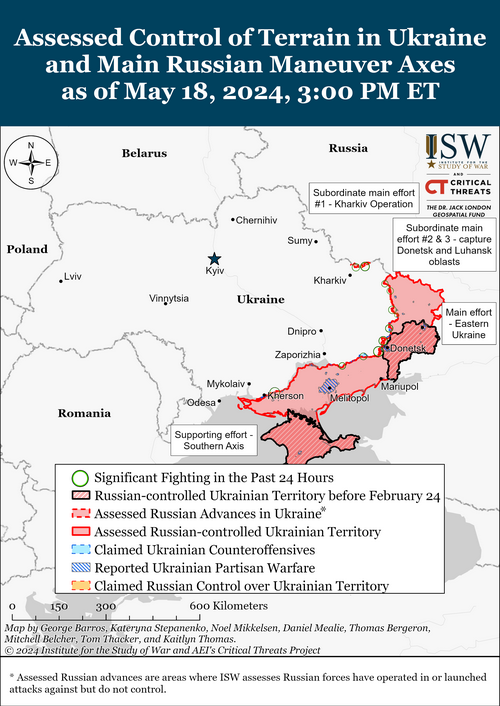
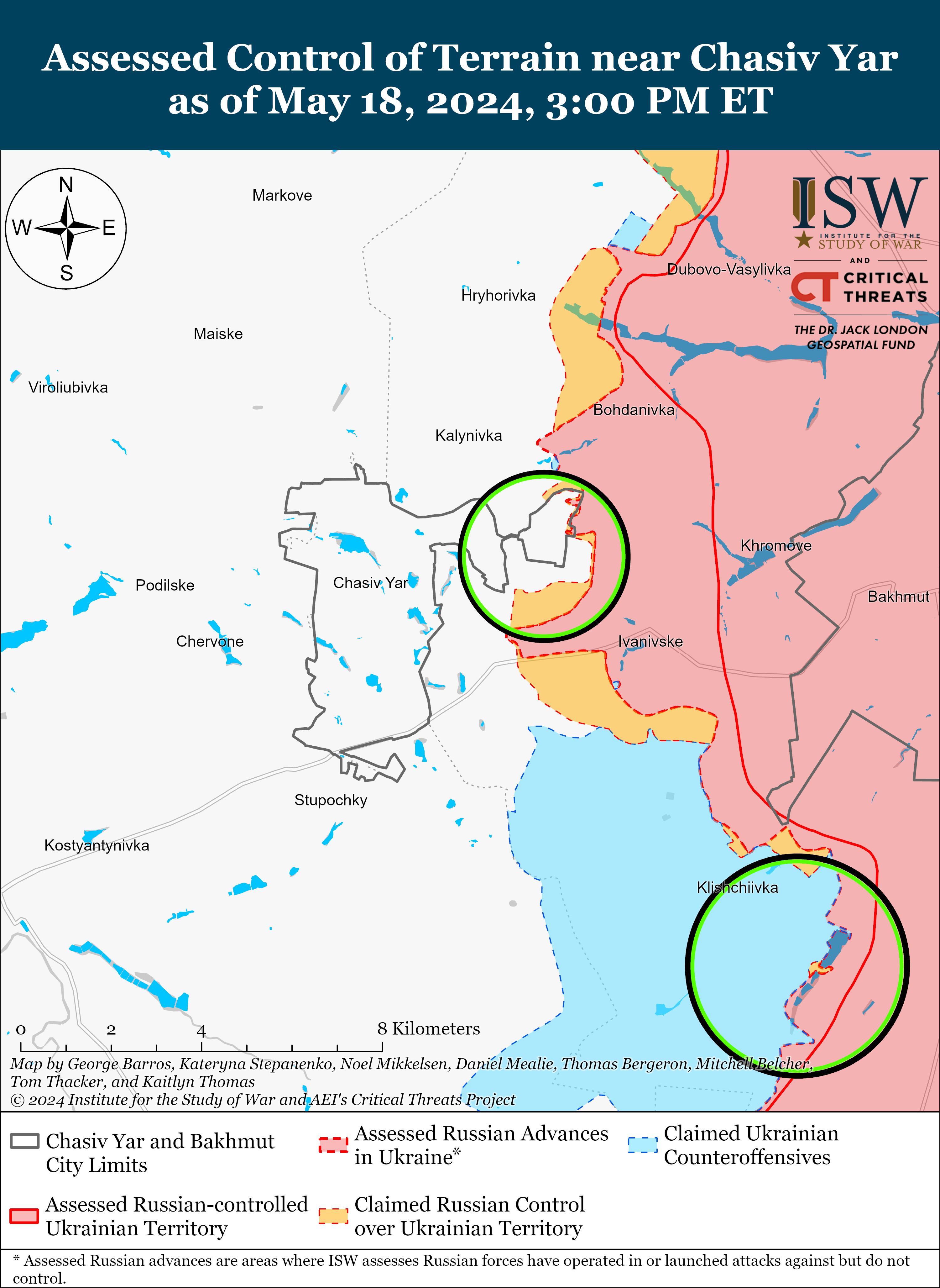
Russian forces have recently intensified their effort to seize the operationally significant town of Chasiv Yar, seeking to exploit how Russian offensive operations in northern Kharkiv Oblast and ongoing offensive operations throughout eastern Ukraine have generated greater theater-wide pressure on Ukrainian forces. The Ukrainian General Staff reported that Russian forces conducted an unsuccessful roughly reinforced company-sized mechanized assault with two tanks and 21 infantry fighting vehicles (IFVs) in the direction of the Novyi Microraion in eastern Chasiv Yar on May 17.[1] The Ukrainian General Staff reported that Russian forces conducted a roughly reinforced platoon-sized mechanized assault in the same area on May 18.[2] Geolocated footage published on May 17 shows Russian forces attacking with at least seven armored vehicles near Ivanivske (east of Chasiv Yar).[3] The Ukrainian General Staff noted that Russian forces are widely using armored vehicles in the Chasiv Yar area, and Ukrainian President Volodymyr Zelenksy thanked Ukrainian forces near Chasiv Yar for destroying at least 20 Russian armored vehicles (presumably over the past day).[4] Russian forces have not made notable tactical gains in the Chasiv Yar area since conducting a company-sized mechanized assault on the town’s eastern outskirts on April 4 and have not conducted similar sized-mechanized assaults in the area until May 17.[5] The April 4 mechanized assault was followed by intensified Russian offensive operations near Chasiv Yar, and recent Russian mechanized assaults in the area likely portend an overall intensification of the Russian effort to seize the town.[6] The Russian seizure of Chasiv Yar would be operationally significant since it would provide Russian forces with favorable positions to launch subsequent offensive operations against Kostyantynivka and Druzhkivka, cities that form the southern portion of a Ukrainian defensive belt that is the backbone of Ukraine’s defense of Donetsk Oblast.[7]
Russian forces launched a limited offensive operation into northern Kharkiv Oblast on May 10 that aims to strategically draw and fix Ukrainian manpower and materiel from ongoing Ukrainian defensive operations in eastern Ukraine.[8] Russian forces have maintained the tempo of their offensive operations throughout eastern Ukraine in the previous week and will likely continue to do so in order to exploit any vulnerabilities from the transfer of Ukrainian materiel and manpower to defensive operations in northern Kharkiv Oblast.[9] Ukrainian forces have recently transferred elements of a Ukrainian brigade defending in the Chasiv Yar area to the Vovchansk area, and Russian forces have likely intensified offensive operations near Chasiv Yar to quickly take advantage of weakened Ukrainian defenses.[10] Ukrainian Commander-in-Chief Colonel General Oleksandr Syrskyi reported that Russian forces aim to force Ukrainian forces to commit available reserves to the defensive operation in northern Kharkiv Oblast, and Russian forces may hope that intensified offensive operations near Chasiv Yar will be more successful if Ukraine cannot commit additional reserves to the area in the future.[11] Russian forces will likely pursue an offensive operation in Ukraine over the coming months that aims to stretch Ukrainian forces across a wide frontline and maintain regular offensive pressure to attempt to weaken the Ukrainian defensive line in aggregate.[12] Russian forces likely hope to make an operationally significant penetration anywhere along the frontline but will likely prioritize the Chasiv Yar area, where Russian forces have the most immediate prospects for an operationally significant advance, and the front west of Avdiivka, where Russian forces have been able to achieve tactically significant gains in recent weeks.[13] Russian forces are currently attempting to achieve tactically and operationally significant gains in Ukraine before the arrival of US security assistance at scale in June and July 2024 allows Ukrainian forces to blunt Russian advances.[14]
Russian forces are likely preparing for the second phase of their offensive operation in northern Kharkiv Oblast, which Russian forces likely intend to launch following their anticipated seizure of Vovchansk. Ukrainian President Volodymyr Zelensky stated on May 18 that Russian forces advanced between five and 10 kilometers in northern Kharkiv Oblast before Ukrainian forces stopped Russian advances and that Russian forces are conducting the first of several waves of offensive operations in the area.[15] A second wave of tactical attacks is not the same as the second phase of the operation, and Russian forces may need to launch several “waves” of tactical attacks to achieve the objective of any given singular phase of their offensive operation in northern Kharkiv Oblast. Zelensky stated that the Russian military command seeks to attack Kharkiv City but that Russian forces lack the manpower required to seize such a large city, so Russian forces will slowly push towards Kharkiv City as part of efforts to force Ukrainian forces to withdraw from the area. Available evidence indicates that Russian forces have so far only committed a limited amount of the prepared forces that Russia maintains in Belgorod, Kursk, and Bryansk oblasts for offensive operations in the area.[16] Ukrainian sources previously stated that Russian forces have committed 2,000 personnel to the frontline along the border and have 1,500 to 2,000 personnel in immediate reserve as of May 11.[17] Ukrainian sources, however, have noted that the Russian forces so far committed to offensive operations in northern Kharkiv Oblast may already be degraded after suffering heavy losses.[18] Ukrainian sources have also recently stated that Russian forces are “leasing” limited elements of Russian formations operating in the Svatove area as part of the Western Grouping of Forces but that other Russian forces groupings do not have “free” combat-ready forces or regiment- or brigade-level assets to transfer to the Northern Grouping of Forces to help sustain and intensify Russian offensive operations along the border.[19] The Russian military command is likely not committing available reserves from the Northern Grouping of Forces to current offensive operations because it intends for these elements to support later phases of the offensive operations or subsequent waves of assaults.
Russian forces reportedly launched offensive operations in the international border area before they completed bringing the Northern Grouping of Forces up to its reported planned end strength and will likely continue offensive operations in the border area in waves as the Russian military attempts to reinforce the grouping. Ukrainian Main Military Intelligence Directorate (GUR) Deputy Chief Major General Vadym Skibitskyi recently reported that Russian forces have roughly 35,000 personnel deployed to the border area in Kursk, Bryansk, and Belgorod oblasts and that Russian forces intend to establish a grouping in the area that is between 50,000 to 75,000 personnel in size.[20] Ukrainian sources also recently reported that an additional 3,750 Russian personnel may arrive in the northern Kharkiv Oblast area in the near future. Russian forces have repeatedly conducted offensive operations along different sectors of the front in “pulses” with one sector decreasing in intensity as another increases, and Russian forces may temporarily slow offensive operations in northern Kharkiv Oblast in order to replenish losses and bring the Northern Grouping of Forces up to its desired end strength before resuming the tempo in a second wave at a later time of their choosing.[21]
Russian forces are currently prioritizing the seizure of Vovchansk because it is likely one of the remaining tactical objectives of the first phase of offensive operations in northern Kharkiv Oblast. Russian forces conducted strikes on bridges across the Siverskyi Donets River to quickly isolate the battlefield east of the river in order to improve their chances to degrade Ukrainian ground lines of communication and quickly seize Vovchansk.[22] Russian forces are reportedly conducting a larger number of glide bomb strikes on the settlement than elsewhere along the border and appear to have committed more manpower to the area than in the Lyptsi direction.[23] The Russian military command likely chose the seizure of Vovchansk as one of the key tactical objectives of the first phase of the offensive operation in northern Kharkiv Oblast, since Vovchansk is the largest settlement immediately on the border that would provide Russian forces a staging ground close to the Russian rear to prepare for and launch the second phase of the Russian offensive operation. It is unclear if the second phase of the Russian offensive operation in northern Kharkiv Oblast will prioritize Russia’s operational objective to expand the desired “buffer zone” further in width along the international border or Russia’s operational objective to advance to within effective tube artillery range of Kharkiv City and its environs.[24] Russian forces could also envision a subsequent phase of the offensive operation from Vovchansk that aims to advance towards Velykyi Burluk to threaten the operational rear of the Ukrainian force grouping defending in the Kupyansk direction.[25]
Zelensky also outlined materiel requirements for Ukraine to combat Russia’s air superiority and defend against the Russian air threat, especially given US-imposed restraints on Ukraine that prohibit Ukraine from striking targets within Russian territory and airspace.[26] Zelensky stated that Ukrainian forces only have 25 percent of the air defenses that Ukraine needs to defend against Russian strikes and called for Western countries to send two Patriot batteries, which Ukraine would specifically deploy to Kharkiv Oblast, as a show of strength against the Russian offensive. Zelensky also stated that Ukraine would need about 120-130 F-16s or other advanced fighter aircraft to achieve air parity with Russia. Air parity is the lowest level of air control, in which no side controls the sky.[27] Zelensky stated that Russia’s biggest advantage is Ukraine’s restriction against using Western-provided weapons to strike military targets in Russia, and ISW has recently noted that this restriction creates a sanctuary for the Russian military in Russia to strike Ukraine safely without leaving Russian airspace.[28] Ukrainian forces have been able to strike Russian airbases in Russia and occupied Ukraine with some success, but Ukrainian forces have not made a sufficient impact to deter Russian forces from conducting missile and drone strike campaigns against Ukrainian deep-rear areas or glide bomb strikes on frontline and near rear areas.[29] Zelensky’s proposed two Patriot batteries in northern Kharkiv Oblast will have a limited effectiveness in defending against Russian airstrikes if Ukrainian forces cannot use the Patriots to intercept Russian fighter-bombers in Russian airspace.[30]
Ukrainian officials have reportedly asked the US presidential administration to ease the restriction against using US-provided weapons to strike military targets in Russia. The New York Times (NYT) and Wall Street Journal (WSJ) reported on May 17, citing Ukrainian and US officials, that Ukraine submitted the request within the past week.[31] The NYT and WSJ reported that Ukraine also requested additional targeting assistance for military targets inside Russia, and former Ukrainian military officials reportedly told the NYT that targeting assistance would allow Ukrainian forces to more accurately plan for drone and missile strikes given the requirements for more detailed terrain mapping for these strikes. White House officials state that the United States does not want to encourage or enable attacks within Russia, and the NYT noted that the White House has rejected similar appeals in the past. ISW continues to assess that this US policy severely compromises Ukraine’s ability to defend itself, particularly against Russian offensive operations in northern Kharkiv Oblast.[32]
Zelensky noted that Ukraine must overcome its manpower challenges in order to contest the theater-wide initiative in Ukraine. Zelensky stated that Ukraine is currently forming a significant number of brigades as part of its reserve and that Ukraine still needs to fully staff some of these units.[33] Zelensky stated that consistent rotations for frontline units are an important step in improving Ukrainian morale and noted that Ukraine must first stabilize the frontline and sufficiently staff its units in order to conduct counteroffensive operations in the future. ISW has repeatedly assessed that addressing Ukraine’s manpower challenges will be crucial to Ukraine’s ability to conduct counteroffensive operations and contest the theater-wide initiative in Ukraine in the future.[34] ISW continues to assess that Ukraine should contest the initiative as soon as possible as Russian forces are reaping a variety of benefits from holding the initiative, including deciding where and at what scale offensive operations will occur throughout the theater and how much materiel Ukrainian forces will have to expend to defend against such efforts.[35]
Ukraine’s new mobilization law went into effect on May 18 and will help Ukraine stabilize its force generation apparatus amid ongoing manpower constraints.[36] The Ukrainian Verkhovna Rada adopted the law, which included lowering the mobilization age from 27 to 25, on April 11 and Ukrainian President Volodymyr Zelensky signed the law on April 16.[37] Ukrainian officials have repeatedly emphasized that Ukraine’s new mobilization law will help address its manpower challenges and, alongside the delivery of US military assistance, empower Ukraine’s defense in critical areas and future counteroffensive operations.[38]
Russian Security Council Deputy Chairperson Dmitry Medvedev called for Russia’s envisioned “buffer zone” to encompass all of Ukraine, illustrating that the Kremlin’s concept of the buffer zone is a thinly veiled justification for Russia’s long-held intent to subsume the entirety of Ukraine and likely an effort to garner domestic support for the Russian war effort. Medvedev stated in a post on his Russian-language Telegram channel on May 17 that Russia’s “sanitary [buffer] zone” must at least extend over all central Ukraine and a significant part of western Ukraine in order to place Russian cities out of the range of Ukraine’s Western-provided long-range strike systems.[39] Medvedev claimed that if Ukraine continues to strike Russian cities, then Russian forces will have to extend the sanitary zone further to Ukraine’s western border with Poland or within Poland itself. Mikhail Zvinchuk, founder of the Rybar Telegram channel, also called during an interview on May 18 for Russian forces to occupy additional areas of Ukraine as part of a “buffer zone,” claiming that Russian forces should seize areas of Sumy and Chernihiv oblasts along the Russian border.[40] Russian President Vladimir Putin recently characterized Russia’s offensive operations in northern Kharkiv Oblast as part of Russia’s effort to develop a “buffer zone” on Ukrainian territory to defend Belgorod City against Ukrainian strikes.[41] Russian Foreign Minister Sergei Lavrov suggested during an interview on April 19 that Russian forces will have to keep attacking further into Ukraine to protect the settlements that come under Russia’s expanding buffer zone, insinuating that the Kremlin intends to use the creation of a buffer zone to justify Russian offensive operations even further into Ukraine.[42] Medvedev’s and Zvinchuk’s comments highlight Russia’s likely intent to use this buffer zone narrative to justify Russia’s occupation of all of Ukraine. Medvedev’s decision to publish this post on his Russian-language Telegram channel suggests that his message is intended for a domestic Russian audience, and Medvedev may intend to generate support and excitement around an imagined future Russian victory in Ukraine ahead of Russia’s anticipated summer 2024 offensive operations, which will likely result in large-scale Russian personnel losses.
Founder of the Kremlin-linked Rybar Telegram channel, Mikhail Zvinchuk, gave an uncharacteristically public interview in which he criticized the Russian Ministry of Defense (MoD) and speculated on possible changes within the MoD. Zvinchuk gave an interview to Russian-language diaspora-focused outlet RTVi on May 18 that focused on the replacement of former Russian Defense Minister and current Russian Security Council Secretary Sergei Shoigu and corruption in the Russian MoD.[43] Zvinchuk complained about the Russian MoD’s bureaucratic issues and claimed that recently appointed Russian Defense Minister Andrei Belousov will need to start to make “positive changes” to the MoD within three months before people “start asking questions.” Zvinchuk claimed that Belousov will likely replace former Russian Deputy Defense Minister Ruslan Tsalikov, who reportedly submitted his resignation to Shoigu a week before Shoigu’s replacement, because Tsalikov was Shoigu’s “right hand man,” not Belousov’s. Zvinchuk also claimed that Russian Deputy Defense Minister Tatyana Shevtsova and Russian Deputy Defense Minister and Head of the Russian MoD’s Main Military-Political Directorate Viktor Goremykin will remain in their positions. A Russian insider source, who has previously accurately reported on Russian military command changes, claimed on May 14 that Shevtsova will likely resign, however.[44] Zvinchuk claimed that he has information that Russian Deputy Defense Minister Colonel General Yunus-Bek Yevkurov will leave his post to head the Russian MoD’s Africa Corps and that Head of the Russian MoD’s Main Directorate of Military Police General Sergei Kuralenko will replace Yevkurov.
Should the Kremlin allow select prominent Russian milbloggers to increase their criticisms of the Russian MoD, public pressure may grow in favor of reforms that would, if implemented, assist Russia’s war effort in Ukraine. The Russian MoD notably awarded Zvinchuk in December 2023 for his efforts in military-patriotic education and military-political work for the Russian military, and Russian President Vladimir Putin awarded Zvinchuk with the Russian Order of Merit to the Fatherland Second Class in November 2023.[45] ISW continues to assess that the Kremlin awarding Zvinchuk, whose Telegram channel has over 1.2 million followers as of May 18, was likely part of wider efforts to gain control over and co-opt the often-critical Russian milblogger information space.[46] Russian milbloggers have largely reduced their personal criticisms of Shoigu and Russian Chief of the General Staff Army General Valery Gerasimov following the Wagner Group’s armed rebellion in June 2023.[47] Zvinchuk may be trying to use his public interview to gauge the Kremlin’s response to critical voices following Shoigu’s replacement with Belousov. Considering Zvinchuk’s affiliations with the Kremlin, however, the Kremlin may have tasked Zvinchuk with criticizing the Russian MoD publicly while dictating the content and severity of his statements, which may establish an accepted bound of criticisms against the MoD. Any possible Kremlin permittance of increased criticisms of the Russian MoD from Russian milbloggers could lead to bureaucratic reforms that improve the efficacy of Russia’s war effort in Ukraine, especially when coupled with Belousov’s and Putin’s intentions to mobilize the Russian economy and defense industrial base (DIB) to support a protracted war in Ukraine and possibly prepare for a future confrontation with NATO.[48]
Georgian President Salome Zurabishvili vetoed the Russian-style “foreign agents” bill on May 18, but the ruling Georgian Dream party will likely override Zurabishvili’s veto in the coming weeks. Zurabishvili announced on May 18 that she vetoed the foreign agent bill that is “fundamentally Russian” and contradicts both Georgia’s constitution and all European standards after she previously signaled that she would veto the bill should it pass Georgian parliament.[49] The Georgian parliament passed the foreign agents bill in its final reading on May 14 in an 84-30 vote largely spearheaded by the ruling Georgian Dream party, which has the votes needed to override Zurabishvili’s veto.[50] The Georgian parliament will reportedly meet again in four weeks, and Georgia Dream will likely propose to override Zurabishvili’s veto to pass the foreign agents bill at that time.[51]
Key Takeaways:
- Russian forces have recently intensified their effort to seize the operationally significant town of Chasiv Yar, seeking to exploit how Russian offensive operations in northern Kharkiv Oblast and ongoing offensive operations throughout eastern Ukraine have generated greater theater-wide pressure on Ukrainian forces.
- Russian forces are likely preparing for the second phase of their offensive operation in northern Kharkiv Oblast, which Russian forces likely intend to launch following their anticipated seizure of Vovchansk.
- Zelensky also outlined materiel requirements for Ukraine to combat Russia’s air superiority and defend against the Russian air threat, especially given US-imposed restraints on Ukraine that prohibit Ukraine from striking targets within Russian territory and airspace.
- Ukrainian officials have reportedly asked the US presidential administration to ease the restriction against using US-provided weapons to strike military targets in Russia.
- Zelensky noted that Ukraine must overcome its manpower challenges in order to contest the theater-wide initiative in Ukraine.
- Ukraine’s new mobilization law went into effect on May 18 and will help Ukraine stabilize its force generation apparatus amid ongoing manpower constraints.
- Russian Security Council Deputy Chairperson Dmitry Medvedev called for Russia’s envisioned “buffer zone” to encompass all of Ukraine, illustrating that the Kremlin’s concept of the buffer zone is a thinly veiled justification for Russia’s long-held intent to subsume the entirety of Ukraine and likely an effort to garner domestic support for the Russian war effort.
- Founder of the Kremlin-linked Rybar Telegram channel, Mikhail Zvinchuk, gave an uncharacteristically public interview in which he criticized the Russian Ministry of Defense (MoD) and speculated on possible changes in the MoD.
- Should the Kremlin allow select prominent Russian milbloggers to increase their criticisms of the Russian MoD, public pressure may grow in favor of reforms that would, if implemented, assist Russia’s war effort in Ukraine.
- Georgian President Salome Zurabishvili vetoed the Russian-style “foreign agents” bill on May 18, but the ruling Georgian Dream party will likely override Zurabishvili’s veto in the coming weeks.
- Russian forces recently marginally advanced near Avdiivka, Hulyaipole, and Robotyne.
- The BBC News Russian Service reported on May 18 that Russian military authorities in Astana, Kazakhstan, detained a Russian contract service personnel (kontraktnik) for desertion on April 23 – the first such instance in Kazakhstan.
Go here to read the rest. The Russians have taken enormous losses since the beginning of the War and still have not solved their problem of insufficient combat infantry. There projections of future offensives are fantasies unless they can increase their boots on the ground by at least a half million.