
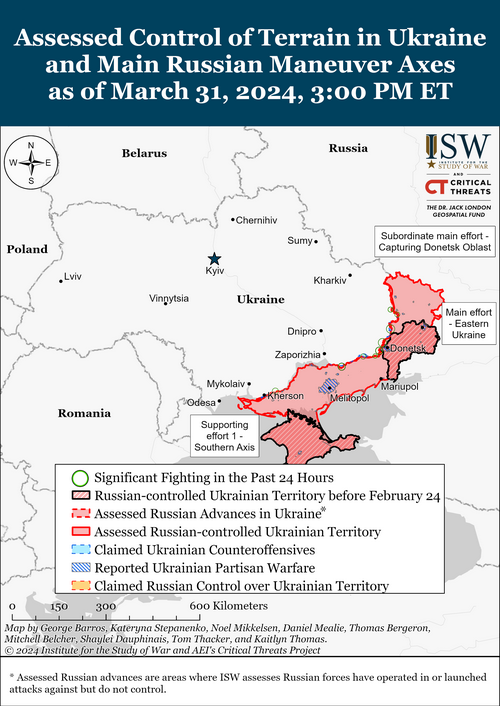
From The Institute for the Study of War:
Russian Offensive Campaign Assessment, March 31, 2024
Kateryna Stepanenko, Angelica Evans, Nicole Wolkov, Christina Harward, and George Barros
March 31, 2024, 6:55pm ET
Click here to see ISW’s interactive map of the Russian invasion of Ukraine. This map is updated daily alongside the static maps present in this report.
Click here to see ISW’s 3D control of terrain topographic map of Ukraine. Use of a computer (not a mobile device) is strongly recommended for using this data-heavy tool.
Click here to access ISW’s archive of interactive time-lapse maps of the Russian invasion of Ukraine. These maps complement the static control-of-terrain map that ISW produces daily by showing a dynamic frontline. ISW will update this time-lapse map archive monthly.
Note: The data cut-off for this product was 1:15pm ET on March 31. ISW will cover subsequent reports in the April 1 Russian Offensive Campaign Assessment.
The Kremlin-controlled Russian Orthodox Church Moscow Patriarchate (ROC MP) reportedly directed all its clergy to change their liturgy to include pro-war prayers in support of Russia’s war of conquest against Ukraine and is likely threatening to defrock ROC MP clergy who do not support the war. A Russian Telegram channel with insider sources within the ROC MP amplified on March 31 a document dated March 29, in which Head of the ROC MP Affairs, Metropolitan Gregoriy of Voskresensk, instructed clergy to read a prayer — the “Prayer for Holy Rus” — on a daily basis during Lent.[1] Metropolitan Gregoriy of Voskresensk also called on the clergy to read the “Prayer for Holy Rus” at home and to offer to read this prayer to parishioners. The “Prayer for Holy Rus” is a new prayer that the ROC MP officially introduced in September 2022. This prayer is a highly politicized and pro-war and pro-Kremlin prayer filled with Kremlin talking points and other false Russian narratives. The prayer asks God to “to help [Russian] people and grant [Russia] victory” against “those who want to fight [and] have taken up arms against Holy Rus, eager to divide and destroy her one people.”[2] The mention of “Holy Rus” and “one people” echoes Putin’s long-term false narrative that Ukrainians, Belarusians, and Russians comprise one Russian nation, and is a misappropriation of the history of Kyivan Rus.[3] ROC MP Head Patriarch Kirill — reportedly himself a former Soviet Committee for State Security (KGB) officer and a known staunch supporter of Russian President Vladimir Putin — first read the “Prayer for Holy Rus” (which he supposedly authored) on September 25, 2022, following Putin’s unpopular call for partial mobilization. The ROC MP had previously instituted politicized prayers in June 2014 and March 2022 supporting Russia’s aggression against Ukraine, and ISW has long assessed that the ROC MP is a Kremlin-controlled organization and a known tool within the Russian hybrid warfare toolkit that promotes the Kremlin’s interests and nationalist ideology domestically and abroad.[4]
The ROC MP leadership has intensified internal scrutiny against ROC MP clergy and has reportedly defrocked several clergy members that refused to promote Kremlin-introduced prayers supporting Russia’s full-scale invasion of Ukraine. A guest researcher at the Carnegie Endowment for International Peace, Ksenia Luchenko, noted that the ROC MP regards individual ROC MP clergy members’ refusal to use assigned prayers in liturgy as perjury and a sin punishable by defrocking under the 25th Apostolic Canon.[5] The Christians Against War Project, a Russian organization that tracks persecutions of Russian, Ukrainian, and Belarusian priests, reported that ROC MP or Russian state authorities have already disciplined no fewer than 28 ROC MP clergy members from Russia, five from Belarus, one from Kazakhstan, and six from Lithuania for anti-war rhetoric or refusing to read the assigned pro-war prayers during liturgy.[6] The ROC MP has reportedly administered various punishments, including defrocking, demotions, and excommunication.[7] Local Russian state officials opened administrative cases and issued fines for “discrediting the Russian Armed Forces” against several such anti-war ROC MP clergy members.[8] Patriarch Kirill, for example, approved a decision in February 2024 to defrock one of the most famous and respected ROC MP priests, Archpriest Alexey Uminsky, for refusing to read the “Prayer for Holy Rus.”[9] The Court of the Moscow Diocese also defrocked a priest in May 2023 for substituting the word “victory” with “peace” when reading the ”Prayer for Holy Rus.” Luchenko also reported that clergy members are increasingly self-censoring themselves out of fear that their own parishioners will report them for sharing anti-war sentiments. Parishioners, for example, reportedly called the police on a ROC MP priest in March 2022 after he prayed for peace in Ukraine. The ROC MP recently intensified Kremlin rhetoric about Russia’s war in Ukraine and cast it as an existential and civilizational “holy war,” and the Kremlin will likely continue to use the ROC MP to promote its imperialist and aggressive goals in Ukraine and elsewhere to secure long-term domestic support for Putin’s war efforts.[10] The ROC MP also recently approved an ideological and policy document tying several Kremlin ideological narratives together in an apparent effort to form a wider nationalist ideology around the war in Ukraine and Russia’s expansionist future.[11]
Russia conducted another series of missile and drone strikes largely targeting Ukrainian energy infrastructure on the night of March 30 to 31 as delays in US security assistance continue to degrade Ukraine’s air defense umbrella and enable Russia to significantly damage Ukraine’s energy grid. The Ukrainian Air Force reported that Russian forces launched 14 Kh-101/555 cruise missiles from Saratov Oblast; 11 Shahed-136/131 drones from Primorsko-Akhtarsk, Krasnodar Krai and occupied Crimea; one Iskander-M ballistic missile from occupied Crimea; and one Kh-59 cruise missile from occupied Zaporizhia Oblast.[12] The Ukrainian Air Force added that Ukrainian forces shot down nine Kh-101/555 missiles and nine Shahed drones.[13] The Rivne Oblast Police reported that Ukrainian forces also shot down a Kh-55 missile and an Iskander missile over Rivne Oblast.[14] Ukrainian officials reported that Russian forces launched two S-300 air-defense missiles at Selydove, Donetsk City and an unspecified number of S-300 missiles at Beryslav, Kherson Oblast.[15] Lviv Oblast Military Administration Head Maskym Kozytskyi reported that Russian forces conducted a cruise missile strike on the same critical infrastructure facility that Russian forces previously struck on March 24 and March 29, and a Russian milblogger claimed that Russian forces struck unspecified targets in Stryi, Lviv Oblast.[16] Ukrainian officials reported that Russian forces targeted energy and agricultural infrastructure in Kherson Oblast, struck civilian infrastructure in Kharkiv Oblast, and struck energy infrastructure in Odesa Oblast.[17] Ukrainian state electricity transmission operator Ukrenergo reported that they implemented emergency power shutdowns in Odesa City and nearby areas following the overnight Russian strike on energy facilities in southern Ukraine.[18] Russian forces reportedly shot down one of their own Kh-101 missiles over Saratov Oblast on the morning of March 31.[19]
Ukrainian forces appear to have repelled a Russian battalion-sized mechanized assault near Avdiivka, Donetsk Oblast, on March 30 — the first battalion-sized mechanized assault since Russian forces began the campaign to seize Avdiivka in late October 2023. A Ukrainian serviceman reported on March 31 that Russian forces, including elements of the Russian 6th Tank Regiment (90th Tank Division, Central Military District [CMD]), committed 36 tanks and 12 BMP infantry fighting vehicles (IFV) to a large-mechanized assault near Tonenke on March 30.[20] Geolocated imagery published on March 31 shows a large number of destroyed and damaged Russian armored vehicles and tanks along a road northwest of Tonenke (west of Avdiivka).[21] The Ukrainian serviceman stated that Ukrainian forces destroyed 12 Russian tanks and eight IFVs during the assault and noted that the frontal assault failed to breakthrough the Ukrainian line. This appears to be the first report of any elements of the 90th Tank Division participating in assaults following the Russian seizure of Avdiivka and ISW previously assessed that elements of the 90th Tank Division, alongside other Russian units and formations, likely represent a sizeable uncommitted operational reserve that the Russian military command can commit to continue and intensify efforts to push west of Avdiivka.[22] The elements of the 6th Tank Regiment appear to have failed in their March 30 attack near Tonenke, however, suggesting that elements of Russia’s uncommitted operational reserve near Avdiivka may be too degraded or otherwise unable to lead further Russian advances westward in the short term.
The scale of the Russian mechanized assault on March 30 is significant. Russian forces have not conducted a mechanized assault this large since the beginning of the Russian localized offensive effort to seize Avdiivka in late October 2023, when Ukrainian forces reportedly destroyed almost 50 Russian tanks and over 100 armored vehicles on October 19-20, 2023.[23] Ukraine’s ability to defend against the March 30 assault, particularly near Avdiivka where Ukrainian forces have been forced to quickly withdraw to new, defensive positions following the loss of the settlement, is a positive indicator for Ukraine’s ability to defend against future large-scale Russian assaults and the expected summer 2024 Russian offensive operation. Ukrainian officials, justifiably so, continue to warn about Ukraine’s ability to defend against the expected summer Russian offensive effort in the face of ammunition shortages, manpower limitations, and delayed Western assistance.[24] Ukrainian forces may have had to expend a significant amount of material to defend against the Russian assault near Tonenke, highlighting Russia’s ability to conduct assaults that force Ukraine to expend outsized portions of its already limited material and manpower reserves to defend against.[25] Ukraine’s demonstrated ability to skillfully defend against a large-scale Russian assault in a particularly critical part of the front despite Ukraine’s challenges suggests that Ukrainian forces can achieve significant battlefield effects if they are properly equipped.
The Russian command may be prioritizing the Avdiivka area in Donetsk Oblast. The Russian military command’s willingness to commit a battalion’s worth of tanks to an attack near Avdiivka indicates that this assault was a priority effort. The Russian command may focus their forecasted late spring/summer 2024 offensive operation on western Donetsk Oblast in hopes of building upon Russian forces’ steady but marginal advances in this sector.[26] Ukrainian officials have recently warned that Russian forces are accumulating personnel along the Kharkiv-Luhansk axis, near Bakhmut, near Avdiivka, and in western Zaporizhia Oblast, but ISW continues to assess that Russian forces will likely only be able to launch a concerted large-scale offensive operation in one operational direction at a time due to Russia’s own manpower and planning limitations.[27]
French Defense Minister Sebastien Lecornu announced on March 31 that France will provide an unspecified number of Aster 30 surface-to-air missiles and “hundreds” of armored vehicles and other equipment to Ukraine.[28] Lecornu stated that France will provide Ukraine with “hundreds” of old, but still functional, armored vehicles and equipment from the French military and that the materiel will arrive in 2024 and early 2025. Lecornu also reported that France will provide a “new batch of Aster 30 missiles” to Ukraine for the SAMP/T MAMBA air defense systems and that France is developing remotely operated munitions to provide to Ukraine as early as summer 2024.
Russian President Vladimir Putin signed on March 31 the scheduled decree authorizing Russia’s semi-annual spring military conscription, which will conscript 150,000 Russians between April 1 and July 15.[29] The decree specifies that Russia’s spring 2024 conscription will conscript men aged 18 to 30 years old who are not currently in military service. Russia’s spring 2024 conscription marks the first conscription cycle in which the Russian Ministry of Defense (MoD) will conscript men up to age 30. The Russian law raising the upper limit of the conscription age from 27 to 30 years of age officially came into force on January 1, 2024, although Putin signed the law in August 2023.[30] Kremlin newswire TASS reported that Russian men who turned 27 before the end of 2023 and men who are 28 or 29 and currently in zapas (general mobilizable human resource composed of men who could be mobilized regardless of prior military experience) are excluded from conscription.[31] Russian Deputy Chief of the General Staff Vice Admiral Vladimir Tsimlyansky stated on March 29 that the spring 2024 conscription cycle will include the conscription of men in occupied Ukraine and all Russian federal subjects, except for certain federal subjects in northern Russia due to inclement weather.[32] The Geneva Convention forbids any occupying power to force civilians in occupied territories to serve in the occupying power’s military or auxiliary services.[33] Tsimlyansky also stated that Russia will not deploy Russian conscripts to occupied Ukraine and that conscripts will not participate in combat or support operations in the war in Ukraine. ISW continues to assess that the Kremlin remains unlikely to deploy conscripts to participate in combat operations in Ukraine due to concerns that conscript causalities may cause societal discontent within Russia, although Russia may expand its crypto-mobilization efforts during the spring 2024 conscription cycle.[34] The Kremlin, however, will likely continue using conscripts to defend the international border between Ukraine and Russia.[35]
The Russian military command reportedly appointed Chief of Staff of the Russian Ground Forces Colonel General Alexander Lapin as commander of the newly formed Leningrad Military District (LMD). Ural regional information agency URA.ru, citing an unspecified military source, claimed on March 31 that the Russian military command appointed Lapin as LMD Commander.[36] There has been no official confirmation of this appointment. Lapin previously served as the commander of the Central Military District [CMD] and commanded Russian forces in Kharkiv and northern Donetsk oblasts during the Ukrainian counteroffensive in September 2022, which resulted in significant Russian territorial and materiel losses.[37] Russian military bloggers widely criticized Lapin for Russian battlefield defeats under his command in September 2022, but later received praise for his role in defending Belgorod Oblast against raids by all-Russian pro-Ukrainian forces in May and June 2023.[38] URA.ru has previously accurately reported on Lapin’s previous appointments prior to their official confirmations and may have credible insider sources within the CMD given its affiliation with the Russian government and the outlet’s presence within the CMD’s geographic boundaries.[39]
The Kremlin continues efforts to enforce Russian federal laws in post-Soviet countries where Russia has no legal jurisdiction. Russian Prosecutor General Igor Krasnov stated on March 31 that Russia will continue to assert its right, contrary to international law, to enforce Russian federal law on officials of NATO and post-Soviet states for their actions taken within the territory of their own countries where Russian courts have no jurisdiction, despite acknowledging that prosecuting such cases would be “unrealistic.”[40] The Russian Ministry of Internal Affairs (MVD) has placed multiple officials from NATO member countries on its wanted list for them allegedly breaking various Russian laws within their own counties.[41] ISW continues to assess that the Kremlin’s attempt to enforce its federal laws over NATO officials for actions in their own countries effectively denies the sovereignty of these states and are part of Russian efforts to set informational conditions justifying possible Russian escalations against NATO states in the future.[42]
Russian authorities conducted a counterterrorism operation and detained suspected terrorists in the Republic of Dagestan on March 31. The Russian Federal Security Service (FSB) in Dagestan declared a counterterrorism operation regime in Makhachkala and Kaspiysk, and the Russian National Anti-Terrorism Committee stated that Russian authorities detained three militants who were allegedly planning terrorist acts.[43] Dagestan Head Sergei Melikov stated that Russian authorities conducted the counterterrorism operation as part of efforts to strengthen security in the region following the Crocus City Hall attack.[44] Select Russian milbloggers alleged that the detained terrorist suspects in Dagestan are connected to the Crocus City Hall attackers.[45] Russian authorities previously meted out minor punishments following large-scale antisemitic riots in Dagestan in October 2023.[46] The intensification of counterterrorism operations in Russia, particularly in the Caucasus region, is likely due to either Russian law enforcement’s actual heightened fears of another terrorist attack in Russia or part of efforts to show the Russian public that authorities are taking competent preventative steps following the major law enforcement and intelligence failure that was the Crocus City Hall attack.
Key Takeaways:
- The Kremlin-controlled Russian Orthodox Church Moscow Patriarchate (ROC MP) reportedly directed all its clergy to change their liturgy to include pro-war prayers in support of Russia’s war of conquest against Ukraine and is likely threatening to defrock ROC MP clergy who do not support the war.
- The ROC MP leadership has intensified internal scrutiny against ROC MP clergy and has reportedly defrocked several clergy members who refused to promote Kremlin-introduced prayers supporting Russia’s full-scale invasion of Ukraine.
- Russia conducted another series of missile and drone strikes largely targeting Ukrainian energy infrastructure on the night of March 30 to 31 as delays in US security assistance continue to degrade Ukraine’s air defense umbrella and enable Russia to significantly damage Ukraine’s energy grid.
- Ukrainian forces appear to have repelled a Russian battalion-sized mechanized assault near Avdiivka, Donetsk Oblast, on March 30 — the first battalion-sized mechanized assault since Russian forces began the campaign to seize Avdiivka in late October 2023.
- French Defense Minister Sebastien Lecornu announced on March 31 that France will provide an unspecified number of Aster 30 surface-to-air missiles and “hundreds” of armored vehicles and other equipment to Ukraine.
- Russian President Vladimir Putin signed on March 31 the scheduled decree authorizing Russia’s semi-annual spring military conscription, which will conscript 150,000 Russians between April 1 and July 15.
- The Russian military command reportedly appointed Chief of Staff of the Russian Ground Forces Colonel General Alexander Lapin as commander of the newly formed Leningrad Military District (LMD).
- The Kremlin continues efforts to enforce Russian federal laws in post-Soviet countries where Russia has no legal jurisdiction.
- Russian authorities conducted a counterterrorism operation and detained suspected terrorists in the Republic of Dagestan on March 31.
- Russian forces recently made confirmed advances near Avdiivka and southwest of Donetsk City on March 31.
- The Russian government continues to fail to properly compensate volunteer and irregular forces fighting in Ukraine, despite recently passing new legislation that simplifies the access to veteran statuses for these servicemen and their families.
Go here to do the rest. The subservience of the Russian Orthodox Church demonstrates yet again how fortunate we are in this country to have the first amendment.


Happy Easter, Don.
Not paying armed men is a good way to set yourself up for bad times. Ask a Roman emperor.
surprised no apparent pushback against the terrorists. Will it be big and meaningful when it does arrive. Russia is fighting on too many fronts it appears.
Dave RX:
I had a relative (Col USAF) who analyzed satellite intelligence in the 1960s-70s, who would say, “The Russians have more problems than they ever admit”. You can hide a lot across 11 time zones. They can’t strip the frontier with China, nor have all their special ops in the field at once, nor leave those regions where Russians are not the majority (especially where Muslims are) unpoliced. Wonder how many “situations” they could handle at once? That might get tested.