
From The Institute for the Study of War:
Russian Offensive Campaign Assessment, March 8, 2024
Christina Harward, Angelica Evans, Grace Mappes, Riley Bailey, and George Barros
March 8, 2024, 6:35pm ET
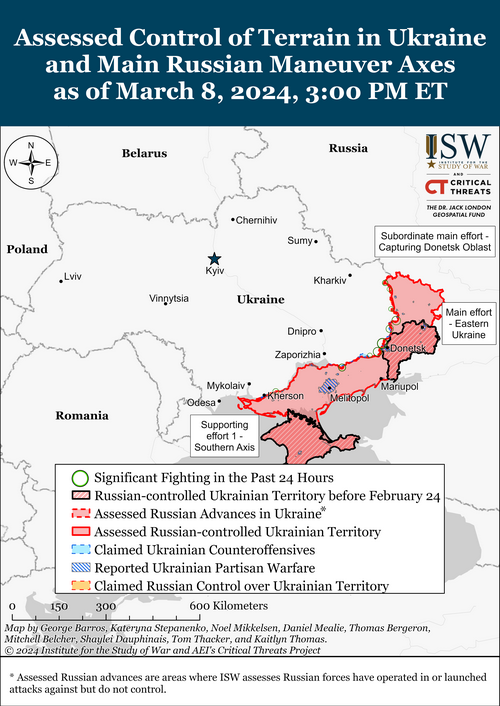
Click here to see ISW’s interactive map of the Russian invasion of Ukraine. This map is updated daily alongside the static maps present in this report.
Click here to see ISW’s 3D control of terrain topographic map of Ukraine. Use of a computer (not a mobile device) is strongly recommended for using this data-heavy tool.
Click here to access ISW’s archive of interactive time-lapse maps of the Russian invasion of Ukraine. These maps complement the static control-of-terrain map that ISW produces daily by showing a dynamic frontline. ISW will update this time-lapse map archive monthly.
Note: The data cut-off for this product was 12:30 pm ET on March 8. ISW will cover subsequent reports in the March 9 Russian Offensive Campaign Assessment.
Ukrainian President Volodymyr Zelensky reiterated that a ceasefire in Ukraine would allow Russia to rebuild its forces and means for future offensive operations, as Russia previously did following the start of Russia’s 2014 invasion. Zelensky stated on March 8 that a pause in fighting in Ukraine would pose a serious challenge and problem both to Ukraine and all of Europe.[1] Zelensky noted that Russia would benefit from a pause or ceasefire as Russian forces would use the pause to optimize Russia’s military and overall war effort, including by training its soldiers, many of whom deploy to the front line with very little training. Zelensky also stated that Russian forces are suffering from missile, artillery, and drone shortages, so Russia is sourcing these weapons from North Korea and Iran and needs to rebuild its stockpiles. Zelensky stated that Russia similarly benefited from previously freezing the war in 2014 and was able to build up its weapons, accumulate forces, and invade Ukraine again in 2022. ISW continues to assess that any ceasefire in Ukraine would benefit Russia, giving it time to reconstitute and regroup for future offensive operations, optimize command and control, implement lessons learned from experience in Ukraine, and resupply Russian forces in a manner that is exceedingly difficult to do while high-intensity combat is underway.[2] Zelensky also stated that Russian President Vladimir Putin’s goal is not just to occupy all of Ukraine, but to deprive Ukraine of its independence and integrate Ukraine into Russia using either force or political means.[3] Kremlin officials, including Putin, have repeatedly indicated that Russia hopes to occupy most, if not all, of Ukraine and eliminate Ukrainian statehood and independence.[4] Putin has also geographically defined historical ”Russian” lands – a characterization which the Kremlin has used to justify its full-scale invasion of Ukraine – as encompassing the former Russian Empire and Soviet Union.[5]
Some Russian forces may have improved their tactical capabilities and leveraged limited tactical surprise during the final weeks of the Russian effort to seize Avdiivka, suggesting that select elements of the Russian military may have internalized tactical adaptations from conducting offensive operations in Ukraine. Ukrainian military observer Kostyantyn Mashovets published a retrospective on March 8 about the Russian effort to seize Avdiivka in which he stated that Russian forces were able to tactically regroup and shift the tactical focus of their offensive operations from north of the Avdiivka Coke Plant in northwestern Avdiivka to areas near northeastern Avdiivka.[6] Mashovets stated that Russian forces achieved this regrouping and tactical shift without Ukrainian forces fully realizing that the regrouping had shifted Russia’s tactical focus.[7] Russian forces initially began their turning movement through Avdiivka after making tactical gains in northeastern Avdiivka, and Mashovets’ reporting suggests that Russian forces may have advanced in the area due to some tactical surprise.[8] Even limited tactical surprise, in which attacking forces engage defenders at a time, place, or manner for which the defender is unprepared, is a notable development given that both Russian and Ukrainian forces have widespread visibility throughout the frontline.[9] The Russian force’s ability to achieve elements of tactical surprise in such an operating environment with little-to-no concealment is therefore noteworthy. ISW has not observed other recent notable incidents of Russian forces achieving or leveraging tactical surprise. The reported Russian ability to do so near Avdiivka is not necessarily indicative of a wider Russian capability. Russian forces have shown limited tactical-level adaptations on certain sectors of the front, but continued widespread Russian tactical failures throughout Ukraine suggest that the Russian military command has not internalized and disseminated all possible tactical adaptations among all the various Russian force groupings operating in Ukraine.[10]
Ukrainian Air Force Commander Lieutenant General Mykola Oleshchuk stated on March 8 that Ukrainian forces are regularly targeting Russian fighter aircraft.[11] Oleshchuk stated that Russian forces continue to conduct guided aerial strikes against Ukrainian frontline positions, but that Russian aircraft “no longer dare” to fly too close to the frontlines and that Ukrainian air defenses recently attempted to strike a Russian aircraft from over 150 kilometers away.[12] Oleshchuk stated that the recent reported downing of Russian A-50 long-range radar detection aircraft and Su-34 and Su-35 fighter aircraft have caused Russian forces to ”significantly reduce” the frequency of Russian air strikes in Ukraine.[13] ISW has not observed dispositive evidence that the tempo of Russian unguided glide bomb strikes has decreased, however. Forbes recently reported that Russian aircraft are conducting one hundred or more sorties per day to conduct unguided glide bomb strikes on Ukrainian positions at a range of 25 miles (about 40 kilometers), indicating that Russian aircraft are continuing to conduct a relatively high volume of glide bomb strikes in Ukraine despite Ukraine’s claimed shoot-downs of such aircraft.[14]
Ukraine’s European partners continue efforts to send additional aid and materiel to Ukraine. Czech officials stated on March 8 that Ukraine’s partners have raised enough funds to purchase the first batch of 300,000 shells to send to Ukraine “in the coming weeks.”[15] The Czech Republic is leading an initiative to purchase 800,000 ammunition shells outside of Europe and deliver them to Ukraine.[16] European Commission Executive Vice President Valdis Dombrovskis stated on March 8 that the European Union (EU) will send the first tranche of 4.5 billion euros (about $4.9 billion) to Ukraine in March and will send 1.5 billion euros (about $1.6 billion) in April as part of the EU’s previously announced support package of 50 billion euros (about $54.7 billion) for 2024-2027.[17]
The International Atomic Energy Agency (IAEA) Board of Governors approved a resolution calling for Russia’s withdrawal from the Zaporizhzhia Nuclear Power Plant (ZNPP), undermining Russian efforts to use the IAEA and other international organizations to legitimize its occupation of the plant.[18] The March 7 IAEA resolution calls for the urgent withdrawal of all Russian unauthorized military and other personnel from the ZNPP and the return of the ZNPP to full Ukrainian control.[19] The resolution also expresses significant concern for the unstable security situation at the ZNPP during armed conflict, including the lack of qualified personnel, gaps in planned and preventative maintenance, lack of reliable supply chains, vulnerable water supply for cooling the ZNPP‘s nuclear reactors, and the installation of antipersonnel mines between the ZNPP’s internal and external perimeters.[20] The March 6 resolution echoes previous calls from the IAEA on March 3, 2022, September 15, 2022, November 17, 2022, and September 28, 2023.[21] Russian authorities have repeatedly attempted to use Russia’s physical control over the ZNPP to force international organizations including the IAEA to meet with Russian occupation officials to legitimize Russia’s occupation of the ZNPP and by extension Russia’s occupation of sovereign Ukrainian land.[22] The IAEA’s March 7 resolution reiterates the IAEA’s recognition of Ukraine as the legitimate operator of the ZNPP and undermines the consistent Russian assertion that Russia is the only safe operator of the ZNPP.[23]
Ukrainian efforts to encourage women to serve in the Ukrainian armed forces continues allowing Ukraine to tap into a wider mobilization base for its war effort. The Ukrainian Military Media Center reported in honor of International Women’s Day on March 8 that over 45,500 women serve in the Ukrainian army as of January 2024, including more than 13,000 women serving in combat roles.[24] Ukrainian officials previously reported that over 5,000 women were actively serving in frontline combat zones as of November 2023.[25] ISW previously noted that Ukraine has not been conscripting women but that Ukrainian women are nonetheless volunteering for military service, including combat roles, and that Ukrainian society appears to be galvanized by a popular desire to defend Ukraine strong enough to bring so many Ukrainian women near and onto the battlefield of their own accord.[26]
Russian information space actors are intensifying their focus on covering recent events surrounding the governor of the pro-Russian Moldovan autonomous region Gagauzia, Yevgenia Gutsul, and are amplifying Kremlin narratives aimed at destabilizing Moldova to a wider audience. Gutsul returned from Russia to Chisinau on March 8 without incident and hundreds of supporters gathered to meet her at the airport.[27] US-sanctioned, pro-Kremlin Moldovan politician Ilan Shor claimed on March 7 that Moldovan authorities would arrest Gutsul upon her arrival to Moldova after the Moldovan Prosecutor General’s Office publicly stated that Moldovan authorities collected enough evidence to demonstrate Gutsul’s involvement in unspecified criminal acts.[28] Kremlin newswire TASS closely followed Gutsul’s return to Moldova on March 8, reporting that Gutsul stated that Moldova must have friendly relations with Russia and criticized Moldovan President Maia Sandu after arriving at the Chisinau airport.[29] An abnormally large number of Russian milbloggers reported on Gutsul’s return to Moldova and promoted commonplace Kremlin narratives that target the Moldovan government.[30] Such a pattern of activity could indicate a centrally directed Kremlin information operation. ISW continues to assess that the Kremlin’s intensified focus on spreading destabilizing narratives regarding Gagauzia after a recent rhetorical focus on Moldova’s other pro-Russian region, the breakaway republic of Transnistria, indicates that the Kremlin seeks to use both these regions in information operations to support hybrid operations aimed at sabotaging Moldova‘s EU accession process.[31]
A recent Russian state-run poll suggests that the Kremlin aims for Russian President Vladimir Putin’s predetermined “support level” to be around 80 percent in the upcoming March 17 presidential election in an effort to portray Putin as legitimately popular and use the March election to legitimize Putin’s next term. The Public Opinion Foundation, a Russian state-owned polling institution, reported on March 7 that roughly 83 percent of Russians surveyed view Putin favorably and that roughly 82 percent plan to vote for him in the upcoming presidential election.[32] The Public Opinion Foundation published the results of another poll on March 5 claiming that 83 percent of Russians plan to vote in the upcoming election.[33] The Public Opinion Foundation’s numbers are consistent with recent reporting from Russian opposition outlets suggesting that the Kremlin aims to portray the election as having a 70-80 percent turnout and for Putin to win the election with 80 percent of the votes.[34] The Kremlin is likely using claims of strong voter turnout and support for Putin to set informational conditions to portray Russian society as confidently unified around Putin and his agenda.[35]
Key Takeaways:
- Ukrainian President Volodymyr Zelensky reiterated that a ceasefire in Ukraine would allow Russia to rebuild its forces and means for future offensive operations, as Russia previously did following the start of Russia’s 2014 invasion.
- Some Russian forces may have improved their tactical capabilities and leveraged limited tactical surprise during the final weeks of the Russian effort to seize Avdiivka, suggesting that select elements of the Russian military may have internalized tactical adaptations from conducting offensive operations in Ukraine.
- Ukrainian Air Force Commander Lieutenant General Mykola Oleshchuk stated on March 8 that Ukrainian forces are regularly targeting Russian fighter aircraft.
- Ukraine’s European partners continue efforts to send additional aid and materiel to Ukraine.
- The International Atomic Energy Agency (IAEA) Board of Governors approved a resolution calling for Russia’s withdrawal from the Zaporizhzhia Nuclear Power Plant (ZNPP), undermining Russian efforts to use the IAEA and other international organizations to legitimize its occupation of the plant.
- Ukrainian efforts to encourage women to serve in the Ukrainian armed forces continues allowing Ukraine to tap into a wider mobilization base for its war effort.
- Russian information space actors are intensifying their focus on covering recent events surrounding the governor of the pro-Russian Moldovan autonomous region Gagauzia, Yevgenia Gutsul, and are amplifying Kremlin narratives aimed at destabilizing Moldova to a wider audience.
- A recent Russian state-run poll suggests that the Kremlin aims for Russian President Vladimir Putin’s predetermined “support level” to be around 80 percent in the upcoming March 17 presidential election in an effort to portray Putin as legitimately popular and use the March election to legitimize Putin’s next term.
- Russian forces recently made confirmed advances near Avdiivka amid continued positional engagements along the entire line of contact on March 8.
- BBC Russian Service and Russian opposition outlet Mediazona published a joint report on March 8 that at least 46,678 Russian soldiers have died in Ukraine since the start of the full-scale invasion in February 2022, including at least 1,555 confirmed killed in the past two weeks.
- Unspecified actors, likely Ukrainian partisans, assassinated a Russian occupation official in occupied Berdyansk, Kherson Oblast on March 6.
Go here to read the rest. If the Russians lost 1,555 men killed in the last week, a big it, it demonstrates the cost of Putin’s politic stunt mini-offensives/

