
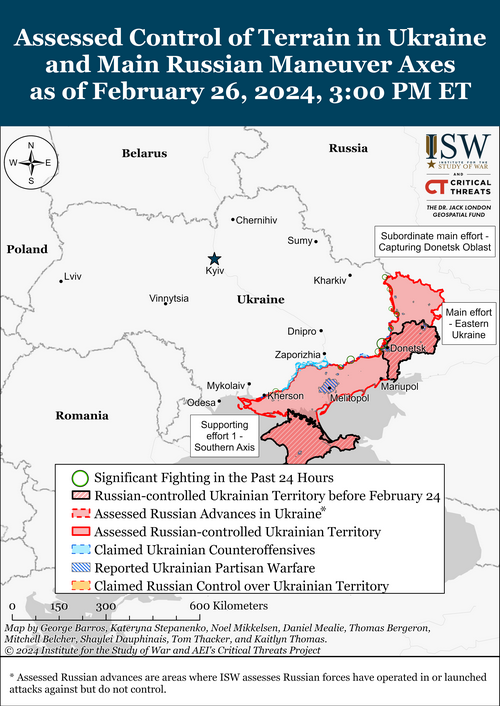
From The Institute for the Study of War:
Russian Offensive Campaign Assessment, February 26, 2024
Karolina Hird, Kateryna Stepanenko, Grace Mappes, Nicole Wolkov, and Frederick W. Kagan
February 26, 2024, 8pm ET
Click here to see ISW’s interactive map of the Russian invasion of Ukraine. This map is updated daily alongside the static maps present in this report.
Click here to see ISW’s 3D control of terrain topographic map of Ukraine. Use of a computer (not a mobile device) is strongly recommended for using this data-heavy tool.
Click here to access ISW’s archive of interactive time-lapse maps of the Russian invasion of Ukraine. These maps complement the static control-of-terrain map that ISW produces daily by showing a dynamic frontline. ISW will update this time-lapse map archive monthly.
Note: The data cut-off for this product was 2:30pm ET on February 26. ISW will cover subsequent reports in the February 27 Russian Offensive Campaign Assessment.
Sweden will join NATO following Hungary’s formal approval of Sweden’s accession bid on February 26.[1] Hungary was the final NATO member that needed to approve Sweden’s bid, but Sweden’s accession to the alliance has been a major sticking point for the Hungarian Parliament and Hungarian Prime Minister Viktor Orban.[2] Sweden will now become NATO’s 32nd member upon completing official accession procedures.
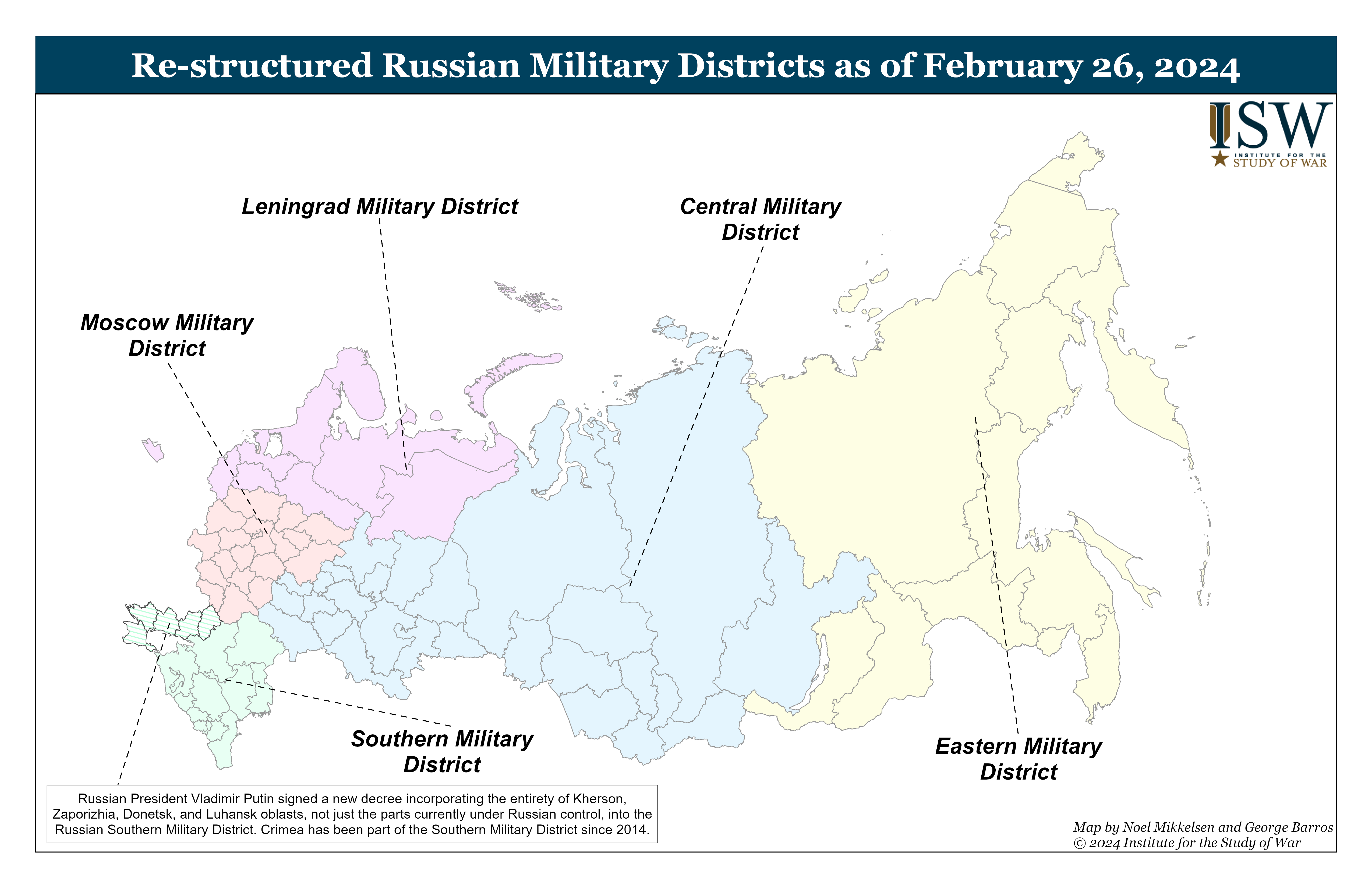
Russian President Vladimir Putin signed two decrees on February 26 that officially re-establish the Moscow and Leningrad Military Districts, codifying major Russian military restructuring and reform efforts. Putin signed one decree that deprives Russia’s Northern Fleet (NF) of its status as an “interservice strategic territorial organization” (a joint headquarters in Western military parlance) and transfers the land of the Northwestern Federal Okrug previously under the NF’s command to the newly formed Leningrad Military District (LMD).[3] Putin signed a second decree that formally re-establishes the LMD and the Moscow Military District (MMD) — with the LMD taking over most of the territory previously under the NF and the MMD taking over most of the territory previously under the Western Military District (WMD).[4] The second decree also incorporates occupied Ukraine into the Southern Military District (SMD), notably including all of Kherson, Zaporizhia, Donetsk, and Luhansk oblasts (as well as Crimea, which has been part of the SMD since 2014), not just the parts currently under Russian occupation. The inclusion of both the occupied and un-occupied parts of Ukrainian territory further suggests that Russia maintains maximalist objectives in Ukraine and seeks to fully absorb all five of these Ukrainian territories into the Russian Federation.
The formal transfer of regions previously under the responsibility of the Northern Fleet is likely part of a wider Russian effort to re-establish military district commands as the primary headquarters for the Russian ground forces while reassigning naval assets to the Russian Navy, as ISW previously reported.[5] Russian state media reported in November 2023 that naval assets of all five of Russia’s fleets — the Northern, Pacific, Baltic, and Black Sea fleets and the Caspian Flotilla — may return to direct subordination to the Russian Navy, while the ground, aviation, and air defense assets of the fleets will be allocated to military district commands. This information is still unconfirmed, but it appears that the Russian military is trying to reconsolidate ground forces and assets under military districts while consolidating naval forces and assets under the Russian naval chain of command.[6]
The re-creation of the MMD and LMD supports the parallel objectives of consolidating control over Russian operations in Ukraine in the short-to-medium term and preparing for a potential future large-scale conventional war against NATO in the long term.[7] The February 26 decree officially disbands the WMD, which the Russian Ministry of Defense (MoD) formed in 2010 by merging the MMD and LMD.[8] The WMD previously covered the Russian border with northeastern Ukraine, Belarus, and the Baltic States, which stretched the WMD’s strategic focus between overseeing Russian operations in Ukraine following the 2022 full-scale invasion and posturing against NATO.[9] The re-separation of the WMD into the MMD and LMD, therefore, is a direct remedy to this issue. The LMD will now run along NATO’s northeastern border, and the MMD will border northeastern Ukraine and Poland, which will allow Russia to simultaneously posture against NATO and streamline command and control (C2) for the war in Ukraine. Putin previously claimed that it was necessary to create the LMD after Finland joined NATO in 2023, signaling the Kremlin’s clear intent to use the LMD to posture against NATO.[10]
Ukrainian President Volodymyr Zelensky stated on February 25 that Russia is preparing a new offensive that will start in late May or summer 2024, consistent with ISW’s assessment that Russian forces have regained the theater-wide initiative and will be able to pursue offensive operations when and where they choose as long as they hold the initiative.[11] Zelensky also stated that the Ukrainian military has a clear plan to counter Russian forces. ISW continues to assess that Russian forces regained the initiative across the theater following Ukraine’s summer 2023 counteroffensive and that Russia will likely be able to determine the time, location, and scale of future offensive operations in Ukraine if Ukraine conducts an active defense throughout the theater in 2024, thereby ceding the strategic initiative to Russia. Russian forces will have the ability to maneuver reserve concentrations and determine how and where to allocate resources while forcing Ukraine to respond defensively as long as Russia maintains the strategic initiative. Ukrainian forces could deny Russia these opportunities if Ukrainian forces have enough means to challenge the Russian initiative and pursue their own offensive operations in 2024.
Chief of the Russian General Staff Army General Valery Gerasimov is continuing a recent campaign to engage with Russian military personnel following the Russian capture of Avdiivka, Donetsk Oblast and reportedly visited a command post of the 58th Combined Arms Army (CAA) in Ukraine. The Russian Ministry of Defense (MoD) posted footage on February 26 claiming to show Gerasimov visiting a 58th CAA command post in Ukraine, hearing reports about the operational situation, and presenting medals to Russian servicemen.[12] The 58th CAA is currently pursuing offensive operations in western Zaporizhia Oblast, so the MoD video suggests that Gerasimov visited a command post somewhere in the Zaporizhia Oblast direction. The Russian MoD published footage showing Gerasimov awarding Russian soldiers after the capture of Avdiivka on February 21, which is notably the first public depiction of Gerasimov serving his command duties since December 29.[13] Gerasimov fired former 58th CAA Commander Major General Ivan Popov in July 2023 following reports that Popov bypassed Gerasimov’s command and directly appealed to the Kremlin to complain about Gerasimov’s refusal to rotate 58th CAA troops away from the frontline for rest and reconstitution while they were defending against Ukraine’s summer 2023 counteroffensive push in Zaporizhia Oblast.[14] Gerasimov likely visited the 58th CAA command post in part to rebuild his relationship with 58th CAA lower-level commanders and servicemembers following Popov’s firing and the criticism it generated of Gerasimov.[15] Gerasimov also appears to be engaged in a campaign to present himself as an effective and interested chief of the General Staff, and his recent public appearances on areas of the front where Russian forces are making tactical gains are likely part of this effort to bolster his public image.
Over 20 heads of state, including 15 European Union (EU) leaders met in Paris on February 26 to discuss ramping up ammunition supplies to Ukraine.[16] French President Emmanuel Macron organized the conference and announced the creation of a new coalition to supply Ukraine with longer-range missiles and munitions.[17] Macron also stated that France “will do whatever it takes to ensure that Russia cannot win this war” and that European states should prepare for possible Russian escalations in the coming years.[18] Estonian Prime Minister Kaya Kallas stated that Estonia is providing long-term military aid to Ukraine worth 0.25 percent of Estonia’s GDP through 2028 and called on Ukraine’s other supporters to make similar commitments.[19]
Germany announced a new military aid package to Ukraine on February 26. The new military aid package includes 14,000 155mm artillery shells, 10 Vector recon drones, four WISENT-1 mine-clearing machines, and other equipment.[20] German outlet Der Spiegel reported on February 26 that the Bundeswehr’s Ukraine Situation Center Head, Major General Christian Freuding, stated that Germany is looking “all over the world” for artillery ammunition to provide to Ukraine.[21] Unspecified insider sources told Der Spiegel that Germany is engaged in “discreet negotiations” to obtain Indian artillery rounds through intermediaries and that “similar negotiations” may be possible with Arab countries.
Transnistrian sources reportedly told Russian independent outlet Verstka that Transnistria, a pro-Russian breakaway region of Moldova, is not planning to ask to join Russia during the Congress of Deputies in Tiraspol on February 28. Two unnamed sources close to Transnistrian authorities told Verstka that the Congress of Deputies will not discuss integration with Russia and instead focus on discussing economic pressure from Moldova, without taking any “sudden steps.”[22] A source involved in preparing for Russian presidential elections in Transnistria claimed that Transnistria did not receive any tasks from the Kremlin aside from preparations for presidential elections. Verstka observed that Transnistrian foreign policy department head Vitaly Ignatiev “cooled off” many speculations about Transnistria’s possible request to join Russia after claiming on a local TV broadcast that the purpose of the congress is to bring to attention Moldova’s latest “economic pressure” on Transnistria. The Moldovan Bureau for Reintegration stated on February 22 that “there is no reason to believe that the situation in [Transnistria] could deteriorate” in response to public discourse regarding the Congress of Deputies in Tiraspol.[23] Ukrainian officials similarly stated that the possibility of a Russian ground attack on Ukraine from Transnistria is low.[24] ISW issued a warning forecast on February 22 and assessed that Transnistrian officials may call for a referendum on annexation to Russia to support Russian hybrid operations intent on politically and socially destabilizing Moldova.[25] It remains noteworthy that Transnistrian authorities have suddenly ordered the convening of the Congress of Deputies for the first time since that body authorized referenda on joining Moldova (that failed) and on seeking Russian annexation (that passed) in 2006. ISW amends its warning in light of these reports, however, and will continue to monitor the situation in Transnistria closely.
Key Takeaways:
- Sweden will join NATO following Hungary’s formal approval of Sweden’s accession bid on February 26.
- Russian President Vladimir Putin signed two decrees on February 26 that officially re-establish the Moscow and Leningrad Military Districts, codifying major Russian military restructuring and reform efforts.
- The formal transfer of regions previously under the responsibility of the Northern Fleet is likely part of a wider Russian effort to re-establish military district commands as the primary headquarters for the Russian ground forces while reassigning naval assets to the Russian Navy, as ISW previously reported.
- The re-creation of the MMD and LMD supports the parallel objectives of consolidating control over Russian operations in Ukraine in the short-to-medium term and preparing for a potential future large-scale conventional war against NATO in the long term.
- Ukrainian President Volodymyr Zelensky stated on February 25 that Russia is preparing a new offensive that will start in late May or summer 2024, consistent with ISW’s assessment that Russian forces have regained the theater-wide initiative and will be able to pursue offensive operations when and where they choose as long as they hold the initiative.
- Chief of the Russian General Staff Army General Valery Gerasimov is continuing a recent campaign to engage with Russian military personnel following the Russian capture of Avdiivka, Donetsk Oblast and reportedly visited a command post of the 58th Combined Arms Army (CAA) in Ukraine.
- Over 20 heads of state, including 15 European Union (EU) leaders met in Paris on February 26 to discuss ramping up ammunition supplies to Ukraine.
- Germany announced a new military aid package to Ukraine on February 26.
- Transnistrian sources reportedly told Russian independent outlet Verstka that Transnistria, a pro-Russian breakaway region of Moldova, is not planning to ask to join Russia during the Congress of Deputies in Tiraspol on February 28.
- Russian forces recently made confirmed gains near Kreminna, Bakhmut, and Avdiivka amid continued positional engagements along the entire frontline.
- Russia reportedly imported almost 450 million euros (about $488 million) worth of sanctioned “sensitive” European goods, including weapons technology, between January and September 2023.
Go here to read the rest. One of Putin’s excuses for starting the Ukrainian War was because Russia felt threatened by the expansion of NATO. This was risible. Prior to the Ukraine War NATO was becoming a moribund organization with European military forces at their lowest post war ebb. Now NATO has been rejuvenated, and Sweden and Finland have joined. It used to be wryly noted during the Cold War that the Soviet Union was the only nation on Earth to be completely surrounded by hostile Communist countries. Putin has done his worst to ensure that Russia has as few friends as possible going forward.


If Putin gets a hold of Ukraine’s natural resources, he can buy all the friends he’ll need.
Russia already has immense natural resources to buy friends. Hasn’t worked yet.
Putin has done his worst to ensure that Russia has as few friends as possible going forward.
==
As of 2012, the ratio of the Russophile vote to the remainder in the Ukrainian electorate was about 0.75. After 2014, that ratio was 0.2, though some of the loss could be attributed to the removal of the Crimea and parts of the Donetsk and Lukhansk regions from the electorate. What do you imagine in might be today? One problem Russia has is that people who prosper in its political life fancy the way to accomplish something in international politics is to beat the other guy with a club until he collapses.
==
If the future is better than the present, it will be because the post-1970 birth cohorts in Russia are composed of people who prefer a national state and indifferent to the object of rebuilding the post-war East Bloc.
f Putin gets a hold of Ukraine’s natural resources, he can buy all the friends he’ll need.
==
Fuel and mineral exports from the Ukraine in 2021 amounted to about $9.5 bn. Doesn’t buy many friends in today’s world.
“Hasn’t worked yet.”
Hasn’t it? His biggest fuel customers, China and India, remain reluctant to take sides while they cheaply fill their petroleum reserves to capacity. And somebody’s selling Putin the tech he needs to maintain his missile production.
He didn’t invade Ukraine because he doesn’t like the way Zelenskyy combs his hair, he has designs on Ukraine’s grain and natural gas production, and at this point, if he doesn’t secure them, he’s toast.
His biggest fuel customers, China and India, remain reluctant to take sides
There stances have bupkis to do with that. China has been distancing itself from Putin due to the Ukraine war. India has just demanded that the Russians discharge Indian natives swindled into the Russian army. Putin’s one really firm ally is Iran.
he has designs on Ukraine’s grain and natural gas production, and at this point, if he doesn’t secure them, he’s toast.
==
Do the math. You are almost never going to make a business case for starting a shooting war in order to seize natural resources. Two exceptions: you want certain resources under your control for future use in establishing a war economy or (2) the resources are abnormally large in relation to the population and territory you have to conquer. Unless you’re trying to seize some place like Kuwait, they will not be.
“Putin’s one really firm ally is Iran.”
Probably N. Korea too.
As far as India goes, there’s a big difference between going to bat for your own citizens and denouncing the war. In this war, ‘If you’re not against it, you’re for it’, especially if you’re funding it with oil purchases,