
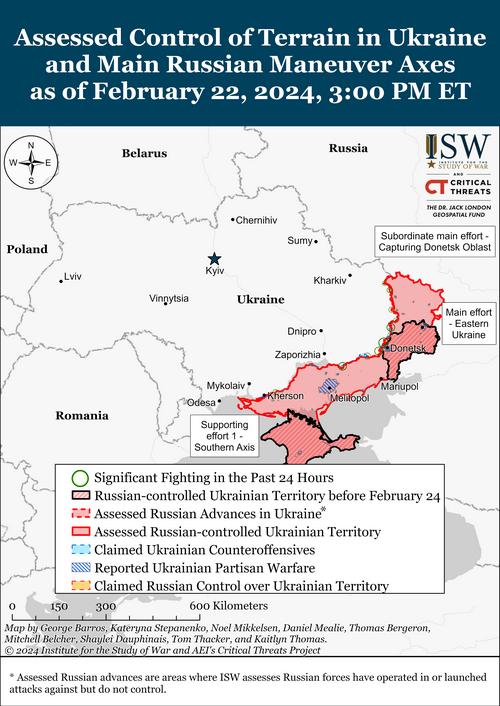
From The Institute for the Study of War:
Russian Offensive Campaign Assessment, February 22, 2024
Christina Harward, Angelica Evans, Grace Mappes, Kateryna Stepanenko, George Barros, and Frederick W. Kagan
February 22, 2024, 8:15pm ET
Click here to see ISW’s interactive map of the Russian invasion of Ukraine. This map is updated daily alongside the static maps present in this report.
Click here to see ISW’s 3D control of terrain topographic map of Ukraine. Use of a computer (not a mobile device) is strongly recommended for using this data-heavy tool.
Click here to access ISW’s archive of interactive time-lapse maps of the Russian invasion of Ukraine. These maps complement the static control-of-terrain map that ISW produces daily by showing a dynamic frontline. ISW will update this time-lapse map archive monthly.
Note: The data cut-off for this product was 2:00pm ET on February 22. ISW will cover subsequent reports in the February 23 Russian Offensive Campaign Assessment.
Click here to read ISW’s latest warning update on the possibility of Transnistria, a pro-Russian breakaway region of Moldova, calling for Russian annexation or taking other action to support Russian hybrid operations against Moldova.
Russian Security Council Deputy Chairperson Dmitry Medvedev said that Russia would likely have to seize Kyiv sooner or later while identifying Russia’s possible further territorial objectives in Ukraine. Medvedev responded in an interview published on February 22 to a question asking if there will “still be any part of Ukraine left that [Russia] will consider as a legitimate state, whose borders [Russia] will be ready to recognize.”[1] Medvedev stated that Russia must “ensure its interests” by achieving the goals of the “special military operation” as laid out by Russian President Vladimir Putin – referring to Russian demands for Ukraine’s “demilitarization,” “denazification,” and neutrality. Medvedev reiterated Russia’s intention of changing the government in Ukraine, stating that the Ukrainian government “must fall, it must be destroyed, it must not remain in this world.” Medvedev claimed that Russia must create a “protective cordon” in order to protect against “encroachments on [Russia’s] lands,” including shelling and active offensive operations. Medvedev stated that he does not know where Russia should “stop” but that Russia “probably” must seize and occupy Kyiv “if not now then after some time.” Medvedev claimed that Kyiv is historically a “Russian” city from where “international” threats to Russia’s existence currently originate. Medvedev also labeled Odesa a historical “Russian” city. Putin similarly emphasized on January 31 the idea of a “demilitarized” or “sanitary” zone in Ukraine.[2] ISW previously assessed that Putin’s statements about creating a “protective” zone in which Russia’s claimed and actual territories are out of Ukrainian firing range actually mean that Russia cannot accept the existence of any independent Ukraine with the ability to defend itself.[3] Medvedev, however, also claimed that “if … something remains of Ukraine,” then it “probably” has a low chance of survival and reiterated his previous comments about a possible Ukrainian rump state in Lviv Oblast while alluding to the fact that this area was Polish territory earlier in history.[4] Medvedev’s comments continue to indicate that the Kremlin has returned to its domestic narrative that Russia is fighting the war to “liberate its historic lands.”[5]
Medvedev’s mention of Russia’s possible intentions to occupy Odesa may be worth noting in light of recent developments in the pro-Russian breakaway republic of Transnistria in Moldova, the southern tip of which is about 50 kilometers from the city. Transnistrian authorities recently announced that the Transnistrian Congress of Deputies is planning to meet on February 28.[6] ISW forecasts that deputies may initiate a new referendum seeking annexation by Russia or propose or demand action on a 2006 referendum that called for Transnistria’s annexation by Russia.[7] ISW has not observed clear indications of Russian military preparations to intervene in Transnistria or Moldova more generally, and Russian military intervention would be challenging for Moscow since Moldova and Transnistria are landlocked and accessible only through Romanian or Ukrainian territory.[8]
Medvedev also described Russian plans to repress Ukrainian citizens in occupied Ukraine. Medvedev claimed that Ukrainian citizens in occupied Ukraine who “harm” (vredyat) Russia in must be “exposed and punished, sent to Siberia … for re-education in forced labor camps.”[9] Stalin-era show trials and repressions starting in the 1920s and 1930s similarly targeted saboteurs (vrediteli), particularly in the agricultural sphere.[10] Medvedev’s usage of Stalin-era purge rhetoric is significant. Zaporizhia Oblast occupation governor Yevgeny Balitsky also openly discussed – and attempted to defend – the illegal Russian occupation policies, including the forced deportation of Ukrainian citizens who oppose Russia’s invasion of Ukraine and possibly even alluded to Russian occupation forces’ summary executions of Ukrainian citizens.[11]
Russian President Vladimir Putin met with Commonwealth of Independent States (CIS) leaders and Republic of Tatarstan Head Rustam Minnikhanov on February 21 and 22. Putin attended the “Games of the Future” in Kazan alongside Belarusian President Alexander Lukashenko, Kazakhstan’s President Kassym-Jomart Tokayev, Kyrgyzstan’s President Sadyr Japarov, Uzbekistan’s President Shavkat Mirziyoyev, and Tajikistan’s President Emomali Rahmon.[12] Putin also met with Minnikhanov and former head of Tatarstan Mintimer Shamaiev to discuss the construction of a new unspecified research and development center in Sibur, Tatarstan.[13] CTP-ISW previously reported that Minnikhanov visited Iran, likely to discuss Russo-Iranian defense industrial and military cooperation.[14] Minnikhanov’s visit was particularly noteworthy given his trip to the Esfahan Province, where several prominent Iranian defense industrial and military sites are located and considering that Iran is helping to construct a military drone manufacturing facility in the “Alabuga” Special Economic Zone (SEZ) in Tatarstan. Minnikhanov also has previous ties to authorities in Gagauzia, a pro-Russia autonomous region of Moldova (although separate from Transnistria), which is notable given ISW’s February 22 warning forecast about a possible Russian hybrid operation against Moldova.[15]
Ukrainian forces conducted another successful strike against a Russian training ground in occupied Kherson Oblast on February 21 and likely inflicted significant casualties. Ukrainian Southern Operational Command Spokesperson Colonel Nataliya Humenyuk reported on February 22 that a Ukrainian strike killed nearly 60 Russian servicemen at a Russian training ground in occupied Podo-Kalynivka, Kherson Oblast.[16] Humenyuk stated that the targeted Russian assault groups were training to conduct operations near Krynky.[17] Footage published on February 21 shows the strike, which reportedly killed members of the Russian 328th Airborne Assault (VDV) Regiment (104th VDV Division), 810th Naval Infantry Brigade (Black Sea Fleet), and 81st Self-Propelled Artillery Regiment (likely a reconstituted Soviet-era unit).[18] Russian milbloggers criticized the Russian command for conducting training exercises within the range of Ukrainian drones and HIMARS systems and advocated for updated training policies that account for the threat of Ukrainian strike systems and better protect Russian servicemen.[19] Some Russian milbloggers noted that this strike follows the February 20 Ukrainian HIMARS strikes against a Russian training ground near Volnovakha, Donetsk Oblast, which reportedly killed “dozens” of Russian military personnel.[20]
Ukraine’s European and Western allies continue to ramp up their support for Ukraine. The Danish Ministry of Defense (MoD) announced a new military aid package for Ukraine on February 22 valued at 1.7 billion Danish kroner ($228 million). This package includes 15,000 155mm shells jointly produced with the Czech Republic, air defense materiel and ammunition, mine clearance equipment, drones, radar, and communication equipment.[21] Denmark also signed a 10-year bilateral security agreement with Ukraine.[22] UK Defense Minister Grant Shapps announced that the UK is sending 200 Brimstone anti-tank missiles to Ukraine.[23] New Zealand also announced a new aid package for Ukraine valued at 25.9 million NZD ($15.4 million), including humanitarian aid and funding for other international funds that support Ukraine’s weapons acquisition, recovery, and reconstruction.[24] The German Bundestag approved additional military support to Ukraine, including unspecified long-range weapons systems and ammunition, but rejected a bill that called for Germany to provide Taurus cruise missiles to Ukraine.[25]
Russian opposition outlet Proekt reported on February 22 that the Russian government has subjected at least 116,000 Russians to criminal and administrative charges since the start of Russian President Vladimir Putin’s fourth term in office in 2018.[26] Proekt reported that Russian authorities pursued criminal charges against 11,442 people for politically motivated charges, including extremism, justifying terrorism, discrediting the Russian military, and spreading “fake” information about Russia’s war in Ukraine in 2018-2023.[27] Proekt noted that Russian authorities brought administrative charges against an additional 105,000 people for charges related to speech, conscience, and assembly, including at protests.[28] Proekt reported that Russian authorities initiated 5,829 cases for crimes against the state in this time period, including espionage, disclosure of state secrets, cooperation with foreign organizations, and for refusing to participate in the war in Ukraine.[29] Proekt’s partner organization Agenstvo Novosti noted that Russian authorities have tried 329 people for disclosing state secrets since 2018, more than the Soviet Union did during the entirety of the Cold War.[30] Proekt reported that Russian authorities have tried over 13,000 people under criminal statues introduced due to the war in Ukraine, including spreading fake information and discrediting the Russian military, including roughly 4,500 military personnel punished for new articles related to conduct in the military or on the battlefield.[31] Proekt reported that Russian authorities have pursued over 600,000 cases for insubordination against, insulting, and violence against Russian government officials and over 159,000 cases for violating pandemic restrictions in this timeframe.[32] While it is likely that some and even many of these cases are legitimate, the Kremlin has increasingly weaponized the Russian criminal justice system to crack down on domestic dissent against the war and Putin’s autocratic rule to consolidate control over domestic Russian society.[33] Proekt noted that the number of political repression-related cases initiated has sharply increased since 2022 and that many of the cases are dubious, either due to officials’ obfuscation of the criminal case itself or because they are prosecutions of a fake or overblown crime to cover up another misdeed.[34]
Kremlin Spokesperson Dmitry Peskov stated on February 22 that the Kremlin does not regard Russian military correspondents (voyenkory) and milbloggers as participants of the Russian full-scale invasion of Ukraine, shortly after the suicide of a prominent Russian milblogger on February 21. Peskov stated that it would be wrong to linearly equate voyenkory to Russian servicemen fighting in Ukraine because they do not bear arms.[35] Peskov implied that Russian President Vladimir Putin holds a similar opinion and noted that Russian military correspondents’ contributions to the war effort should be acknowledged in their own distinct category, despite the fact that many Russian milbloggers do in fact bear arms and engage in combat operations, among other tasks that military personnel perform.[36] Peskov’s statement follows the Russian information space‘s widespread discussion of the suicide of Russian serviceman and independent milblogger Andrei Morozov (alias Boytsovskiy Kot Murz).[37] Morozov served in the Russian 4th Separate Motorized Rifle Brigade (2nd Luhansk People’s Republic’s [LNR] Army Corps) while simultaneously maintaining a Telegram channel with over 100,000 followers — where he avidly criticized the Russian military command and senior Russian political figures — and coordinating aid provisions to Russian frontline forces. Morozov blamed the Russian military command and propagandists for triggering his decision to commit suicide after an abusive Russian military commander ordered him to delete his reports about high Russian personnel losses around Avdiivka. The timing of Peskov’s remarks is notable and may reflect a broader Kremlin campaign to consolidate a monopoly over the Russian military correspondent and milblogger community. The Kremlin has been increasingly collaborating with voyenkory who work as frontline correspondents, and ISW observed an increase in reports about persecutions against milbloggers who perform humanitarian or combat operations in addition to maintaining Telegram channels.[38] Russian officials have previously threatened to restrict certain milbloggers from reporting on the frontlines unless they possess Kremlin-issued “press” vests, and the Kremlin may be attempting to eliminate the independent class of milbloggers and replace them with Kremlin-affiliated voyenkory.[39]
Key Takeaways:
- Russian Security Council Deputy Chairperson Dmitry Medvedev said that Russia would likely have to seize Kyiv sooner or later while identifying Russia’s possible further territorial objectives in Ukraine.
- Medvedev’s mention of Russia’s possible intentions to occupy Odesa may be worth noting in light of recent developments in the pro-Russian breakaway republic of Transnistria in Moldova, the southern tip of which is about 50 kilometers from the city.
- Medvedev also described Russian plans to repress Ukrainian citizens in occupied Ukraine.
- Russian President Vladimir Putin met with Commonwealth of Independent States (CIS) leaders and Republic of Tatarstan Head Rustam Minnikhanov on February 21 and 22.
- Ukrainian forces conducted another successful strike against a Russian training ground in occupied Kherson Oblast on February 21 and likely inflicted significant casualties.
- Ukraine’s European and Western allies continue to ramp up their support for Ukraine.
- Russian opposition outlet Proekt reported on February 22 that the Russian government has subjected at least 116,000 Russians to criminal and administrative charges since the start of Russian President Vladimir Putin’s fourth term in office in 2018.
- Kremlin Spokesperson Dmitry Peskov stated on February 22 that the Kremlin does not regard Russian military correspondents (voyenkory) and milbloggers as participants of the Russian full-scale invasion of Ukraine, shortly after the suicide of a prominent Russian milblogger on February 21.
- Russian forces recently made confirmed advances near Bakhmut and Avdiivka.
- A Russian insider source claimed that Russian officials have postponed creating Rosgvardia’s 1st Volunteer Corps from remaining Wagner Group detachments because of an ongoing rotation of former Wagner personnel in Africa.
- Russia continues to export its state policies on systemic religious persecution to occupied Ukraine.
Go here to read the rest.
From Strategy Page:
February 22, 2024: Overall Russian combat losses from February 24, 2022, to February 15, 2024, are estimated as follows:
Personnel: Around 399,090
Tanks: 6,442
IFV (Infantry Fighting Armored Vehicles): 12,090
Artillery systems: 9,620
MLRS (Multiple launch rocket systems): 984
Anti-aircraft warfare systems: 671
Aircraft: 332
Helicopters: 325
UAV operational-tactical level: 7,404
Cruise missiles: 1,882
Warships/boats: 25
Submarines: 1
Vehicles and fuel tankers: 12,691
Special equipment: 1,524
Russia had spent two decades before the Ukraine Invasion rebuilding their armed forces after the collapse of the Soviet Union in 1991. This decline in Russian military power was a painful process. Between 1992 and 2003 the Russian military lost over half its manpower. That left 1.1 million troops commanded by 1,400 generals and admirals, or one for every 830 soldiers or sailors. About 140,000 were contract soldiers who agreed to serve longer periods as higher paid professional soldiers. The military also has 730,000 civilian employees. In 2003 another 36,800 officers and career enlisted troops lost their jobs. In 2003 the Russian army only had 321,000 troops, which was fewer than what the American army had. This was something that had never happened since the United States was established in 1776.
In 2003 the Russian Air Force, including air defense forces, had 148,600 troops and the navy had 171,500. Russia still relied on conscripts for most of their manpower, and these young troops serve only two years. This was reduced to one year in 2008. Much time and effort has to be dedicated to training new conscripts to replace those who have left, and the conscripts serving one year received little training because it was not worth the effort and cost. On the plus side all these conscripts entered the inactive reserve forces for about twenty years.
Go here to read the rest. Yep, the old Russian tactic of drowning the enemy in rivers of Russian blood appears to be in operation in the current War.

