From The Institute for the Study of War:
Russian Offensive Campaign Assessment, February 15, 2024
Riley Bailey, Nicole Wolkov, Angelica Evans, Kateryna Stepanenko, George Barros, and Frederick W. Kagan
February 15, 2024, 8:35pm ET
Click here to see ISW’s interactive map of the Russian invasion of Ukraine. This map is updated daily alongside the static maps present in this report.
Click here to see ISW’s 3D control of terrain topographic map of Ukraine. Use of a computer (not a mobile device) is strongly recommended for using this data-heavy tool.
Click here to access ISW’s archive of interactive time-lapse maps of the Russian invasion of Ukraine. These maps complement the static control-of-terrain map that ISW produces daily by showing a dynamic frontline. ISW will update this time-lapse map archive monthly.
Note: The data cut-off for this product was 2:10pm ET on February 15. ISW will cover subsequent reports in the February 16 Russian Offensive Campaign Assessment.
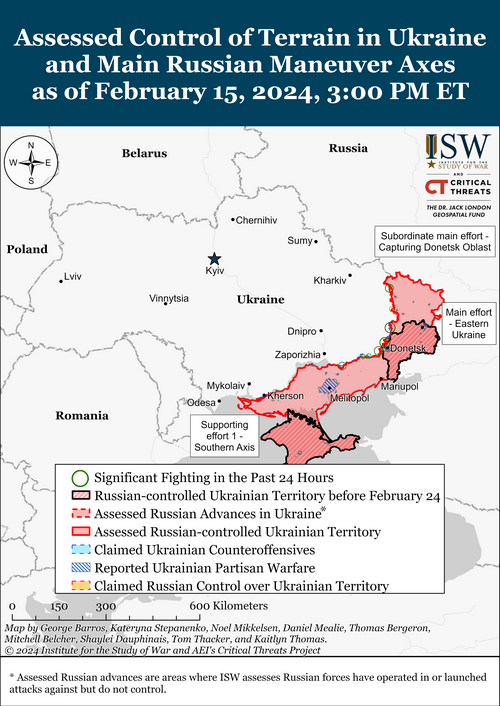
Russian forces are conducting a tactical turning movement through Avdiivka likely to create conditions that would force Ukrainian troops to withdraw from their positions in the settlement. Ukrainian forces have yet to fully withdraw from the settlement and continue to prevent Russian forces from making gains that are more significant than the current incremental Russian advances. Geolocated footage published on February 15 indicates that Russian forces recently advanced to the southern outskirts of the Avdiivka Coke Plant in northwestern Avdiivka.[1] Additional geolocated footage published on February 15 indicates that Russian forces captured a Ukrainian fortified position south of Avdiivka that has long been a Russian sub-tactical objective, and Russian milbloggers widely claimed that Russian forces effectively encircled nearby Ukrainian positions south of Avdiivka.[2] Recently geolocated Russian advances indicate that Russian forces have cut the last road in Avdiivka connecting southern and northern Avdiivka, but Ukrainian Tavriisk Group of Forces Spokesperson Dmytro Lykhoviy stated that Ukrainian forces are currently using prepared secondary ground lines of communication (GLOCs) to supply Ukrainian forces in southern and eastern Avdiivka.[3] Russian milbloggers claimed that Russian forces made further advances west of Avdiivka in an effort to cut dirt roads that Ukrainian forces are using to supply positions in Avdiivka from Lastochkyne and Sieverne (both west of Avdiivka), although ISW has not yet observed any confirmation of these claimed Russian advances.[4] Lykhoviy acknowledged that Ukrainian forces are withdrawing from unspecified positions in the Avdiivka area but stated that Ukrainian forces also continue to recapture some unspecified positions from Russian forces.[5] The spokesperson for a Ukrainian brigade previously deployed to the Bakhmut area stated on February 15 that elements of the brigade redeployed to Avdiivka and are counterattacking Russian positions within the settlement.[6] Russian forces may be able to complete the envelopment of some Ukrainian forces if the Ukrainian forces do not withdraw or conduct successful counterattacks.
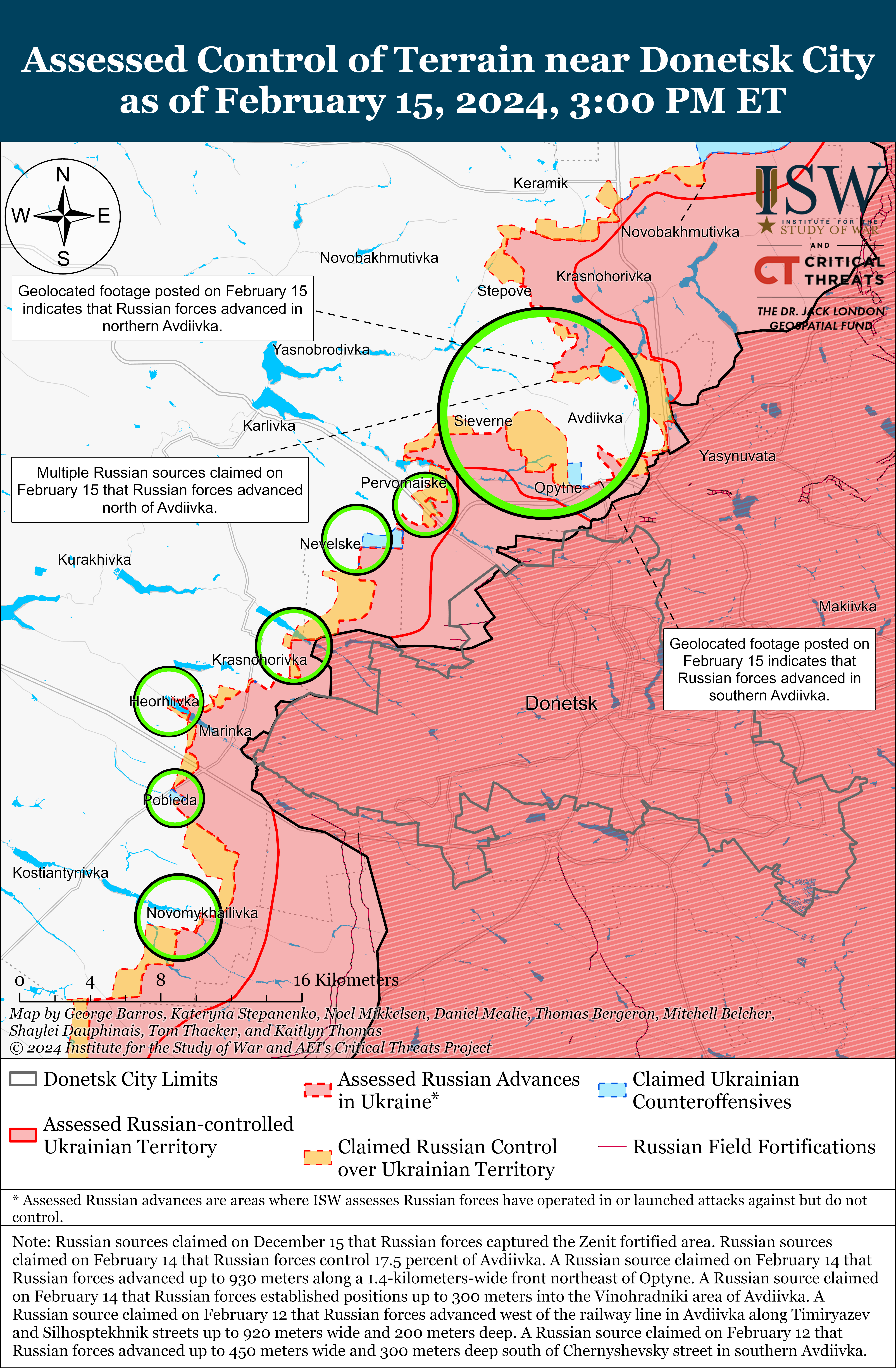
The Russian offensive effort to capture Avdiivka underscores the Russian military’s inability to conduct a successful operational envelopment or encirclement in Ukraine. Russian forces initially attempted to operationally encircle Ukrainian forces in Avdiivka at the start of the localized offensive effort in October 2023, but gradually shifted towards fighting through the settlement in a turning movement after failing to conduct the rapid maneuver required for envelopment or encirclement.[7] An operational encirclement is a maneuver in which attacking forces completely surround and then destroy an enemy grouping of forces. An operational envelopment is a maneuver wherein attacking forces aim to avoid an enemy’s principal defenses to seize objectives behind those defenses that allow the attacking forces to destroy the defenders in their current positions.[8] Russian forces have achieved neither in Avdiivka and have notably repeatedly failed to conduct operations to envelop or encircle Ukrainian forces throughout the full-scale invasion of Ukraine.[9] Russian forces instead have conducted a turning movement in Avdiivka, as they did with their capture of Bakhmut in spring 2023, wherein Russian forces have only sought to avoid Ukraine’s principle defensive positions to facilitate tactical gains but have not pursued the wider destruction of a Ukrainian force grouping.[10] The repeated Russian inability to conduct successful operational-level envelopments or encirclements suggests that the Russian military will likely continue to advance through gradual minor tactical advances instead of through these wider maneuvers that could lead to more rapid advances or the destruction of large groups of Ukrainian forces.
The potential Russian capture of Avdiivka would not be operationally significant and would likely only offer the Kremlin immediate informational and political victories. Russian forces have been conducting offensive operations to capture Avdiivka since the beginning of Russia’s full-scale invasion of Ukraine in 2022 and Avdiivka has been a notable Ukrainian strongpoint defensive position since the Russian invasion in 2014.[11] Russian forces began a localized offensive operation to capture Avdiivka in October 2023 and only recently began to make tactical progress through the settlement after months of costly infantry assaults and waves of mass mechanized attacks.[12] Avdiivka is a small settlement with a pre-war population of roughly 31,000 people and offers Russian forces limited avenues for future advance.[13] (Bakhmut had a pre-invasion population of 70,000 people, in comparison.) Ukrainian forces have long fortified many of the surrounding settlements, which Russian forces are also struggling to capture, and subsequent Ukrainian positions west and north of Avdiivka are likely similarly fortified.[14] The nearest relatively large settlements in the area are at least 30 kilometers west of Avdiivka, and Russian forces have not shown that they can conduct the rapid mechanized forward movement that would be required to reach these settlements in the near or even medium-term.[15] Russian forces have expended a considerable amount of manpower and materiel on their effort to capture Avdiivka and will likely need to engage in a prolonged period of consolidation, reconstitution, and rest before attempting a further concerted offensive effort in the area.[16] Russian forces would be highly unlikely to make rapid operationally significant advances from Avdiivka if they captured the settlement, and the potential Russian capture of Avdiivka at most would set conditions for further limited tactical gains.
The potential capture of Avdiivka would give the Kremlin a battlefield victory, however tactical, to promote to a domestic audience ahead of the Russian presidential election in March 2024. The Kremlin has reportedly increasingly desired any battlefield victory ahead of the presidential elections and has reportedly set objectives in Ukraine specifically to generate informational effects.[17] Russian ultranationalists, specifically those with ties to the Donetsk People’s Republic (DNR), have long argued that the capture of Avdiivka would push Ukrainian forces out of strike range of Donetsk City and thereby secure the regional center of occupied Donetsk Oblast.[18] Ukrainian forces would be able to continue to strike Russian targets in near rear areas in the vicinity of Donetsk City, both with indirect fire and long-range strike capabilities, regardless of the Russian capture of Avdiivka. Putin will nevertheless likely attempt to sell the potential capture of Avdiivka as a significant victory cementing control over occupied Donetsk City to the Russian ultranationalist community and the wider Russian public.
The Russian command reportedly reorganized the command structures of the Russian grouping of forces in southern Ukraine. Ukrainian military observer Kostyantyn Mashovets stated on February 15 that the Russian command dissolved the “Zaporizhia” Grouping of Forces (the unnamed Russian grouping of forces that has been responsible for western Zaporizhia Oblast since at least the start of the Ukrainian summer 2023 counteroffensive) and transferred elements of the 58th Combined Arms Army (CAA) (Southern Military District) to the “Dnepr” Grouping of Forces under the command of Russian Airborne Forces (VDV) and ”Dnepr” Grouping of Forces Commander Colonel General Mikhail Teplinsky.[19] Elements of the 58th CAA were primarily responsible for manning Russian defensive lines in western Zaporizhia Oblast during the Ukrainian counteroffensive alongside elements of the Russian 7th and 76th VDV Divisions and has since conducted limited counterattacks in the area.[20] ISW has observed indications that the Russian command may view western Zaporizhia Oblast and Kherson Oblast as a single operational axis, and subordinating the 58th CAA to the “Dnepr” Grouping of Forces may be an effort to bring the existing battlefield command structures in line with this vision.[21] Mashovets reported that the Russian command also transferred elements of the 5th, 35th, and 36th CAAs (Eastern Military District), which have generally been responsible for Russian operations in Zaporizhia Oblast and the Donetsk-Zaporizhia Oblast border area alongside Donetsk People’s Republic (DNR) units and various other Russian units, from the “Zaporizhia“ Grouping of Forces to the Eastern Grouping of Forces.[22]
Ukrainian Tavriisk Group of Forces Spokesperson Dmytro Lykhoviy stated on February 14 that Russian forces are amassing a large grouping of forces in the Orikhiv direction, possibly in preparation for renewed offensive efforts in western Zaporizhia Oblast.[23] Lykhoviy stated that the Russian grouping in the Orikhiv direction is comparable in size to the Russian grouping around Avdiivka, which Lykhoviy recently estimated is comprised of roughly 50,000 personnel.[24] ISW has not observed recent indicators that Russian forces intend to imminently renew offensive efforts in western Zaporizhia Oblast, although the Russian command is likely interested in efforts to retake territory that Ukrainian forces captured during the summer 2023 counteroffensive.
Russian forces conducted a relatively larger series of missile strikes against Ukraine on the night of February 14 to 15. The Ukrainian Air Force reported on February 15 that Russian forces launched 12 Kh-101/555/55 cruise missiles from aircraft based at Engels air base; six Iskander-M ballistic missiles from Voronezh Oblast; two Kalibr cruise missiles from Novorossiysk, Krasnodar Krai; four Kh-59 guided missiles from occupied Zaporizhia Oblast and Kursk Oblast; and two S-300 guided missiles from Belgorod Oblast at targets in Ukraine.[25] Ukrainian air defenses destroyed a total of 13 missiles, including 8 Kh-101/555/55 missiles, one Iskander-M missile, two Kaliber missiles, and two Kh-59 missiles.[26] Ukrainian Air Force Spokesperson Colonel Yuri Ihnat noted that Russian forces have recently not been using many Kalibr missiles, possibly due to issues transporting Kalibrs or unspecified technical issues with the missiles.[27] Ukrainian officials stated that Russian forces launched over 10 missiles at Lviv Oblast, striking an infrastructure facility in Lviv City, and conducted another missile strike on Selydove, Donetsk Oblast.[28] Ukrainian officials reported that Russian missiles also damaged civilian infrastructure and residential buildings in Kharkiv, Donetsk, Khmelnytskyi, Dnipropetrovsk, and Zaporizhia oblasts and struck a warehouse in Myrnohrad, Poltava Oblast.[29]
Ukrainian security forces reportedly conducted a successful drone strike against an oil depot in Kursk Oblast. Ukrainian outlet Suspilne reported on February 14 that the Ukrainian Main Military Intelligence Directorate (GUR) conducted a successful drone strike on the Polyova Oil Depot, and Kursk Oblast Governor Roman Starovoit stated that a Ukrainian drone strike caused a fire at the oil depot.[30] Russian sources published footage of explosions at the oil depot and reported that the strike caused at least two oil tanks filled with diesel fuel to catch fire.[31] This is the fifth successful Ukrainian drone strike against Russian oil infrastructure in the past month.[32]
Russian President Vladimir Putin continues to elaborate on an amorphous ideology for Russia to support geopolitical confrontation with the West by attempting to portray Russia as the leader of an international anti-Nazi movement. Putin told Kremlin journalist Pavel Zarubin in an interview on February 14 that “many countries” are supporting an ideology of “the exclusivity of some nations (народ) over others” and that such an ideology is the root of Nazism.[33] Putin claimed that Russia should begin promoting ”anti-fascist and anti-Nazi” work and propaganda at a global level and that such work would not be effective at the state level.[34] ISW previously assessed that the Kremlin may be intensifying portrayals of an alleged Nazi and fascist West in an attempt to posture for international audiences, particularly those not aligned with the West.[35] Putin continues to fail to clearly define what comprises this ”anti-fascist and anti-Nazi” ideology and instead solely frames his anti-Western position as the basis for his envisioned ideological confrontation with the West. Putin’s stated goals of “uniting” and maintaining control over the Russian World (Russkiy Mir) – purposefully vaguely defined as ethnic Russians, Russian language-speakers, and any territory and people formerly colonized by the Soviet Union and Russian Empire – is part of Russia’s larger imperialist ambitions and unrelated to alleged interests in combatting fabricated modern Nazism. Putin is attempting to further both the Russian World framework to justify the war in Ukraine and Russia’s larger imperialistic objectives and the portrayal of Russia as a leader in the international fight against alleged Western Nazism simultaneously but not congruently.
Putin intentionally misrepresented a statement from US Secretary of State Antony Blinken in an attempt to promote pseudo-history aimed at denying Ukrainian statehood. Putin purposefully misrepresented Blinken’s statement about his Jewish great-grandfather fleeing the Russian Empire due to pogroms.[36] Putin claimed that Blinken’s great-grandfather was from Poltava Oblast and lived in and left Kyiv City, thus demonstrating, according to Putin, Blinken’s recognition that these areas of Ukraine are “primordially Russian territory.” Putin and other senior Russian officials have routinely misrepresented Western officials’ statements to further Russian information operations.[37]
Russian sources claimed that the Russian military officially removed Russian Black Sea Fleet (BSF) Commander Admiral Viktor Sokolov and replaced him with the BSF’s Chief of Staff Vice Admiral Sergei Pinchuk.[38] A Ukrainian strike on the Russian BSF headquarters in occupied Sevastopol, Crimea in September 2023 likely killed Sokolov.[39] A Russian milblogger claimed that Sokolov, who had been BSF commander since September 2022, prohibited the BSF from installing non-standard devices on vessels for detecting maritime drones and other technologically advanced equipment and claimed that the BSF lost about 20 precent of its strength under Sokolov’s command.[40] Ukrainian Navy Spokesperson Captain Third Rank Dmytro Pletenchuk reported that the BSF had almost 80 pieces of naval combat equipment at the start of Russia’s full-scale invasion in February 2022 of which 30 to 35 were “heavily armed.”[41] Pletenchuk stated that Ukrainian forces have “destroyed” 26 naval combat pieces as of February 15, 2023, and “seriously damaged” another 15. Pletenchuk also stated that the Russian coast guard (subordinate to the Russian Federal Security Service [FSB]) has up to 20 various vessels.
Select members of the US-led coalition the Ukraine Defense Contact Group (also known as the Ramstein format) formally launched an air defense coalition and agreed to form a drone coalition and demining coalition to support Ukraine following the group’s 19th meeting in Brussels on February 14. German Defense Minister Boris Pistorius and his French counterpart Sebastien Lecornu signed an agreement to create the Air and Missile Coalition to support Ukraine’s air defense capabilities, and Ukrainian Defense Minister Rustem Umerov added that Germany, France, and the United States will lead the coalition of 15 states.[42] Latvia and eight countries, including Ukraine, signed a letter of intent to join the Drone Coalition that aims to deliver one million first person view (FPV) drones to Ukraine.[43] The Latvian MoD announced that Latvia plans to spend at least 10 million euro (about $10.8 million) over the next year to bring the coalition to the next level, and UK Defense Secretary Grant Shapps announced that Ukraine will receive “thousands” of drones from the UK.[44] Shapps also announced that the UK will co-lead the coalition with Latvia. The Lithuanian MoD also announced that it signed a protocol of intent to create a Demining Coalition with 20 other countries, and Lithuanian Defense Minister Arvydas Anusauskas announced that Lithuania will lead the Demining Coalition with Iceland and will transfer armored personnel carriers to the Ukrainian military and allocate 1.2 million euros (nearly $1.3 million) to NATO’s demining support program for Ukraine.[45] Anusauskas also announced that Lithuania joined the French-led Artillery Coalition, which was launched in Paris on January 18 and will make its first contribution to the coalition by providing 155mm artillery shells to Ukraine on an unspecified date.
European officials also announced additional aid to Ukraine during the Ramstein format. Pistorius announced that Germany recently pledged to transfer 100 million euros worth of military equipment to Ukraine, including small drone bombs, 77 MULTI 1A1 trucks, medical equipment, spare parts for various weapons systems, and equipment repairs.[46] Anusauskas announced that Lithuania will also provide Ukraine with unspecified drones and anti-drone systems as part of its participation in the Drone Coalition and will also deliver another batch of winter equipment to Ukraine. Spanish Defense Minister Margarita Robles announced that Spain is preparing to transfer another batch of an unspecified number of M113 armored personnel carriers, personnel transport vehicles, other vehicles, anti-aircraft defense systems, and other materiel to Ukraine.[47] Ukrainian military officials stated that Ukraine’s partners discussed the need to provide Ukraine with long-range weapons and logistics for the transfer of the F-16 fighter aircraft.[48]
NATO Secretary-General Jens Stoltenberg announced that NATO and Ukraine will create a joint analysis, training, and education center in Poland following the meetings of NATO Defense Ministers in Brussels on February 15.[49] Stoltenberg stated that NATO will open the center in Bydgoszcz, Poland, which will allow Ukrainian forces to share their combat experience with NATO and train alongside their allied counterparts. Stoltenberg also stated that NATO had negotiated contracts with ammunition manufacturers worth $10 billion and that NATO needs to come out of peace time ammunition production to replenish NATO stocks and support Ukraine.[50] Stoltenberg added that European NATO members for the first time will collectively invest a total of $380 billion on defense in 2024, which constitutes two percent of all NATO members’ collective GDP.[51]
Key Takeaways:
- Russian forces are conducting a tactical turning movement through Avdiika likely to create conditions that would force Ukrainian troops to withdraw from their positions in the settlement. Ukrainian forces have yet to fully withdraw from the settlement and continue to prevent Russian forces from making gains that are more significant than the current incremental Russian advances.
- The Russian offensive effort to capture Avdiivka underscores the Russian military’s inability to conduct a successful operational envelopment or encirclement in Ukraine.
- The potential Russian capture of Avdiivka would not be operationally significant and would likely only offer the Kremlin immediate informational and political victories.
- The Russian command reportedly reorganized the command structures of the Russian grouping of forces in southern Ukraine.
- Russian forces conducted a relatively larger series of missile strikes against Ukraine on the night of February 14 to 15.
- Ukrainian security forces reportedly conducted a successful drone strike against an oil depot in Kursk Oblast.
- Russian President Vladimir Putin continues to elaborate on an amorphous ideology for Russia to support geopolitical confrontation with the West by attempting to portray Russia as the leader of an international anti-Nazi movement.
- Putin intentionally misrepresented a statement from US Secretary of State Antony Blinken in an attempt to promote pseudo-history aimed at denying Ukrainian statehood.
- Russian sources claimed that the Russian military officially removed Russian Black Sea Fleet (BSF) Commander Admiral Viktor Sokolov and replaced him with the BSF’s Chief of Staff Vice Admiral Sergei Pinchuk.
- Select members of the US-led coalition the Ukraine Defense Contact Group (also known as the Ramstein format) formally launched an air defense coalition and agreed to form a drone coalition and demining coalition to support Ukraine following the group’s 19th meeting in Brussels on February 14.
- NATO Secretary-General Jens Stoltenberg announced that NATO and Ukraine will create a joint analysis, training, and education center in Poland following the meetings of NATO Defense Ministers in Brussels on February 15.
- Russian forces recently made confirmed advances near Kupyansk, Bakhmut, Avdiivka, and in the Donetsk-Zaporizhia Oblast border area.
- Russian President Vladimir Putin visited the Uralvagonzavod plant in Sverdlovsk Oblast, one of Russia’s largest tank producers, on February 15 to promote Russian efforts to expand Russia’s defense industrial base (DIB).
- Head of Ukraine’s nuclear operating enterprise Energoatom Petro Kotin stated that the situation at the occupied Zaporizhzhia Nuclear Power Plant (ZNPP) is becoming more dangerous due to Russian activity near and at the plant.
Go here to read the rest. One useful thing from the Carlson interview is that it should put paid to the wishful thinking that Putin is in ill health. I saw quite the opposite.