
From The Institute for the Study of War:
Russian Offensive Campaign Assessment, February 7, 2024
Karolina Hird, Christina Harward, Nicole Wolkov, and Fredrick W. Kagan
February 7, 2024, 8:10pm ET
Click here to see ISW’s interactive map of the Russian invasion of Ukraine. This map is updated daily alongside the static maps present in this report.
Click here to see ISW’s 3D control of terrain topographic map of Ukraine. Use of a computer (not a mobile device) is strongly recommended for using this data-heavy tool.
Click here to access ISW’s archive of interactive time-lapse maps of the Russian invasion of Ukraine. These maps complement the static control-of-terrain map that ISW produces daily by showing a dynamic frontline. ISW will update this time-lapse map archive monthly.
Note: The data cut-off for this product was 1:30pm ET on February 7. ISW will cover subsequent reports in the February 8 Russian Offensive Campaign Assessment.
Russian forces conducted the second largest combined drone and missile strike of 2024 on the morning of February 7. Ukrainian military sources stated that Russian forces launched 64 drones and missiles at Ukraine: 20 Shahed 136/131 drones; 29 Kh-101/555/55 cruise missiles; four Kh-22 cruise missiles; three Kalibr cruise missiles; three Iskander-M ballistic missiles; and five S-300 surface-to-air missiles.[1] Ukrainian air defenses destroyed 44 of 64 targets: 26 Kh-101/555/55 cruise missiles; three Kalibr cruise missiles; and 15 Shahed-131/131 drones.[2] The Kyiv City Administration reported that Russian forces launched at least two dozen of the Kh-101/555/55 cruise missiles at Kyiv City and damaged residential infrastructure in several neighborhoods.[3] Ukrainian sources additionally stated that Russian forces hit Kharkiv City with S-300 surface-to-air missiles and Kh-22 cruise missiles and confirmed that two missiles that struck Kharkiv City were North Korean-provided Kn-23 (Hwasong-11 Ga) missiles.[4] Ukrainian outlet Suspilne reported that its sources in Ukrainian law enforcement suggested that Russian forces may have additionally launched 3M22 Zircon ship-launched hypersonic cruise missiles at Kyiv City but that they are still working to confirm this information.[5]
The February 7 strike package is emblematic of the constant air domain offense-defense innovation-adaptation race in which Russia and Ukraine are engaged. Ukrainian air defense managed to shoot down the majority of the Kh-101/555/55 cruise missiles and Shahed drones, which may suggest that Russian forces fired the Kh-101 series missiles and Shaheds in order to distract Ukrainian air defense. Ukrainian forces did not shoot down any of the Kh-22 cruise missiles, Iskander-M ballistic missiles, or S-300 surface-to-air missiles, by contrast. Russian forces may have specifically designed this strike package to distract Ukrainian air defense with the Kh-101s and Shahed combination with the intention of helping the other missiles make it through to their intended targets. The unconfirmed reports of 3M22 Zircon strikes are also noteworthy as Zircons are typically fired from naval vessels at other vessels or coastal targets, so Russian forces may have had to adapt the Zircon launchers to strike targets so far inland.[6] Russian forces additionally appear to have integrated North Korean missiles into their strike packages, which may have been harder for Ukrainian forces to detect and shoot down. ISW has previously assessed that Russia is experimenting with the strike packages it can launch at Ukraine to achieve the maximum desired effect, and that Ukraine in return continues efforts to adapt and respond to new Russian strike packages.[7]
Russia targeted Kyiv City during the February 7 strike for the third time thus far in 2024, notably coinciding with EU High Commissioner Josep Borrell’s visit to Kyiv.[8] Borrell arrived in Kyiv on February 6 to discuss EU military aid and continued support to Ukraine.[9] Russia has previously targeted Kyiv City during high-level foreign visits, such as UN Secretary-General Antonio Guterres’s visit in April 2022.[10] The US is also, of course, currently engaged in critical discussions over continued military aid to Ukraine, and Russia has frequently timed such massive missile strikes with international aid discussions to deter continued Western support for Ukraine.[11] Russia likely therefore purposefully conducted this strike series and targeted Kyiv City to achieve informational effects in the EU and the collective West apart from any objectives it was intended to achieve in Ukraine.
Deputy Chairperson of the Russian Security Council Dmitry Medvedev continued his nuclear saber-rattling rhetoric likely aimed in part at deterring Western aid to Ukraine. Medvedev claimed on February 7 that Russia has repeatedly “underscored” that it’s “plans” do not include any conflict “with NATO and EU member states.”[12] Kremlin officials, including Russian President Vladimir Putin, however, have recently and consistently rhetorically threatened NATO member states, and Kremlin-affiliated actors appear to be attempting to sow instability and set information conditions for possible future Russian aggressive actions against various European states.[13] Medvedev stated that NATO’s military budget and population are significantly larger than Russia’s, so that if a war were to break out between Russia and NATO, Russia would have to respond “asymmetrically” by using “ballistic and cruise missiles carrying special warheads” — referring to nuclear warheads — resulting in an “apocalypse.” Medvedev posted these claims on his English language X (formerly Twitter) channel and Russian language Telegram channel, suggesting that his statements are meant for both an international and domestic audience. Kremlin officials and pundits have consistently threatened to use nuclear weapons against NATO members, and ISW continues to assess that this nuclear rhetoric is aimed at deterring Western aid to Ukraine.[14] Medvedev‘s statements about NATO’s larger size and military budget relative to Russia are likely aimed at domestically promoting Kremlin narratives that NATO — and the West generally — poses an existential threat to Russia — a claim the Kremlin has used to try to justify its full-scale invasion of Ukraine.[15]
The Russian Federation Council approved a bill on February 7 that allows the Russian government to confiscate property from individuals convicted of spreading “fake” information about the Russian military, likely as part of ongoing censorship efforts to limit criticisms of Russia’s war effort ahead of the March 2024 Russian presidential election.[16] The bill also allows Russian authorities to confiscate property from individuals found guilty of calling for terrorist or extremist activities and advocating for sanctions against Russia.[17] ISW previously observed increasing complaints from the relatives of mobilized Russian servicemen concerning the Russian military’s mistreatment of mobilized personnel, and continues to assess that the Kremlin likely wants to silence concerned relatives to maintain appearances of wide support for the war ahead of the presidential election.[18]
Yandex NV — the Dutch holding company of Russian internet technology company Yandex — announced that it will sell all of its Russian assets for 475 billion rubles (about $5.2 billion) to a purchasing consortium consisting of five Russian companies. Yandex stated in a press release published on February 5 that the purchasing consortium will pay at least half of the considerations in cash using Chinese yuan.[19] Yandex NV will maintain no businesses in Russia but will continue to hold four international businesses. The New York Times (NYT) reported that Yandex NV made 95 percent of its revenues between January and September 2023 in Russia.[20] ISW continues to assess that the Kremlin is likely nationalizing Yandex in order to strengthen control over the Russian information space, especially in preparation for the March 2024 Russian presidential election.[21]
Key Takeaways:
- Russian forces conducted the second largest combined drone and missile strike of 2024 on the morning of February 7. The February 7 strike package is emblematic of the constant air domain offense-defense innovation-adaptation race in which Russia and Ukraine are engaged.
- Russia targeted Kyiv City during the February 7 strike for the third time thus far in 2024, notably coinciding with EU High Commissioner Josep Borrell’s visit to Kyiv.
- Deputy Chairperson of the Russian Security Council Dmitry Medvedev continued his nuclear saber-rattling rhetoric likely aimed in part at deterring Western aid to Ukraine.
- The Russian Federation Council approved a bill on February 7 that allows the Russian government to confiscate property from individuals convicted of spreading “fake” information about the Russian military, likely as part of ongoing censorship efforts to limit criticisms of Russia’s war effort ahead of the March 2024 Russian presidential election.
- Yandex NV — the Dutch holding company of Russian internet technology company Yandex — announced that it will sell all of its Russian assets for 475 billion rubles (about $5.2 billion) to a purchasing consortium consisting of five Russian companies.
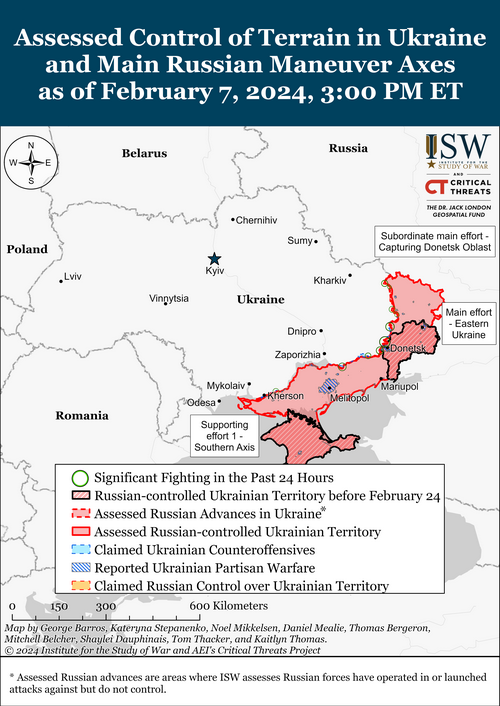
- Russian forces made confirmed gains west of Horlivka and in the Donetsk-Zaporizhia Oblast border area amid continued positional engagements along the entire frontline.
- The Ukrainian Main Military Intelligence Directorate (GUR) stated on February 7 that Russia is mobilizing citizens from Syria who come to Russia under the guise of security guard jobs at oil refineries.
- Russian occupation authorities continue to militarize Ukrainian children and youth in occupied Ukraine.
Go here to read the rest. The mobilization of Syrian refugees shows how desperate Putin is to put anyone in a Russian uniform.


The Russians are making steady daily gains all along the front … I sure hope the Ukrainians are making them pay dearly for them. I also hope that the U.S. Congress’ unwillingness to throw massive piles of cash at Ukraine is waking up the EU to the realization that they shouldn’t count on others to clean up problems in their own back yard.
European countries are a particularly obtuse lot. They simply refuse to learn from the past. That is why they continually violate the Einstein maxim of repetitive identical actions. If Putin and his sycophants Lavrov and Medvedev simply continue the present course, Ukraine will lose the war by being worn down, no matter the cost to individual Russian soldiers.