
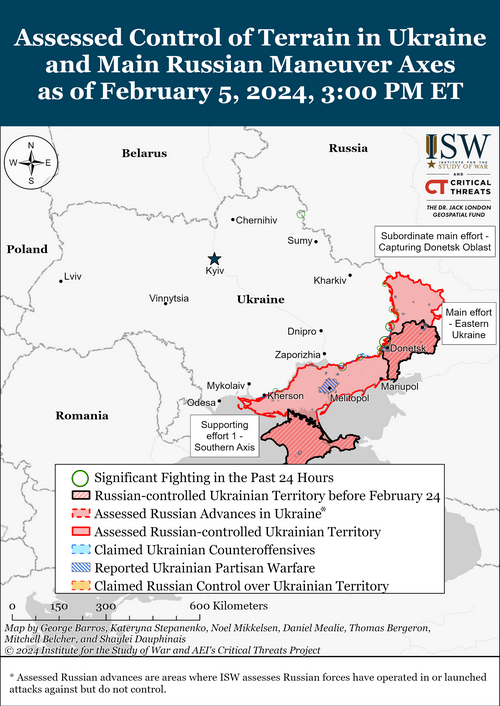
From The Institute for the Study of War:
Russian Offensive Campaign Assessment, February 5, 2024
Grace Mappes, Nicole Wolkov, Karolina Hird, Riley Bailey, George Barros, and Fredrick W. Kagan
February 5, 2024, 8:40pm ET
Click here to see ISW’s interactive map of the Russian invasion of Ukraine. This map is updated daily alongside the static maps present in this report.
Click here to see ISW’s 3D control of terrain topographic map of Ukraine. Use of a computer (not a mobile device) is strongly recommended for using this data-heavy tool.
Click here to access ISW’s archive of interactive time-lapse maps of the Russian invasion of Ukraine. These maps complement the static control-of-terrain map that ISW produces daily by showing a dynamic frontline. ISW will update this time-lapse map archive monthly.
Note: The data cut-off for this product was 1pm ET on February 5. ISW will cover subsequent reports in the February 6 Russian Offensive Campaign Assessment.
US Senate negotiators unveiled their proposed supplemental appropriations bill on February 4 that — if passed — would provide roughly $60 billion of security assistance for Ukraine, the overwhelming majority of which would go to American companies and US and allied militaries. The bill provides three main packages of assistance to Ukraine totaling $48.83 billion: $19.85 billion for replenishing weapons and equipment from the US Department of Defense (DoD) inventory; $13.8 billion for the purchase of weapons and munitions for Ukraine from US manufacturers; and $14.8 billion for continued US support to Ukraine through military training, intelligence sharing, and other support activities.[1] The appropriations bill provides that funds can go to foreign countries that have provided support to Ukraine at the request of the US, but the vast majority of the aid — if approved — would go to US companies and US or allied government entities supporting Ukraine.[2] Roughly 16 percent of the Ukraine-related appropriations in the bill would go directly to Ukraine, including $7.85 billion of direct budget support for the Ukrainian government and $1.58 billion for efforts to build a self-reliant Ukrainian economy amid the ongoing Russian invasion.[3] The appropriations bill also provides $1.6 billion in foreign military financing, which must be used to purchase goods and services from the US, to address Ukraine’s and other US partners’ air defense, artillery, maritime security, and maintenance requirements.[4] The appropriations bill provides smaller packages of $300 million to help Ukraine promote the rule of law and protect its borders and $100 million to support demining, counterterrorism, and nonproliferation programs.[5] The bill provides $8 million for the DoD Inspector General to exercise oversight over US security assistance to Ukraine.[6]
Ukrainian President Volodymyr Zelensky stated on February 4 that Ukraine needs to replace a “series of state leaders” across the Ukrainian government who are “not just in a single sector” such as the Ukrainian military.[7] Zelensky responded to a question from Italian outlet Rai News about reports that he may intend to replace Ukrainian Commander-in-Chief General Valerii Zaluzhnyi by stating that he is considering changing multiple “state leaders” and emphasized that this effort involves replacing multiple unspecified individuals, not just “a single person.”[8] Zelensky emphasized the importance of Ukrainian morale, as the Ukrainian leadership “cannot be discouraged” and must maintain the “right positive energy” in order to win the war.
The Kremlin is intensifying rhetoric pushing for the hypothetical partition of Ukraine by seizing on innocuous and unrelated topics, likely in an attempt to normalize the partition narrative in Western discussions about Ukraine. Deputy Chairperson of the Russian Security Council Dmitry Medvedev claimed on February 5 that purported European plans to construct a railway line from Spain to Lviv City are evidence of the West’s acknowledgement that Lviv City would be “the new capital of Ukraine within the borders of [Lviv Oblast],” presumably following the end of Russia’s war in Ukraine.[9] The plan, notably, has nothing to do with Ukrainian borders or an end state to the war in Ukraine and is an independent European infrastructure project. Russian President Vladimir Putin and other senior Russian officials have recently reignited the narrative framing the invasion of Ukraine as an historically justified imperial conquest and proposed to a largely Russian-speaking audience in December 2023 that Russia and European powers could partition Ukraine and leave it as “sovereign” rump state within the borders of Lviv Oblast, comments that subsequently gained some attention from a few right-wing nationalist Central European politicians.[10] Medvedev notably posted his February 5 claims on his English-language X (formerly Twitter) account and not on his Russian-language Telegram account, suggesting that his statement was intended for an international audience as opposed to a Russian domestic audience. Medvedev’s statement furthers the Russian information operation that erroneously portrays Ukraine as an artificially constructed state, likely in an effort to reduce Western military support for Ukraine and normalize Western discussions that push Ukraine to cede much of its territory and people to Russia as a legitimate way to end the war. ISW continues to assess that Russian President Vladimir Putin maintains his maximalist objectives in Ukraine, which are tantamount to complete Ukrainian and Western capitulation.[11]
Russian ultranationalists continue to support the Kremlin’s maximalist objectives in Ukraine and reject the notion that negotiations would lead to a lasting end to the war. Deputy Head of the Donetsk People’s Republic (DNR) Main Directorate of Rosgvardia, Commander of its special rapid response and riot police (OMON and SOBR), and prominent Russian milblogger Alexander Khodakovsky claimed that a “truce” would not result in peace and that “achieving lasting peace is only possible through war and the victory” of either Russia or Ukraine.[12] Khodakovsky also claimed that the current period of positional warfare hinders Russian forces from exhausting Ukrainian forces along the entire frontline and argued that Russian forces need to pressure Ukrainian forces and compel Ukraine to commit more resources to battle along the entire frontline. Khodakovsky’s zero-sum framing of the war is indicative of the wider Russian ultranationalist support for the Kremlin’s maximalist objectives of a complete Ukrainian and Western defeat. This zero-sum framing is also incompatible with any serious negotiations for an armistice or lasting peace.
Delays in Western security assistance continue to exacerbate Ukraine’s shell shortage and undermine Ukraine’s ability to use high-value Western counterbattery systems. Ukrainian Minister of Internal Affairs Ihor Klymenko stated on February 5 that Russian forces intensified their rate of artillery strikes by nearly 25 percent over the last week and shelled Ukraine over 1,500 times, targeting over 570 settlements.[13] The New York Times reported on February 4 that, by contrast, Ukrainian forces in critical areas of the front, such as Avdiivka, are increasingly rationing shells and can therefore only target masses of advancing Russian soldiers, noting that Russian forces have apparently adapted and are now advancing in smaller groups that are harder for Ukrainian artillery to strike.[14] Ukrainian military analyst and retired Colonel Petro Chernyk noted that Ukrainian forces possess relatively better counterbattery capabilities writ large than Russian forces, particularly because they have American AN/TPQ-36, -48, and -50 radars and the German COBRA radar system.[15] Counterbattery radars are effective in that they detect incoming fire and calculate its point of origin so that artillery forces can conduct return fire — for which artillery forces require sufficient artillery ammunition, however. A lack of artillery ammunition thus severely degrades counterbattery systems: AN/TPQ, COBRA, and other Western counterbattery systems are only as effective as the number of shells that Ukrainian forces have at their disposal to pursue the targets that counterbattery radars identify. ISW previously reported that Russian forces are benefitting from the combined dynamic of Ukraine’s ammunition shortage and its subsequent inability to conduct sufficient counterbattery warfare, and this dynamic is likely to become more acute as Ukraine’s period of shell shortages protracts.[16]
The Kremlin may not allow Boris Nadezhdin, the only anti-war Russian presidential candidate, to run in the March 2024 presidential election due to Nadezhdin’s larger-than-anticipated popularity. A Russian Central Election Commission (CEC) working group claimed on February 5 that 15 percent of the signatures that Nadezhdin collected to register as an election candidate were fraudulent and that the CEC recommends not registering him as a candidate.[17] Nadezhdin stated in response to the CEC’s announcement that his campaign plans to collect the 4,500 valid signatures he needs to run and that he will appeal to the Russian Supreme Court if the CEC refuses to register him as a presidential candidate.[18] Nadezhdin previously claimed to have submitted 200,000 signatures to the Russian CEC on January 31.[19] Russian presidential candidates sponsored by political parties need to submit 100,000 signatures with additional regional requirements in order to run in the presidential election, and no more than five percent of the total submitted signatures can be fraudulent.[20] The CEC stated that it will announce its final decision on February 7, but the CEC is unlikely to allow Nadezhdin to run.[21]
Nadezhdin previously stated that he believes the CEC will have to allow him to run in the March 2024 presidential election due to his widespread popularity and that he wanted as many uncontestable signatures as possible so the CEC could not disqualify him. ISW assessed on January 23 that the Kremlin may intend to use the March 2024 election as an unofficial referendum on Russia’s war in Ukraine by allowing Nadezhdin to run in an election that portrays Russian President Vladimir Putin (and by extension his war in Ukraine) as overwhelmingly popular, but the CEC’s February 5 announcement suggests that the Kremlin may have backtracked from this plan out of concern that Nadezhdin might gain too many votes and reduce Putin’s margin of victory below levels the Kremlin is willing to accept.[22] The CEC’s valid signature requirement is the logical mechanism for ending Nadezhdin’s presidential campaign whether or not the Kremlin was initially willing to tolerate the campaign.
Russian officials and sources have increasingly censored and sought to discredit Nadezhdin after Nadezhdin’s campaign gained significant notoriety while collecting signatures.[23] Russian CEC Deputy Chairperson Nikolai Bulaev claimed on February 2 that Nadezhdin’s campaign collected dozens of signatures of deceased Russians and questioned the integrity of the Nadezhdin campaign.[24] Russian opposition outlet Novaya Gazeta recently reported that Nadezhdin’s campaign struggled to find a printing house to print copies of Nadezhdin’s campaign newsletter, citing a source within the campaign.[25] Nadezhdin previously claimed that Russian state television attempted to censor him and his campaign.[26] A Russian ultranationalist milblogger cryptically suggested on January 30 that the Russian Federal Security Service (FSB) would “meet” with Nadezhdin prior to the election, implying that the FSB would interrogate or imprison him.[27]
The Kremlin is reportedly nationalizing private enterprises in Russia quietly. Russian opposition outlet Meduza published an investigation on February 5 detailing how the Russian Prosecutor General’s Office uses three main schemes to seize and nationalize assets from Russians despite Russian President Vladimir Putin’s assurances that there will not be nationalization in Russia.[28] Meduza found that Russian courts pursue one scheme through challenging cases regarding the privatization of certain companies that were subject to the widespread privatization efforts of the 1990s. The Prosecutor General’s Office reportedly utilizes this scheme to claim that regional authorities exceeded their powers by privatizing a given company and to demand that it be returned to the state. Meduza reported that the second scheme is to deem owners of private enterprises “foreign investors,” which allows Russian authorities to seize the assets of the private enterprise owners more easily under Russian foreign investment laws.[29] The final avenue for nationalization, according to Meduza, is when the Prosecutor General’s Office seizes assets from defendants accused of corruption or fraud, charges that courts reportedly used more frequently in 2023.[30] ISW has previously observed Russian courts expanding the prosecution of certain cases to broadly suppress dissent, and the Russian Prosecutor General may be employing a similar prosecution strategy as it pertains to property law in order to nationalize private assets using corruption, fraud, and foreign investment laws.[31]
Key Takeaways:
- US Senate negotiators unveiled their proposed supplemental appropriations bill on February 4 that — if passed — would provide roughly $60 billion of security assistance for Ukraine, the overwhelming majority of which would go to American companies and US and allied militaries.
- Ukrainian President Volodymyr Zelensky stated on February 4 that Ukraine needs to replace a “series of state leaders” across the Ukrainian government who are “not just in a single sector” such as the Ukrainian military.
- The Kremlin is intensifying rhetoric pushing for the hypothetical partition of Ukraine by seizing on innocuous and unrelated topics, likely in an attempt to normalize the partition narrative in Western discussions about Ukraine.
- Delays in Western security assistance continue to exacerbate Ukraine’s shell shortage and undermine Ukraine’s ability to use high-value Western counterbattery systems.
- The Kremlin may not allow Boris Nadezhdin, the only anti-war Russian presidential candidate, to run in the March 2024 presidential election due to Nadezhdin’s larger-than-anticipated popularity.
- The Kremlin is reportedly nationalizing private enterprises in Russia quietly.
- Russian forces made confirmed gains near Kupyansk, Kreminna, Avdiivka, and northeast of Bakhmut amid continued positional fighting along the entire frontline.
- The Russian Federal Security Service (FSB) may expand the list of courses available to women at the FSB Academy.
- Russian occupation administrations continue efforts to indoctrinate Ukrainian children into Russian culture and nationalism through patronage networks with Russian federal subjects (regions).
Go here to read the rest.
From John Schindler at Top Secret Umbra:
Online cope is fading too. Ukraine’s helpers abroad consistently have pushed myriad NATO Wunderwaffen in a downright Hitlerian manner as the salve to the ZSU’s shortcomings in men and munitions. First it was tanks like Leopard 2s and the M1 Abrams, then it was HIMARS rocket artillery, now it’s F-16 fighters: these will turn the tide, at last. Nobody can discount the impact of weapons on the battlefield, technology matters, yet these systems will no more win the war for Kyiv than V-1 and V-2 rockets, Me-262 jet fighters, and Tiger II super-tanks won World War Two for the Nazis. The unavoidable truth is that, on its current trajectory, Russia is tracking to win this war, though perhaps no time soon, and at terrible cost. Only enormous amounts of NATO military assistance, which seem to be beyond the capabilities of the West’s mostly dilapidated defense industries, can change that reality now.
Instead, Ukraine is now losing. The winter has halted major military operations, while the front sees daily artillery duels in the southeast that the shell-starved ZSU is losing, but few large-scale attacks. Both armies are tired, badly bloodied, and hunkered down for the winter, licking wounds while waiting for the spring thaw and the mud to disappear. Few doubt that the spring will bring a major Russian offensive, somewhere, that Ukraine appears poorly positioned to defeat. That offensive may determine the war’s outcome. Therefore, it’s important to review recent military operations in Ukraine, to assess what may happen this year.
Ukraine has enjoyed two unambiguous successes in this war: the crafty defense of Kyiv at the outset, against a bumbling Russian effort at a coup de main which failed disastrously; and the September 2022 offensive around Kharkiv, which inflicted a significant local defeat on Russian forces. Both were the handiwork of Gen. Oleksandr Syrskyi, the commander of ZSU Ground Forces. However, Kyiv oversold the success of the Kharkiv operation both at home and abroad. ZSU forces punished thinly spread, mostly second-rate Russian units there.
The following spring, Kyiv got ready to launch its misnamed strategic counteroffensive* in the southeast, yet it was delayed until June. The propaganda hype surrounding this operation was impossible to miss. Expectations were high and the offensive, which was projected to achieve successes like Croatia’s historic Operation STORM in August 1995, was led by Ukraine’s NATO (mostly U.S.) trained and equipped brigades, the ZSU’s version of shock troops.
However, Kyiv’s usual propaganda magic didn’t help this time: Ukrainian officials were cagey about when the offensive even started and its wasn’t until mid-summer that it became evident that a major operation was in fact underway. Although Kyiv’s Western cheerleaders did their best to sell the offensive, it quickly got bogged down in bloody attritional slugfests along the extended southeastern front. The simple truth is that the ZSU never enjoyed significant overmatches in men or firepower against the Russians, as they needed to if they expected to achieve strategic success. To make matters worse, Ukrainian forces undertook a series of disjointed local attacks, failing to concentrate their forces in any one place, what experts call the Schwerpunkt.
By the onset of fall, as casualties mounted, even Kyiv’s superfans were beginning to allow that the “counteroffensive” wasn’t proceeding as promised. Combat engineering has long been a Russian specialty, and attacking into dense defenses against dug-in defenders who are protected by belts of minefields and battalions of pre-sighted artillery is among the most difficult of military undertakings, thus nowhere along the southeastern front did ZSU attacks make any gains which could be termed more than minor. All you needed to know about how this operation would proceed could be derived from the Wikipedia entry on the mid-1943 battle of Kursk, where the Wehrmacht attacked right into dense Soviet defenses without any superiority in men, tanks, artillery, or airpower.
None can fault Ukrainian soldiers for any lack of bravery, but heroism can’t substitute for competence – or weight of shell. As casualties mounted and unit commanders fell, ZSU tactical leadership suffered and, contrary to NATO claims, ZSU high-level leadership still displayed some bad old Soviet habits (as of course the Russians do too). The fighting quickly devolved into sharp platoon-level skirmishes lacking any strategic import or even rationale. Still, Kyiv kept the “counteroffensive” going long after it lost any military logic and no breakthrough ever emerged.
Go here to view the rest. A somber analysis. I don’t entirely share its pessimism. After the Spanish Civil War a victory celebration was held attended by most of the top Nationalist Generals. Speeches were given lauding the generalship of the Nationalists. All of it was too much for one of the better combat generals. He finally stood up and said, “Amigos, do you really want to know why we won? We were slightly less inept than the Reds were!”
The Ukrainians may not have the ability to win the War, but I have faith in the ability of the Russians to lose it.

