
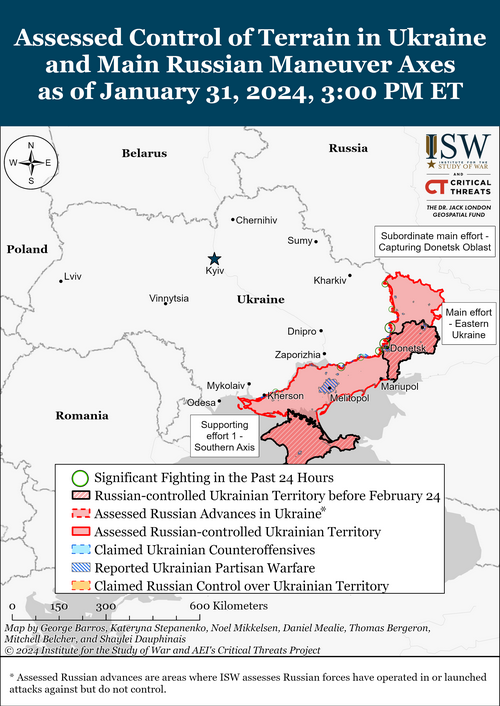
From The Institute for the Study of War:
Russian Offensive Campaign Assessment, January 31, 2024
Riley Bailey, Christina Harward, Nicole Wolkov, Grace Mappes, and Frederick W. Kagan
January 31, 2024, 8:05pm ET
Click here to see ISW’s interactive map of the Russian invasion of Ukraine. This map is updated daily alongside the static maps present in this report.
Click here to see ISW’s 3D control of terrain topographic map of Ukraine. Use of a computer (not a mobile device) is strongly recommended for using this data-heavy tool.
Click here to access ISW’s archive of interactive time-lapse maps of the Russian invasion of Ukraine. These maps complement the static control-of-terrain map that ISW produces daily by showing a dynamic frontline. ISW will update this time-lapse map archive monthly.
Note: The data cut-off for this product was 2pm ET on January 31. ISW will cover subsequent reports in the February 1 Russian Offensive Campaign Assessment.
Note: ISW added a new section on Russian air, missile, and drone campaign to track Russian efforts to target Ukrainian rear and frontline areas, grow its drone and missile arsenals, and adapt its strike packages.
Ukrainian forces struck Russian targets in the vicinity of Belbek airfield in occupied Sevastopol, Crimea on January 31. Ukrainian Air Force Commander Lieutenant General Mykola Oleshchuk amplified geolocated footage on January 31 showing a Ukrainian strike near the Belbek airfield and thanked Ukrainian forces for striking targets in occupied Crimea.[1] Additional geolocated footage published on January 31 shows large smoke plumes rising from the airfield.[2] ISW has yet to observe evidence indicating what Russian targets Ukrainian forces struck at or near the airfield. The Russian Ministry of Defense (MoD) claimed that Russian forces intercepted 20 Ukrainian missiles, 17 reportedly on the approaches to Sevastopol and three reportedly elsewhere over occupied Crimea.[3] The Russian MoD claimed that missile fragments fell in Lyubimivka (northwest of Sevastopol), and Sevastopol occupation governor Mikhail Razvozhaev claimed that missile fragments damaged buildings along Fedorivska Street and the “Ust-Belbek” garden association, both in the vicinity of the Belbek airfield.[4] A prominent Kremlin-affiliated milblogger claimed that Ukrainian forces used Storm Shadow cruise missiles in the strikes.[5] Ukrainian forces recently repeatedly targeted the Saky airfield (north of Sevastopol) as part of a multi-day strike campaign against Russian targets in occupied Crimea in early January 2024.[6] Ukrainian forces previously conducted a more extensive strike campaign against Russian military infrastructure and Black Sea Fleet (BSF) assets in the summer of 2023 that pushed Russian naval assets largely out of the western part of the Black Sea and that aimed to degrade the Russian military’s ability to use Crimea as a staging and rear area for defensive operations in southern Ukraine.[7]
Russian President Vladimir Putin doubled down on his maximalist and purposefully vague territorial objectives in Ukraine on January 31. Putin stated during a meeting with his election “proxies” that pushing the current frontline deeper into Ukraine is the most important goal for Russian forces across the theater.[8] Putin emphasized the idea of a “demilitarized” or “sanitary” zone in Ukraine that he claimed would place Russian territory – including occupied Ukraine – out of range of both frontline artillery systems and Western-provided long-range systems. Putin’s stated goal of pushing the front line so that Russia’s claimed and actual territories are outside of Ukrainian firing range is a vague goal that is actually unattainable as long as there is an independent Ukraine with any ability to fight. Putin would likely annex any Ukrainian territories Russia managed to capture in pursuit of this supposed objective (particularly in the four oblasts Russia has already claimed to have annexed but only partially controls), thus bringing the new Russian territories into range of Ukrainian systems in whatever remains of an independent Ukraine. A Russian nationalist milblogger expanded on this dilemma, noting that Russia would also have to capture Mykolaiv and Odesa cities to eliminate the threat of Ukrainian long range strikes against occupied Crimea and that Russian forces would need to capture the Slovyansk-Kramatorsk line in Donetsk Oblast to relieve the current front line.[9] The milblogger notably suggested even further territorial expansion by asking whether Russia wants Slovyansk to ”bear the fate of an eternally frontline city.”[10] Putin’s January 31 statements do not represent significant inflections in Russia’s stated war aims or actual military capabilities but are rather likely intended to capitalize on existing narratives in Western media that could block short and long term Western military assistance to Ukraine and compel the West to negotiate with Russia on Russian terms.
Putin also included Kharkiv City, which he has previously described as “Russian,” in this hypothesized demilitarized zone, likely to capitalize on discussions surrounding the unlikely possibility of a Russian offensive effort along Kharkiv Oblast’s northern border from Belgorod Oblast.[11] Putin may intend to amplify these discussions to divert Ukrainian attention away from the ongoing Russian offensive operation along the Kharkiv-Luhansk Oblast axis, but ISW continues to assess that Russian forces in Belgorod Oblast can conduct only tactical-level actions that would serve as feints to draw and fix Ukrainian forces along the border.[12] Putin is also likely trying to appeal to resurgent calls from Russian ultranationalists to create a ”buffer zone” between Kharkiv and Belgorod oblasts to push Ukrainian MLRS and artillery away from the international border with Belgorod Oblast. Putin previously claimed that he would consider creating such a “buffer zone” during widespread discontent about limited cross border raids by pro-Ukraine forces into Belgorod Oblast in summer 2023, but the Russian military has yet to take any actions that suggest that Putin has seriously considered these calls.[13]
Putin also highlighted the Russian offensive effort near Avdiivka likely to portray that effort as successful to domestic Russian audiences and to further justify the Russian war in Ukraine.[14] Putin claimed that the “Veterany” Assault Brigade (Volunteer Assault Corps) fought ahead of regular Russian forces, broke through Ukrainian lines, and captured 19 houses near Avdiivka, which Putin characterized as one of the most important areas of the frontline. Putin stated that the “Veterany” Brigade “fights properly” and should be “educating young people.” Putin also reiterated boilerplate narratives that the Russian war in Ukraine is a struggle for Russian sovereignty that is purging Russian society of those who are against this sovereignty, thus unifying Russian society.[15]
Ukrainian and Russian forces conducted a prisoner-of-war (POW) exchange on January 31, exchanging 195 Russian POWs for 207 Ukrainian POWs.[16] Ukrainian officials reported that this was the 50th POW exchange, presumably since the full-scale Russian invasion in February 2022.[17] Russian and Ukrainian officials stated that the United Arab Emirates helped facilitate the POW exchange.[18] Ukrainian Main Military Intelligence Directorate Spokesperson Andriy Yusov stated that the POWs on the preliminary list for the POW exchange planned for January 24 and later canceled due to the Il-76 crash in Belgorod Oblast were not part of the January 31 POW exchange.[19]
The European Union (EU) will reportedly fall short of its promise to provide Ukraine with one million artillery shells by March 1, 2024, as European leaders call on EU member states to intensify deliveries of ammunition to Ukraine. Bloomberg reported on January 31 that Western diplomats stated that EU partners will only deliver 600,000 artillery shells to Ukraine by the March 1, 2024 deadline.[20] European Union (EU) Internal Market Commissioner Thierry Breton stated on January 20 that the EU will have the capacity to produce one million shells per year by March or April 2024 and will ensure that it delivers the “majority” of the shells to Ukraine.[21] German Chancellor Olaf Scholz, Danish Prime Minister Metter Frederiksen, Czech Prime Minister Petr Fiala, Estonian Prime Minister Kaja Kallas, and Dutch Prime Minister Mark Rutte acknowledged that the EU fell short of its promise to deliver one million shells to Ukraine by March 2024 in a letter published by the Financial Times on January 31.[22] The letter noted that new orders for artillery ammunition will not reach the battlefield in Ukraine until 2025 and urged the EU to find ways to accelerate the delivery of promised shells to Ukraine, either through provisions of existing stocks or through joint procurement efforts.[23]
Russian Defense Minister Sergei Shoigu claimed that Russian-Chinese relations are at their “best period in their history” in a January 31 call with Chinese Defense Minister Admiral Dong Jun. Shoigu claimed that Russian-Chinese military cooperation is steadily developing and that the Russian and Chinese militaries regularly conduct operational and combat training exercises.[24] Shoigu claimed that Russian and Chinese defense and security cooperation has helped “reduce the potential for conflict.”[25] Shoigu and Dong emphasized a desire to increase Russian-Chinese strategic cooperation, and Dong reported that China provided unspecified “support” to Russia in the war in Ukraine despite continued US and European pressure.[26] Dong also stated that the US and Europe will not be able to interfere with ”normal Russian-Chinese cooperation.”[27] Dong’s statement is a more overt rhetorical expression of Chinese support for Russia than statements from previous meetings between senior Russian and Chinese officials. Dong’s rhetorical support for Russia is likely primarily posturing against the West. Russian Security Council Deputy Chairperson Dmitry Medvedev recently made inflammatory comments about Japan likely in an effort to demonstrate Russia’s support of China’s opposition to the US alliance system in the Indo-Pacific.[28] ISW continues to assess that China is unwilling to establish the no-limits bilateral partnership with Russia that Russia desires.[29]
Kremlin officials and mouthpieces continued rhetorical efforts to prevent Moldova’s integration into the EU and to set information conditions to justify future Russian aggression against Moldova. Moldovan and Ukrainian officials reiterated on January 29 and 30 that Moldova and Ukraine are committed to resolving the Transnistrian conflict through diplomatic means and dialogue with Transnistria.[30] A prominent Kremlin-affiliated milblogger, who has recently fixated on the Moldovan-Transnistrian conflict, continued to claim that Moldova is engaging in military actions that threaten Transnistria, likely as part of efforts to justify future Russian aggression in the area as necessary to protect Transnistria.[31] The milblogger also responded to Ukrainian and Moldovan official statements, claiming that Moldova is only “verbally” interested in diplomatic solutions to the Transnistria conflict and is instead trying to use its economic policies to “blackmail” Transnistria. Russian Foreign Ministry Spokesperson Maria Zakharova claimed on January 31 that Moldova is economically “strangling” regions in Moldova that do not agree with the Moldovan government’s policies – likely referring to both Transnistria and Gagauzia, whose leaders have reportedly complained about Moldovan economic policies recently.[32] Zakharova claimed that the Moldovan government is using increased “Russophobic rhetoric” to divert attention from Moldova’s internal socio-economic and political problems.[33] Another Russian milblogger largely mirrored Zakharova‘s claims, alleging that the Moldovan government is blaming Russia for Moldova’s socio-economic problems.[34] Kremlin narratives about alleged socio-economic issues in Moldova are likely aimed at promoting the idea that Moldova’s moves towards Western integration, particularly with the European Union (EU), are hurting Moldova’s economy and generating discontent among its population.
The Ukrainian Main Military Intelligence Directorate (GUR) reported that it recently conducted a cyberattack on a Russian Ministry of Defense (MoD) communications server. The GUR reported on January 30 that GUR hackers successfully hacked a Russian MoD server used to exchange information between Russian units. The GUR reported that Russia has installed the software on this server on various other strategic objects including military objects and that the GUR’s cyber operation is ongoing.[35] ISW has recently observed an increase in reported Ukrainian cyberattacks against Russian targets.[36]
Estonian Defense Forces Commander General Martin Herem stated that Russia may be behind recent GPS jamming in the Baltic region.[37] Bloomberg reported on January 31 that Herem stated that Russia may be “learning and testing” its jamming capabilities against the backdrop of the risk of future conflict with NATO. Bloomberg stated that the Russian Ministry of Defense (MoD) previously confirmed the presence of Russian electronic warfare (EW) units in Kaliningrad Oblast, and Herem stated that Russia may also jam signals from ships in the Baltic Sea. Swedish Lieutenant Colonel Joakim Paasikivi previously stated that he believes that high GPS interference levels in December 2023 and January 2024 are a result of “Russian influence activities or so-called hybrid warfare.”[38]
The Ukrainian Cabinet of Ministers approved and submitted an updated version of a draft law on mobilization to the Verkhovna Rada on January 30.[39] The Verkhovna Rada withdrew the previous version of the draft law on mobilization for revisions on January 11 after discussions between Ukrainian legislators and political and military leadership.[40] The updated version of the draft law has not amended key provisions concerning the lowering of the mobilization age from 27 to 25 years of age, the discharge of servicemen after 36 months of service, and an effort to systematize Ukrainian mobilization infrastructure.[41] Deputy Chairperson of the Verkhovna Rada Committee on Digital Transformation Oleksandr Fedienko stated on January 31 that the Verkhovna Rada will likely consider the updated second draft law no earlier than March 2024.[42]
In accordance with its policy against speculating about future Ukrainian actions, ISW is not covering reported leaks concerning possible changes in the Ukrainian command structure. ISW will continue to report official statements by Ukrainian government officials and organizations as they are made.
Key Takeaways:
- Ukrainian forces struck Russian targets in the vicinity of Belbek airfield in occupied Sevastopol, Crimea on January 31.
- Russian President Vladimir Putin doubled down on his maximalist and purposefully vague territorial objectives in Ukraine on January 31.
- Ukrainian and Russian forces conducted a prisoner-of-war (POW) exchange on January 31, exchanging 195 Russian POWs for 207 Ukrainian POWs.
- The European Union (EU) will reportedly fall short of its promise to provide Ukraine with one million artillery shells by March 1, 2024, as European leaders call on EU member states to intensify deliveries of ammunition to Ukraine.
- Russian Defense Minister Sergei Shoigu claimed that Russian-Chinese relations are at their “best period in their history” in a January 31 call with Chinese Defense Minister Admiral Dong Jun.
- Kremlin officials and mouthpieces continued rhetorical efforts to prevent Moldova’s integration into the EU and to set information conditions to justify future Russian aggression against Moldova.
- The Ukrainian Main Military Intelligence Directorate (GUR) reported that it recently conducted a cyberattack on a Russian Ministry of Defense (MoD) communications server.
- Estonian Defense Forces Commander General Martin Herem stated that Russia may be behind recent GPS jamming in the Baltic region.
- Russian forces recently made confirmed advances near Bakhmut, near Avdiivka, and southwest of Donetsk City amid positional engagements along the entire line of contact on January 31.
- Russian forces reportedly formed a “secret” battalion of penal recruits to conduct offensive operations in western Zaporizhia Oblast but are reportedly disbanding the battalion.
- Russian and occupation officials continue efforts to erase Ukrainian cultural and ethnic identity in occupied territories.
Go here to read the rest. Putin is beating his chest and claiming that the Ukrainian War is a glorious success. Politics, ever the theater of the absurd.