
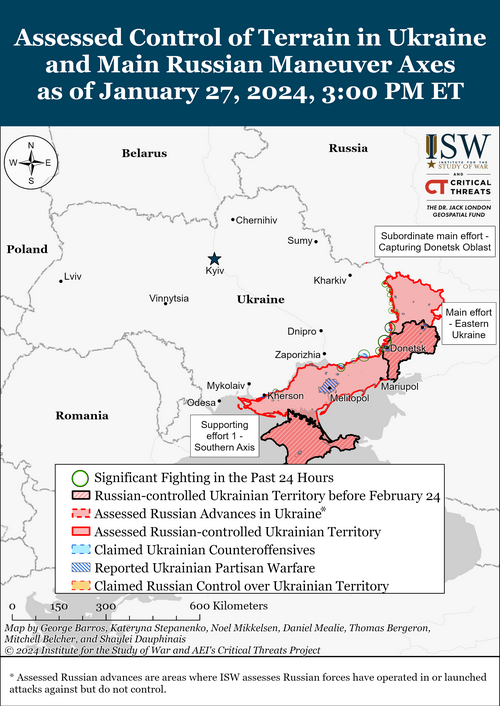
From The Institute for the Study of War:
Russian Offensive Campaign Assessment, January 29, 2024
Angelica Evans, Riley Bailey, Nicole Wolkov, Karolina Hird, and Frederick W. Kagan
January 29, 2024, 5:45pm ET
Click here to see ISW’s interactive map of the Russian invasion of Ukraine. This map is updated daily alongside the static maps present in this report.
Click here to see ISW’s 3D control of terrain topographic map of Ukraine. Use of a computer (not a mobile device) is strongly recommended for using this data-heavy tool.
Click here to access ISW’s archive of interactive time-lapse maps of the Russian invasion of Ukraine. These maps complement the static control-of-terrain map that ISW produces daily by showing a dynamic frontline. ISW will update this time-lapse map archive monthly.
Note: The data cut-off for this product was 1:00pm ET on January 29. ISW will cover subsequent reports in the January 30 Russian Offensive Campaign Assessment.
Note: ISW added a new section on Russian air, missile, and drone campaign to track Russian efforts to target Ukrainian rear and frontline areas, grow its drone and missile arsenals, and adapt its strike packages.
The Ukrainian Ministry of Defense (MoD) denied rumors about the purported resignation or dismissal of Ukrainian Commander-in-Chief General Valerii Zaluzhnyi on January 29.[1] Ukrainian People’s Deputy Oleksii Honcharenko claimed on January 29 that “Zaluzhnyi announced his resignation, but there is no decree yet.”[2] Former Ukrainian People’s Deputy Boryslav Bereza claimed that the Ukrainian Presidential Office “dismissed” Zaluzhnyi.[3] Western media amplified Honcharenko’s and Bereza’s posts, and Russian sources and state media outlets also picked up claims of Zaluzhnyi’s dismissal or resignation.[4] The Ukrainian MoD apparently responded to the rumors by saying “no, this is not true,” but has not yet offered additional information on the situation as of the time of this writing.[5] ISW cannot independently confirm rumors about Zaluzhnyi‘s dismissal or resignation at this time. Russian sources are seizing on rumors of Zaluzhnyi’s dismissal or resignation to further several information operations about domestic Ukrainian affairs they have been conducting for some time.[6] Veteran Russian propagandist and RT editor-in-chief Margarita Simonyan emphasized that whether or not reports of Zaluzhnyi’s removal are true, “chaos … is useful to [Russia].”[7]
Russia may be retooling aspects of its air defense umbrella in deep rear areas amid continued Ukrainian drone strikes within Russia. Russian outlet Kommersant reported on January 29 that the Russian Ministry of Digital Development ordered Russian authorities in Leningrad, Novgorod, and Pskov oblasts to block 4G LTE internet connection until January 30 so that Russian officials can “fine-tune” anti-drone and air defense systems.[8] Leningrad, Novgorod, and Pskov oblasts previously announced disruptions to 4G LTE internet services from January 25 to January 30 in connection with technical adjustments to the “radio frequency spectrum.”[9] One of Kommersant’s sources stated that Voronezh Oblast is conducting similar efforts that have been “planned at the federal level” and that many other unspecified Russian federal subjects are pursuing these efforts at different paces.[10]
Kommersant stated that Russian electronic warfare (EW) systems and mobile internet providers both operate on frequencies permitted by the Russian State Commission on Radio Frequencies (SCRF), and Kommersant’s source stated that indiscriminate EW use can interfere with mobile data.[11] It is unclear what impact internet operations may have on the reorientation of EW systems or the deployment of new capabilities and vice versa. It is equally possible that Russian forces may be testing new EW capabilities and preemptively turned off internet services to avoid sudden disruptions. Russian officials may also be limiting access to the internet to conceal the movement of conventional air defense systems within Russia after Ukrainian drone strikes in Leningrad Oblast on January 18 and January 21 suggested that Russian air defenses in northwestern Russia may be ill-deployed to defend against drones launched from Ukraine.[12] Yaroslavl Oblast Governor Mikhail Yevraev claimed on January 29 that Russian EW systems downed a Ukrainian drone targeting the Slavneft-Yanos oil refinery in Yaroslavl Oblast.[13] Russian sources amplified images of the downed drown at the refinery and claimed that it did not cause any damage.[14] Kommersant’s source stated that they believe that the timing of the internet disruptions is also associated with security for Russian President Vladimir Putin’s ongoing trip to St. Petersburg and Leningrad Oblast.[15]
Russia appears to be fueling and seizing on neo-imperialist and nationalist sentiments in Europe in order to drive wedges between Ukraine and its western neighbors. Right-wing Hungarian politician and Our Homeland Movement party leader Laszlo Toroczkai stated on January 27 that Hungary should claim Ukraine’s Zakarpattia Oblast in the event of a Ukrainian defeat in the war.[16] Right-wing Romanian politician and Alliance for the Union of Romanians party leader Claudiu Tarziu emphasized on January 29 that Romania needs to “reintegrate” areas of Ukraine neighboring Romania where Romanian populations lived in order to maintain sovereignty.[17] Russian sources amplified Toroczkai’s and Tarziu’s statements and emphasized these ultranationalist Romanian and Hungarian claims to Ukrainian territory.[18] Russia previously proposed the idea of a “partitioned Ukraine” between Russia and the West prior to the full-scale invasion.[19] Russian President Vladimir Putin and other senior Russian officials reignited this narrative in December 2023 by claiming that Ukraine has historical “territorial disputes” with Poland, Romania, and Hungary but could maintain its “sovereignty” if the whole country is comprised of the borders of Lviv Oblast.[20] The Russian ultranationalist framework of the Russian World (Russkiy Mir) concept appears to have gained traction among nationalist European factions as applied to their own nationalist ideologies, and Russian information space actors likely seek to leverage this ideological bent to drive a wedge between Ukraine and its European neighbors.
Russian President Vladimir Putin and Belarusian President Alexander Lukashenko signed a series of economic and technological agreements on January 29 advancing the Kremlin’s efforts to further integrate Belarus into the Union State structure. Putin and Lukashenko approved three agreements on the implementation of the Union State Treaty, joint scientific and technological development, and the coordination of both countries’ foreign policies during a meeting of the Supreme State Council of the Union State in St. Petersburg.[21] Putin reiterated claims that Russians and Belarusians are “fraternal peoples,” united by a common history and values.[22] Lukashenko highlighted Russian and Belarusian cooperation in Africa, claiming that he coordinated his December 2023 trips to various African countries with Putin, and stated that Russia and Belarus have not yet resolved the issue of creating common markets for gas, oil, and petroleum products under the Union State framework.[23] Lukashenko has previously resisted the Kremlin’s efforts to further integrate Belarus into the Union State, but the fallout of the Wagner Group’s armed rebellion, which Lukashenko reportedly played a role in mediating, and the death of Wagner financier Yevgeny Prigozhin may have hindered Lukashenko’s ability to resist further Union State integration efforts.[24]
Key Takeaways:
- The Ukrainian Ministry of Defense (MoD) denied rumors about the purported resignation or dismissal of Ukrainian Commander-in-Chief General Valerii Zaluzhnyi on January 29.
- Russia may be retooling aspects of its air defense umbrella in deep rear areas amid continued Ukrainian drone strikes within Russia.
- Russia appears to be fueling and seizing on neo-imperialist and nationalist sentiments in Europe in order to drive wedges between Ukraine and its western neighbors.
- Russian President Vladimir Putin and Belarusian President Alexander Lukashenko signed a series of economic and technological agreements on January 29 advancing the Kremlin’s efforts to further integrate Belarus into the Union State structure.
- Russian forces recently advanced near Kreminna and Avdiivka and in the Donetsk-Zaporizhia Oblast border area.
- Russia reportedly deployed more Rosgvardia troops to occupied Ukraine ahead of the March 2024 Russian presidential election.
Go here to read the rest. And the low level winter War continues.

