
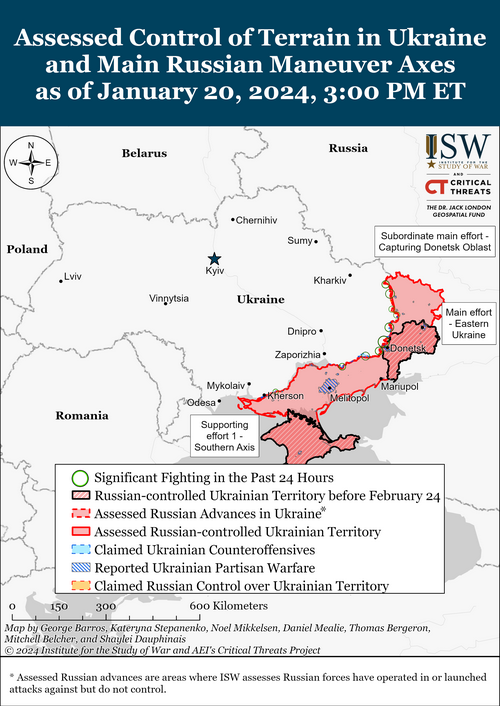
From The Institute for the Study of War:
Russian Offensive Campaign Assessment, January 20, 2024
Angelica Evans, Nicole Wolkov, Riley Bailey, Karolina Hird, and Frederick W. Kagan
January 20, 2024, 4:15pm ET
Click here to see ISW’s interactive map of the Russian invasion of Ukraine. This map is updated daily alongside the static maps present in this report.
Click here to see ISW’s 3D control of terrain topographic map of Ukraine. Use of a computer (not a mobile device) is strongly recommended for using this data-heavy tool.
Click here to access ISW’s archive of interactive time-lapse maps of the Russian invasion of Ukraine. These maps complement the static control-of-terrain map that ISW produces daily by showing a dynamic frontline. ISW will update this time-lapse map archive monthly.
Note: The data cut-off for this product was 12:45pm ET on January 20. ISW will cover subsequent reports in the January 21 Russian Offensive Campaign Assessment.
Note: ISW has added a new section on Ukrainian defense industrial base (DIB) efforts to the daily Russian Offensive Campaign Assessment to track the development of Ukraine’s DIB and the international support for Ukraine’s DIB efforts. ISW will be publishing its assessments in this section based on public announcements, media reporting, and official statements.
Russian President Vladimir Putin falsely claimed that Russia supports the “unconditional equality” and “sovereignty” of all states in a January 20 letter to the Non-Aligned Movement Summit, contradicting Russia’s official position on its war in Ukraine and its wider imperial ambitions. Putin claimed that Russia rejects “neocolonialist ambitions, double standards, as well as forceful pressure, dictatorship, and blackmail as a means of achieving foreign policy and foreign economic goals.”[1] Russian officials have routinely denied Ukraine’s sovereignty and refused to treat it as an equal. The Kremlin rejects Ukrainian statehood and nationhood by incorporating Ukraine into the ideological and geographic conception of the Russian World (Russkiy Mir), which includes any Russian speakers and ”carriers of Russian history and culture“ as “compatriots“ and includes all of the former territories of Kyivan Rus, the Kingdom of Muscovy, the Russian Empire, the Soviet Union, and the contemporary Russian Federation.”[2] Russia uses the framework of “Russkiy Mir” to justify Russian imperialist expansion and the subjugation of independent, sovereign states and their peoples within a pseudo-cultural and historical context. Russian officials have routinely justified the full-scale invasion of Ukraine by claiming that Russia aims to protect its “compatriots” abroad, again rejecting Ukraine‘s sovereignty.[3] Russia also continues to trivialize the sovereignty of other post-Soviet countries and has been setting information conditions to escalate tensions in the Baltics and Moldova under the guise of protecting its “compatriots” abroad.[4] Russia has been in violation of its own commitments to respect Ukraine’s territorial integrity and “inviolability of borders” and its agreement to center relations with Ukraine on ”non-use of force or threat of force” and “non-interference in internal affairs” undertaken in the 1994 Budapest Memorandum since its initial invasion in 2014.[5] Putin’s false claims that Russia respects “equality” and “sovereignty” are likely intended to cater to states that the Kremlin desires to pull into its wider sphere of influence, much as it initially intended to do with Ukraine before the initial 2014 invasion.
Russian Ambassador to Denmark Vladimir Barbin threatened Denmark, a founding member of NATO, on January 20 in response to a recent US-Danish agreement allowing US forces access to military bases in Denmark. Barbin claimed during an interview with Russian news outlet RIA Novosti that the December 2023 US-Danish agreement “creates new challenges” for Russia’s security in the Baltic Sea region and stated that Russia will determine the “necessary responses” to such actions.[6] The US and Denmark signed a Defense Cooperation Agreement on December 21, 2023, allowing the US to permanently station forces and equipment at military bases in Denmark.[7] Barbin called the agreement a “deliberate course towards further degradation of the military-political situation in the region under the slogans of containing and intimidating Russia.“[8] A prominent Kremlin-affiliated Russian milblogger previously claimed that Finland is becoming a ”second Ukraine” in response to a similar US-Finnish agreement.[9] Russian officials, including Russian President Vladimir Putin, have recently threatened Finland, and the Kremlin’s threats against a founding member of NATO that shares no borders with Russia is a notable challenge to the wider alliance.[10] Russian threats made towards a founding member of NATO also undermine Russia’s longstanding information operation that its aggressive actions are in response to NATO expansion.[11]
Russian energy exports to China significantly increased in 2023 amid increasing Russian reliance on oil revenues to manage the fiscal burdens of the war in Ukraine. Kremlin newswire TASS amplified data from the Chinese General Customs Administration on January 20 that shows a 24 percent increase in Russian crude oil exports to China from 2022 to 2023 and a 23 percent increase in Russian exports of Liquified Natural Gas (LNG).[12] TASS noted that Russia became China’s largest oil supplier in 2023.[13] Increased Russian energy exports to Indo-Pacific states, primarily India and China, and widespread Russian efforts to skirt the G7 price cap on Russian crude oil and petroleum products allowed Russia to significantly increase oil revenues in 2023.[14]
European Union (EU) Internal Market Commissioner Thierry Breton stated on January 20 that the EU will have the capacity to produce 1.3 to 1.4 million artillery shells by the end of 2024 and will ensure that it delivers the “majority” of the shells to Ukraine.[15] Breton stated that the EU will be able to produce one million shells per year by March or April 2024 and intends to “significantly” increase its shell production capacity in 2025.[16] NATO announced on January 19 that it plans to announce a major unspecified investment in artillery ammunition on January 23.[17]
A poll conducted by independent analytical platform VoxUkraine found that 63 percent of Ukrainians who left the country because of Russia’s invasion had returned by July-August 2023.[18] The poll also found that 64 percent of respondents who have not yet returned to Ukraine do have plans to return and that 27 percent will return to Ukraine. At the same time, the war continues as long as there are suitable housing and employment opportunities.[19] As many as 6.2 million Ukrainians are living abroad due to the war, according to various international estimates.[20]
Russian forces conducted a limited series of strikes against Ukraine on January 20 amid continued Russian efforts to test and pressure Ukrainian air defenses. Ukrainian military officials reported that Russian forces launched seven Shahed-136/131 drones from Primorsko-Akhtarsk, Krasnodar Krai, and three S-300 missiles from occupied Luhansk Oblast.[21] Ukrainian officials reported that Ukrainian forces intercepted four of the drones and that the S-300 missiles struck Novohrodivka, Donetsk Oblast.[22] Ukrainian Air Force Spokesperson Colonel Yuriy Ihnat stated that recent Russian strike series have attempted to overload Ukrainian air defenses and that Russian forces continue to launch drones and missiles in ways designed to avoid, penetrate, and degrade limited Ukrainian air defense capabilities.[23] Russian forces will likely continue to adapt missile and drone strike packages in an effort to penetrate Ukrainian air defenses and place pressure on Ukrainian air defense deployments.[24] Ihnat acknowledged that Ukrainian forces have concentrated a considerable amount of air defense near Kyiv to defend against regular Russian strikes and that it will be difficult for Ukrainian forces to disperse these systems as Russia’s strike campaign continues.[25]
Key Takeaways:
- Russian President Vladimir Putin falsely claimed that Russia supports the “unconditional equality” and “sovereignty” of all states in a January 20 letter to the Non-Aligned Movement Summit, contradicting Russia’s official position on its war in Ukraine and its wider imperial ambitions.
- Russian Ambassador to Denmark Vladimir Barbin threatened Denmark, a founding member of NATO, on January 20 in response to a recent US-Danish agreement allowing US forces access to military bases in Denmark.
- Russian energy exports to China significantly increased in 2023 amid increasing Russian reliance on oil revenues to manage the fiscal burdens of the war in Ukraine.
- European Union (EU) Internal Market Commissioner Thierry Breton stated on January 20 that the EU will have the capacity to produce 1.3 to 1.4 million artillery shells by the end of 2024 and will ensure that it delivers the “majority” of the shells to Ukraine.
- Russian forces made confirmed advances along the Kupyansk-Svatove-Kreminna line, near Bakhmut, and in the Donetsk-Zaporizhia Oblast border area amid continued positional engagements along the front.
- A Russian Storm-Z instructor claimed on January 16 that Rosgvardia personnel operating in occupied Ukraine have systematic issues with equipment and weapons storage.
- Occupation authorities continue preparations for the March 2024 Russian presidential election.
Go here to read the rest.
From Strategy Page:
January 21, 2024: Unlike the Ukrainians, Russian commanders are willing to suffer heavy troop losses in combat. Russian tactics include sending more and more infantry at the enemy regardless of losses. Often this works, but when it doesn’t, the losses are substantial. This is the case in Ukraine, where Russian forces have lost at least about 400,000 soldiers so far. Not all were killed, but those who were not killed were badly wounded and no longer fit for service in the infantry.
Currently Russia is losing about 300 soldiers, dead or wounded, a day. If this continues throughout 2024, Losses to Russian forces will reach 500,000 dead and badly wounded. In contrast, the Ukrainians have had 70,000 soldiers killed and about 110,000 wounded. The lower Ukrainian losses are the result of tactics that seek to minimize casualties while deaths are reduced by providing prompt and more effective medical care for the wounded. The Ukrainians also take advantage of the Russian tactics by preparing for these attacks so that Ukrainian losses are low and Russian losses are high. Russian soldiers and junior officers understand what’s going on, but senior Russian leadership persists in using these wasteful tactics without noticing that their troops are less successful in these attacks because they keep their heads down and stay in one place if the Ukrainian fire is too intense. Russian soldiers are also more willing to be captured by the Ukrainians, who adopted a “I want to live” program to make it easier for Russian soldiers to be captured and moved from the combat zone to a prisoner camp. If the Russian government threatens to prosecute these soldiers after the war, Ukraine will offer asylum. The Ukrainian and Russian languages are similar enough for a captured Russian soldier to learn Ukrainian and blend in with the Ukrainian population after the war.
Russia lost more troops in less than a year of fighting in Ukraine than they did during eight years of fighting in Afghanistan during the 1980s. While the Russian government portrayed the fighting in Ukraine as an effort to keep NATO from harming Russia, it was obvious that no one was invading or attacking Russia and that it was Russians that invaded Ukraine. Like the Germans who invaded Russia in 1941, where they were on the defensive by 1944. The Russians invading Ukraine were soon on the defensive and could be driven out in another year or so.
Fourteen months after Russia invaded Ukraine, the Ukrainians are attacking and driving the Russian forces out. This was bad news for the Russian government, which was receiving growing criticism from its citizens about not merely the war’s cost, but the need for it at all. The government responded to the internal criticism and did so more effectively than their military efforts in Ukraine. Russia declared criticism of the Russian war effort in Ukraine illegal. Arrests were made and some critics went on trial. This discouraged some Russian critics but emboldened others. This sort of thing was uncommon in Russia.
Throughout most of its history, Russia has been a police state. In addition to the secret police, Russia also intercepted and read mail and overheard radio and telephone conversations. Russia mobilized support inside Russia for detecting anonymous critics and threatening them with arrest if they did not curb their criticism.
This criticism made it obvious that the Russian government was losing the support of its own people, including a growing number of senior officers who spoke out, usually via encrypted messages on Telegram, an internet app in Russia and Ukraine. Early on many of these Russian internet based military bloggers supported the invasion and were supplied with information by the Russian government, including opportunities to spend some time with the troops inside Ukraine. After a few months the Russian bloggers were no longer reporting the official Russian version of events in Ukraine, but what was being reported by Russian veterans of the fighting.
After Russia announced a pause in offensive military operations in early July 2023, one of these bloggers, a former general who had served in occupied Ukraine before the invasion, reported a different reality. He insisted that Russia had suffered higher losses in eastern Ukraine than the Ukrainians, who were conducting a classic attrition defense. The Russians had suffered far more losses in men and equipment. Ukrainians withdrew slowly and deliberately to encourage Russia to keep attacking and losing troops and combat vehicles that could not be replaced. Meanwhile the Ukrainians were receiving more weapons and equipment from NATO and forming new units, including armed resistance groups in occupied Ukraine. This was not the official Russian assessment, but it was the reality that Russian troops in Ukraine were experiencing and some Russian bloggers were reporting.
Go here to read the rest. Russian tactics have too often boiled down to: Hey diddle, diddle, straight up the middle. Bloody, but it works if you have an immense numerical advantage, something the Russians do not have in the Ukraine War.


In WW II, it was military doctrine that the attacking/landing force should be three times the number of defenders. The allies could rarely muster this number, especially in the Pacific. They relied instead on better weapons and training. The Israelis have been forced into this situation many times because of the numbers of the opposition. We now face an opponent in China that is well armed and trained, but it appears that we have not taken past lessons to heart. This will not end well.