
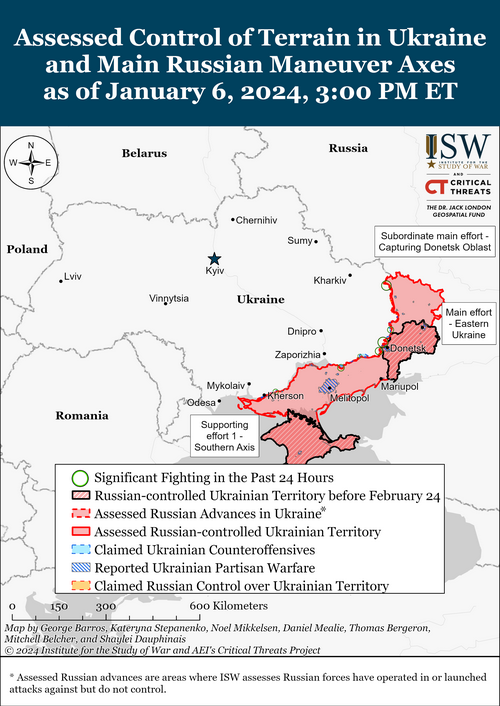
From The Institute for the Study of War:
Russian Offensive Campaign Assessment, January 6, 2024
Christina Harward, Riley Bailey, Grace Mappes, Karolina Hird, and Frederick W. Kagan
January 6, 2024, time 3:50pm ET
Click here to see ISW’s interactive map of the Russian invasion of Ukraine. This map is updated daily alongside the static maps present in this report.
Click here to see ISW’s 3D control of terrain topographic map of Ukraine. Use of a computer (not a mobile device) is strongly recommended for using this data-heavy tool.
Click here to access ISW’s archive of interactive time-lapse maps of the Russian invasion of Ukraine. These maps complement the static control-of-terrain map that ISW produces daily by showing a dynamic frontline. ISW will update this time-lapse map archive monthly.
Note: The data cut-off for this product was 12:00pm ET on January 6. ISW will cover subsequent reports in the January 7 Russian Offensive Campaign Assessment.
Ukrainian forces are conducting a multi-day strike campaign against Russian military targets in occupied Crimea and have successfully struck several targets throughout the peninsula. Russian sources claimed that Ukrainian forces struck an administrative building at the Russian airfield in occupied Saky, Crimea with up to four Storm Shadow cruise missiles on the night of January 5 to 6.[1] The Russian Ministry of Defense (MoD) claimed that Russian forces destroyed five Ukrainian drones and four missiles over the Black Sea and Crimea on the night of January 5 to 6 and six Ukrainian Neptune missiles over the northwestern Black Sea on January 6.[2] Ukrainian Air Force Commander Lieutenant General Mykola Oleshchuk thanked Ukrainian pilots for successfully striking targets at the Saky airfield but did not specify if he was referring to Ukrainian strikes on January 4, 5, or 6.[3] Oleshchuk posted satellite imagery showing the target of the reported successful Ukrainian strike at the Saky airfield, although ISW is currently unable to identify what the target was.[4] The Ukrainian Main Military Intelligence Directorate (GUR) stated on January 6 that the GUR, Ukrainian Air Force, and Ukrainian forces conducted a complex special operation that struck Russian radar positions at the Saky airfield and an equipment depot near Hryshyne (60km northeast of Yevpatoria) on January 4.[5] GUR posted satellite imagery showing damage to the Russian ammunition depot near Hryshyne.[6] Ukrainian officials and sources have reported that Ukrainian forces have also struck an air defense radar system and a communications center in Yevpatoria responsible for coordinating Russian air defense operations in occupied Crimea, ammunition warehouses near Pervomaiske (82km north of Simferopol), and a Russian command post near Sevastopol in strikes since January 4.[7] Ukrainian and Russian reporting indicates that Ukrainian missiles and drones are penetrating Russian air defenses in occupied Crimea and have successfully struck some intended targets.
A prominent Kremlin-affiliated Russian milblogger claimed that Ukrainian forces are conducting strikes aimed at degrading the Russian air defense umbrella over occupied Crimea.[8] ISW will not assess the intent of the current Ukrainian strike campaign against Russian rear areas in occupied Crimea at this time. Ukrainian forces conducted a strike campaign against Russian military infrastructure, headquarters, logistics routes, and Black Sea Fleet (BSF) assets in summer 2023 that pushed Russian naval operations out of the western part of the Black Sea and that aimed to degrade the Russian military’s ability to use Crimea as a staging and rear area for defensive operations in southern Ukraine.[9]
A Russian milblogger argued that Russian forces need to improve planning and coordination at the tactical and operational levels so that Russian offensive operations can break out of the current positional warfare in Ukraine.[10] The milblogger stated that Russian forces should not concentrate the attacking formations – especially mechanized units – in the intended directions of attack due to the threat of Ukrainian strikes against large force accumulations. The milblogger stated that Russian forces must precede any breakthrough with preparatory artillery fire against both the objective that Russian forces are attacking and Ukrainian artillery firing positions in a wider area within range of the objective. The milblogger emphasized the importance of coordinating the actions of various units, including allocating individual artillery units to cover certain sectors of the front and allocating some ammunition for preparing the battlefield while reserving ammunition for after the assault has begun. The milblogger noted that the attacking Russian units need to maintain uninterrupted communications and be able quickly to exchange intelligence data – coordination that the Russian military units on multiple fronts have struggled with in recent months, as ISW has frequently reported.[11] The milblogger observed that the Russian military command must understand and incorporate the battlefield geography and the array of Ukrainian forces and defenses in the area into battle plans.[12] ISW has not observed any indication that Russian forces have improved their ability to plan and coordinate offensive operations given the ongoing costly and disorderly Russian offensive effort near Avdiivka. Russian forces in Ukraine have proven capable of successfully adapting limited aspects of their operations or defensive efforts in certain sectors of the front, however.[13] It is unclear if the Russian command will be able to improve tactical and operational coordination across larger sectors of the front as the milblogger called for.
Western provision of air defense systems and missiles to Ukraine in the near- and medium-term remain crucial for Ukraine’s development of a defense industrial base (DIB) that can sustain Ukraine’s war effort against Russia in the long term. Ukrainian Deputy Defense Minister Lieutenant General Ivan Havrylyuk stated on January 6 that the Ukrainian Ministry of Defense (MoD) completed the approvals process for about 15 new types of weapons and military equipment, including robotic systems, drones, electronic warfare (EW) systems, engineering equipment, a modernized armored fighting vehicle, and anti-tank guided missiles systems and ammunition, to the Ukrainian Armed Forces in the first week of 2024.[14] This approvals process allows the Ukrainian MoD to make agreements with defense manufacturers and to issue the weapons to the Ukrainian military. Havrylyuk stated that the Ukrainian Armed Forces completed the approvals process for more than 200 types of domestically produced weapons and military equipment in 2023.
US State Department Spokesperson Matthew Miller stated on January 4 that the provision of US aid remains “critical” because Ukraine is not yet able to defend itself but will not need to continue at current levels because Ukraine is working to expand its defense industry to be able to “stand on its own feet.”[15] ISW previously assessed that recent large-scale Russian strikes targeted Ukrainian industrial facilities in an effort to degrade Ukraine’s ability to develop its DIB and sustain its war effort against Russia.[16] The configuration of Ukraine’s air defense umbrella, including Western-provided air defense systems, in targeted areas have proven vital to Ukraine’s ability to defend against Russian missiles, particularly ballistic missiles.[17] Ukrainian Commander-in-Chief General Valerii Zaluzhnyi stated on January 2 that Patriot systems enabled Ukrainian forces to down a record number of 10 Kinzhal hypersonic missiles during Russian strikes on January 1-2.[18] The New York Times (NYT) reported on January 6 that White House and Pentagon officials warned that the US will soon be unable to supply Ukraine with Patriot air defense missiles, however.[19]
The Danish Ministry of Defense (MoD) announced on January 6 that it is delaying its first delivery of six F-16 fighter jets to Ukraine for up to six months.[20] Danish officials previously stated that Denmark would deliver F-16s to Ukraine around the start of 2024, and a recent Estonian MoD strategy document identified Denmark as committed to delivering F-16s to Ukraine before the end of 2023.[21]
Key Takeaways:
- Ukrainian forces are conducting a multi-day strike campaign against Russian military targets in occupied Crimea and have successfully struck several targets throughout the peninsula.
- A Russian milblogger argued that Russian forces need to improve planning and coordination at the tactical and operational levels so that Russian offensive operations can break out of the current positional warfare in Ukraine.
- Western provision of air defense systems and missiles to Ukraine in the near- and medium-term remain crucial for Ukraine’s development of a defense industrial base (DIB) that can sustain Ukraine’s war effort against Russia in the long-term.
- The Danish Ministry of Defense (MoD) announced on January 6 that it is delaying its first delivery of six F-16 fighter jets to Ukraine for up to six months.
- Russian and Ukrainian forces continued positional engagements along the entire line of contact on January 6.
- The Russian Ministry of Defense (MoD) continues efforts to incentivize service with the Russian military by advertising support for housing.
- Russian occupation authorities are struggling to provide basic services to residents of occupied areas of Ukraine.
Go here to read the rest. Russia is an immensely more powerful nation than Ukraine, but in almost two years of war Russia has been unable to achieve air supremacy.

