
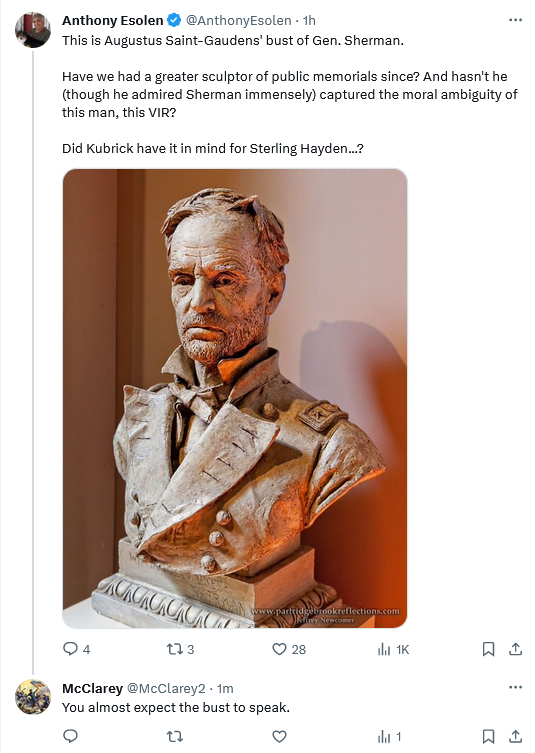
Civil War General William Tecumseh Sherman (1830-1891), venerated by the Union and vilified by the Confederacy, is remembered as a brilliant, if controversial tactician, and longtime commanding officer of the United States Army. During his triumphant—and destructive—”March to the Sea,” in 1864, he moved his troops three hundred miles across Georgia in twenty-four days. He retired from active duty in 1884 and relocated two years later to New York, where he frequently sat for portraits.
According to Saint-Gaudens, this vigorously naturalistic bust of Sherman in military uniform was modeled during eighteen visits, each lasting about two hours. The sculptor depicted Sherman exactly as he appeared during the sittings—with his deeply creased brow, stubbly beard, and unbuttoned collar. His steely independent streak is represented by the askew bowtie that he apparently refused to straighten during the sittings. The bust rests on a block inscribed with his name that itself surmounts a pillow of laurel leaves, bound by a ribbon, with a larger plinth below.
Go here to read the rest. Sherman had a cross-grained personality and did not suffer fools, and most non-fools gladly. That he gave thirty-six hours of his time to a sculptor indicates to me his faith that Saint-Gaudens would capture something of him to pass down to posterity. He was correct. He stared directly at the sculptor as he worked, which made his task more difficult, but an unlikely friendship resulted from the sittings between the man of war and the man of art.

