
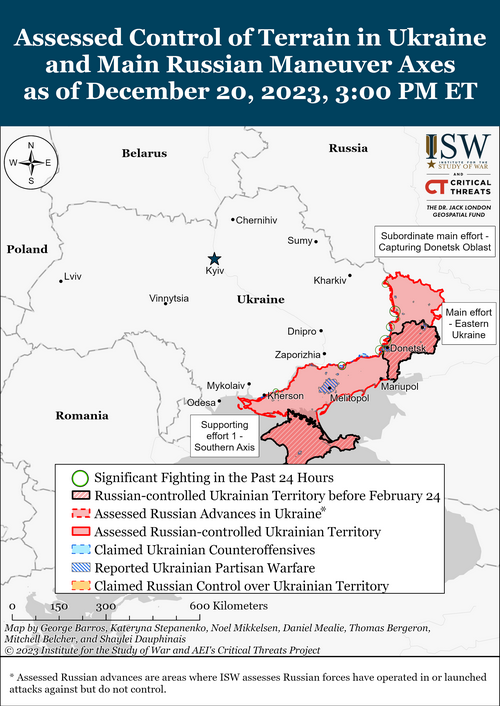
From The Institute for the Study of War:
Russian Offensive Campaign Assessment, December 20, 2023
Nicole Wolkov, Christina Harward, Karolina Hird, Kateryna Stepanenko, George Barros, and Frederick W. Kagan
December 20, 2023, 6pm ET
Click here to see ISW’s interactive map of the Russian invasion of Ukraine. This map is updated daily alongside the static maps present in this report.
Click here to see ISW’s 3D control of terrain topographic map of Ukraine. Use of a computer (not a mobile device) is strongly recommended for using this data-heavy tool.
Click here to access ISW’s archive of interactive time-lapse maps of the Russian invasion of Ukraine. These maps complement the static control-of-terrain map that ISW produces daily by showing a dynamic frontline. ISW will update this time-lapse map archive monthly.
Note: The data cut-off for this product was 12:30pm ET on December 20. ISW will cover subsequent reports in the December 21 Russian Offensive Campaign Assessment.
Head of the Kremlin-controlled Russian Orthodox Church Patriarch Kirill made a series of anti-migrant and xenophobic remarks that directly contradict Russian President Vladimir Putin’s ongoing efforts to reestablish the inclusive Russian World (Russkiy Mir) ideology. During the Moscow Diocesan Assembly on December 20, Kirill blamed migrants for increasingly threatening interreligious and interethnic peace in Russia by refusing to integrate into Russian society and forming criminal and extremist organizations.[1] Kirill added that life for the ethnically Russian “indigenous population” is almost unbearable in some areas, including Moscow, claiming that if such trends continue then the Russian Orthodox people will “lose Russia.” Kirill’s statements contrast with Putin’s recent efforts to present himself as a centrist figure and to reestablish the concept of the Russian World, which includes all people of different ethnicities and religious affiliations who have lived or are living in geographical areas that belonged to Ancient Rus (Kyivan Rus), the Kingdom of Muscovy, the Russian Empire, the Soviet Union, and the contemporary Russian Federation.[2] Putin notably also stated during the Meeting of the Council of Legislators on December 20 that the Russian constitution and government are trying to ensure harmony in a diverse and large Russia – reemphasizing his efforts to present Russia as an inclusive and harmonious multicultural Russian state.[3]
Putin, on the one hand, has been increasingly reimagining himself as a modern tsar who is defending Russian sovereignty to justify his war in Ukraine and to appease his ultranationalist constituencies who tend to have more intolerant views on religion and Russian identity.[4] But Putin has, on the other hand, been trying to seem to be an inclusive leader to incentivize all religious and ethnic groups to support his regime and war efforts. ISW assessed on November 28 that Kirill’s anti-migrant and xenophobic rhetoric is more closely aligned with Russian government policies towards migrants and non-Russian ethnicities in Russia than Putin’s more inclusive rhetoric in the context of the Russian World.[5] These narratives and policies are thus contradictory and may ultimately complicate Putin’s efforts to appease different constituency groups in Russia and may trigger further interethnic and interreligious conflicts.
Kremlin Spokesperson Dmitry Peskov explicitly stated that the Kremlin is uninterested in negotiations with Ukraine, suggesting that the Kremlin is moving away from its information operation meant to feign interest in negotiations. Peskov responded to a question on December 20 about Ukrainian President Volodymyr Zelensky’s December 19 statement that the issue of negotiations with Russia is currently “irrelevant,” stating that the Kremlin has repeatedly said that there is no “basis” or “foundation” for negotiations with Ukraine.[6] Peskov also stated that the “prerequisites” for negotiations are absent, likely referring to Russia‘s unchanged maximalist objectives in Ukraine – which are tantamount to full Ukrainian and Western surrender.[7] ISW has long assessed that the Kremlin does not intend to engage in serious negotiations with Ukraine or the West in good faith.[8] The Kremlin previously pushed information operations feigning interest in negotiations with Ukraine in order to cast itself as a responsible party and blame Ukraine for refusing “reasonable” Russian negotiations, but the Kremlin appears to be moving away from this information operation, as ISW suggested on December 15.[9]
Russian forces conducted another series of drone and missile strikes against Ukraine on the night of December 19 to 20. Ukrainian military sources reported that Russian forces launched 19 Shahed-131/136 drones at Ukraine from Chauda and Balaklava, occupied Crimea, and that Ukrainian forces shot down 18 of the drones over Kherson, Dnipropetrovsk, Vinnytsia, Khmelnytskyi, Kyiv, Chernihiv, and Kirovohrad oblasts.[10] The Ukrainian Air Force also reported that Russian forces launched two S-300 missiles at Kharkiv Oblast from Belgorod Oblast.[11] The Kyiv City Military Administration noted that this is the fifth Russian air attack against Kyiv Oblast in the month of December.[12]
The Russian Ministry of Defense (MoD)-controlled Africa Corps announced a recruitment campaign targeting former and current Wagner Group personnel and people with combat experience in the war in Ukraine. The Africa Corps, a Russian MoD initiative to expand Russian military presence in the Middle East and Africa, announced that it started recruitment on December 20.[13] Africa-focused Russian media outlet African Initiative stated that Russian Deputy Defense Minister Colonel General Yunus-Bek Yevkurov is “supervising” the new unspecified leadership of the Africa Corps.[14] The Africa Corps claimed that its command staff consists of former combat commanders of elite units in the Russian military and unspecified private military companies (PMCs) – possibly referring to the Redut PMC (affiliated with the Main Directorate of the Russian General Staff [GRU]).[15] The Africa Corps advertised an unspecified “high salary,” but noted that interested applicants who are currently fighting in the war in Ukraine cannot transfer to serve in the Africa Corps, though active-duty Russian military personnel not fighting in the war can transfer to serve in the Africa Corps.[16] The Africa Corps also clarified that an individual cannot transfer from Rosgvardia to the Africa Corps before completing their Rosgvardia contract.[17] The Africa Corps’ desire to clarify eligibility for service suggests that its advertisement campaign has successfully generated interest among former Wagner personnel given that some Wagner fighters signed contracts with the Russian MoD or Rosgvardia after the death of Wagner financier Yevgeny Prigozhin in August 2023.[18] The Africa Corps suggested that it would operate in Mali, Niger, and Burkina Faso – areas consistent with ISW’s previous assessment of the Africa Corps’ area of operations.[19]
Russian Prime Minister Mikhail Mishustin discussed bilateral economic cooperation with Chinese President Xi Jinping in Beijing on December 20. Mishustin stated that the previous two Russian-Chinese summits in March and October 2023 indicated the importance of further strengthening the “comprehensive partnership” and “strategic interaction” between the two countries.[20] Mishustin and Xi highlighted increased Russian-Chinese trade in 2023, which has reportedly already surpassed its goal of $200 billion, and Mishustin continued to claim that Russian and Chinese transactions are almost entirely done in national currencies (the yuan and ruble). China and Russia issued a joint communique on December 20 which stated that the “comprehensive strategic partnership” between the two countries is in line with the two states’ interests, not aimed at third parties, and not subject to external influence.[21] The communique highlighted Russian-Chinese energy and investment cooperation and the development of the Belt and Road Initiative (BRI). The communique included Russian statements about Taiwan but did not mention Ukraine, which suggests that the Kremlin continues to be concerned with China’s reticence to participate fully in the no-limits partnership that Russia wants to establish, and that China continues to hold the upper hand in the Russian-Chinese relationship.[22]
Moscow State University (MGU) is reportedly ending its master’s program in “information and hybrid warfare” aimed at teaching students how to create information operations and conduct hybrid warfare, generating outrage from Russian propagandist Vladimir Solovyov. MGU Higher School of Telecommunications Dean Vitaly Tretyakov defended MGU’s decision to discontinue the master’s program on Solovyov’s show on December 18 because students graduating from the program would face difficulties finding employment abroad.[23] Tretyakov also argued that the master’s program, which offers a course in “special propaganda” (a Russian term for information and psychological operations), would threaten MGU’s reputation.[24] Solovyov dismissed Tretyakov’s explanations and questioned the patriotism of MGU’s students and faculty.[25] Solovyov praised the now-closing master’s program and noted that Russian universities need to teach “special propaganda” and combat Western narratives of history.[26] Former Duma Deputy Elena Panina echoed Solovyov’s support for the program and claimed that the Russian government should fund similar programs at various universities.[27] MGU announced the creation of the master’s program in 2022, the same year it admitted its first class of students, reportedly to teach and promote Russian objectives for the war in Ukraine.[28] MGU also is reportedly closing the program due to the low salaries of the professors teaching its courses and an ongoing scandal regarding faculty bribery.[29]
The Kremlin continues to set conditions to create a veneer of legitimacy over the upcoming March 2024 presidential election. Russian Central Election Commission (CEC) Chairperson Ella Pamfilova reported on December 20 that the CEC has already received applications for 16 individuals who are running as presidential candidates and that 29 Russian federal subjects will use remote electronic voting for the first time during the presidential election.[30] ISW has long assessed that the Kremlin uses the remote electronic voting system to manipulate election results.[31] Russian State Duma Chairperson Vyacheslav Volodin claimed that Russia has developed all the necessary legal frameworks to ensure that the election is “competitive, open, and legitimate.”[32] By contrast, a Russian insider source claimed that the CEC has been tasked with ensuring a voter turnout of 75 percent, 80 to 85 percent of which will reportedly vote for Putin.[33] While ISW cannot independently verify the veracity of the insider source’s claim, the insinuation that the Kremlin is interested in creating the guise of Putin’s legitimate election is consistent with ISW’s assessment that Putin remains interested in engaging in legal theater to legitimize his regime.[34]
Key Takeaways:
- Head of the Kremlin-controlled Russian Orthodox Church Patriarch Kirill made a series of anti-migrant and xenophobic remarks that directly contradict Russian President Vladimir Putin’s ongoing efforts to reestablish the inclusive Russian World (Russkiy Mir) ideology.
- Kremlin Spokesperson Dmitry Peskov explicitly stated that the Kremlin is uninterested in negotiations with Ukraine, suggesting that the Kremlin is moving away from its information operation meant to feign interest in negotiations.
- The Russian Ministry of Defense (MoD)-controlled Africa Corps announced a recruitment campaign targeting former and current Wagner Group personnel and people with combat experience in the war in Ukraine.
- Russian Prime Minister Mikhail Mishustin discussed bilateral economic cooperation with Chinese President Xi Jinping in Beijing on December 20.
- Moscow State University (MGU) is reportedly ending its master’s program in “information and hybrid warfare” aimed at teaching students how to create information operations and conduct hybrid warfare, generating outrage from Russian propagandist Vladimir Solovyov.
- The Kremlin continues to set conditions to create a veneer of legitimacy over the upcoming March 2024 presidential election.
- Russian forces made a confirmed advance north of Bakhmut and continued positional meeting engagements along the entire line of contact.
- Russian officials issued military summonses to migrants at a naturalization ceremony on December 20 as part of ongoing efforts to target naturalized migrants for crypto-mobilization efforts and to placate the Russian ultranationalist community.
- Russian occupation administrators continue to use educational organizations to facilitate the temporary deportation of Ukrainians to Russia.
Go here to read the rest.
From Strategy Page:
December 20, 2023: At the end of 2023 Vladimir Putin ordered the military to increase active duty troops to 1.32 million. This involves finding another 170,000 recruits. If you include civilian military employees, the Russian military now have 2.2 million personnel. That’s 1.5 percent of the Russian population. At the beginning of 2023 there were purportedly 1.15 million Russian military personnel. By the end of 2023, Russian personnel losses in Ukraine had grown to over a million, of which at least half were permanent losses, mostly dead but also prisoners, missing and those discharged because of disabling wounds. About 40% of Russian casualties are dead compared to only 20% of Ukrainian casualties because the Russians in this war get no battlefield medical treatment whatever, though even in World War Two they did have at least minimal battle treatment, largely by dragging wounded off the battlefield (by female soldiers) to medics. Wounded soldiers in freezing conditions die of exposure or shock within about an hour unless they are carried to shelter, but that is not happening for Russians in this war. Prospective recruits know this.
Putin wants to replace those losses and increase the size of the military. To that he has to depend mostly on volunteers and former soldiers, or reservists. Then there are the conscripts, young men who are obliged to spend one year in the military. Once that year is over, these men are eligible to become reservists or, now that the military service law has changed, subject to mobilization to supply the military with more troops.
Mandatory conscript service brings in nearly 300,000 new troops a year. Half these men are called up between April and July while the other have are called up during the last few months of the year. This has been the way it has been done for over a century. Conscription gives Russia some badly needed military manpower but there is a catch. Conscripts only serve for one year and nominally cannot be sent into a foreign combat zone. Russian public will not tolerate tinkering with the 12-month limit and the post-communist Russian government lacks the coercive power to overcome that. Conscripts have been sent to the Ukraine war, but an uneasy de facto compromise has arisen that they can only be used in non-combat roles.
Since Putin ordered Ukraine invaded in February 2022, he has clashed with Russian attitudes towards conscription and lost. After the Soviet Union dissolved in 1991, the communist rule was replaced by democracy and frequent opinion polls. There were no professional politicians to make the new democracy work. There were former Soviet officials trying to get elected to powerful positions. More than ever before, these new political candidates had to pay close attention to public opinion. Former KGB officer Putin got elected once and managed to change the rules to keep him in office for as long as he likes or can survive. Putin also put all Russian media under state control. The catch was that successful dictators, and Putin is one, pay attention to public opinion because if too many of your subjects get too angry, it’s the end for the supreme leader. Russians experienced this in 1991 and even zealots like Putin must pay heed. Push the Russian people too far and they will push back.
Putin’s solution is to make the most of a bad situation. Conscripts currently get a few weeks of training followed by service doing any work they can handle. This allows many of the volunteer, or contract, soldiers to go to Ukraine, where the Russian personnel situation is desperate. Training for the conscripts ties up the few remaining military training facilities all the time, as almost all the pre-war training staff were sent to the Ukraine after the war started and became casualties themselves. Russian non-commissioned officers are basically useless because 70 years of the Red Army predecessor of the current Russian army destroyed their role as trainers and leaders of more junior enlisted men, and all attempts to revive an effective non-com system since 1991 have failed.
This makes it impossible to provide training for the contract soldiers or older men, former conscripts, mobilized into the military for as long as the government can get away with it. Few Russian men serve in Ukraine voluntarily and most are coerced or tricked into volunteering, with a few persuaded by offers of high pay, which they rarely get, or are convicts spending six months in Ukraine to get a full pardon. Putin’s alleged plan is to obey the law about not sending conscripts into battle, and hope to later persuade them, after their discharge, to volunteer for some form of mobilization. Putin lacks sufficient internal security forces to overcome a lot of public opposition to his seriously unpopular or illegal schemes, so he has to be resourceful.
The fighting in Ukraine crippled the Russian ground forces and destroyed most of the modern equipment Putin had managed to manufacture since the early 2000s. Economic sanctions reduced the amount of money he has available for military operations. Sanctions have also increased the percentage of Russians living below the poverty line. Putin embarrassed himself in Ukrainian because he initially boasted that the victory in Ukraine would be quick and relatively painless because the Ukrainians were not willing or able to fight and most accepted the Putin view that Ukraine was actually part of Russia that got confused and lost their way. The Ukrainians were better prepared, armed, and motivated to defeat the invading Russians. Putin’s response was that it was NATO forces that inflicted all those casualties on Russian troops. That fiction worked for a short while because state-controlled media had been pushing the idea that NATO was conspiring to destroy Russia. That fable faded as the months of defeats went by and Russians were told by returning wounded soldiers that Ukrainians were fighting back and simply doing so more effectively than anyone expected. Many Russians have family, friends, or contacts in Ukraine and that, added to what Russian soldiers who had returned Ukraine said put an end to the blame NATO. Putin propagandists had to come up with a new explanation for the mess in Ukraine and he came up with a reheated version of the; NATO is trying to destroy Russia, explanation for the mess in Ukraine.
Russia has a problem with the fact that for over a year Russian soldiers have been fighting in another country and getting killed or wounded in large numbers. Russia had not been invaded and Putin sought to portray it as a successful Russian defense of the homeland. Once more, Russians eventually see through that disinformation by paying attention to Ukrainian media which makes no mention of plans to invade Russia, only efforts to get Russian soldiers out of Ukraine. Putin also tried, with some success, to persuade people in nations supporting Ukraine with weapons and money that Ukraine is not worth the expense because of a growing list of Russian short shelf-life disinformation.
Russia has few allies or foreign supporters and most of these, like Iran, North Korea, Syria, and Cuba have little to give. China could provide lots of tangible support but prefers not to because China believes the Ukrainian operation was a stupid idea and does not want to get hit with sanctions for providing military support for Russia. China and India both advise Putin to just get out of Ukraine and out from under all those sanctions before long-term damage is done to Russia.
Putin is working on what he agrees are needed reforms so that the next time Russian troops are in combat they will perform better and perhaps even win. There have been several rounds of unsuccessful military reforms since the Soviet Union collapsed in 1991. One of the major causes of that collapse was their unaffordable and largely ineffective armed forces. In post-Soviet Russia there were far fewer restrictions on criticizing the military. Most Russians had a very negative attitude towards conscription and the reforms underway because of the Ukraine War disaster were seen as typical of several previous efforts to remedy problems that continue to resist any fundamental change.
The new plan calls for a massive training program to replace all the officers lost in the first few months of 2022’s fighting. The immediate problem with that is all the officer instructors were sent to the front in March and April 2022 where they too became casualties. Next is another serious problem that few want to discuss, corruption. Even in wartime, especially during the recent fighting, corruption was still a problem. Officers and other government officials continued to put their own financial gain above the need to equip the troops with what they needed to survive and win. There have been several corruption scandals in Russia since the Ukraine War began. The military’s corruption is rooted in political corruption at the highest levels including Putin and his cronies, and inevitably drifted downward until even supply sergeants routinely steal back and sell gear issued to new troops when they are outside their barracks just before leaving for the front. Russia is descending into a Third World state known as a resource kleptocracy but run by a for-real gangster confederacy. Only with nuclear and biological weapons from before the Soviet Union collapsed.
Go here to read the rest. Putin believes that his Ukraine War is a means of restoring Russian greatness. Instead he is merely exacerbating weaknesses in the Russian military.

