
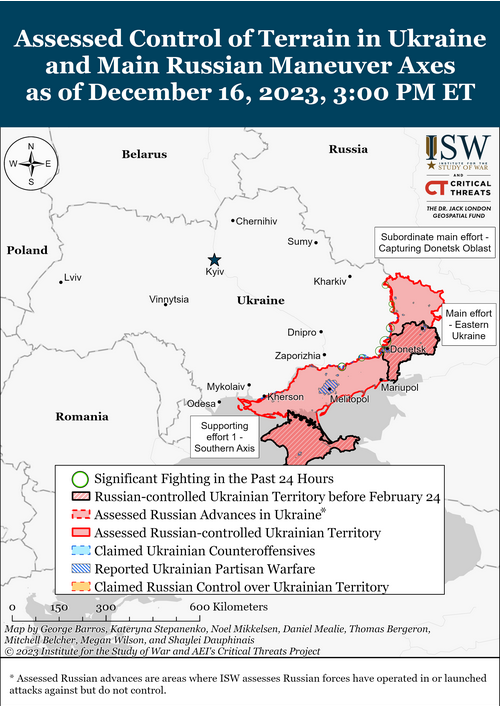
From The Institute For The Study of War:
Russian Offensive Campaign Assessment, December 16, 2023
Riley Bailey, Kateryna Stepanenko, Christina Harward, Angelica Evans, and Frederick W. Kagan
December 16, 2023, 8:10pm ET
Click here to see ISW’s interactive map of the Russian invasion of Ukraine. This map is updated daily alongside the static maps present in this report.
Click here to see ISW’s 3D control of terrain topographic map of Ukraine. Use of a computer (not a mobile device) is strongly recommended for using this data-heavy tool.
Click here to access ISW’s archive of interactive time-lapse maps of the Russian invasion of Ukraine. These maps complement the static control-of-terrain map that ISW produces daily by showing a dynamic frontline. ISW will update this time-lapse map archive monthly.
Note: The data cut-off for this product was 1:00 pm ET on December 16. ISW will cover subsequent reports in the December 17 Russian Offensive Campaign Assessment.
Ukrainian forces continue operations on the east (left) bank of the Dnipro River in Kherson Oblast amid reported difficult conditions in the area as part of an apparent effort to set conditions for future Ukrainian operations and the resettlement of west (right) bank Kherson Oblast. The New York Times published a series of interviews with Ukrainian military personnel operating on the east bank and along the Dnipro River on December 16, wherein the commander of a Ukrainian regiment stated that Ukrainian drone strikes have heavily suppressed Russian long-range artillery on the east bank in recent months.[1] Ukrainian officials previously stated that Ukrainian forces established several bridgeheads on the east bank as part of an operation that aims to push Russian forces out of artillery range of west bank Kherson Oblast.[2] The reported suppression of long-range Russian artillery may allow Ukrainian forces to operate more freely in near rear areas in west bank Kherson Oblast, which may partially explain intensified Russian glide bomb strikes against Ukrainian targets on the west bank.[3] The much more abundant 152mm tube artillery systems that Russian forces widely operate in Ukraine have an approximate range of 25km, although Russian forces are unlikely to deploy these systems to immediate frontline areas due to the threat of Ukrainian counterbattery fire.
The withdrawal of tube artillery beyond 25km from the west bank and the suppression of long-range Russian artillery would remove consistent threats to populated areas on the west bank and allow the many Ukrainians who fled the Russian occupation of west bank Kherson Oblast to return more safely. The reduction of Russian artillery fire on the west bank would also allow Ukrainian forces to operate more freely along ground lines of communication (GLOCs), deploy more critical counterbattery and air defense systems within the vicinity of the Dnipro River, and more securely launch operations across the Dnipro River. A bridgehead is meant to provide security for crossing forces to continue operations, and the withdrawal of Russian artillery further from the Dnipro River would establish a safer position from which to conduct future operations if the Ukrainian high command so chose.[4]
The Ukrainian commander also reportedly stated that Ukrainian operations on the east bank of the Dnipro River currently aim to draw Russian forces to the area and inflict heavy losses upon them.[5] The Ukrainian commander reportedly added that the effort to draw Russian forces to the area has been successful as the Russian command transferred unspecified Russian Airborne (VDV) elements from western Zaporizhia Oblast to east bank Kherson Oblast.[6] Russian officials have acknowledged that elements of the 7th VDV Division are operating in Kherson Oblast, and it is possible that limited elements of the 7th VDV division operating near Robotyne in western Zaporizhia Oblast (the 247th VDV Regiment, the 108th VDV Regiment, and the 56th VDV Regiment) have redeployed to defend on the east bank, although ISW has observed elements of those units still committed to defending and counterattacking in western Zaporizhia Oblast.[7] Ukrainian military officials previously reported that Ukrainian operations on the east bank between October 17 and November 17 killed 1,126 Russian personnel and wounded 2,217, suggesting that Ukrainian forces may be inflicting significant losses on Russian forces in the area.[8] Russian President Vladimir Putin similarly described Russian defensive operations on the east bank as an intentional attempt to lure and attrit Ukrainian forces, however, and ISW cannot currently assess if there is an asymmetrical attrition gradient in this sector of the front. The degradation of defending Russian forces on east bank Kherson Oblast may be an immediate operational objective, but one that can facilitate the wider stated operational objective of pushing Russian forces out of artillery range of west bank Kherson Oblast.
The New York Times also published interviews with Ukrainian soldiers who have fought on the east bank who described difficult conditions in operating across the Dnipro River and in establishing positions on the east bank.[9] These difficulties are to be expected for what is an economy of force operation with limited positions on a riverbank and may continue until Ukrainian operations set conditions for a more secure Ukrainian bridgehead if the Ukrainian high command chooses to seek to establish one. The expressed Ukrainian objective to push Russian artillery away from the Dnipro River would partially address some of the difficult conditions that Ukrainian personnel described if fully achieved.
Russian President Vladimir Putin’s supporters formally nominated him as an independent candidate for the 2024 presidential elections on December 16, further solidifying Putin’s image as a figure above the Russian political system. The Russian “initiative group of voters” composed of over 500 politicians, actors, athletes, milbloggers, occupation officials, and even a Donetsk People’s Republic’s (DNR) battalion commander, unanimously supported Putin’s decision to run as a self-nominated candidate during the elections.[10] Secretary of the United Russia Party’s General Council Andrey Turchak stated that Putin will be able to establish his election campaign headquarters after completing all procedures for self-nomination – such as registering the initiative group and gathering 300,000 constituents’ signatures – and that the United Russia Party fully supports Putin’s campaign.[11] Russian Prime Minister Mikhail Mishustin also stated that the entire Russian government is “Putin’s team” and that Putin’s decision to run in the presidential elections corresponds to constituencies’ demands.[12] Putin had previously run as an independent candidate in 2018, and ISW’s non-resident Russia fellow Nataliya Bugayova then assessed that Putin creates conditions in which most Russians believe that other Russians support him – an outcome that self-nomination is likely meant to simulate.[13] Bugayova also assessed in 2018 that Putin cares about the perceived legitimacy of the presidential elections, despite the fact that most Russians recognize the regime’s policy failures and the limitations it imposes on their civil liberties. The proclaimed support for Putin of the United Russia Party, other factions, and the government creates the illusion that Putin stands above the Russian political fray and establishes him as a unique figure uniting all of Russia.
Putin also met with faction leaders, Chairman of the Russian State Duma Vyacheslav Volodin, and First Deputy Chief of Staff of the Russian Presidential Administration Sergei Kiriyenko on December 15 to similarly portray himself as above Russian politics.[14] Putin told faction leaders that the presidential election must happen on a competitive basis and called on them to form their positions with a deep understanding of Russian national interests and their responsibility to the Russian public. Putin appears to be positioning himself as a referee able to speak to and guide Russian factions from above even as he nominally “runs” for an office he is certain to win. Putin likely seeks to portray himself as above Russian politics in an effort to distance himself from the controversies of some of these factions and appear as a singular candidate – a role-play that is likely increasingly important to Putin as the veneer of competitive elections in Russia becomes ever thinner.
Russia’s First Deputy Permanent Representative to the United Nations Dmitri Polyanskiy more clearly defined recent statements from high-ranking Russian officials that align with ISW’s long-standing assessment that Russia is unwilling to negotiate with Ukraine in good faith. Polyanskiy stated on December 16 that Ukraine missed its chance to negotiate a “favorable” settlement and that any possible “deal” between Russia and Ukraine would have to entail Ukrainian “capitulation.”[15] Polyanskiy’s statement more clearly explicates Russian Foreign Minister Sergei Lavrov’s statement of December 15, which said the same thing in slightly more coded language.[16] Russian President Vladimir Putin stated on December 14 that Russia’s maximalist objectives in Ukraine – which are tantamount to full Ukrainian and Western surrender – are unchanged.[17]
Putin responded to a question from a French correspondent during Putin’s “Direct Line” forum on December 14 about Putin’s possible plans to speak with French President Emmanuel Macron, stating that he and Macron used to enjoy a good working relationship but that Macron stopped this relationship.[18] Macron stated on December 15 that he would speak to Putin if Putin had any “serious proposals” for establishing peace in Ukraine.[19]
Russian forces launched another series of Shahed-136/131 drone strikes across Ukraine overnight on December 15 to 16. Ukrainian military officials reported that Russian forces launched 31 Shaheds from Bryansk Oblast, Primorsko-Akhtarsk (Krasnodar Krai), and Kursk Oblast and that Ukrainian forces shot down 30 Shaheds over Dnipropetrovsk, Kyiv, Vinnytsia, Chernihiv, Poltava, Cherkasy, Kherson, Zaporizhia, Mykolaiv, and Khmelnytskyi oblasts.[20] Ukraine’s Southern Military Command reported that 12 Shaheds targeted southern Ukraine.[21] Ukrainian Air Force Spokesperson Colonel Yuriy Ihnat stated that Russian forces can launch Shahed drones from a vehicle and that Shahed launchers are mobile.[22] Ihnat added that Russian forces are trying to change Shahed routes by moving them five to 10 kilometers to the left or right to bypass Ukrainian air defenses and reiterated that Ukrainian mobile fire groups are actively destroying Russian drones. Ihnat also observed that Russian forces started launching Shaheds from that Balaklava area (south of Sevastopol) in occupied Crimea – making Balaklava the fifth Russian launching area for Shahed drones.[23]
The Financial Times (FT) reported on December 15 that the G7 may consider using frozen Russian assets to fund Ukraine.[24] FT reported that US officials circulated a discussion paper about how G7 members and other states could seize Russian sovereign assets in a way “consistent with international law” as a “countermeasure to induce Russia to end its aggression” in Ukraine during G7 committee meetings. FT reported that the G7 could use a portion of the $300 billion worth of frozen Russian assets to fund assistance packages to Ukraine and that a US official stated that G7 leaders may discuss the proposal at their meeting in February 2024.
Russian actors continue information operations aimed at discrediting and dividing Ukraine’s military and political leadership, specifically Ukrainian President Volodymyr Zelensky and Commander-in-Chief General Valerii Zaluzhnyi. Ukrainian Defense Minister Rustem Umerov stated on December 16 that Russia is working to discredit Ukraine in the information space by creating artificial conflict within Ukraine’s leadership and a false illusion that Ukraine does not have the support of its Western partners.[25] The Atlantic Council’s Digital Forensic Research Laboratory (DFRLab) and the BBC’s Verify project published a joint report on December 16 that details a Russian information operation that levied corruption accusations against former Ukrainian Defense Minister Oleksii Reznikov ahead of his resignation in September 2023.[26] DFRLab and Verify concluded that Russian actors created thousands of fake accounts aimed at defaming Reznikov and connected the effort to a previous Russian information campaign to discredit Zaluzhnyi in early 2023.[27] ISW has consistently observed Russian actors, including Russian Foreign Intelligence Service (SVR) Director Sergei Naryshkin and Russian Foreign Ministry Spokesperson Maria Zakharova, baselessly claim that high-ranking Western officials intend to “replace” Zelensky and that there is an unspecified conflict between Zelensky and Zaluzhnyi.[28] Russian sources are increasingly promoting reports about internal Ukrainian political tension in an effort to discredit Ukrainian leadership, sow domestic distrust between Ukrainian citizens and the government, and weaken Western support for Ukraine.[29]
A Russian “Storm-Z” assault unit instructor implied that Russian President Vladimir Putin lied about the unregulated status of private military companies (PMCs) during his “Direct Line” forum on December 14 given the state’s significant administrative control over PMCs and other irregular formations.[30] The instructor quoted Putin’s claim that the state cannot account for elements of illegal PMCs fighting in Ukraine because these troops sign contracts directly with the PMCs, which complicates Russia’s ability to grant veteran statuses and provide state benefits. The instructor responded by stating that the Russian State Duma had already adopted a bill in April 2023 that allows the state to recognize all individuals that have fought in Ukraine as veterans, likely implying that the state already has the responsibility to provide veteran statuses to all combatants – even if PMCs are technically illegal.[31] The instructor’s statement was also likely in response to Putin’s concluding observation that Russia might need to adjust the law to account for PMC personnel.[32] The instructor noted that while PMCs, volunteer formations, and other irregular forces may appear as “a whole scattering of some murky and incomprehensible structures,” the Russian Ministry of Defense (MoD) and other Russian institutions account for these troops when they sign contracts or fill out certain questionnaires before being placed in irregular units. The instructor noted that Russia has documentation of most personnel entering volunteer formations under a voluntary contract and that Russian officials improved documentation after they began the formalization campaign in 2023. The instructor further challenged Putin’s claim that most PMC fighters received payments in cash for their service and noted that state structures determine monetary allowances for irregular forces. The instructor observed that the underlying issues are that the Kremlin did not task the MoD officials with ensuring that irregular forces receive their promised benefits, and that the Russian military enlistment system is struggling to account for Russian regular forces not including irregular forces.
The instructor also observed that Russia began to replenish volunteer formations – which operate as irregular forces alongside Russian Armed Forces – with contract servicemen (kontraknik), mobilized personnel, and convicts in 2023.[33] This observation further implies that Russia has notable administrative control over irregular forces, given that mobilized personnel and kontrakniki are part of the Russian Armed Forces and cannot serve in volunteer formations without a directive of the Russian MoD.[34] The Kremlin has to pardon convicts in order for them to serve in volunteer formations. The instructor’s observations not only invalidate Putin’s efforts to distance himself from his decision to expand irregular forces to support his war in Ukraine, but further confirm prior media investigations into the Kremlin’s control of irregular forces.[35] ISW has routinely assessed that Putin’s vast crypto-mobilization campaign that aimed to avoid declaring full-scale mobilization is committing Russia to a long-term financial responsibility – a responsibility that Putin is attempting to downplay.[36]
Key Takeaways:
- Ukrainian forces continue operations on the east (left) bank of the Dnipro River in Kherson Oblast amid reported difficult conditions in the area as part of an apparent effort to set conditions for future Ukrainian operations and the resettlement of west (right) bank Kherson Oblast.
- Russian President Vladimir Putin’s supporters formally nominated him as an independent candidate for the 2024 presidential elections on December 16, further solidifying Putin’s image as a figure above the Russian political system.
- Russia’s First Deputy Permanent Representative to the United Nations Dmitri Polyanskiy more clearly defined recent statements from high-ranking Russian officials that align with ISW’s long-standing assessment that Russia is unwilling to negotiate with Ukraine in good faith.
- Russian forces launched another series of Shahed-136/131 drone strikes across Ukraine overnight on December 15 to 16.
- The Financial Times (FT) reported on December 15 that the G7 may consider using frozen Russian assets to fund Ukraine.
- Russian actors continue information operations aimed at discrediting and dividing Ukraine’s military and political leadership, specifically Ukrainian President Volodymyr Zelensky and Commander-in-Chief General Valerii Zaluzhnyi.
- A Russian “Storm-Z” assault unit instructor implied that Russian President Vladimir Putin lied about the unregulated status of private military companies (PMCs) during his “Direct Line” forum on December 14 given the state’s significant administrative control over PMCs and other irregular formations.
- Russian forces conducted offensive operations along the Kupyansk-Svatove-Kreminna line, near Bakhmut, near Avdiivka, west and southwest of Donetsk City, in the Donetsk-Zaporizhia Oblast border area, and in western Zaporizhia Oblast on December 16 and advanced in some areas.
- A Russian milblogger claimed that Russia will have at least ten Project 22350 Admiral Gorshkov-class frigates in an unspecified time period.
- Ukrainian Mariupol Mayoral Advisor Petro Andryushchenko and the Ukrainian Telegram channel Mariupol Resistance stated on December 16 that Ukrainian partisans recently blew up the car of the commander of an unspecified Russian unit from the North Caucasus in occupied Mariupol.
Go here to read the rest. More of the same as the War is in a winter lull.

