
From The Institute For The Study of War:
Russian Offensive Campaign Assessment, December 9, 2023
Karolina Hird, Grace Mappes, Angelica Evans, Christina Harward, and Frederick W. Kagan
December 9, 2023, 6pm ET
Click here to see ISW’s interactive map of the Russian invasion of Ukraine. This map is updated daily alongside the static maps present in this report.
Click here to see ISW’s 3D control of terrain topographic map of Ukraine. Use of a computer (not a mobile device) is strongly recommended for using this data-heavy tool.
Click here to access ISW’s archive of interactive time-lapse maps of the Russian invasion of Ukraine. These maps complement the static control-of-terrain map that ISW produces daily by showing a dynamic frontline. ISW will update this time-lapse map archive monthly.
Note: The data cut-off for this product was 12:45 pm ET on December 9. ISW will cover subsequent reports in the December 10 Russian Offensive Campaign Assessment.
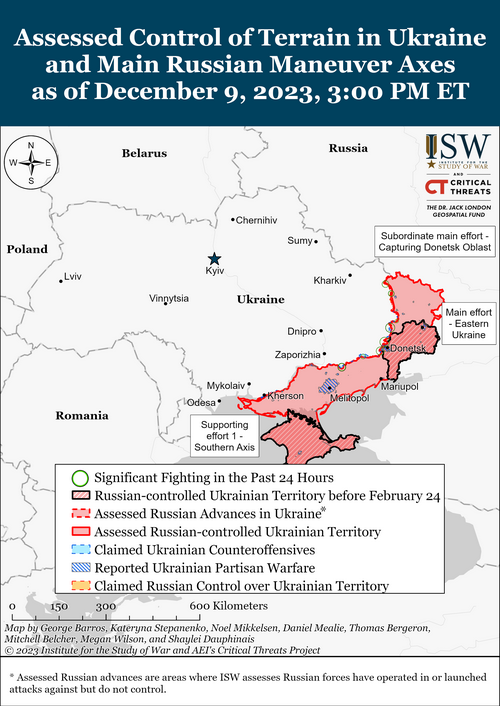
Russian forces have likely committed to offensive operations in multiple sectors of the front during a period of the most challenging weather of the fall-winter season in an effort to seize and retain the initiative prior to the Russian presidential elections in March 2024. Russian forces are currently pursuing offensive efforts along much of the frontline in Ukraine, particularly along the Kharkiv-Luhansk Oblast border, near Bakhmut, and towards Avdiivka as Ukrainian military officials have repeatedly noted, and Russian forces are also conducting continuous ground attacks in western Zaporizhia Oblast.[1] The current pace of fighting across the entire frontline in Ukraine is generally consistent with ISW’s standing assessment that Russian forces have been trying to regain the theater-level initiative since at least mid-November 2023.[2] Recent Ukrainian military official statements further suggest that Russian forces have succeeded in seizing the initiative along the Kharkiv-Luhansk Oblast border, near Bakhmut, and along the Avdiivka-Donetsk City axis, while Ukrainian forces maintain the initiative in key areas of southern Ukraine, as evidenced by continued Ukrainian counterattacks in western Zaporizhia Oblast and the sustained, larger-than-usual Ukrainian presence in east bank Kherson Oblast.[3]
It is noteworthy that Russian forces have made a concerted effort to regain the theater-wide initiative and initiate offensive operations during the period of the most difficult weather conditions for mechanized offensive operations in the fall, supporting ISW’s long-standing assessment that poor weather conditions may slow but do not stop combat along the frontline.[4] Russian forces likely chose to attempt to regain the initiative during such poor weather because Ukrainian forces had largely deprived Russian forces of the ability to regain the initiative and conduct offensives during the summer period of weather much more conducive to military operations.[5] Russian concern over the impending Ukrainian counteroffensive even preceding the start of the Ukrainian counteroffensive in early June 2023 kept Russian forces in southern Ukraine in the first half of 2023 on the defensive, depriving them of the ability to pursue offensive opportunities in the south in that period.
Over the past several weeks, Russian forces have continued offensive operations along the Kharkiv-Luhansk Oblast border despite snow, frost, and mud in eastern Ukraine, and have conducted continuous ground attacks in western Zaporizhia Oblast despite muddy conditions and strong winds throughout most of the south.[6] Large areas of the frontline, particularly in northeastern and eastern Ukraine, are now transitioning into a period of hard freeze as the temperatures drop and the muddy ground freezes over, which will facilitate mechanized operations for both Russian and Ukrainian forces. The fact that Russian forces sought to seize the initiative and pursue offensive operations in early to mid-November 2023, during the most challenging weather conditions of the year, rather than waiting for the hard freeze suggests that Russian forces are under pressure to fully seize and maintain the initiative into the early months of 2024 prior to the upcoming March 2024 Russian presidential elections. The Russian command may also have sought to cause the Ukrainian counteroffensive to culminate or to ensure that Ukrainian forces would be unable to resume it early this winter. The timing of events suggests, however, that Kyiv had decided to significantly scale back its counteroffensive operations of its own accord before the Russian offensive operations began.
It remains unclear whether current Russian offensive operations will set conditions for Russian forces to make operationally significant gains in the near future, however. Difficult weather conditions have likely slowed the rate of Russian advance along much of the frontline, increased Russian losses, and further damaged the morale of Russian soldiers. The rate of Russian losses along the entire frontline in Ukraine appear to be close to the rate of Russian force generation, as ISW has previously observed, likely indicating that Russian forces are not amassing uncommitted reserves in preparation for more extensive winter operations.[7]
Ukrainian forces, by contrast, appear to be using this period of challenging weather and ongoing Russian offensive operations to establish and consolidate defensive positions along the parts of the frontline where they have not been conducting counteroffensive operations, thereby conserving manpower and resources for future offensive efforts. Ukrainian President Volodymyr Zelensky and Ukrainian Commander-in-Chief General Valerii Zaluzhnyi recently signaled Ukraine’s current intent to increase fortifications and defensive capabilities throughout the theater, particularly in the aforementioned areas of the front where Russian forces are pursuing offensive operations.[8] The establishment of Ukrainian tactical defensive positions will most likely strengthen Ukrainian forces’ capabilities to defend against ongoing and costly Russian attacks with fewer forces of their own and/or while suffering fewer casualties in the defense. Furthermore, the establishment of Ukrainian tactical defensive positions may become a springboard for future Ukrainian offensive operations where and when Ukrainian forces choose to re-initiate offensive operations. The establishment of local defensive positions in areas Kyiv is not prioritizing for current or imminent counteroffensive operations is a prudent step and not an indication that Ukraine has abandoned all plans for future counteroffensives.
The Kremlin-backed United Russia party is spearheading Russian President Vladimir Putin’s nomination as an independent candidate in the 2024 Russian presidential election, and Putin’s re-election campaign initiatives group includes people with a variety of backgrounds and constituencies to create the image of widespread support for Putin’s presidency. Putin’s re-election campaign initiatives group includes United Russia Secretary Andrei Turchak, Young Guard of United Russia Chairperson Anton Demidov, and other figures from the military, arts, medicine, and sports.[9] Turchak stated that the United Russia party and its All-Russian Popular Front social movement will organize the procedures necessary to nominate Putin, including collecting signatures and conducting his election campaign.[10] The re-election campaign initiatives group also includes Donetsk People’s Republic (DNR) “Sparta” Battalion Commander and Speaker of the DNR Parliament Artem Zhoga, whom the Kremlin portrayed on December 8 in Putin’s presidential bid announcement as responsible for prompting Putin to run for re-election.[11] A Russian insider source claimed on December 9 that the Kremlin is considering Zhoga for several high political positions following the 2024 elections, including the Deputy Speaker of the Russian State Duma or the head of the DNR should current DNR Head Denis Pushilin resign or transfer to another position.[12] Zhoga’s rapid political advancement, if it occurs, may create tension in the Pushilin-Putin relationship, which may in turn impact aspects of Russia’s occupation of Donetsk Oblast during the election cycle.
Multiple Russian political opposition figures have reportedly developed a common campaign strategy for the upcoming presidential campaign cycle aimed at compelling Putin to address topics he seeks to avoid and revealing the breadth of Russian opposition against Putin. Imprisoned opposition figure Alexei Navalny’s team announced the Anti-Corruption Foundation’s (FBK) election strategy on December 7, which involves calling on Russians to advocate against Putin en masse for 100 days leading up to the election and voting for any candidate except for Putin.[13] Former FBK Chairperson Leonid Volkov noted in a statement to opposition outlet Meduza on December 9 that many outlets are misreporting the FBK’s strategy as simply voting against Putin and stated that the vote alone will not make an impact.[14] Volkov stated that the FBK aims to force Putin to confront difficult topics that he seeks to avoid, such as the Russian war in Ukraine, and noted that these topics are Putin’s “weak point.” Volkov noted that the FBK does not expect to oust Putin from office through this campaign strategy. Russian politician and opposition figure Maxim Kats stated to Meduza on December 9 that he approves of the FBK’s strategy and that the next step in this strategy is to develop a united campaign headquarters to combine resources and that many opposition entities have agreed to join and expressed hope that the FBK will also join.[15] Kats stated that this campaign aims to galvanize enough Russians to vote against Putin that they will protest when the Central Election Commission (CEC) falsifies votes in favor of Putin, ultimately revealing to the world, Russian elites, and even Putin himself how many Russians actually oppose Putin. Russian opposition activist Mikhail Khodorkovsky expressed support for the FBK’s strategy on December 7, encouraged Russians to boycott voting or cast protest votes as part of a “No to Putin” strategy, and stated that these efforts aim to show Putin that Russians are “tired” of him.[16]
Select Russian milbloggers accused the Armenian government of promoting Russophobic policies that inspire violence against Russian media figures in Armenia on December 9. Russian milbloggers seized on footage of an Armenian man assaulting a Russian social media figure in Yerevan on December 9, claiming that Armenian Prime Minister Nikol Pashinyan’s “Russophobic policies” and “dehumanization” of Armenian men are inspiring violence against Russians.[17] One milblogger claimed that ethnic Armenians living in Russia should consider the dangers of Pashinyan’s policies and warned against the possibility of war between Russia and Armenia.[18] Russian sources, including ultranationalist milbloggers and the Ministry of Foreign Affairs (MFA), previously expressed anger and accused Armenia of targeting Russians following the detention of a pro-Russian blogger in Armenia in September 2023.[19] Perceived crimes against Russian public figures may become a more prominent point of tension within the Russian ultranationalist information space amid the increasingly deteriorating Russia-Armenia relationship.[20]
The European Union (EU) will allow member states to restrict Russian gas imports in an effort to restrain Russian petroleum revenues. The EU Council and Parliament reached a provisional agreement regarding hydrogen and gas market regulations on December 8 that allows EU states to restrict imports of natural gas, including liquified natural gas (LNG), from Russia or Belarus.[21] Bloomberg reported on December 6 that Russia’s net oil revenue in October 2023 was the highest since May 2022 and that Russia’s domestic oil tanker fleet and “shadow fleet” allowed Russian officials to control exports and increase prices despite the G7’s and EU‘s price cap on Russian petroleum products in established December 2022.[22]
A prominent Russian milblogger claimed that Russian decoy missiles failed to overwhelm Ukrainian air defenses during December 8 missile strikes against Kyiv City. The milblogger claimed on December 9 that Russian forces used decoy Kh-55 cruise missiles, which closely resemble the modernized Kh-101 missile variant, to confuse Ukrainian air defenses.[23] The milblogger claimed that Russia’s use of decoy missiles explains why Russian missiles did not successfully strike any targets in Kyiv City.[24] The milblogger complained that it is “virtually impossible” for Russian forces to launch enough decoy Kh-55 missiles to overload Ukrainian air defenses due to Russia’s limited number of Tu-95 and T-160 bombers.[25] Russian forces previously used Kh-55 missiles along other missile and drone variants as decoys to overwhelm Ukrainian air defenses and compensate for dwindling high-precision missile stockpiles.[26] Ukrainian officials have repeatedly emphasized that Ukrainian forces do not have enough air defense systems to cover all areas of Ukraine to the same degree that Ukrainian air defenses currently protect Kyiv.[27] Ukrainian military observer Kostyantyn Mashovets reported on December 8 that Russian forces are conducting increased aerial reconnaissance prior to launching large-scale long-range strikes against targets in eastern and southern Ukraine.[28] Mashovets stated that Russian forces conducted seven reconnaissance flights ahead of the December 8 missile strikes, a notable increase compared to one to two flights on the previous days.[29] Russian forces are likely attempting to counter Ukraine’s limited air defenses ahead of an anticipated large-scale winter strike campaign.[30]
Ukrainian Defense Minister Rustem Umerov highlighted Ukrainian anti-corruption efforts and preparations for the arrival of F-16 fighter jets in the near future on December 9. Umerov met with US Department of Defense (DoD) Inspector General Robert Storch on December 9 and stated that Ukraine has already begun to work with the Office of the Inspector General on a system to control and prevent violations and crimes involving American security assistance to Ukraine.[31] Umerov also announced on December 9 that Ukraine will soon receive F-16 fighter jets and that Ukraine is already preparing infrastructure for the jets’ arrival.[32]
Key Takeaways:
- Russian forces have likely committed to offensive operations in multiple sectors of the front during a period of the most challenging weather of the fall-winter season in an effort to seize and retain the initiative prior to the Russian presidential elections in March 2024.
- Ukrainian forces, by contrast, appear to be using this period of challenging weather and ongoing Russian offensive operations to establish and consolidate defensive positions along the parts of the frontline where they have not been conducting counteroffensive operations, thereby conserving manpower and resources for future offensive efforts.
- The establishment of local defensive positions in areas Kyiv is not prioritizing for current or imminent counteroffensive operations is a prudent step and not an indication that Ukraine has abandoned all plans for future counteroffensives.
- The Kremlin-backed United Russia party is spearheading Russian President Vladimir Putin’s nomination as an independent candidate in the 2024 Russian presidential election, and Putin’s re-election campaign initiatives group includes people with a variety of backgrounds and constituencies to create the image of widespread support for Putin’s presidency.
- Multiple Russian political opposition figures have reportedly developed a common campaign strategy for the upcoming presidential campaign cycle aimed at compelling Putin to address topics he seeks to avoid and revealing the breadth of Russian opposition against Putin.
- Select Russian milbloggers accused the Armenian government of promoting Russophobic policies that inspire violence against Russian media figures in Armenia on December 9.
- The European Union (EU) will allow member states to restrict Russian gas imports in an effort to restrain Russian petroleum revenues.
- A prominent Russian milblogger claimed that Russian decoy missiles failed to overwhelm Ukrainian air defenses during December 8 missile strikes against Kyiv City.
- Ukrainian Defense Minister Rustem Umerov highlighted Ukrainian anti-corruption efforts and preparations for the arrival of F-16 fighter jets in the near future on December 9.
- Russian forces continued offensive operations along the Kupyansk-Svatove-Kreminna line, near Bakhmut, near Avdiivka, west and southwest of Donetsk City, in the Donetsk-Zaporizhia Oblast border area, and in western Zaporizhia Oblast and advanced near Kreminna.
- Relatives of mobilized Russian military personnel continued to appeal to the Russian government for the return of their relatives from the war in Ukraine.
- The Russian Ministry of Culture continues to orchestrate efforts to Russify Ukrainian children and facilitate their deportation to Russia.
Go here to read the rest. I agree that the current Russian offensives make no sense militarily and are being done politically due to the Russian presidential election in March. Especially considering the shortage in Russian infantry. attacking in winter is lunacy.

