From The Institute For The Study of War:
Russian Offensive Campaign Assessment, November 29, 2023
Riley Bailey, Karolina Hird, Nicole Wolkov, Angelica Evans, George Barros, and Frederick W Kagan
November 29, 2023, 7pm ET
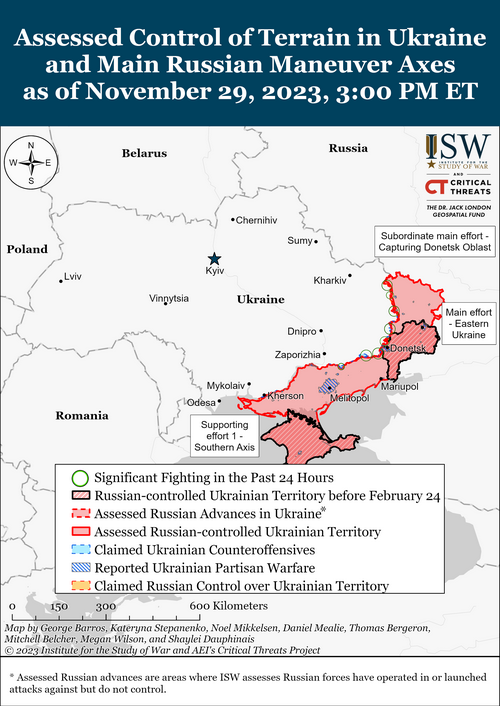
Click here to see ISW’s interactive map of the Russian invasion of Ukraine. This map is updated daily alongside the static maps present in this report.
Click here to see ISW’s 3D control of terrain topographic map of Ukraine. Use of a computer (not a mobile device) is strongly recommended for using this data-heavy tool.
Click here to access ISW’s archive of interactive time-lapse maps of the Russian invasion of Ukraine. These maps complement the static control-of-terrain map that ISW produces daily by showing a dynamic frontline. ISW will update this time-lapse map archive monthly.
Note: The data cut-off for this product was 12:30pm ET on November 29. ISW will cover subsequent reports in the November 30 Russian Offensive Campaign Assessment.
The apparent Russian failure to establish a cohesive command structure among forces defending on the east (left) bank of Kherson Oblast continues to degrade Russian morale and combat capabilities. The Ukrainian General Staff reported on November 29 that elements of the 810th Naval Infantry Brigade (Black Sea Fleet) operating near Krynky (30km northeast of Kherson City and 2km from the Dnipro River) are refusing to conduct assaults on Ukrainian positions due to a lack of artillery coordination, tactical intelligence transmission, and proper communication about the location of Russian minefields.[1] The Ukrainian General Staff reported that maps of the Russian minefields are classified and that Russian commanders have not properly coordinated with assault units about the locations of these minefields, leading to 50 casualties among elements of the 810th Naval Infantry Brigade in the last month.[2] Elements of the 810th Naval Infantry brigade arrived in the Krynky area in early October 2023 and appear to have taken over responsibility for the immediate Krynky area from elements of the newly created 18th Combined Arms Army (CAA) following the start of Ukrainian ground operations on the east bank of the Dnipro in mid-October 2023.[3] The Ukrainian General Staff reported that the 18th CAA’s 28th Motorized Rifle Regiment is currently operating in Pishchanivka (14km east of Kherson City and 3km from the Dnipro River).[4] Additional elements of the 18th CAA and the 7th Airborne (VDV) Division reportedly hold positions in near rear areas on the east bank, and the joint command of these formations is likely overseeing much of the current Russian response to the Ukrainian ground operations on the east bank.[5] The reported minefield incident suggests that the command of the 18th CAA did not share relevant tactical details with the 810th Naval Infantry Brigade’s command, suggesting that higher-level Russian commanders responsible for the defense of the east bank have yet to remedy this failure in coordination.
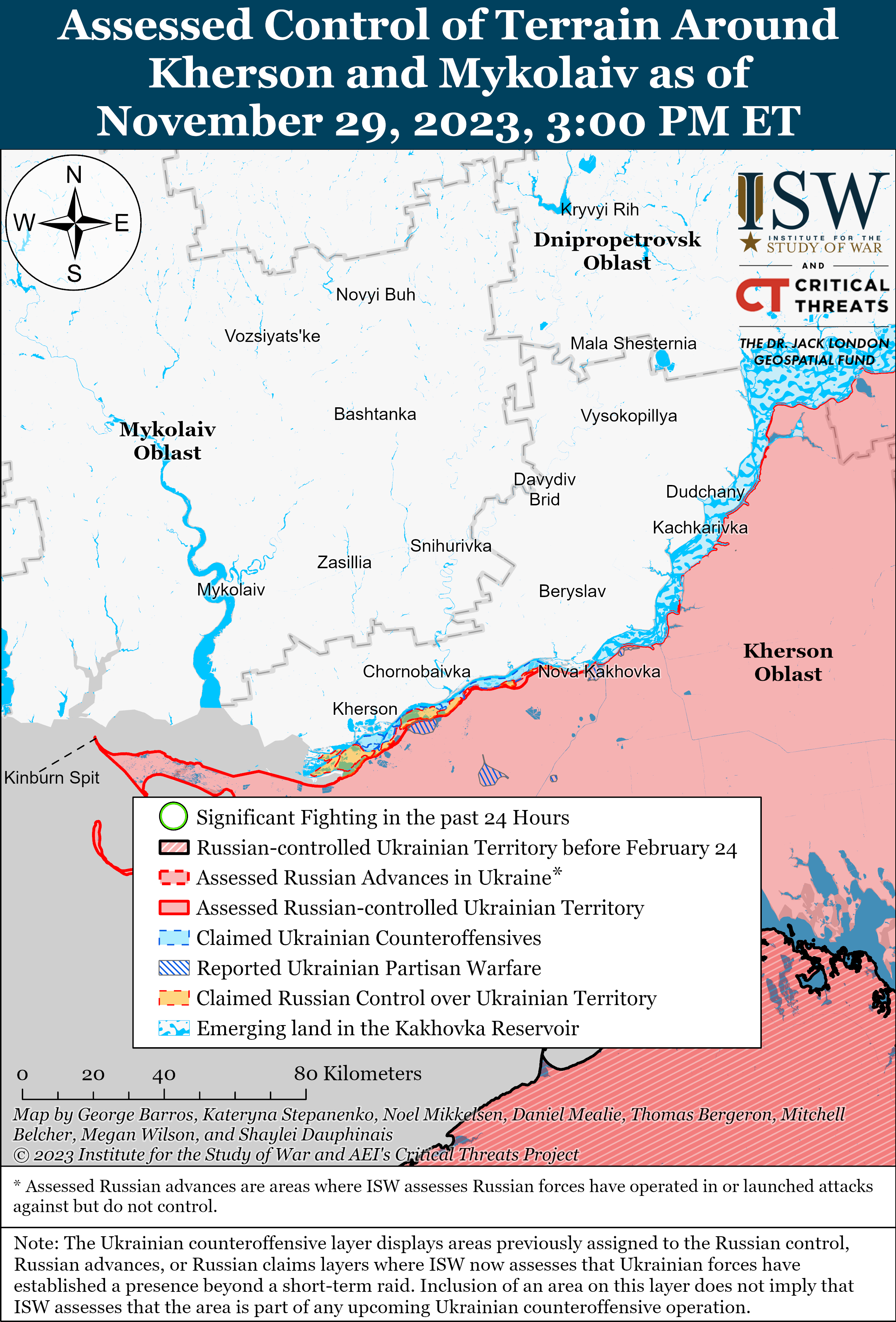
The Russian “Dnepr” Grouping of Forces is increasingly comprised of disparate elements of recently transferred and degraded units and new formations, which may be contributing to this apparent lack of cohesive command structure. Elements of the 810th Naval Infantry Brigade and 177th Naval Infantry Brigade (Caspian Flotilla) transferred to the Kherson direction likely after sustaining heavy casualties defending against the Ukrainian counteroffensive in western Zaporizhia Oblast in the summer of 2023.[6] The majority of the 7th VDV Division’s combat elements are currently still defending in western Zaporizhia Oblast, although the 7th VDV’s 171st Air Assault Battalion (97th VDV Regiment) and 104th Separate Tank Battalion are reportedly operating on the east bank of Kherson Oblast.[7] Elements of the 49th CAA (Southern Military District) have reportedly been operating in the Kherson direction since the Ukrainian liberation of Kherson City in November 2022, but some Russian and Ukrainian sources claim that the Russian command has since redeployed elements of at least one of its brigades to the Donetsk-Zaporizhia Oblast border area.[8] The newly created 18th CAA’s 70th Motorized Rifle Division and 22nd Army Corps (formerly of the Black Sea Fleet) are operating on the east bank.[9] Elements of the newly created 104th VDV Division’s 328th VDV Regiment are reportedly defending in the Krynky area, and Ukrainian military observer Kostyantyn Mashovets stated that additional elements of the 104th VDV Division are currently deploying to the Kherson direction.[10] ISW previously observed elements of the 80th Motorized Rifle Brigade (14th Army Corps, Northern Fleet) operating on the left bank in July 2023, and November 28 reports of 14th Army Corps Deputy Commander Major General Vladimir Zavadsky’s death in the Kherson direction suggests that these elements may still be in the area.[11] Elements of the 41st CAA (Central Military District) reportedly transferred from the Kupyansk direction to Kherson Oblast in early October and may be defending on the east bank.[12]
The Russian “Dnepr” Grouping of Forces, therefore, appears to be comprised of elements of the Black Sea Fleet, the Caspian Flotilla, the Southern Military District, the Central Military District, the Northern Fleet, and the VDV. Russia’s other grouping of forces in Ukraine largely correspond with Russia’s military districts reinforced in some cases with VDV units, making the “Dnepr” Grouping of Forces a notable aberration. The unnamed force grouping in charge of the Russian defense in western Zaporizhia Oblast is primarily comprised of elements of the 58th CAA (Southern Military District) reinforced with elements of several VDV regiments but has not suffered any of the apparent coordination issues that the “Dnepr” Grouping of Forces has faced. The Russian military command should be able to form groupings of forces interchangeably between formations from different military districts and combined arms armies. Persistent Russian issues with sharing situational awareness between units and creating common operating pictures and coherent command structures throughout Ukraine have likely incentivized the creation of groupings of forces comprised of formations and units largely from the same military districts as mitigations.[13] The recent arrival of likely degraded, understaffed, and undertrained Russian elements to the Kherson direction and their immediate commitment to defensive operations has likely further complicated Russian efforts to create a coherent command structure for the disparate elements of the “Dnepr” Grouping of Forces.[14] The Russian military command appointed VDV Commander Colonel General Mikhail Teplinsky as Russian “Dnepr” Grouping of Forces Commander on October 29, 2023, and one of Teplinsky’s main objectives is likely to establish a more unified command for the grouping.[15] The Russian military command is unlikely to remedy the “Dnepr” Grouping of Force’s command issues in the short term, however, and the continuation of Ukrainian ground operations on the left bank will likely only complicate these efforts. It is not yet clear if the command-and-control challenges facing Russian forces in Kherson will generate notable battlefield effects.
Russian forces launched a series of drone and missile strikes against Ukraine on the night of November 28 to 29. Ukrainian military sources reported on November 29 that Russian forces launched three Kh-59 missiles, primarily targeting Khmelnytskyi City, and 21 Shahed-131/-136 drones at targets in Ukraine.[16] Ukrainian air defenses destroyed two of the three Kh-59s and all of the Shahed drones over Odesa, Mykolaiv, Dnipropetrovsk, Kyiv, Kherson, Zaporizhia, and Khmelnytskyi oblasts. The Ukrainian Air Force Command reported that the third Kh-59 missile did not reach its target.[17] The Ukrainian General Staff later reported that Russian forces also launched a Kh-31 missile and two S-300 missiles targeting civilian infrastructure in an unspecified location.[18] Ukrainian Air Force Spokesperson Colonel Yuriy Ihnat reported that Russian forces are flying drones over riverbeds and highways to avoid Ukrainian mobile fire groups that have deployed throughout Ukraine.[19]
Russian authorities plan to extend criminal liability for crimes against the law on military service to participants in volunteer formations, a measure that would impact many irregular military formations and personnel on which the Russian military relies for manpower in Ukraine. Russian media reported on November 29 that the Russian State Duma adopted a bill in its first reading extending criminal liability for crimes against regular military service to volunteer servicemen.[20] Russian volunteer servicemen are currently exempt from existing legislation that holds Russian conscripts, contract servicemen, and reservists liable for crimes committed while performing combat missions. The new bill empowers Russian military courts to try volunteer servicemen for select crimes including desertion, failure to comply with an order, resistance to or violent actions against a superior, unauthorized leaving of a place of service, evasion of duties by feigning illness, and intentional or accidental destruction, damage, or loss of military property. Russian senators previously called for the introduction of criminal penalties for volunteer servicemen for “improper performance of their contractual duties” and desertion.[21] This legislation may impact the Kremlin’s ongoing volunteer recruitment efforts if the threat of criminal liabilities outweighs incentives for volunteer service such as high salaries and additional social benefits.[22]
Russian officials proposed laws that would restrict the actions of foreign citizens in Russia, likely to support continued efforts to coerce migrants into Russian military service. Russian Duma deputies Alexei Zhuravlev, Mikhail Matveev, and Dmitri Kuznetsov proposed a bill that would consider migration violations an aggravating circumstance in a criminal offense.[23] Zhuravlev, Matveev and Kuznetsov cited figures that Russian Investigative Committee Head Alexander Bastrykin released on September 25 claiming that the number of serious crimes that foreign citizens committed in Russia increased by 32 percent from 2022 to 2023.[24] Kremlin newswire TASS reported on November 28 that the Russian Ministry of Internal Affairs (MVD) proposed a bill that would require all foreigners entering Russia to sign a ”loyalty agreement” banning them from discrediting Russian domestic and foreign policy, denying Russian family values, or “disrespecting the diversity of regional and ethnocultural ways of life” in Russia among other restrictions.[25] The proposed measures likely seek to increase Russian law enforcement’s ability to investigate and arrest migrants with foreign citizenship as part of an effort to coerce them into Russian military service. Russian authorities are also continuing efforts to coerce migrants with Russian citizenship into the Russian military by threatening to revoke their citizenship and forcibly issuing them military summonses.[26]
The NATO–Ukraine Council (NUC) met at the foreign minister-level for the first time on November 29 and discussed steps to increase weapons and ammunition production. NATO reported that it is developing a roadmap for full Ukrainian interoperability with NATO and reaffirmed its support for Ukraine’s democratic and security sector reforms “on its path toward future membership in NATO.”[27] Ukrainian Foreign Minister Dmytro Kuleba stated that the NUC discussed increasing the production of weapons and ammunition and noted on the sidelines of the NUC that the European Union (EU) has provided Ukraine with 300,000 rounds of ammunition of the promised 1 million.[28]
Poland is reportedly considering sending military advisors to Finland in response to Russia’s ongoing attempts to artificially create a migrant crisis on the Finnish-Russian border as part of a known Russian hybrid warfare tactic meant to destabilize NATO and the EU. Polish Secretary of State and Head of the Polish National Security Bureau Jacek Siewiera stated on November 28 that during Finnish President Sauli Niinistö’s official visit to Poland, Niinistö requested “allied support” against the hybrid Russian attack on the Finnish border.[29] Siewiera reported that Poland intends to respond to the request by sending a team of military advisors to Finland to provide “on-site knowledge on border security” and other unspecified operational support.[30] Finnish authorities announced on November 28 that Finland will close the last open border checkpoint at midnight on November 30 until at least December 13, following Russia’s artificial creation of a migrant crisis on the Finnish border that started on November 18.[31] Russian sources, including Kremlin spokesperson Dmitri Peskov and a prominent Kremlin-affiliated milblogger, responded negatively to Siewiera’s announcement and claimed that it is “excessive” and meant to prepare Finland for a confrontation against Russia in the Arctic.[32] Poland has experienced the impacts of Russian hybrid warfare firsthand on its borders from a Russian-orchestrated migrant crisis on the Poland-Belarus border in fall of 2021, and Finland likely seeks to leverage Poland’s knowledge of such crises to address the current situation on the Finnish border.[33] Poland and Finland both belong to a number of military, political, economic, and diplomatic organizations, including NATO, the EU, and the Organization for Security and Cooperation in Europe (OSCE).
The Russian Foreign Ministry (MFA) formally announced Russia’s termination of a nuclear reduction pact with Japan on November 28.[34] The Russian MFA stated that the bilateral agreement with Japan on cooperation in nuclear weapons reduction, initially signed in 1993, will terminate on May 21, 2024, six months after Russia’s formal notification of termination.[35] Kremlin newswire TASS reported on November 9 that Russian Prime Minister Mikhail Mishustin signed an order approving Russia’s termination of the bilateral agreement with Japan.[36] Japanese news outlet the Japan Times reported that the agreement allowed Japan to support the decommissioning of weapons, including Russian nuclear submarines.[37] The Russian MFA claimed that Russia is withdrawing from the agreement against the backdrop of ”the openly anti-Russian policy of [Japanese Prime Minister Fumio] Kushida’s administration” including Japanese sanctions against Russia and alleged increasing Japanese military activity near the Japanese-Russian border.[38] The Japan Times also noted that Russia has withdrawn from several other bilateral negotiations and initiatives following the imposition of Japanese sanctions against Russia after Russia’s full-scale invasion of Ukraine.[39]
Russia’s efforts to generate combat power via recruitment from Central Asian countries may become a source of tension in Russia’s relationship with its Central Asian neighbors. Radio Free Europe/Radio Liberty (RFE/RL)’s Central Asian service Radio Azattyk reported on November 28 that a Kazakh court sentenced Kazakh citizen Alexei Shompolov to six years and eight months in prison on charges of mercenarism.[40] Shompolov reportedly fought in a Wagner Group artillery unit near Bakhmut.[41] Shompolov’s case represents the second charge of mercenarism pursued by a Central Asian country against a combatant who fought for Russia in Ukraine—an Uzbek court similarly sentenced an Uzbek man who fought with Donetsk People’s Republic (DNR) troops in Ukraine in 2014–2015 on October 31.[42] Russian milbloggers responded to Shompolov’s sentencing by criticizing Kazakh leadership for taking an “anti-Russian” stance and questioned if Kazakh authorities would similarly charge Kazakh citizens who fought in the Ukrainian army.[43] Russia’s continued insistence on leveraging Central Asian populations for force-generation purposes, both within Central Asian countries and in Central Asian migrant communities in Russia itself, is likely to create friction between Russia and its neighbors as Central Asian countries use mercenarism laws to punish residents who fought for Russia.[44]
Adam Kadyrov, younger son of Chechen Republic Head Ramzan Kadyrov, will reportedly “oversee” the newly formed “Sheikh Mansur” volunteer battalion in a new unspecified position, possibly further indicating Ramzan Kadyrov’s desire for Adam to succeed him as head of Chechnya. Chechen Republic Parliament Deputy Magomed Daudov claimed on November 29 that Adam will “oversee” the battalion but did not provide additional information regarding Adam’s official title, although the role may be more ceremonial than combat- or command-oriented given Adam’s age.[45] Daudov stated that Adam also received the star of the “Sheikh Mansur” Battalion award. Ramzan Kadyrov has previously appeared increasingly favorable to Adam in recent months, including appointing Adam to a prominent yet unspecified “important position” in the Chechen secret service.[46]
Key Takeaways:
- The apparent Russian failure to establish a cohesive command structure among forces defending on the east (left) bank of Kherson Oblast continues to degrade Russian morale and combat capabilities.
- The Russian “Dnepr” Grouping of Forces is increasingly comprised of disparate elements of recently transferred and degraded units and new formations, which may be contributing to this apparent lack of cohesive command structure.
- Russian authorities plan to extend criminal liability for crimes against the law on military service to participants in volunteer formations, a measure that would impact many irregular military formations and personnel on which the Russian military relies for manpower in Ukraine.
- Russian officials proposed laws that would restrict the actions of foreign citizens in Russia, likely to support continued efforts to coerce migrants into Russian military service.
- The NATO-Ukraine Council (NUC) met at the foreign minister-level for the first time on November 29 and discussed steps to increase weapons and ammunition production.
- Poland is reportedly considering sending military advisors to Finland in response to Russia’s ongoing attempts to artificially create a migrant crisis on the Finnish-Russian border as part of a known Russian hybrid warfare tactic meant to destabilize NATO and the EU.
- The Russian Foreign Ministry (MFA) formally announced Russia’s termination of a nuclear reduction pact with Japan on November 28.
- Russia’s efforts to generate combat power via recruitment from Central Asian countries may become a source of tension in Russia’s relationship with its Central Asian neighbors.
- Adam Kadyrov, younger son of Chechen Republic Head Ramzan Kadyrov, will reportedly “oversee” the newly formed “Sheikh Mansur” volunteer battalion in a new unspecified position, possibly further indicating Ramzan Kadyrov’s desire for Adam to succeed him as head of Chechnya.
- Russian forces continued offensive operations along the Kupyansk-Svatove-Kreminna line, near Bakhmut, near Avdiivka, west and southwest of Donetsk City, the Donetsk-Zaporizhia Oblast border area, and in western Zaporizhia Oblast but did not make any confirmed advances.
- Russian Liberal Democratic Party (LDPR) Head and Duma Deputy Leonid Slutsky proposed a bill on November 28 that would grant war correspondents “combat veteran” status and associated social support benefits.
- Russian authorities continue efforts to erase Ukrainian culture and identity in occupied Ukraine.
Go here to read the rest. Russia continues to attempt to find troops anyplace they can, while throwing troops away in fruitless assaults. The proper course would be to build up a large number of conscripts, train them properly and only then bring build up combat units until Russia would have the numerical advantage to launch successful offensives. That nothing like this has been attempted indicates either gross incompetence, a lack of will or a simply inability of the Russian government to do what is necessary to prevail.