
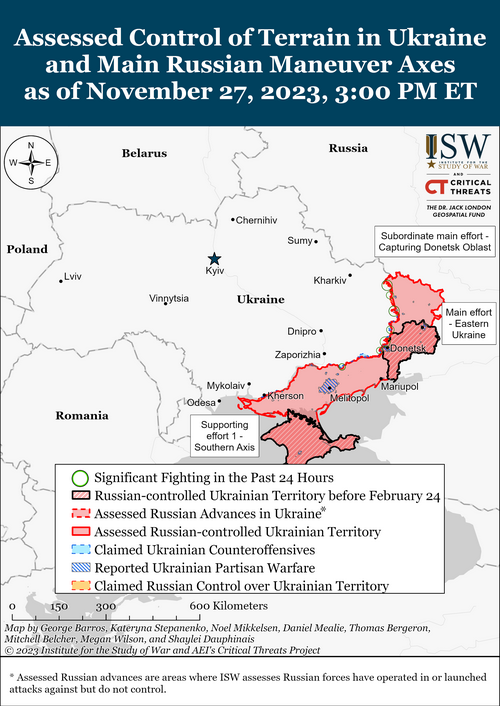
From The Institute For The Study of War:
Russian Offensive Campaign Assessment, November 27, 2023
Karolina Hird, Riley Bailey, Grace Mappes, Nicole Wolkov, George Barros, and Mason Clark
November 27, 2023, 6:00pm ET
Click here to see ISW’s interactive map of the Russian invasion of Ukraine. This map is updated daily alongside the static maps present in this report.
Click here to see ISW’s 3D control of terrain topographic map of Ukraine. Use of a computer (not a mobile device) is strongly recommended for using this data-heavy tool.
Click here to access ISW’s archive of interactive time-lapse maps of the Russian invasion of Ukraine. These maps complement the static control-of-terrain map that ISW produces daily by showing a dynamic frontline. ISW will update this time-lapse map archive monthly.
Note: The data cut-off for this product was 12:30pm ET on November 27. ISW will cover subsequent reports in the November 28 Russian Offensive Campaign Assessment.
A cyclone in the Black Sea and southern Ukraine caused infrastructure damage in many areas of coastal southern Russia and occupied Ukraine and is impacting the tempo of military operations along the frontline in Ukraine, but has notably not stopped military activity entirely. Russian sources posted images and footage of the impact of the cyclone on civilian and transportation infrastructure in coastal areas of Krasnodar Krai, including near Sochi, Anapa, Gelendzhik, Novorossiysk, and Taupse.[1] Ukrainian and Russian sources also noted that coastal areas of occupied Crimea, occupied Kherson Oblast, and much of Odesa Oblast were heavily impacted by heavy snow and high winds, leaving large swaths of the population without electricity.[2] The Ukrainian Navy and Ukraine’s Southern Operational Command notably reported that dangerous weather in the Black Sea forced Russia to return all of its naval vessels and missile carriers to their base points.[3] A prominent Russian milblogger warned that the threat of mines in the Black Sea will increase for both military and civilian vessels in the coming days because the storm has broken boom nets and dispersed minefields, causing mines to drift throughout the northwestern Black Sea.[4] Several sources also reported that the storm damaged rail lines in coastal areas, which may have logistical ramifications for Russian forces in occupied Crimea and southern Ukraine.[5]
Despite the challenging weather conditions, both Russian and Ukrainian forces are continuing ground attacks throughout Ukraine, albeit at a slightly slower pace due to snow and resulting poor visibility. Russian milbloggers noted that heavy snow and winds have reduced visibility and complicated aerial reconnaissance and artillery correction in the Kherson direction, but noted that Ukrainian forces have taken advantage of low visibility conditions to consolidate positions on the east (left) bank of the Dnipro River.[6] Ukrainian Tavriisk Group of Forces Spokesperson Colonel Oleksandr Shtupun reported that Russian forces in the Tavriisk direction (ranging from Avdiivka all the way through western Zaporizhia Oblast) have reduced artillery use by one and a half times and drone use six times due to the weather but emphasized that Russian forces continue to heavily use aviation in the Avdiivka direction.[7] Challenging winter conditions will force both sides to rely more heavily on infantry-led ground attacks in the absence of aerial reconnaissance and artillery correction capabilities.[8]
Russian Foreign Minister Sergei Lavrov and several Russian milbloggers stated that Russia must maintain active operations in Ukraine and expressed worry over the prospect of further Western military support to Ukraine, though some milbloggers additionally expressed increased discontent with the perceived lack of articulated Russian war aims and stated Russia must clarify its war aims before discussing any pause or end to the war. Lavrov claimed on November 27 that the West is currently trying to “freeze” the war to gain time and rearm Ukraine for future attacks on Russia.[9] Several Russian milbloggers similarly claimed that any “truce” or pause in the war will only benefit Ukraine and allow Ukrainian forces to rest, refit, and relaunch offensive operations.[10] One prominent critical milblogger claimed that a pause in the war will allow Ukraine to conduct a “Minsk-3,” alluding to the previous Minsk agreements that temporarily paused large-scale combat operations in eastern Ukraine in 2014 and 2015 but ultimately allowed Russia to prepare for the full-scale invasion in 2022.[11] The critical milblogger also observed that any discussions regarding pauses or negotiations in the war will be particularly harmful to Russia because Russia has failed to clearly define war aims or conditions necessary for a Russian victory.[12] The milblogger noted that the lack of a clear definition for victory has caused internal destabilization within Russia.[13] Other Russian milbloggers noted that Ukraine still controls several territories that Russia has claimed to have (illegally) annexed, arguing that Russia should not see any negotiations until or unless Russia can capture the rest of the four occupied oblasts (Donetsk, Luhansk, Kherson, and Zaporizhia oblasts), as well as Odesa and Mykolaiv oblasts.[14]
Renewed discussion of hypothetical negotiations underlined Russia’s lack of clearly articulated war aims and are causing significant anxiety in the pro-war Russian information space. Some milbloggers claimed that Russia cannot even consider the possibility of pausing the war until they have fully captured the four occupied Ukrainian oblasts, while other milbloggers advocated for more maximalist aims such as the capture of Odesa and Mykolaiv oblasts, in which Russia currently has no presence (with the exception of a small Russian presence on the Mykolaiv Oblast side of the Kinburn Peninsula).[15] The apparent lack of consensus as to what exactly would constitute a Russian victory is compounding anxieties over the perceived pace of the war in the Russian information space —an anxiety that is increasingly reflected in the highest levels of the Russian government. ISW has previously reported that select voices in the Russian information space, namely deceased Wagner Group financier Yevgeny Prigozhin, advocated for freezing the lines in Ukraine to afford Russian troops the ability to rest and reconstitute, but Lavrov’s statement against any sort of pause in Ukraine is an explicit rejection of this argument, as well as a tacit acceptance of a protracted war in Ukraine.[16] Clear Russian concern about Ukraine’s ability to rearm and relaunch offensives in the case of the pause highlights Russia’s concern over continued NATO and Western support for Ukraine. Russia is rapidly replacing losses and belatedly moving its economy to a war footing, and ISW continues to assess that the Kremlin would leverage any pause or ceasefire to prepare for renewed aggression against Ukraine.[17] Ukraine’s partners have the capability to sustain and accelerate aid to Ukraine and enable Ukraine to restore maneuver to the battlefield.[18]
Ukrainian National Defense and Security Council Secretary Oleksiy Danilov stated that the Kremlin has activated a network of sleeper agents in Ukraine in the past few months to destabilize Ukrainian society. Danilov stated in an interview with the Times published on November 27 that these sleeper agents are embedded in public institutions and threaten Ukrainian security agencies, including the Ukrainian Security Service (SBU).[19] Danilov stated that these sleeper agents aim to undermine Ukrainian unity by causing fractures between Ukrainian political and military leadership, as well as between Ukrainian civilians and the government. Danilov warned that these sleeper agents are specifically exploiting alleged tensions between Ukrainian President Volodymyr Zelensky and Commander-in-Chief General Valerii Zaluzhnyi and are additionally targeting female relatives of Ukrainian soldiers to foment anti-government sentiments as part of these efforts to fracture Ukrainian society.
Russia’s attempt to artificially create a migrant crisis at the Finnish border appears to be failing due to Finnish authorities’ swift response. Finnish Prime Minister Petteri Orpo stated on November 27 that the Finnish government will close the last border crossing with Russia “if necessary” and reported that the Finnish government is ready to take unspecified additional measures in response to Russia’s artificially generated migrant crisis.[20] Finland previously closed three checkpoints on the Finnish-Russian border on November 23, leaving only its northernmost border crossing open.[21] Several other Finnish government officials also signaled their support for closing the entire border with Russia.[22] A Russian insider source claimed that Russian Presidential Administration First Deputy Head Sergei Kiriyenko instructed Russian Ministry of Internal Affairs (MVD) Head Vladimir Kolokoltsev to gather migrants from the Middle East, Africa, and other regions to send them to the Finnish border.[23] The insider source complained that Finnish border authorities stopped most migrants from crossing into Finland and that Russian authorities must now settle the migrants in Russia.[24]
The Kremlin appears to be shifting responsibility for potential future austerity measures onto Russian occupation heads and the heads of four select Russian republics. Russian state news outlet Kommersant reported on November 27 that the Russian Ministry of Finance’s 2024 subsidy provision agreements will directly assign budget deficit responsibilities to the heads of the republics of Dagestan, Ingushetia, Chechnya, and Tuva and the heads of the four Russian occupation administrations in Ukraine.[25] The Russian Ministry of Finance reportedly plans to add additional obligations to the subsidy agreements with the four Russian republics and the four occupation administrations in order to reduce gaps between regional income and expenses and will withdraw federal subsidies if these regional and occupation administrations fail to lower budget deficits.[26] These additional obligations will ask republic and occupation heads to sign promises levels of targeted spending of federal money on social programs; increase the efficiency of their respective budgetary institutions; refuse to expand the number of state employees; and not increase state salaries above the inflation level.[27] The additional obligations will also reportedly require that the heads of these administrations increase state revenue collection and agree with the Ministry of Finance’s 2025 draft budget.[28] The heads of the republic and occupation administrations reportedly have until December 18, 2023, to sign the 2024 subsidy provision agreements with the new obligations or refuse subsidies for the upcoming year.[29] These obligations appear to amount to an austerity package as increases to state revenue collection will likely require tax hikes, while targeted spending for social programs may portend cuts to existing regional and occupation programs.
The Russian Ministry of Finance reportedly selected the occupation administrations and the four republics because of their high ratio of federal subsidies to regional income.[30] The Russian government has heavily subsidized regions in the North Caucasus since the Chechen wars and has almost completely subsidized occupied territories in Ukraine following their illegal annexation into Russia.[31] Federal subsidies reportedly accounted for 54 percent of the Republic of Tuva’s budget revenue in 2020, making it the most subsidized Russian federal subject, followed by the republics of Dagestan, Chechnya, and Ingushetia.[32] Russian Finance Minister Anton Siluanov stated on September 11 that Russia has a plan to reduce its overall budget deficit in the coming years amid continued significant spending on the war in Ukraine.[33] The potential austerity measures in the most subsidized Russian federal subjects and the almost entirely subsidized occupation administrations may represent the beginning of a wider set of measures to cut budget deficits while maintaining defense spending. The Kremlin may have instructed the Russian Ministry of Finance to shift responsibility for the measures directly onto the republic and occupation administrations to prevent the Kremlin from bearing the expected discontent for austerity. The Kremlin may have also chosen the occupied territories and four non-ethnic Russian republics to contain social discontent in non-ethnic Russian areas and existing areas of concern ahead of the 2024 Russian presidential elections.
The Kremlin may risk undermining Russian integration efforts in occupied territories and prompt discontent in federal subjects if it pursues significant austerity measures. Large-scale federal spending on infrastructure and social programs, as well as preferential tax codes and benefits, have been a central component of the Russian effort to establish economic and social control over occupied territories in Ukraine, and potential austerity measures may complicate these efforts. Concerns about domestic discontent in the North Caucasus have recently intensified alongside heightened ethnoreligious tensions in Russia, and economic strains may make this discontent more pronounced.[34]
Key Takeaways:
- A cyclone in the Black Sea and southern Ukraine caused infrastructure damage in many areas of coastal southern Russia and occupied Ukraine and is impacting the tempo of military operations along the frontline in Ukraine, but has notably not stopped military activity entirely.
- Russian Foreign Minister Sergei Lavrov and several Russian milbloggers stated that Russia must maintain active operations in Ukraine and expressed worry over the prospect of further Western military support to Ukraine.
- Some milbloggers additionally expressed increased discontent with the perceived lack of articulated Russian war aims and stated Russia must clarify its war aims before discussing any pause or end to the war.
- Ukrainian National Defense and Security Council Secretary Oleksiy Danilov stated that the Kremlin has activated a network of sleeper agents in Ukraine in the past few months to destabilize Ukrainian society.
- Russia’s attempt to artificially create a migrant crisis at the Finnish border appears to be failing due to Finnish authorities’ swift response.
- The Kremlin appears to be shifting responsibility for potential future austerity measures onto Russian occupation heads and the heads of four select Russian republics.
- Russian forces conducted offensive operations along the Kupyansk-Svatove-Kreminna line, near Bakhmut, near Avdiivka, in the Donetsk-Zaporizhia Oblast border area, and in western Zaporizhia Oblast and did not make confirmed advances.
- Deputy Commander of the Russian Navy Lieutenant General Viktor Astapov confirmed on November 27 that the Russian navy is reorganizing naval infantry brigades into divisions in order to increase their combat capabilities.
- Likely Ukrainian partisans continue to target Russian occupation elements throughout occupied Ukraine.
Go here to read the rest. The war is beginning to slow down as the weather worsens.

