
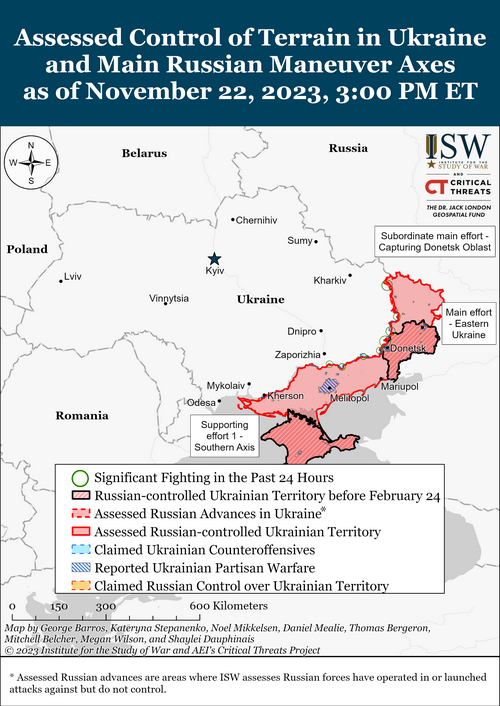
From The Institute For The Study of War:
Russian Offensive Campaign Assessment, November 22, 2023
Riley Bailey, Grace Mappes, Nicole Wolkov, Angelica Evans, and Frederick W. Kagan
November 22, 2023, 7:30pm ET
Click here to see ISW’s interactive map of the Russian invasion of Ukraine. This map is updated daily alongside the static maps present in this report.
Click here to see ISW’s 3D control of terrain topographic map of Ukraine. Use of a computer (not a mobile device) is strongly recommended for using this data-heavy tool.
Click here to access ISW’s archive of interactive time-lapse maps of the Russian invasion of Ukraine. These maps complement the static control-of-terrain map that ISW produces daily by showing a dynamic frontline. ISW will update this time-lapse map archive monthly.
Note: ISW and CTP will not publish a campaign assessment (or maps) tomorrow, November 23, in observance of the Thanksgiving holiday. Coverage will resume Friday, November 24.
Note: The data cut-off for this product was 12:30pm ET on November 22. ISW will cover subsequent reports in the November 24 Russian Offensive Campaign Assessment.
Russian President Vladimir Putin reframed the Kremlin’s stance on the Israeli-Hamas war to a much more anti-Israel position in an attempt to demonstrate the supposed hypocrisy of Western condemnations of the Russian invasion of Ukraine. Putin stated that attendees of the G20 summit who expressed shock at the continued Russian war in Ukraine should instead be “shocked” by the “bloody” 2014 Euromaidan Revolution in Ukraine and the subsequent war that the “Kyiv regime waged against its own people” in Donbas and by the “extermination of the civilian population in Palestine, in the Gaza sector.”[1] Putin’s November 22 statement on the Israel-Hamas war referring to the “extermination of the civilian population of Palestine” was a departure from previous Kremlin framing that largely focused on calling for peace and claiming that the Israel-Hamas war will distract from the provision of Western military aid to Ukraine.[2] Putin’s November 22 framing of the Israeli-Hamas war continues to exploit that war to undermine Western support for Ukraine, as ISW has previously assessed, and also signals potentially increasing support for Iranian interests in the region and an increased willingness to antagonize Israel.[3]
Putin also reiterated boilerplate rhetoric falsely portraying Russia as willing to engage in meaningful negotiations, likely to pressure the West into prematurely pushing Ukraine to negotiate with Russia. Putin stated that the world must “think about how to stop this tragedy [the Russian-initiated war in Ukraine],” falsely signaling a willingness to engage in meaningful peace negotiations in Ukraine.[4] Putin and other Russian officials have routinely falsely claimed that the Kremlin is ready to negotiate to end the war while signaling that the Kremlin maintains its maximalist objectives, including territorial claims and regime change.[5] Kremlin officials have pushed this narrative while claiming that Ukraine is unwilling to negotiate with Russia, likely to coerce Western officials into prematurely offering concessions favorable to Russia rather than engage in meaningful, good faith negotiations.[6] Ukrainian officials have routinely expressed their willingness to negotiate with Russia as soon as Russia removes its forces from Ukraine’s internationally-recognized territory, including Donbas and Crimea.[7] ISW has observed no indications that Putin does not retain his maximalist objectives and continues to assess that a premature cessation of hostilities in Ukraine greatly increases the likelihood of renewed Russian aggression on terms far more favorable to the Kremlin in the near future.[8]
US National Security Council Spokesperson John Kirby reported on November 21 that Iran is supplying Russia with glide bombs and that Iran may be preparing to transfer short-range ballistic missiles to Russia.[9] ISW has observed Russian forces increasingly using glide bombs, particularly modified FAB-500, KAB-500, and RPK-500 aerial bombs equipped with glide bomb structures, in the Lyman and Kherson directions.[10] It is unclear whether Kirby meant that Iran is supplying Russia with glide bomb components or with fully constructed glide bombs. The Critical Threats Project (CTP)-ISW’s Iran Update reported on August 14 that Iran produces a variety of glide bombs domestically, such as the Ghaem glide bombs, Yasin long-range glide bombs, Sadid glide bombs, and Balaban glide bombs.[11] Iran commonly uses these bombs with its various drone platforms, likely including the Shahed-131/136 drones that Iran supplies to Russia. A Russian milblogger previously amplified claims that Russian Su-25 aircraft may be compatible with Iranian glide bombs.[12] Iran presented several glide bomb variants at the Russian Army-2023 Forum in Moscow in August 2023 and possibly during Russian Defense Minister Sergei Shoigu’s visit to Tehran in September 2023.[13] Kirby added that Iran also continues to supply Russia with drones and artillery ammunition.[14] Ukrainian Main Military Intelligence Directorate (GUR) Deputy Chief Major General Vadym Skibitskyi stated on November 6 that Iran may continue to send small batches of Shahed-131/136 drones to Russia despite increased Russian efforts to produce Shahed drones domestically and Iran’s fulfillment of its first Shahed supply contracts with Russia.[15] CTP-ISW previously assessed that Iran and Russia may conclude a drone and missile sale agreement following the expiration of UN missile restrictions against Iranian missile and missile-related technology exports on October 18, 2023.[16]
The Kremlin appears to be inexplicably concerned about the outcome of the upcoming March 2024 Russian presidential elections, despite apparent widespread Russian approval of Putin. Russian Central Election Commission (CEC) Chairperson Ella Pamfilova stated on November 21 that some Russian citizens who left Russia and others still in Russia have already begun efforts to discredit the upcoming Russian presidential elections.[17] Pamfilova’s statement suggests that the Russian government will continue to intensify censorship efforts under the guise of fighting attempted internal election meddling ahead of the presidential elections. Putin also stated on November 15 that the Russian government will suppress any foreign or domestic election interference at a meeting with Russian election commission representatives.[18] Two unnamed sources from Russian federal and regional authorities told Russian opposition outlet Verstka in an article published on November 22 that the Kremlin instructed Russian regional authorities to stop relatives of mobilized personnel from protesting by paying them.[19] The sources added that the Kremlin advised Russian regional governments to “make every effort” to ensure that the governments issue payments to the relatives of mobilized personnel and address other complaints about poor treatment of mobilized personnel in response to rising dissatisfaction among the relatives.[20] The sources also told Verstka that the Kremlin considers the relatives of mobilized personnel a social group that may pose one of the greatest threats to the beginning of Putin’s still unannounced presidential campaign.[21]
The Kremlin may also be concerned about a perceived lack of support for Putin from the Russian veteran community.[22] This veteran community is a subsection of the Russian ultranationalist community and has routinely argued in favor of full mobilization and continued Russian offensive operations in Ukraine, as opposed to freezing the current frontlines.[23] The Kremlin’s apparent concern about Putin’s support is odd given that the Levada Center – an independent Russian polling organization – found that 82 percent of Russians approve of Putin’s performance as of October 2023.[24] The Kremlin may also want Putin to receive an even higher percentage of the vote and may be attempting to placate specific groups that vocally express dissatisfaction with Putin’s decisions.
Russian Investigative Committee Head Alexander Bastrykin called for Russia to codify an unspecified state ideology in the Russian constitution, suggesting that some Russian officials may want to explicitly end nominal constitutional protections for civil rights, democratic pluralism, and ethnic equality. Bastrykin made the call on November 22 during a conference about the Russian constitution at the Russian Ministry of Justice in Moscow and argued that dismissing his call would not work.[25] Bastrykin previously called on Russian Constitutional Court Chairperson Valery Zorkin to look into ways of establishing an unspecified state ideology in May 2023, although Zorkin rebuffed Bastrykin by noting that the current constitution contains a set of values that protect civil society.[26] The Russian constitution declares that Russia is a democratic state in which Russia’s multinational people should exercise power directly and that the “supreme direct expression” of that power are referendums and free elections.[27] The constitution establishes that the Russian state’s obligation is to recognize, observe, and protect human and civil rights.[28] Article 13 of the Russian constitution notably forbids Russia from proclaiming a state ideology and commits the Russian state to recognize ideological diversity, political diversity, and a multi-party system.[29] Bastrykin’s calls would require Russian officials to amend or even repeal Article 13 of the Russian constitution, and possibly would require more extensive amendments depending on the potential new state ideology. Russia adopted its current constitution in 1993 and laid out codified state protections for multiethnic democratic pluralism and human and civil rights to mark a definitive break with the Soviet system of autocratic one-party ideological rule. Bastrykin, who has previously advocated for Stalinist-era domestic policies, may hope that a new ideology enshrined in the Russian constitution would further weaken or outright cancel Russia’s existing constitutional commitment to democratic pluralism and human and civil rights.[30] Bastrykin may be voicing this position on behalf of a wider group of Russian officials wishing to end these nominal constitutional projections, but the Kremlin has shown no indication that it wishes to do away with the veneer of legitimacy that these nominal constitutional protections offer.[31]
Bastrykin has yet to detail what a potential Russian state ideology should be, although the Kremlin’s support for Russian ultranationalism would likely heavily influence any potential Russian state ideology. The Kremlin has heavily courted the Russian ultranationalist community against the backdrop of the war in Ukraine, a community that supports Russian imperial goals, efforts to Russify and ethnically cleanse occupied territories, and nationalist demands to protect ethnic Russian communities.[32] The focus on protecting and enforcing the Russian ethnic identity would likely be a key component of any state ideology should the Kremlin entertain Bastrykin’s calls. Bastrykin himself may have had this Russian ultranationalism in mind when he called for a state ideology given that he has heavily sought to capitalize on heightened ethnic tensions in Russia and is increasingly casting himself as a prominent anti-migration figure.[33] Bastrykin and the Russian Investigative Committee have reportedly directly engaged in the forced deportation of Ukrainian children to Russia and the forced placement of Ukrainian children into Russian military training programs — parts of a campaign to destroy Ukrainian ethnic identity and Russify Ukraine.[34] The Kremlin’s support for Russian ultranationalism is also heavily focused on promoting Russian Orthodoxy and appeals to “traditional” social values. Putin most recently signed a decree on November 22 declaring 2024 the “Year of the Family” to focus on preserving traditional family values.[35] ISW has previously assessed that the war in Ukraine is likely exacerbating an emerging identity crisis within Russian society resulting from tensions between Russian identity and Russian nationalism.[36] This crisis as well as pronounced ethnoreligious tensions will likely worsen if the ultranationalist Kremlin decides to pursue codifying a state ideology. Putin and elements of the Kremlin, highly aware of the potential for these ethnic, religious, and national tensions to prompt instability and discontent, are unlikely to support Bastrykin’s calls to codify an explicit state ideology in the short term.
Bloomberg reported on November 21 that the European Union (EU) proposed a plan to strengthen security commitments from EU member states to Ukraine.[37] Bloomberg reported, citing a draft proposal, that the EU’s proposal would build on existing bilateral agreements established within the framework of the Group of Seven’s (G7) declaration on security guarantees for Ukraine. The proposal reportedly includes mechanisms for: long-term military aid; training of Ukrainian forces; cooperation with Ukraine’s domestic defense industrial base (DIB); strengthening Ukraine’s ability to counter cyber and hybrid threats; demining assistance; support for Ukraine’s reform agenda as part of the EU accession process; assistance for Ukraine’s energy transition and nuclear safety efforts; and the sharing of intelligence and satellite imagery. EU Foreign Affairs Representative Josep Borrell stated on November 13 that Ukraine is the EU’s top priority and that the EU’s commitment to Ukraine will not waiver.[38] Bloomberg reported that EU member states are expected to consider the EU’s draft proposal in December 2023.
Russian forces conducted a series of missile and drone strikes against Ukraine on the night of November 21 to 22. The Ukrainian General Staff reported that Ukrainian forces shot down all 14 Shahed-131/136 drones that Russia launched at Ukraine.[39] Ukrainian military officials reported that Russian forces also launched two missiles, of which one Kh-22 cruise missile fell in an unpopulated area in Zaporizhia Oblast.[40] Ukrainian Air Force Spokesperson Colonel Yuriy Ihnat stated on November 21 that Russian forces have paused their use of cruise and ballistic missiles and began using KAB glide bombs and Kh-59 and Kh-31 missiles to conduct strikes against Ukraine.[41]
Russian milbloggers appear to be focusing renewed complaints against the Russian military command for what milbloggers perceive as poor choices that contribute to Russian casualties. Russian milbloggers expressed anger on November 21 and 22 after a Ukrainian HIMARS strike on Kumachove, Donetsk Oblast (37km southeast of Donetsk City and 61km from the frontline) allegedly killed over 25 and injured over 100 personnel of the 810th Naval Infantry Brigade (Black Sea Fleet) who were attending a concert for a Russian military holiday on November 19.[42] The milbloggers largely focused on poor security measures, criticizing the Russian command for allowing a large gathering of people within HIMARS range of the frontline in violation of operational security principles.[43] The milbloggers largely called for the Russian military to ban such events and expressed frustration that the Russian military command has not learned this lesson despite nearly two years of war and multiple instances in which publicly available information facilitated Ukrainian strikes.[44]
Though this strike does not affect the battlefield situation in Ukraine, the Russian milbloggers’ reaction to this strike reflects the Russian ultranationalist community’s continued frustration with the Russian military command’s management of the war. Russian milbloggers have recently begun to complain about the Russian military command following a period of self-censorship likely prompted by the death of Wagner Group financier Yevgeny Prigozhin and the arrests of highly critical Russian ultranationalist milbloggers in summer 2023.[45] The milbloggers’ complaints have largely focused on how the Russian military command’s poor conduct of the war and poor discipline have led to poor treatment of Russian military personnel and casualties instead of focusing on the success or failure of Russian military operations. Russian milbloggers have routinely complained that the Russian military command’s orders to use “meat assaults” to push Ukrainian forces from positions on the east (left) bank of Kherson Oblast have led to extensive Russian casualties, for example.[46]
Key Takeaways:
- Russian President Vladimir Putin reframed the Kremlin’s stance on the Israeli-Hamas war to a much more anti-Israel position in an attempt to demonstrate the supposed hypocrisy of Western condemnations of the Russian invasion of Ukraine.
- Putin also reiterated boilerplate rhetoric falsely portraying Russia as willing to engage in meaningful negotiations, likely to pressure the West into prematurely pushing Ukraine to negotiate with Russia.
- US National Security Council Spokesperson John Kirby reported on November 21 that Iran is supplying Russia with glide bombs and that Iran may be preparing to transfer short-range ballistic missiles to Russia.
- The Kremlin appears to be inexplicably concerned about the outcome of the upcoming March 2024 Russian presidential elections, despite apparent widespread Russian approval of Putin.
- Russian Investigative Committee Head Alexander Bastrykin called for Russia to codify an unspecified state ideology in the Russian constitution, suggesting that some Russian officials may want to explicitly end nominal constitutional protections for civil rights, democratic pluralism, and ethnic equality.
- Bastrykin has yet to detail what a potential Russian state ideology should be, although the Kremlin’s support for Russian ultranationalism would likely heavily influence any potential Russian state ideology.
- Bloomberg reported on November 21 that the European Union (EU) proposed a plan to strengthen security commitments from EU member states to Ukraine.
- Russian forces conducted a series of missile and drone strikes against Ukraine on the night of November 21 to 22.
- Russian milbloggers appear to be focusing renewed complaints against the Russian military command for what milbloggers perceive as poor choices that contribute to Russian casualties.
- Russian forces continued offensive operations along the Kupyansk-Svatove-Kreminna line, near Bakhmut, northwest of Horlivka, near Avdiivka, west and southwest of Donetsk City, in the Donetsk-Zaporizhia Oblast border area, in western Zaporizhia Oblast, and in east (left) bank Kherson Oblast and advanced east of Synkivka.
- The Russian Federation Council approved the Russian 2024-2026 federal budget on November 22, and Russian officials continue to emphasize social spending over defense expenditures.
- The Russian government and occupation authorities continue to forcibly deport children in occupied Ukraine to Russia under medical treatment schemes.
Go here to read the rest.Putin’s concern about the 2024 Russian presidential election in March is interesting. Reasons might be Putin’s health and fear that the election might become an epicenter for unrest.

