
From The Institute For The Study of War:
Russian Offensive Campaign Assessment, November 20, 2023
Nicole Wolkov, Christina Harward, Grace Mappes, Karolina Hird, and Frederick W. Kagan
November 20, 2023, 5:30pm ET
Click here to see ISW’s interactive map of the Russian invasion of Ukraine. This map is updated daily alongside the static maps present in this report.
Click here to see ISW’s 3D control of terrain topographic map of Ukraine. Use of a computer (not a mobile device) is strongly recommended for using this data-heavy tool.
Click here to access ISW’s archive of interactive time-lapse maps of the Russian invasion of Ukraine. These maps complement the static control-of-terrain map that ISW produces daily by showing a dynamic frontline. ISW will update this time-lapse map archive monthly.
Note: The data cut-off for this product was 12:30pm ET on November 20. ISW will cover subsequent reports in the November 21 Russian Offensive Campaign Assessment.
Russia appears to be employing a known hybrid warfare tactic to artificially create a migrant crisis on the Finnish border. Finnish authorities closed four border checkpoints on Finland’s southeastern border with Russia on November 18 after the Finnish Border Guard reported that an influx of about 300 asylum seekers, mostly from Iraq, Yemen, Somalia, and Syria, had arrived at the Finnish border from Russia since September 2023.[1] Finnish Border Guards recorded 89 migrant crossings during a two-day period between November 7 and 14 — a sharp increase from the 91 crossings recorded from mid-July to November 12.[2] Four checkpoints currently remain open on Finland’s northeastern border with Russia with only two open for asylum applicants.[3] Reuters reported on November 19 that dozens of migrants arrived at the closed Finnish Nuijamaa and Vaalimaa crossings on November 18 and gathered around a campfire in sub-zero temperatures.[4] Finnish outlet Iltalehti reported on November 20 that Finnish authorities are considering closing the entire border with Russia on the night of November 21.[5] Finnish Prime Minister Petteri Orpo stated on November 14 that Russian border guards are escorting or transporting migrants to the Finnish border, and the Finnish government stated on November 16 that there are indications that “foreign authorities or other actors” have played a role in helping people illegally cross the border.[6] Radio Free Europe/Radio Liberty (RFE/RL) reported on November 19 that Jouko Kinnunen, head of the Finnish Vartius checkpoint that currently remains open, stated that Russian border guards pushed migrants to the Finnish side of the barrier and then closed the Russian border barriers behind them.[7] It is unlikely that these migrants would continue to remain at the Finnish border in sub-zero temperatures of their own volition after Finnish border authorities denied their entrance into Finland, suggesting that Russia is likely involved in the situation in some way.
The Kremlin has denied Finland’s accusations about Russia’s involvement in creating an artificial influx of migrants. Kremlin Spokesperson Dmitri Peskov responded on November 17 to the announcement of the closure of the four checkpoints, stating that Finland had chosen a path of confrontation, which Peskov labeled as a “big mistake.”[8] Peskov also stated on November 20 that Finland’s possible decision to close the entire border “causes nothing but deep regret” and claimed that Finland’s “Russophobic” position has harmed Finnish-Russian relations of the past.[9]
Russia’s apparent hybrid warfare tactic on the Russian-Finnish border is similar to Russia’s and Belarus’ creation of a migrant crisis on the Polish border in 2021 and is likely similarly aimed at destabilizing NATO. ISW previously assessed that the Kremlin enabled, or possibly directly controlled, Belarus’ artificial creation of a migrant crisis on its border with Poland in 2021, when Belarusian security personnel aided thousands of Middle Eastern migrants in crossing the Belarusian border to Poland.[10] The Kremlin exploited the manufactured crisis in 2021 to falsely accuse NATO of aggression against Belarus.[11] Peskov responded to Finland’s accession into NATO on April 4, threatening that Russia would take any “countermeasures [deemed necessary] to ensure [Russia’s] own security.”[12] The Russian Ministry of Foreign Affairs similarly stated on April 4 that Russia will be “forced to take retaliatory measures” and that Finland’s accession to NATO “cannot but have a negative impact on Russian-Finnish bilateral relations.”[13] ISW previously assessed that the Kremlin may be attempting to set information space conditions to destabilize the NATO states on Russian borders and distract from the war in Ukraine.[14] ISW has also consistently assessed that one of Putin’s goals in launching the full-scale invasion of Ukraine in 2022 was to break up NATO – a goal he continues to pursue.[15]
Russian milbloggers expressed continued anger at deteriorating Russian-Armenian relations as Armenia appears to distance itself further from Russia while entering further agreements with Western governments. Collective Security Treaty Organization (CSTO) Secretary General Imangali Tasmagambetov claimed in Minsk on November 20 that Armenia asked to remove provisions on assistance to Armenia from the agenda of the upcoming CSTO Summit’s agenda.[16] Russian media also reported that Armenian Deputy Foreign Minister Paruyr Hovhannisyan and the European Union (EU) Ambassador to Armenia Vassilis Maragos signed an agreement that increases “legal certainty” surrounding the EU Mission to Armenia (EUMA)’s “rights and obligations” within Armenia, and creates easier conditions for EUMA observers to operate in the country.[17] Russian milbloggers latched onto Tasmagambetov’s claim and the Armenia-EU agreement, reamplifying a thus-far unsubstantiated claim from November 19 that Armenia is preparing to leave the CSTO and provide missiles and missile launchers to Ukraine.[18] The milbloggers accused Armenia of “betrayal” for growing closer to the West and distancing itself from Russia and expressed bitterness at Armenia’s alleged provision of weapons to Ukraine while doing nothing “besides throwing mud” at Russian peacekeepers in Nagorno-Karabakh.[19] ISW has observed no indications to substantiate the milblogger claim of Armenia providing missiles and missile launchers to Ukraine.[20]
The Russian Ministry of Defense (MoD) reportedly started public recruitment for the Russian “Africa Corps” aimed at subsuming Wagner Group operations in Africa after alleged failed MoD attempts to directly recruit former Wagner personnel. A Russian milblogger posted an advertisement for contract service in the Russian “Africa Corps” on November 20.[21] The milblogger claimed that the Russian MoD decided to form the Russian “Africa Corps” in Libya after Russian Deputy Defense Minister Colonel General Yunus-Bek Yevkurov met with Libyan National Army Commander Marshal Khalifa Haftar, likely referencing their August 22 meeting.[22] The milblogger claimed that the formation of the Russian “Africa Corps” in Libya is part of wider Russian-Libyan agreements established at the Moscow International Security Conference and Army-2023 Forum.[23] The milblogger claimed that the starting salary for “Africa Corps” personnel is 280,000 rubles (about $3,160), significantly higher than the salaries that the Russian MoD reportedly offered former Wagner fighters and that the Wagner Group offered recruits for its operations in Africa in 2023.[24] ISW previously observed a Russian insider source’s claim that the Russian MoD unsuccessfully attempted to recruit former Wagner Group personnel to Russian MoD operations in Africa.[25] The need to publicly advertise recruitment into the Russian “Africa Corps” supports the insider source’s claim that the MoD’s attempt to directly recruit former Wagner personnel for operations in Africa were largely unsuccessful.
The Russian Strelkov (Igor Girkin) Movement (RDS) predictably backed Girkin’s November 19 formal announcement of his intent to run in the 2024 Russian presidential election. The RDS stated on November 20 that its first congress as an official political movement began in Moscow on November 18 and reiterated that its current main priority is to secure Girkin’s release from prison and the dismissal of all charges against him. The RDS also emphasized that the RDS Congress fully supports Girkin’s nomination and is creating an organizing committee to support Girkin’s campaign.[26] The RDS reiterated its main political tenets that it first announced on June 26, which center around supporting the Russian military and veterans and pursuing military and governmental reforms.[27] Girkin’s wife, Miroslava Reginskaya, has not yet acknowledged Girkin’s presidential campaign or the RDS’ support of the campaign as of this publication.[28]
Chechen Republic Head Ramzan Kadyrov continues efforts to distinguish himself in the Russian information space, infringing on the generally accepted boundaries between Russian federal subject (region) heads and Russian President Vladimir Putin. During a video conference on the renewal of the Russian public transport fleet in the Russian regions, Kadyrov publicly invited Putin, who was also on the call, to visit Chechnya.[29] Kadyrov told Putin that Chechen elders had “scolded” Kadyrov because Putin has not visited Chechnya in a long time.[30] Putin did not directly respond to the invitation and instead thanked Kadyrov and the Chechen people for their hard work in restoring the republic. Kadyrov’s public invitation to Putin, who has notably not visited Chechnya since 2011, places Putin in a difficult position, as he either ignores the invitation and risks snubbing Kadyrov, or he accepts the invitation and risks looking as though he is amendable to Kadyrov’s pressure.[31] This implicit veiled challenge to Putin in a public forum is unusual and represents a clear attempt at informational posturing on the part of Kadyrov, who has recently tried to balance an apparent desire to curry favor with Putin while also appealing to his own Chechen constituency.[32]
The US Department of Defense (DoD) announced a new security assistance package to Ukraine during US Secretary of Defense Lloyd Austin’s visit to Kyiv on November 20. Austin met with Ukrainian President Volodymyr Zelensky and Ukrainian Defense Minister Rustem Umerov and reiterated long-term US support for Ukraine.[33] The new DoD package contains military equipment valued at up to $100 million, including Stinger anti-aircraft missiles; one HIMARS system and additional ammunition; Tube-Launched, Optically-Tracked, Wire-Guided (TOW) missiles; Javelin and AT-4 anti-armor systems; and artillery and small arms rounds.[34]
Key Takeaways:
- Russia appears to be employing a known hybrid warfare tactic to artificially create a migrant crisis on the Finnish border.
- Russia’s apparent hybrid warfare tactic on the Russian-Finnish border is similar to Russia’s and Belarus’ creation of a migrant crisis on the Polish border in 2021 and is likely similarly aimed at destabilizing NATO.
- Russian milbloggers expressed continued anger at deteriorating Russian-Armenian relations as Armenia appears to distance itself further from Russia while entering further agreements with Western governments.
- The Russian Ministry of Defense (MoD) reportedly started public recruitment for the Russian “Africa Corps” aimed at subsuming Wagner Group operations in Africa after alleged failed MoD attempts to directly recruit former Wagner personnel.
- The Russian Strelkov (Igor Girkin) Movement (RDS) predictably backed Girkin’s November 19 formal announcement of his intent to run in the 2024 Russian presidential election.
- Chechen Republic Head Ramzan Kadyrov continues efforts to distinguish himself in the Russian information space, infringing on the generally accepted boundaries between Russian federal subject (region) heads and Russian President Vladimir Putin.
- The US Department of Defense (DoD) announced a new security assistance package to Ukraine during US Secretary of Defense Lloyd Austin’s visit to Kyiv on November 20.
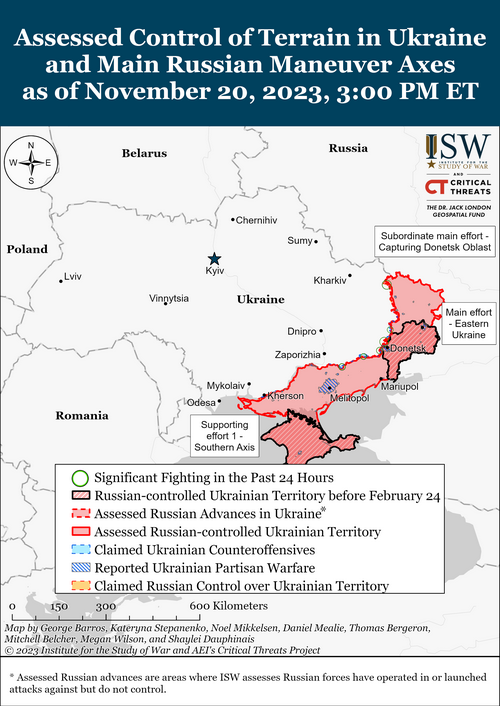
- Russian forces conducted offensive operations along the Kupyansk-Svatove-Kreminna line, near Bakhmut, near Avdiivka, west and southwest of Donetsk City, in the Donetsk-Zaporizhia Oblast border area, and in western Zaporizhia Oblast and marginally advanced in some areas.
- A Russian federal subject (region) and occupation officials are reportedly planning to work together to provide drones to Russian forces.
- A Ukrainian official reported that Ukraine successfully returned 45 Ukrainian children whom Russian authorities forcibly deported to Russia in the past six months.
Go here to read the rest. So the Russians are forming an Africa Corps? Now all they need is a Rommel to lead it.


If they haven’t got a Rommel in Ukraine, Don, they won’t find one for Africa.