
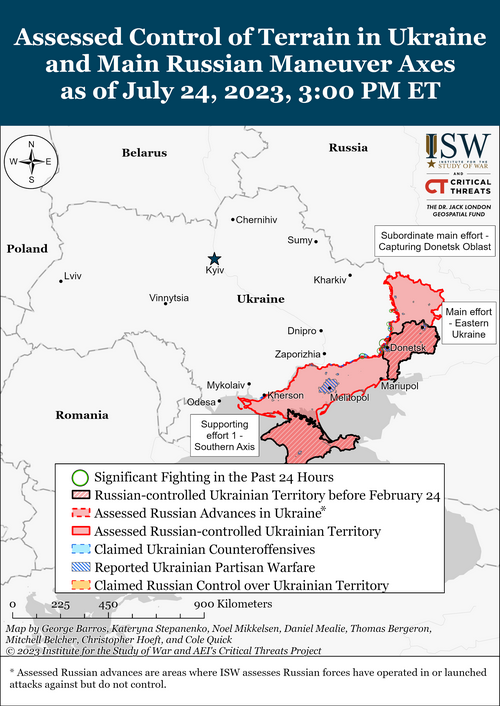
From The Institute For The Study of War:
Russian Offensive Campaign Assessment, July 24, 2023
Karolina Hird, Grace Mappes, Nicole Wolkov, Christina Harward, and Frederick W. Kagan
July 24, 2023, 6:45pm ET
Click here to see ISW’s interactive map of the Russian invasion of Ukraine. This map is updated daily alongside the static maps present in this report.
Click here to access ISW’s archive of interactive time-lapse maps of the Russian invasion of Ukraine. These maps complement the static control-of-terrain map that ISW produces daily by showing a dynamic frontline. ISW will update this time-lapse map archive monthly.
Note: The data cutoff for this product was 1pm ET on July 24. ISW will cover subsequent reports in the July 25 Russian Offensive Campaign Assessment.
Likely Ukrainian forces conducted a drone strike near the Russian Ministry of Defense (MoD) building in Moscow on July 24. The Russian Ministry of Foreign Affairs (MFA) claimed that Russian electronic warfare (EW) suppressed two Ukrainian UAVs that detonated, damaging two non-residential buildings.[1] One drone detonated on Komsomolsky Prospekt within 500 meters of the MoD building and within 200 meters of a reported secret Russian General Staff Main Directorate (GRU) building.[2] Russian sources reported that the second drone hit a business center on Likhachev Prospekt.[3] CNN reported that an unspecified Ukrainian intelligence official confirmed that Ukrainian forces conducted the attack.[4] Ukrainian Digital Transformation Minister Mykhailo Fedorov stated that unspecified UAVs attacked the capital and warned that more UAV attacks against Russia will occur.[5] Russian opposition source The Insider reported that Russian authorities banned Russian television channels from covering the drone strikes, citing sources in Russian state media channels.[6] Russian milbloggers had a muted reaction to these strikes; some criticized the Russian air defenses for allowing the drones to penetrate that far into Moscow, while others argued that the informational victory of such attacks is minimal and short-lived.[7]
Likely Ukrainian forces targeted Russian military assets in occupied Crimea, temporarily disrupting Russian logistics through Crimea on July 24. The Russian MFA accused Ukrainian forces of attacking occupied Crimea with 17 UAVs, and the MFA claimed that Russian EW suppressed 14 UAVs while air defenses shot down three UAVs.[8] Crimean occupation head Sergey Aksyonov claimed that one UAV hit an ammunition depot in Dzhankoy Raion.[9] A prominent Russian milblogger claimed that Ukrainian forces also launched three Storm Shadow missiles at an ammunition depot in Vilne (19km southwest of Dzhankoy) and a repair base in Novostepne (immediately south of Dzhankoy).[10] Ukrainian Mariupol Mayoral Advisor Petro Andyushchenko reported that strikes injured three Russian personnel at the Vesele military airfield (10km southwest of Dzhankoy) and reported additional explosions near Krasnohvardiiske (20km southwest of Dzhankoy).[11] Aksyonov temporarily suspended road traffic on the Dzhankoy-Simferopol highway as well as rail traffic through Dzhankoy Raion.[12] Aksyonov also announced the evacuation of all civilians within a five-kilometer radius of the strike area in Dzhankoy Raion.[13] Crimean occupation advisor Oleg Kryuchkov stated that occupation authorities will strictly monitor social media posts that could help Ukrainian forces identify targets in Crimea.[14]
Russian President Vladimir Putin signed an article published on July 24 likely intended to mitigate damage to Russia’s position in Africa and his own reputation resulting from Russia’s withdrawal from the Ukraine-Russia grain deal, Russian attacks on Ukrainian grain and port facilities, and Putin’s inability to attend the upcoming BRICS summit due to the International Criminal Court (ICC) arrest warrant issued for him. Putin outlined Russia’s goals for establishing partner relationships with Africa and called for the continuation of “traditionally close cooperation on the world stage.”[15] Putin also emphasized Russia’s trade with African economic partners and the importance of “uninterrupted food supply” for the “maintenance of the political stability of African states,” accusing the collective West of exploiting the grain deal for its own benefit at the expense of Russia and countries such as Ethiopia, Sudan, and Somalia.[16] Putin’s article follows Russia’s withdrawal from the grain deal and attacks that have destroyed tens of thousands of tons of Ukrainian grain and Ukrainian facilities essential to transporting the grain to areas of Africa that rely heavily on Ukrainian grain. Putin is also likely attempting to mitigate the opportunity cost and embarrassment of his inability to personally attend the BRICS Summit in South Africa due to the ICC arrest warrant.[17]
Russia conducted another drone strike on Ukrainian port infrastructure in Odesa Oblast overnight on July 23-24. Ukrainian military sources reported that Russian forces launched Iranian-made Shahed drones at port infrastructure in Reni, along the Danube River in far western Odesa Oblast, within a few kilometers of the Romanian border.[18] Odesa Oblast Head Oleh Kiper also stated that the drone strikes damaged 25 architectural monuments in Odesa Oblast, including the Transfiguration Orthodox Cathedral in Odesa City.[19] Russian sources claimed that Ukraine used the port infrastructure in Reni for the export of weapons, equipment, and grain.[20]
Ukrainian forces continued counteroffensive operations along at least three sectors of the front on July 24 and have reportedly advanced in certain areas. Ukrainian Deputy Defense Minister Hanna Malyar reported that over the past week, Ukrainian forces have advanced gradually on the southern flank of Bakhmut and in the Berdyansk (western Donetsk-eastern Zaporizhia Oblast border area) and Melitopol (western Zaporizhia Oblast) directions.[21] Malyar also noted that these counteroffensive actions are taking place against the backdrop of continued Russian offensive operations in the Kupyansk, Lyman, Avdiivka, and Marinka directions.[22] Russian sources claimed that Ukrainian forces conducted limited ground attacks in western Donetsk Oblast south of Velyka Novosilka and advanced south of Orikhiv in western Zaporizhia Oblast.[23] The Ukrainian General Staff indicated that Ukrainian troops are continuing offensive actions in the Berdyansk and Melitopol directions but did not specify locations or outcomes.[24]
The Kremlin continues to codify domestic repression into Russian law, generating minimal opposition from select Russian lawmakers. Russian President Vladimir Putin signed laws on July 24 allowing the Russian Ministry of Justice to conduct unscheduled inspections of those classified as “foreign agents” under new Russian laws and requiring Russian citizens, government officials, and organizations to comply with restrictions on foreign agents.[25] Putin also signed a law that would fine citizens up to 50,000 rubles (about $550), officials up to 100,000 rubles (about $1,100), and organizations up to 300,000 (about $3,300) rubles for violating the law on foreign agents.[26] Russian opposition news outlet Vazhnye Istorii reported on July 24 that the Russian Federation Council proposed a bill that would allow Russian authorities to deprive natural born Russian citizens of citizenship due to certain “political crimes” and “desertion.”[27] Vashnye Istorii also noted, however, three senators Olga Bas (representing the Luhansk People’s Republic), Ekaterina Altabayeva, and Sergei Kolbin (both representing Sevastopol in occupied Crimea) withdrew their authorship of the bill, potentially due to nuances and intricacies within the ever-expanding new body of Russian law pertaining to citizenship in occupied areas.[28] Federation Council Constitutional Legislation and State Building Committee Head Andrey Klishas criticized the bill and claimed that it would violate the Russian Constitution, likely referencing Article 6 which states that a Russian citizen may not be deprived of their citizenship or of the right to change citizenship status.[29] Vazhnye Istorii reported that Russia has already adopted a law that would allow Russian authorities to revoke Russian citizenship from an individual who did not acquire Russian citizenship by birth for posing what the Russian Federal Security Service (FSB) deems a “security threat.”[30] ISW has previously reported on measures taken by Russian authorities to intensify domestic repression and encourage self-censorship through various amendments to and manipulations of domestic law.[31]
Key Takeaways:
- Likely Ukrainian forces conducted a drone strike near the Russian Ministry of Defense (MoD) building in Moscow on July 24.
- Likely Ukrainian forces targeted Russian military assets in occupied Crimea, temporarily disrupting Russian logistics through Crimea on July 24.
- Russian President Vladimir Putin signed an article published on July 24 likely intended to mitigate damage to Russia’s position in Africa and his own reputation resulting from Russia’s withdrawal from the Ukraine-Russia grain deal, Russian attacks on Ukrainian grain and port facilities, and Putin’s inability to attend the upcoming BRICS summit due to the International Criminal Court (ICC) arrest warrant issued for him.
- Russia conducted another drone strike on Ukrainian port infrastructure in Odesa Oblast overnight on July 23-24.
- Ukrainian forces continued counteroffensive operations along at least three sectors of the front on July 24 and have reportedly advanced in certain areas.
- The Kremlin continues to codify domestic repression into Russian law, generating minimal opposition from select Russian lawmakers.
- Russian forces conducted offensive operations along the Kupyansk-Svatove-Kreminna line, in the Bakhmut area, and along the Avdiivka-Donetsk City line and made marginal gains south of Kreminna.
- Ukrainian forces conducted offensive operations along the Kupyansk-Svatove-Kreminna line, and in the Bakhmut area and reportedly advanced in the Bakhmut area.
- Russian forces conducted offensive operations in western Donetsk Oblast and did not make any confirmed or claimed gains.
- Ukrainian forces conducted offensive operations in western Donetsk Oblast and in western Zaporizhia Oblast and reportedly advanced in the Orikhiv area.
- Russian officials continue to highlight the claimed successes of the Russian defense industrial base (DIB).
- Ukrainian officials continue to reveal the involvement of Belarusian entities in the forced deportation of Ukrainian children.
Go here to read the rest. The drone attacks are a strong feature of the war in Ukraine. Thus far more flash than substance, but it is definitely a sign of things to come in warfare in the present century. If this war spreads it might be due to unrestricted drone warfare on trains and ships of neutral powers going to, or coming from Ukraine. Russia would state that no member of NATO is really neutral, but go down that path and Russia could see NATO military in the field, which somber possible consequences for the entire worl.

