
From The Institute For The Study of War:
Russian Offensive Campaign Assessment, July 7, 2023
Riley Bailey, Grace Mappes, George Barros, Nicole Wolkov, Karolina Hird, Angelica Evans, and Frederick W. Kagan
July 7, 2023, 5pm ET
Click here to see ISW’s interactive map of the Russian invasion of Ukraine. This map is updated daily alongside the static maps present in this report.
Click here to access ISW’s archive of interactive time-lapse maps of the Russian invasion of Ukraine. These maps complement the static control-of-terrain map that ISW produces daily by showing a dynamic frontline. ISW will update this time-lapse map archive monthly.
Note: The data cutoff for this product was 1pm ET on July 7. ISW will cover subsequent reports in the July 8 Russian Offensive Campaign Assessment.
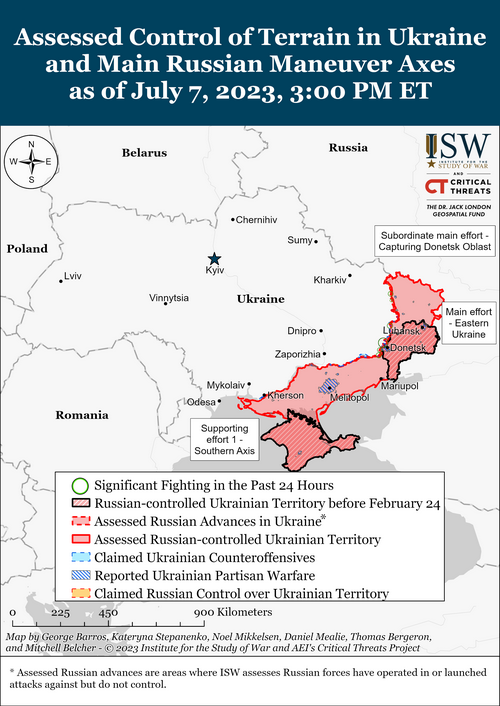
Ukrainian forces made tactically significant gains in the Bakhmut area and continued counteroffensive operations in at least three other sectors of the front on July 7. Geolocated footage published on July 6 indicates that Ukrainian forces have made tactically significant gains near Yahidne (2km north of Bakhmut).[1] The Ukrainian General Staff reported that Ukrainian forces conducted offensive operations north and south of Bakhmut, and Ukrainian Ground Forces Commander Colonel General Oleksandr Syrsykyi reported that Ukrainian forces established control over unspecified previously lost positions in the Bakhmut area.[2] Ukrainian General Staff Spokesperson Andriy Kovalev reported that Ukrainian forces also achieved partial success near Klishchiivka (7km southwest of Bakhmut).[3] The Ukrainian General Staff reported that Ukrainian forces continued offensive operations in western Zaporizhia Oblast and along the administrative border between Zaporizhia and Donetsk oblasts.[4] The Russian Ministry of Defense (MoD) and other Russian sources claimed that Ukrainian forces conducted offensive operations in the Kreminna direction along the Kharkiv-Luhansk Oblast border.[5]
Russian forces have reportedly committed almost the entirety of the Russian Eastern Grouping of Forces to southern Ukraine. Ukrainian military observer Konstantin Mashovets stated on July 5 that the Eastern Grouping of Forces is comprised of the 5th Combined Arms Army (CAA), the 35th CAA, the 36th CAA, and the 29th CAA (all of the Eastern Military District).[6] ISW cannot confirm the exact composition of the Eastern Grouping of Forces, although it continues to appear that this operational direction command structure is largely coextensive with the Eastern Military District (EMD). Mashovets claimed that the 5th CAA’s 127th Motorized Rifle Division and 60th Motorized Rifle Brigade are operating along the administrative border between Zaporizhia and Donetsk oblasts and that the CAA’s other main unit, the 57th Motorized Rifle Brigade, is operating south of Bakhmut. ISW has observed the 5th CAA‘s 127th Division and 60thBrigade in the Zaporizhia Oblast-Donetsk Oblast border area along with previous Russian claims that the 57th Motorized Rifle Brigade has been operating on Bakhmut’s southern flank.[7] Mashovets stated that the 35th CAA’s 38th Motorized Rifle Brigade, 64th Motorized Rifle Brigade, and 69th Separate Cover Brigade are deployed to western Zaporizhia Oblast and that the 36th CAA’s 37th Motorized Rifle Brigade and 5th Separate Tank Brigade are deployed to areas south of Velyka Novosilka in western Donetsk Oblast.[8] ISW previously assessed that the 35th CAA’s Chief of Staff’s alleged death from a Ukrainian missile strike on June 13 in Zaporizhia Oblast suggested that significant elements of the 35th CAA are likely operating along the Zaporizhia front.[9] The Ukrainian General Staff previously reported on March 19 that elements of the 37th Motorized Rifle Brigade would deploy to western Donetsk Oblast.[10] Mashovets also stated that the 29th CAA, the smallest combined arms army in the EMD, is the only formation of the Eastern Grouping of Forces in reserve.[11] Mashovets added that the 58th and 49th CAAs and 22nd Army Corps of the Southern Military District (SMD) are committed to operations in Southern Ukraine.[12] Mashovets stated that elements of the 68th Army Corps (EMD) are also deployed to southern Ukraine, but suggested that the 68th Army Corps is not a part of the Eastern Grouping of Forces, making it the only higher-level EMD formation separate from the Eastern Grouping of Forces.[13] ISW has also observed elements of the EMD Pacific Fleet’s naval infantry brigades (40thand 155th) continuing to serve in western Donetsk Oblast after suffering heavy losses during the Russian winter spring 2023 offensive.[14] Mashovets‘ reporting and ISW’s current observation of the Russian order of battle (ORBAT) in southern Ukraine indicates that almost the entirety of the EMD’s combat power is committed to defending against Ukrainian counteroffensives, primarily in southern Ukraine.
The deployment of almost the entirety of the Russian Eastern Grouping of Forces and extensive SMD elements to the frontline in southern Ukraine suggests that Russian defenses in southern Ukraine may be brittle. Mashovets’ report suggests that the only reserve that the Russian military maintains in southern Ukraine consists of elements of the 29th Combined Arms Army – the Eastern Military District’s smallest combined arms army that has only one maneuver brigade: the 36thMotorized Rifle Brigade. Elements of the 36th Motorized Rifle Brigade participated in the Battle of Kyiv in early 2022 and fought near Vuhledar in early 2023 and are thus likely degraded.[15]
Russian defenses in southern Ukraine, while formidable, are not insurmountable. Russian forces in southern Ukraine would likely have to fall back on prepared defensive positions without significant support from operational reserves if Ukrainian forces achieved an operational breakthrough. Withdrawal in contact is an exceedingly difficult military task, and it is unclear that Russian forces in contact would be able to successfully withdraw from their first lines to other prepared lines in good order, especially if those forces – and the forces behind them in echelon – are worn-down and unsupported. ISW previously assessed that Ukrainian forces are likely conducting a gradual effort to systematically degrade Russian combat power in southern Ukraine over time, increasing the brittleness of the Russian defenses.[16]
Russia temporarily disconnected at least partially from the global internet during a test of its “sovereign internet” system overnight on July 4-5. Russian state affiliated media outlet RBK cited telecommunications sources that claimed that Russia successfully conducted a test of the Sovereign Internet system overnight.[17] The test reportedly prevented Russians from accessing common Western services including Google and Wikipedia while retaining access to Russian-hosted web services.[18] The test likely disconnected some Russian government services, however, including Russian Railways and the Russian federal veterinary and agricultural oversight body Rosselkhoznadzor.[19] Russian telecommunications operators Megafon and Beeline also reported outages during the test.[20] Continued tests and development of the ”sovereign internet” indicate that the Kremlin continues long term efforts to be able to isolate Russia from Western influence and the global sphere, and this effort will likely have ramifications that spread beyond the information space.[21] Russia’s economy would likely significantly from protracted internet isolation, for example, because so much international commerce relies on the global internet.
Russian forces conducted a series of missile and drone strikes against rear areas in Ukraine on June 6 to 7. The Ukrainian General Staff reported that Ukrainian air defenses shot down 12 of 18 Shahed-131/136 drones and seven of 11 Kalibr cruise missiles.[22] The Ukrainian General Staff reported that Russian forces launched the drones from areas near Primorsk-Akhtarsk in Krasnodar Krai and that Russian missiles struck Lviv City, an infrastructure facility in Zaporizhzhia City, and a residential building in Cherkasy Oblast.[23] Ukrainian Permanent Representative to the UN Serhiy Kyslytsya stated that Russian forces have launched over 1,000 Iranian Shahed-131/136 and Mohajer-6 drones against Ukraine since September 2022.[24]
Key Takeaways:
- Ukrainian forces made tactically significant gains in the Bakhmut area and continued counteroffensive operations in at least three other sectors of the front on July 7.
- Russian forces have reportedly committed almost the entirety of the Russian Eastern Grouping of Forces to southern Ukraine.
- The deployment of almost the entirety of the Russian Eastern Grouping of Forces and extensive SMD elements to the frontline in southern Ukraine suggests that Russian defenses in southern Ukraine may be brittle.
- Russia temporarily disconnected at least partially from the global internet during a test of its “sovereign internet” system overnight on July 4-5.
- Russian forces conducted a series of missile and drone strikes against rear areas in Ukraine on June 6 to 7.
- Russian and Ukrainian forces continued ground attacks along the Kharkiv-Luhansk Oblast border. Ukrainian forces made tactically significant gains in the Bakhmut area between July 6-7.
- Russian and Ukrainian forces conducted ground attacks in western Donetsk Oblast.
- Russian sources claimed that Ukrainian forces launched a renewed wave of counterattacks in western Zaporizhia Oblast on July 7.
- The Russian occupation of the Zaporizhzhia Nuclear Power Plant (ZNPP) continues to restrict international monitors’ access to the facility.
- The Russian Ministry of Defense (MoD) reportedly drafted a law that would expand the list of gross disciplinary offenses within the Russian Armed Forces.
- Russian authorities continue to portray themselves as responsible custodians of Ukrainian children in an effort to discredit Ukraine while continuing to forcibly deport Ukrainian children to Russia.
- A Belarusian military official stated that Wagner Group forces have not yet decided to deploy to Belarus while giving a press tour of the speculated Wagner Group base in Asipovichy on July 7.
Go here to read the rest. The Russians are hiring Hessians Cuban soldiers for $2,000 per month a head, eighty percent going to the Cuban government. The Russians are running out of ground combat troops and that is very bad news for the ability of the Russians to fight long term the type of ground struggle confronting them in the Ukraine.

