
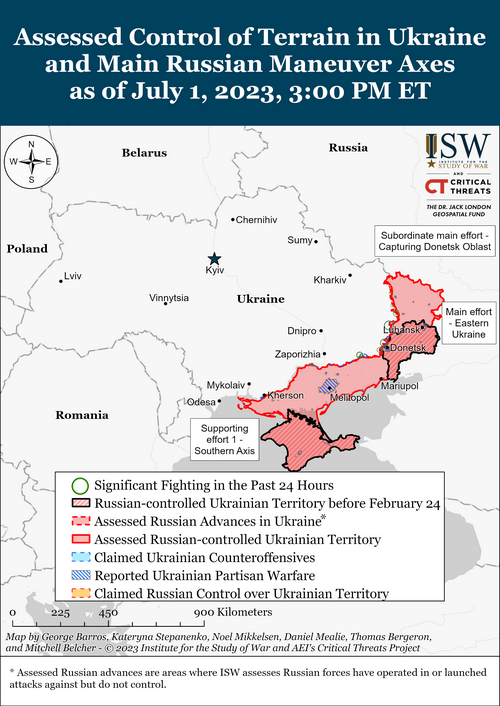
From The Institute For The Study of War:
Russian Offensive Campaign Assessment, July 1, 2023
Kateryna Stepanenko, Riley Bailey, Nicole Wolkov, George Barros, Angelica Evans, and Frederick W. Kagan
July 1, 2023, 5:15 pm ET
Click here to see ISW’s interactive map of the Russian invasion of Ukraine. This map is updated daily alongside the static maps present in this report.
Click here to access ISW’s archive of interactive time-lapse maps of the Russian invasion of Ukraine. These maps complement the static control-of-terrain map that ISW produces daily by showing a dynamic frontline. ISW will update this time-lapse map archive monthly.
Note: The data cutoff for this product was 12:30 pm ET on July 1. ISW will cover subsequent reports in the July 2 Russian Offensive Campaign Assessment.
Russian sources claimed that Ukrainian forces conducted counteroffensive operations in at least four sectors of the frontline on July 1. The Russian Ministry of Defense (MoD) claimed that Russian forces repelled Ukrainian assaults in the Bakhmut area and along the Avdiivka-Donetsk City front.[1] Russian milbloggers claimed that Ukrainian forces made marginal gains near Rozdolivka (18km north of Bakhmut) and unspecified gains near Klishchiivka (7km southwest of Bakhmut).[2] Russian sources claimed that Ukrainian forces continued offensive operations along the administrative border between Zaporizhia and Donetsk oblasts and made gains southwest of Velyka Novosilka.[3] Russian sources claimed that Ukrainian forces conducted offensive operations south and southwest of Orikhiv in western Zaporizhia Oblast, with one milblogger claiming that Ukrainian forces made gains up 1.5km deep and 6km wide in the direction of Robotyne (12km south of Orikhiv).[4] Other milbloggers claimed that Ukrainian forces are still at least 1.5km north of Robotyne as of July 1, consistent with ISW’s current assessment of the control of terrain in the area.[5]
US Chairman of the Joint Chiefs of Staff General Mark Milley acknowledged that Ukrainian counteroffensive operations will take longer than some Western observers had expected. Milley stated that Ukrainian forces are deliberately working through difficult minefields and advancing from 500m to 2,000m a day.[6] Milley reiterated that he expects Ukrainian counteroffensive operations to last up to 10 weeks and urged people to realize that the Ukrainian counteroffensive will be a long and likely costly operation.[7] Russian sources are increasingly claiming that Ukrainian forces are currently conducting assaults in southern Ukraine with smaller infantry groups and fewer armored vehicles than during earlier counteroffensive operations.[8] Russian sources also claim that Ukrainian forces are conducting reconnaissance-in-force operations in southern Ukraine in even smaller groups, some of them allegedly with seven to nine personnel.[9] These claims about Ukrainian operations suggest that Ukrainian forces are not currently attempting the kind of large-scale operations that would result in rapid territorial advances. Ukrainian officials have routinely indicated that Ukrainian forces have yet to commit a substantial portion of their forces to counteroffensive operations and have yet to launch the main phase of the counteroffensive.[10]
Russian officials and sources celebrated claims that Russian forces defeated small-scale Ukrainian landings in east (left) bank Kherson Oblast on July 1 as if they had won a major victory. Kherson Oblast Occupation Head Vladimir Saldo claimed that servicemen of the Russian “Dnepr” Group of Forces cleared areas near the Antonivsky Bridge on the eastern bank of the Dnipro River after special forces elements conducted a surprise landing on Ukrainian forces’ rear positions overnight.[11] Saldo claimed that elements of a “Storm” detachment, the 61st Naval Infantry Brigade (Northern Fleet), the 126th Coastal Defense Brigade (22nd Army Corps, Black Sea Fleet), the 127th Reserve Brigade (likely a new reserve unit), and the 205th Separate Motorized Rifle Brigade (49th Combined Arms Army, Southern Military District [SMD]) participated in the operation that decisively repelled Ukrainian forces from their position near Antonivsky Bridge. Saldo also claimed that Ukrainian forces no longer have any “bridgeheads” on the eastern bank, and a Kremlin-affiliated milblogger claimed that Russian forces were able to advance to the dacha areas near the Antonivsky Bridge after launching an Iskander ballistic missile at the bridge on June 30.[12] A Crimean-based Russian blogger also claimed that elements of the 7th Guards Mountain Air Assault (VDV) Division using T-72 tanks also participated in an attack against Ukrainian positions near the Antonivsky Bridge.[13] The Russian Ministry of Defense (MoD) claimed that Russian forces eliminated a Ukrainian sabotage group that attempted to land on the island north of Oleshky (9km southeast of Kherson City) – likely referring to the Antonivsky Bridge area.[14] The Russian MoD also demonstratively awarded servicemen of the 80th Arctic Motorized Rifle Brigade (14th Army Corps, Northern Fleet) – a unit within the Russian “Dnepr” Group of Forces – for destroying Ukrainian military equipment in Kherson Oblast.[15] The Russian MoD also published an interview with the commander of the 80th Arctic Motorized Rifle Brigade who claimed that Russian forces fully restored their positions along the coast of the Dnipro River and along the islands and repelled all Ukrainian attempts to cross the river.[16] Russian sources notably did not provide any evidence that Russian forces regained control over coastal areas and many Russian sources reported that clearing operations near the dacha areas adjacent to the Antonivsky Bridge are still ongoing as of July 1.[17]
The exaggerated Russian praise for defeating a small Ukrainian landing suggests either that the Russian military command sincerely fears a Ukrainian attack on east bank Kherson Oblast or that it is desperate for an informational victory following the Wagner Group’s armed rebellion or both. Russian sources previously claimed that a grouping of around 70 Ukrainian servicemen held positions near the Antonivsky Bridge and that the Russian “Dnepr” Group of Forces’ military command had been consistently ordering Russian forces to eliminate the Ukrainian “bridgehead” despite significant personnel and equipment losses.[18] The Russian “Dnepr” Group of Forces is reportedly headquartered in Rostov-on-Don likely within the SMD headquarters.[19] Wagner forces notably surrounded the SMD headquarters during the armed rebellion on June 24, and the Russian MoD is likely trying to recover the headquarters’ reputation. A Kremlin-affiliated milblogger also expressed concern that Ukrainian forces will continue to conduct small unit sorties across the Dnipro River and will launch a large-scale attack to reach Oleshky to break through to southwestern Kherson Oblast.[20] ISW makes no effort to forecast Ukrainian operations, but the milblogger’s statements suggest that the Russian military command may be increasingly concerned over a potential Ukrainian landing on east bank Kherson Oblast.
Russian forces are likely responding to Ukrainian operations around Bakhmut by pulling forces from elsewhere in Ukraine. Ukrainian Eastern Group of Forces Spokesperson Colonel Serhiy Cherevaty reported on July 1 that Russian forces recently transferred an unspecified Russian Airborne Forces (VDV) regiment from the Lyman direction (the area west of Kreminna) to the Bakhmut direction.[21] Geolocated footage published on June 30 shows the 137th Guards Airborne Regiment (106th Airborne Division) operating south of Rozdolivka (18km north of Bakhmut).[22] A Russian milblogger also claimed that elements of the 98th VDV Division are now operating in the Bakhmut direction.[23] ISW has previously observed elements of the 237th Air Assault Regiment (76th VDV Division) and the 331st Airborne Regiment (98th VDV Division) operating in the Lyman direction, although ISW has not seen any visual confirmation of elements of either formation near Bakhmut recently.[24] Cherevaty reported that Russian forces replaced the VDV regiment in the Lyman direction with unspecified territorial defense forces, indicating that Russian forces may be redeploying more elite units to the Bakhmut area and replacing the elite units with inferior formations.[25] Ukrainian Deputy Defense Minister Hanna Malyar previously stated that Russian forces transferred some of their most-combat capable units from the Kherson direction to the Bakhmut and Zaporizhia directions in the week following the start of Ukrainian counteroffensives on June 4.[26] Cherevaty stated that Bakhmut continues to offer Russian forces more propaganda value than military benefits and suggested that Russian forces may be concentrating elite forces in the Bakhmut area to preserve the perceived informational victory resulting from the capture of Bakhmut on May 21.[27] If Russian reinforcements already sent to Bakhmut are insufficient to hold Russian gains in the area the Russian command may face difficult choices about whether to risk creating serious vulnerabilities in Kherson or Luhansk oblasts or to begin drawing forces away from southern Ukraine.
Ukrainian President Volodymyr Zelensky stated that the Russians might initiate an intentional radioactive leak at the Zaporizhzhia Nuclear Power Plant (ZNPP) as part of a potential Russian strategy to freeze the war. Zelensky stated in an interview with Spanish news outlet El Mundo published on June 30 that Russian forces may attempt to remotely detonate the ZNPP if Ukrainian authorities are able to pass control of the ZNPP to the International Atomic Energy Agency (IAEA).[28] Zelensky stated that Russian forces may cause a radiological incident to halt maneuver warfare and buy more time for Russia to recruit more personnel and produce more military equipment.[29] Zelensky also reported that about 5,000 Russian forces remain at the ZNPP with military equipment. ISW continues to assess that Russia remains unlikely to cause a radiological incident at the ZNPP since Russia would not be able to control the impacts of the incident, which would degrade Russia’s ability to operate and govern in occupied southern Ukraine.[30] Russian forces could conduct various possible man-made radiological incidents at varying levels of severity; however, ISW continues to assess that the consequences of a Russian radiological incident would outweigh any benefit for Russian forces at this time.[31] Russia is likely continuing to use the threat of a radiological incident to constrain Ukrainian counteroffensive actions and degrade Western military assistance support for Ukraine.
Russian propagandists are likely conducting an information campaign to destroy the Wagner Group’s reputation as a uniquely effective fighting force in support of the Russian Ministry of Defense’s (MoD) effort to dismantle the Wagner Group and integrate former Wagner fighters into MoD structures. Russian state TV channel Rossiya-1 aired a segment on June 30 trivializing the Wagner Group’s effectiveness in Ukraine, calling into question the “constructed myth about the Wagner Group’s [high level of] effectiveness.”[32] The segment implied that there is a popular misconception in Russia that Wagner forces are extraordinarily effective and argued that regular Russian forces are more effective than the Wagner private military company (PMC). Rossiya-1 argued that regular Russian forces captured a geographically larger and more important city of Mariupol (in 71 days) much faster than Wagner Group forces were able to capture Bakhmut (in 224 days). Many Russian milbloggers – including Wagner-linked milbloggers – decried the report as a shameless rewriting of history and part of a “vile agenda” designed to “consign [Wagner PMC] feats to oblivion.”[33] The Kremlin media apparatus is likely targeting Russian public perception of the Wagner PMC to decrease the group’s popularity as the MoD may seek to effectively disband the Wagner Group in Ukraine and reorganize its elements within the Russian MoD.[34] This segment is likely a supporting effort within Russian President Vladimir Putin’s assessed campaign to destroy Wagner Group financier Yevgeny Prigozhin’s personal reputation.[35]
Key Takeaways:
- Russian sources claimed that Ukrainian forces conducted counteroffensive operations in at least four sectors of the frontline on July 1.
- US Chairman of the Joint Chiefs of Staff General Mark Milley acknowledged that Ukrainian counteroffensive operations will take longer than some Western observers had expected.
- Russian officials and sources celebrated claims that Russian forces defeated small-scale Ukrainian landings in east (left) bank Kherson Oblast on July 1 as if they had won a major victory.
- The exaggerated Russian praise for defeating a small Ukrainian landing suggests either that the Russian military command sincerely fears a Ukrainian attack on east bank Kherson Oblast or that it is desperate for an informational victory following the Wagner Group’s armed rebellion or both.
- Russian forces are likely responding to Ukrainian operations around Bakhmut by pulling forces from elsewhere in Ukraine.
- Ukrainian President Volodymyr Zelensky stated that the Russians might initiate an intentional radioactive leak at the Zaporizhzhia Nuclear Power Plant (ZNPP) as part of a potential Russian strategy to freeze the war.
- Russian propagandists are likely conducting an information campaign to destroy the Wagner Group’s reputation as a uniquely effective fighting force in support of the Russian Ministry of Defense’s (MoD) effort to dismantle the Wagner Group and integrate former Wagner fighters into MoD structures.
- Russian forces continued limited offensive operations along the Svatove-Kreminna line.
- Ukrainian forces continued to conduct ground attacks around Bakhmut.
- Russian forces continued to conduct limited ground attacks in and transfer airborne (VDV) elements to the Bakhmut area.
- Russian forces continued to conduct limited ground attacks along the Avdiivka-Donetsk City line.
- Russian forces continued to counterattack recently-liberated Ukrainian positions on the administrative border between Donetsk and Zaporizhia oblasts.
- Ukrainian forces continued counteroffensive operations in western Zaporizhia Oblast.
- Russian security procedures on the Kerch Strait bridge are likely slowing down Russian logistics from Russia to occupied Crimea.
- Iran may be sending materiel and personnel to Russia to help construct a factory in the Republic of Tatarstan that will reportedly make Iranian combat drones.
- Ukrainian and Western sources continue to report on the abductions of Ukrainian children and adults in the occupied territories.
Go here to read the rest. Since General Mark Milley has said that the Ukrainian offensive will take longer than expected, considering the accuracy of his prior predictions, I expect that the Russians are near collapse.

