
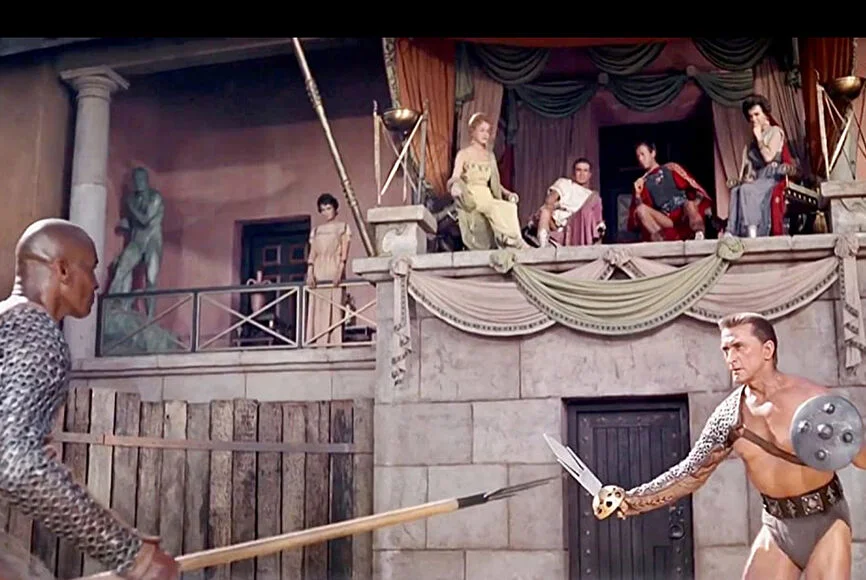
I saw Spartacus (1960) initially in 1967 when it was first broadcast on television and it awakened a lifelong love of ancient history in me.
The film is full of historical howlers, par for the course for Hollywood. Crassus, the richest man in Rome, was not a proto-Fascist dictator. Spartacus, who is a shadowy figure because the source material is sparse (only Plutarch’s Life of Crassus and a brief section in Appian’s Civil Wars), did not simply march to the sea to escape Italy with his liberated slaves, but marauded throughout Italy, defeating several Roman consular armies in the process. There was no Senator called Gracchus, magnificently portrayed in the film by Charles Laughton, who led the opposition to Crassus, and Crassus wasn’t interested in personal dictatorship in any event during the time he put down Spartacus and his slave army. The list of substantial factual errors in the film could go on for considerable length.
However, all that is beside the point. The film is a magnificent work of art, and it gets the atmosphere of the late Roman Republic right: old Roman morality being forgotten, a growth of decadence fueled by ever more wealth from foreign conquests, endless amounts of slaves flooding into Italy from the same foreign conquests, factions in the Senate engaging in what amounted to a cold civil war between bouts of hot civil war, the Roman Republican government teetering on the brink of military dictatorship, the movie presents all of these elements more clearly than any classroom lecture could.
At the time the film attracted attention because it, rightly, broke the Black List against Communists in Hollywood by listing Dalton Trumbo as the screenwriter. The movie was loosely based on the novel of the same name by former Hollywood Communist Howard Fast. (Fast quit the Communist Party in disgust after the Soviets crushed the Hungarian Uprising in 1956.) The leftist politics are fairly easily to discern with Crassus as a proto-Fascist dictator, howlingly anachronistic, and Spartacus and his slave followers as the revolting proletariat. It is a tribute to the quality of the film that this ham-fisted attempt at agit-prop fails to destroy the film.
Here is a first rate fan made trailer of the film:
Of course it wouldn’t be a post on Spartacus the film without a clip of this immortal scene which has been endlessly parodied over the years, but which almost had me in tears when I first saw it as a boy.
Anyone who hasn’t seen this masterpiece really needs to watch it as soon as possible.
Bonus:


One reason “this ham-fisted attempt at agit-prop fails to destroy the film” is Peter Ustinov, who rewrote Trumbo’s pedestrian dialogue for his character, thereby elevating key scenes. I think Laughton might have done some tinkering also. Then, of course, you have the visionary contributions of Kirk Douglas and Stanley Kubric to an epic tale with universal appeal. As for Trumbo, I tend to agree with the quip attributed to Billy Wilder: “Of the unfriendly Ten, only two had any talent; the other eight were just unfriendly.” Yet, I don’t think Trumbo’s talent was so towering as to justify his penchant for reducing key scenes to missives from Moscow. Still, I’d rather have two minutes of cloaked Communism injected into an otherwise enjoyable film than today’s 95 minutes of insufferable Wokeism.