
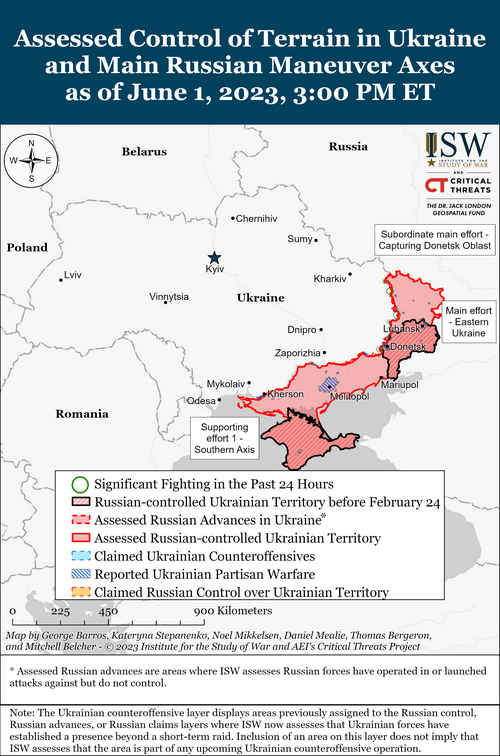
From The Institute For The Study of War:
Russian Offensive Campaign Assessment, June 1, 2023
Riley Bailey, Kateryna Stepanenko, Nicole Wolkov, Layne Philipson, George Barros, and Fredrick W. Kagan
June 1, 2023, 5:30pm ET
Click here to see ISW’s interactive map of the Russian invasion of Ukraine. This map is updated daily alongside the static maps present in this report.
Click here to access ISW’s archive of interactive time-lapse maps of the Russian invasion of Ukraine. These maps complement the static control-of-terrain map that ISW produces daily by showing a dynamic frontline. ISW will update this time-lapse map archive monthly.
Note: The data cutoff for this product was 1:30pm ET on June 1. ISW will cover subsequent reports in the June 2 Russian Offensive Campaign Assessment.
Russian forces conducted another series of missile strikes on Ukraine overnight on May 31 to June 1 and during the day on June 1. The Ukrainian General Staff reported that Russian forces launched 10 Iskander ballistic missiles targeting Kyiv City from Bryansk Oblast, which borders Ukraine, in the morning on June 1, and that Ukrainian air defense destroyed all 10 missiles.[1] The Ukrainian General Staff also reported that Russian forces launched two S-300 missiles targeting critical infrastructure in Kharkiv City during the day on June 1.[2] Ukrainian Air Force Spokesperson Colonel Yuriy Ihnat stated that Ukraine cannot strike launch points of Russian Iskander missiles in Russia as Ukraine is under obligations not to strike Russian territory with Western-provided weapons.[3] ISW has previously assessed that Russian forces began a new limited air campaign in recent months to degrade Ukrainian counteroffensive capabilities, but that the Russian prioritization of Kyiv is likely further limiting the campaign’s ability to meaningfully constrain potential Ukrainian counteroffensive actions.[4]
Elements of the all-Russian pro-Ukrainian Russian Volunteer Corps (RDK) and Freedom of Russia Legion (LSR) reportedly conducted another raid into Belgorod Oblast on June 1. Geolocated footage published on June 1 shows alleged LSR personnel operating near Novaya Tavolzhanka (3.5km from the Russian-Ukrainian border) and LSR and RDK personnel striking Russian positions near the settlement as well as Shebekino, Belgorod Oblast (7km from the Russian-Ukrainian border).[5] The RDK stated that the ”second phase” of its operations has begun and published footage purporting to show RDK personnel engaging in combat on the outskirts of Shebekino.[6] The Russian Ministry of Defense (MoD) claimed that Russian Border Guard Service and Federal Security Service (FSB) officers thwarted two motorized infantry companies reinforced with tanks that attempted to ”invade” Russian territory near Shebekino and Novaya Tavolzhanka.[7] Belgorod Oblast Governor Vyacheslav Gladkov stated that ”there were no enemies on the territory of Belgorod Oblast” during the attempted raids, although geolocated footage shows alleged LSR personnel operating on Russian territory.[8]
A prominent Russian milblogger claimed that 20 Russian border guards and 20 conscripts as well as Russian aviation and artillery units repelled the RDK and LRS personnel that attempted to conduct a raid near Shebekino.[9] Other Russian milbloggers claimed that the formations that conducted the raids near Shebekino and Novaya Tavolzhanka were roughly the size of a company and had tanks as well as other armored fighting vehicles, although one prominent milblogger claimed that the group that tried to enter near the Shebekino checkpoint was only comprised of 10 people.[10] The reported company size elements conducting these operations indicate that these operations in Belgorod Oblast are doctrinally raids. Raids, according to US Army doctrine, are small scale assault operations involving swift entry into hostile territory to secure information, disrupt hostile forces, or destroy installations.[11] Raids end with a planned withdrawal from a narrowly defined target area and do not seek to establish long-term control over territory. The RDK and LRS have not seriously attempted to control territory in Belgorod Oblast, either on June 1 or during their May 22 raid, despite their avowed goal to capture Russian territory.[12]
Russian officials and milbloggers’ responses to the limited raid in Belgorod Oblast are indicative of a continued heightened anxiety within the Russian information space regarding the war in Ukraine. Kremlin Spokesperson Dmitry Peskov stated on June 1 that Russian President Vladimir Putin constantly receives information about the situation in Belgorod Oblast, and that Putin awarded Shebekinsky Raion Head Vladimir Zhdanov the Order of Courage for his response to the situation along the border.[13] Gladkov announced that Russian officials in Belgorod Oblast evacuated 200 children to Penza Oblast and plan to evacuate another 600 children to Kaluga and Yaroslavl oblasts on June 3.[14] BBC’s Russia Service reported on June 1 that Gladkov agreed with authorities of several Russian regions to accept 1,200 Belgorod residents during evacuations.[15] These evacuations, Putin’s reported attentiveness, and the MoD’s characterization of the raid as an attempt to ”invade” Russian territory suggests that the Kremlin is trying to use these limited raids to support ongoing information operations that seek to portray the war in Ukraine as existential and garner domestic support for a protracted war.[16]
Select Russian milbloggers used the situation in Belgorod Oblast to criticize the Russian leadership while others argued that the limited raids are precursors for Ukrainian counteroffensive operations. Former Russian officer and ardent nationalist Igor Girkin argued that increased activity within Russia is a result of Russian forces wasting reserves in the fall of 2022, Russian officials failing to transition the economy to a war footing, and the Kremlin’s decision not to introduce martial law.[17] Girkin argued that these failures caused Ukraine to understand Russia’s relative weaknesses and suggested that they emboldened Ukrainian forces to conduct operations within Russia itself.[18] Girkin also argued that the Kremlin will likely respond to the alleged Ukrainian operations within Russia too late and that the Russian public’s support for the Russian leadership will wane by then.[19] Another milblogger criticized Putin directly for pretending that everything is fine in Shebekino.[20] Other milbloggers argued that the raids in Belgorod Oblast are a Ukrainian effort to divert Russian forces away from important sectors of the front in Ukraine to border regions ahead of potential Ukrainian counteroffensive operations.[21]
Chechen commanders and officials launched a concerted attack on Wagner Group financier Yevgeny Prigozhin on June 1 in a likely attempt to undermine Prigozhin. Chechen member of the Russian State Duma Adam Delimkhanov responded to Prigozhin’s May 31 statement in which Prigozhin noted that he is unaware Chechen units’ new positions in Ukraine and that Chechen forces will fight for select settlements, rather than the entirety of the Donetsk Oblast.[22] Prigozhin’s original statement appeared relatively neutral compared with his more inflammatory statements and did not directly criticize Chechen leader Ramzan Kadyrov or his forces. Delimkhanov informally addressed Prigozhin as “Zhenya” (a nickname for Yevgeny) and urged him to select a date on which they could meet to clarify what Chechen ”Akhmat” forces are doing on the frontlines.[23] Delimkhanov also called on Prigozhin to stop ”screaming” about Wagner’s shortages of military supplies and exposing Russian military failures to the world, and claimed that Prigozhin had already established himself as a “blogger” who is triggering Russian society to question his military capabilities. Delimkhanov stated that Wagner received more military equipment “than anyone else” from the Russian Ministry of Defense (MoD) and still suffered significant casualties.
Akhmat Special Forces (Spetsnaz) Commander Major General Apty Alaudinov echoed Delimkhanov’s statements, noting that he only respected Wagner personnel and not Prigozhin, despite Kadyrov’s personal fondness for Prigozhin.[24] Alaudinov stated that Wagner received tanks, planes, helicopters, and a 50,000-person army that the Akhmat forces did not receive. Alaudinov reiterated that Akhmat Spetsnaz is part of the Russian MoD and claimed that many former Wagner fighter had joined the Chechen armed formation. Chairman of the Chechen Parliament Magomed Daudov said that Prigozhin does not need to know the details of Chechen operations and stated that Prigozhin would have been killed for his critiques of the Russian military during World War II.[25] Daudov also indirectly implied that Kadyrov and Putin are the ones making decisions while Prigozhin overestimated his powers by trying to establish himself as the face of the war.[26]
Prigozhin responded to the attacks claiming that he will continue to voice his opinions until the Russian MoD officials are punished for their mistakes in planning the invasion of Ukraine.”[27] Prigozhin stated that his statements were not “reprehensible” and attached two videos from his latest press conference to eliminate “ambiguity” surrounding his claims. In one video, Prigozhin stated that the Russian security forces will “die instead of convicts” on the frontlines when responding to a question about Kadyrov’s proposal to send qualified security forces to fight in Ukraine. Prigozhin added that “nothing bad will happen” if half of the security forces leave to fight in the war.[28] The other video showed Prigozhin agreeing with Kadyrov’s proposal to declare martial law across Russia and stating that Russia will not finish the war in 2023.[29] Prigozhin also amplified a response from an unnamed Wagner commander to Daudov, who stated that Wagner is the best private military company (PMC) in the world and that Wagner had never received military supplies from Chechnya.[30] The Wagner commander also claimed that the Wagner forces perceived Daudov’s attack as a personal slight and questioned Daudov’s audacity in referring to Prigozhin as “Zhenya.”
Chechen attacks on Prigozhin’s character may be a part of the Kremlin’s efforts to discredit and undermine Prigozhin as his forces withdraw from the frontlines. The attacks notably occurred on June 1, which is both the day Prigozhin claimed Wagner would withdraw from the frontlines and his birthday. Prigozhin had previously complained that Russian state media outlets are banning mention of Prigozhin and Wagner forces.[31] Prigozhin may be finding himself in a more vulnerable position than when the Kremlin relied on his forces to capture Bakhmut, and has likely been attempting to remain relevant in the information space by conducting press conferences across Russia.[32] Igor Girkin speculated that Kadyrov has likely calculated the value in maintaining Prigozhin as an ally and concluded that Prigozhin cannot offer him any significant benefits.[33] Girkin also speculated that Kadyrov is not interested in a total collapse of the current military and political system that benefits him and his army, and so is distancing himself from Prigozhin who is attacking it.
Key Takeaways
- Russian forces conducted another series of missile strikes on Ukraine overnight on May 31 to June 1 and during the day on June 1.
- Elements of the all-Russian pro-Ukrainian Russian Volunteer Corps (RDK) and Freedom of Russia Legion (LSR) reportedly conducted another raid into Belgorod Oblast on June 1.
- Russian officials and milbloggers’ responses to the limited raid in Belgorod Oblast are indicative of a continued heightened anxiety within the Russian information space regarding the war in Ukraine.
- Chechen commanders and officials launched a concerted attack on Wagner Group financier Yevgeny Prigozhin on June 1 in a likely attempt to undermine Prigozhin’s appeal.
- Prigozhin responded to the attacks claiming that he will continue to voice his opinions until Russian MoD officials are punished for their mistakes in planning the invasion of Ukraine
- Chechen attacks on Prigozhin’s character may be a part of the Kremlin’s efforts to discredit and undermine Prigozhin as his forces withdraw from the frontlines.
- Russian forces conducted offensive operations northeast of Kupyansk and northwest of Svatove.
- The tempo of Russian and Ukrainian offensive operations in the Bakhmut direction remains low as of June 1, and Russian forces conducted limited ground attacks along the Avdiivka-Donetsk City line.
- Russian forces did not conduct any confirmed ground attacks along the southern axis.
- The Russian State Duma rejected a draft law that would have granted mobilization exemptions to candidates and doctors of the science.
- Russian occupation authorities announced that regional elections in occupied territories will take place on September 10.
- Ukrainian Prosecutor General Andriy Kostin announced on May 31 that Ukraine is investigating over 2,900 crimes against children committed by Russian forces.
Go here to read the rest. The incursions into Belorussia are likely diversions to cause the Russians to send troops to back up their nervous ally, the dictator of Belorussia.

