
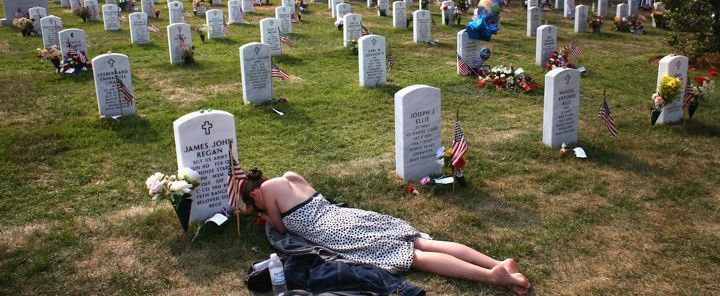
“When You Go Home, Tell Them Of Us And Say,
For Your Tomorrow, We Gave Our Today.”
Inscription on the memorial to the dead of the British 2nd Infantry Division at Kohima.
I went out on Wednesday of this week to visit the grave of Larry with my Bride, and I was pleased to see at our Catholic cemetery, Mount Olivet, that local patriots had already placed the Memorial Day flags by the graves of our veterans. There are a lot of them in Mount Olivet. A deep feeling of gratitude always comes over me when I set foot in an American cemetery at this time of the year and see the flags waving, symbols of service, pride, patriotism, sacrifice and memory. Cemeteries always have a timeless quality to me, but never so much as just before Memorial Day.
A few films to help remember that there is much greater significance to Memorial Day than sun and fun:
1. American Sniper (2015)- A grand tribute to the late Chris Kyle and to all the other troops who served in Iraq.
3. Retreat Hell! (1952)-A rousing tribute to the men of the Marine First Division and their epic march to the sea in North Korea from November 27-December 13, 1950 during which, outnumbered four to one, they put out of action the Ninth Chinese Army, wrecking eight Chinese Communist divisions. Most Americans are woefully ignorant of the military miracle that the hopelessly outnumbered Marines accomplished, in atrocious blizzard conditions and over some of the roughest terrain in the world. As Colonel Lewis Burwell “Chesty” Puller put it at the time: “I don’t give a good g—–n how many Chinese laundrymen there are between us and Hungnam! There aren’t enough in the world to stop a Marine regiment going where it wants to go! Christ in His mercy will see us through.”
https://www.youtube.com/watch?v=csONZWAm-F4&t=56s
4. Hacksaw Ridge (2016): Mel Gibson fully redeemed his career as a director with this masterpiece. A film that goes far beyond mere entertainment and illustrates what a man of faith can accomplish when he stays true to his beliefs and cares so much more about helping others than he does about his own mortal life. Incredibly, the movie does justice to Desmond Doss, a true American hero.
5. Sergeant York (1941)-A film biopic of Sergeant Alvin C. York, who, during the Meuse-Argonne Offensive on October 8, 1918, took 32 German machine guns, killed 28 German soldiers and captured another 132. Viewers who came to see the movie in 1941 must have been initially puzzled. With a title like Sergeant York, movie goers could have been forgiven for thinking that Sergeant York’s experiences in World War I would be the focus, but such was not the case. Most of the film is focused on York’s life in Tennessee from 1916-1917 before American entry into the war. Like most masterpieces, the film has a strong religious theme as we witness York’s conversion to Christ. The film is full of big questions: How are we to live? Why are we here? What role should religion play in our lives? How does someone gain faith? What should we do if we perceive our duty to God and to Country to be in conflict? It poses possible answers to these questions with a skillful mixture of humor and drama. The entertainment value of Sergeant York conceals the fact that it is a very deep film intellectually as it addresses issues as old as Man.
The film was clearly a message film and made no bones about it. The paper of the film industry Variety noted at the time: “In Sergeant York the screen has spoken for national defense. Not in propaganda, but in theater.”
The film was a huge success upon release in 1941, the top grossing film of the year. Gary Cooper justly earned the Oscar for his stellar performance as Alvin C. York. It was Cooper’s favorite of his pictures. “Sergeant York and I had quite a few things in common, even before I played him in screen. We both were raised in the mountains – Tennessee for him, Montana for me – and learned to ride and shoot as a natural part of growing up. Sergeant York won me an Academy Award, but that’s not why it’s my favorite film. I liked the role because of the background of the picture, and because I was portraying a good, sound American character.”
The film portrays a devout Christian who had to reconcile the command to “Love thy Neighbor” with fighting for his country in a war. This is not an easy question and the film does not give easy answers, although I do find the clip above compelling.
8. Gettysburg (1993)- It is fitting that the greatest movie made about the Civil War deals with the greatest battle of that war. You simply cannot understand the United States without understanding the Civil War.
The Civil War was really one of those watershed things. There was a huge chasm between the beginning and the end of the war. The nation had come face-to-face with a dreadful tragedy… And yet that’s what made us a nation. Before the war, people had a theoretical notion of having a country, but when the war was over, on both sides they knew they had a country. They’d been there. They had walked its hills and tramped its roads… They knew the effort that they had expended and their dead friends had expended to preserve it. It did that. The war made their country an actuality.
9. The Alamo (1960)-The story of the Texan Thermopylae and John Wayne’s love note to America.
10. The Buccaneer (1958)-Cecil B. DeMille’s second film salute to Jean Lafitte, Andrew Jackson and their heroic stand at New Orleans. Charlton Heston was perfect as Old Hickory.
11. The Patriot (2001)-There is a lot wrong historically with Mel Gibson’s Revolutionary War opus, but he captures well the war to the knife fighting in the Southern theater of the War and the desperate courage of Patriot partisans who turned the tide.
Have fun during the coming weekend, and think about the silent victors who allow us to enjoy ourselves in freedom.
Honorable mention films:
Northwest Passage (1940)-The story of the long distance raid of Rogers’ Rangers in 1759 on Saint Francis that ended generations of French sponsored Indian raids on New England. This raid established the penchant of Americans for long distance raids on enemy targets. Here are the Rules of the Rangers that have remained ever green among American special forces units:
- All Rangers are to be subject to the rules and articles of war; to appear at roll-call every evening, on their own parade, equipped, each with a Firelock, sixty rounds of powder and ball, and a hatchet, at which time an officer from each company is to inspect the same, to see they are in order, so as to be ready on any emergency to march at a minute’s warning; and before they are dismissed, the necessary guards are to be draughted, and scouts for the next day appointed.
- Whenever you are ordered out to the enemies forts or frontiers for discoveries, if your number be small, march in a single file, keeping at such a distance from each other as to prevent one shot from killing two men, sending one man, or more, forward, and the like on each side, at the distance of twenty yards from the main body, if the ground you march over will admit of it, to give the signal to the officer of the approach of an enemy, and of their number,
- If you march over marshes or soft ground, change your position, and march abreast of each other to prevent the enemy from tracking you (as they would do if you marched in a single file) till you get over such ground, and then resume your former order, and march till it is quite dark before you encamp, which do, if possible, on a piece of ground which that may afford your sentries the advantage of seeing or hearing the enemy some considerable distance, keeping one half of your whole party awake alternately through the night.
- Some time before you come to the place you would reconnoitre, make a stand, and send one or two men in whom you can confide, to look out the best ground for making your observations.
- If you have the good fortune to take any prisoners, keep them separate, till they are examined, and in your return take a different route from that in which you went out, that you may the better discover any party in your rear, and have an opportunity, if their strength be superior to yours, to alter your course, or disperse, as circumstances may require.
- If you march in a large body of three or four hundred, with a design to attack the enemy, divide your party into three columns, each headed by a proper officer, and let those columns march in single files, the columns to the right and left keeping at twenty yards distance or more from that of the center, if the ground will admit, and let proper guards be kept in the front and rear, and suitable flanking parties at a due distance as before directed, with orders to halt on all eminences, to take a view of the surrounding ground, to prevent your being ambuscaded, and to notify the approach or retreat of the enemy, that proper dispositions may be made for attacking, defending, And if the enemy approach in your front on level ground, form a front of your three columns or main body with the advanced guard, keeping out your flanking parties, as if you were marching under the command of trusty officers, to prevent the enemy from pressing hard on either of your wings, or surrounding you, which is the usual method of the savages, if their number will admit of it, and be careful likewise to support and strengthen your rear-guard.
- If you are obliged to receive the enemy’s fire, fall, or squat down, till it is over; then rise and discharge at them. If their main body is equal to yours, extend yourselves occasionally; but if superior, be careful to support and strengthen your flanking parties, to make them equal to theirs, that if possible you may repulse them to their main body, in which case push upon them with the greatest resolution with equal force in each flank and in the center, observing to keep at a due distance from each other, and advance from tree to tree, with one half of the party before the other ten or twelve yards. If the enemy push upon you, let your front fire and fall down, and then let your rear advance thro’ them and do the like, by which time those who before were in front will be ready to discharge again, and repeat the same alternately, as occasion shall require; by this means you will keep up such a constant fire, that the enemy will not be able easily to break your order, or gain your ground.
- If you oblige the enemy to retreat, be careful, in your pursuit of them, to keep out your flanking parties, and prevent them from gaining eminences, or rising grounds, in which case they would perhaps be able to rally and repulse you in their turn.
- If you are obliged to retreat, let the front of your whole party fire and fall back, till the rear hath done the same, making for the best ground you can; by this means you will oblige the enemy to pursue you, if they do it at all, in the face of a constant fire.
- If the enemy is so superior that you are in danger of being surrounded by them, let the whole body disperse, and every one take a different road to the place of rendezvous appointed for that evening, which must every morning be altered and fixed for the evening ensuing, in order to bring the whole party, or as many of them as possible, together, after any separation that may happen in the day; but if you should happen to be actually surrounded, form yourselves into a square, or if in the woods, a circle is best, and, if possible, make a stand till the darkness of the night favours your escape.
- If your rear is attacked, the main body and flankers must face about to the right or left, as occasion shall require, and form themselves to oppose the enemy, as before directed; and the same method must be observed, if attacked in either of your flanks, by which means you will always make a rear of one of your flank-guards.
- If you determine to rally after a retreat, in order to make a fresh stand against the enemy, by all means endeavour to do it on the most rising ground you come at, which will give you greatly the advantage in point of situation, and enable you to repulse superior numbers.
- In general, when pushed upon by the enemy, reserve your fire till they approach very near, which will then put them into the greatest surprise and consternation, and give you an opportunity of rushing upon them with your hatchets and cutlasses to the better advantage.
- When you encamp at night, fix your sentries in such a manner as not to be relieved from the main body till morning, profound secrecy and silence being often of the last importance in these cases. Each sentry therefore should consist of six men, two of whom must be constantly alert, and when relieved by their fellows, it should be done without noise; and in case those on duty see or hear any thing, which alarms them, they are not to speak, but one of them is silently to retreat, and acquaint the commanding officer thereof, that proper dispositions may be made; and all occasional sentries should be fixed in like manner.
- At the first dawn of day, awake your whole detachment; that being the time when the savages choose to fall upon their enemies, you should by all means be in readiness to receive them.
- If the enemy should be discovered by your detachments in the morning, and their numbers are superior to yours, and a victory doubtful, you should not attack them till the evening, as then they will not know your numbers, and if you are repulsed, your retreat will be favoured by the darkness of the night.
- Before you leave your encampment, send out small parties to scout round it, to see if there be any appearance or track of an enemy that might have been near you during the night.
- When you stop for refreshment, choose some spring or rivulet if you can, and dispose your party so as not to be surprised, posting proper guards and sentries at a due distance, and let a small party waylay the path you came in, lest the enemy should be pursuing.
- If, in your return, you have to cross rivers, avoid the usual fords as much as possible, lest the enemy should have discovered, and be there expecting you.
- If you have to pass by lakes, keep at some distance from the edge of the water, lest, in case of an ambuscade or an attack from the enemy, when in that situation, your retreat should be cut off.
- If the enemy pursue your rear, take a circle till you come to your own tracks, and there form an ambush to receive them, and give them the first fire.
- When you return from a scout, and come near our forts, avoid the usual roads, and avenues thereto, lest the enemy should have headed you, and lay in ambush to receive you, when almost exhausted with fatigues.
- When you pursue any party that has been near our forts or encampments, follow not directly in their tracks, lest they should be discovered by their rear guards, who, at such a time, would be most alert; but endeavour, by a different route, to head and meet them in some narrow pass, or lay in ambush to receive them when and where they least expect it.
- If you are to embark in canoes, battoes, or otherwise, by water, choose the evening for the time of your embarkation, as you will then have the whole night before you, to pass undiscovered by any parties of the enemy, on hills, or other places, which command a prospect of the lake or river you are upon.
- In paddling or rowing, give orders that the boat or canoe next the sternmost, wait for her, and the third for the second, and the fourth for the third, and so on, to prevent separation, and that you may be ready to assist each other on any emergency.
- Appoint one man in each boat to look out for fires, on the adjacent shores, from the numbers and size of which you may form some judgment of the number that kindled them, and whether you are able to attack them or not.
- If you find the enemy encamped near the banks of a river or lake, which you imagine they will attempt to cross for their security upon being attacked, leave a detachment of your party on the opposite shore to receive them, while, with the remainder, you surprise them, having them between you and the lake or river.
- If you cannot satisfy yourself as to the enemy’s number and strength, from their fire, conceal your boats at some distance, and ascertain their number by a reconnoitering party, when they embark, or march, in the morning, marking the course they steer, when you may pursue, ambush, and attack them, or let them pass, as prudence shall direct you. In general, however, that you may not be discovered by the enemy upon the lakes and rivers at a great distance, it is safest to lay by, with your boats and party concealed all day, without noise or shew; and to pursue your intended route by night; and whether you go by land or water, give out parole and countersigns, in order to know one another in the dark, and likewise appoint a station every man to repair to, in case of any accident that may separate you.
John Paul Jones (1959)-Robert Stack, just before he rose to fame in The Untouchables, is grand in the role of the archetypal American sea hero. Bette Davis is absolutely unforgettable as Catherine the Great. The climactic sea battle with the Serapis is well done, especially for those pre-CGI days. The only problem with the film is that many of the details are wrong. This is forgivable to a certain extent since scholarship on Jones was badly skewed by Augustus Buell in a two-volume “scholarly biography” which appeared in 1900. Buell was a charlatan who made up many incidents about Jones and then invented sources to support his fabrications. Buell was not completely exposed until Samuel Eliot Morison, Harvard professor of history, and an Admiral in the Navy, wrote his definitive biography of Jones. Here is a list of the fabrications of Buell compiled by Morison. Morison’s book appeared after the movie, which is to be regretted.
The Buccaneer (1938)-Cecil B. DeMille’s second film salute to Jean Lafitte, Andrew Jackson and their heroic stand at New Orleans. Frederic March gave the performance of his career as Lafitte.
The Alamo (2004)-Some people say this version is superior to Wayne’s paean to the men of the Texas Thermopylae.
The Red Badge of Courage, (1951)-I am struck by what a forgotten masterpiece it is. Filmed in stark black and white, the film has almost a documentary feel to it, as if a World War II era newsreel camera had magically transplanted itself to the Civil War. The combat scenes are highly realistic depictions of Civil War combat, and the actors speak and act like Civil War soldiers and not like 1951 actors dressed up in Civil War costumes.
As one critic said at the time, watching the film is like watching a Matthew Brady photograph of the Civil War come to life.
It was a stroke of genius for director John Huston to have as star of his film Audie Murphy, as the youth who, in Stephen Crane’s unforgettable novel, has his first taste of combat in the Civil War. Murphy looked like a typical Hollywood “pretty boy” but he was anything but. From a family of 12 in Texas, Murphy had dropped out of school in the fifth grade to support his family after his father ran off. His mother died in 1941. In 1942 he enlisted in the Army at 16, lying about his birthday, partially to support his family and partially because he dreamed of a military career. By the end of the war, before his 19th birthday, he was a second lieutenant and had earned in hellish combat a Medal of Honor, a Distinguished Service Cross, two Silver Stars, a Legion of Merit, a French Legion of Honor, a French Croix de Guerre, a Belgian Croix de Guerre, two Bronze Stars and three Purple Hearts. He was the most decorated soldier of the US Army in World War 2.
Murphy’s co-star in the film was also an Army combat veteran, Bill Mauldin, the famed cartoonist who drew the Willie and Joe cartoons in Stars and Stripes, the Army newspaper, during World War II.
The film is absolutely stunning to watch, especially when we recall that Huston was forced to cut the film to 70 minutes and to add a narration, both decisions taken over his bitter protests. The making of the film, and the conflicts that ensued, are given masterly treatment in Lillian Ross’ book on the making of the film, Picture (1952). The film was a box office failure, but critics hailed it. I think audiences are often right and critics usually wrong, but in this case I side with the critics.
Major Dundee (1965)-Sam Pekinpah’s flawed, unfinished masterpiece, the film tells the fictional account of a mixed force of Union soldiers and Confederate prisoners who join forces to hunt and ultimately defeat an Apache raider, Sierra Charriba, in 1864-65. Charlton Heston gives an outstanding performance as Major Amos Dundee, a man battling his own personal demons of a failed military career, as he commands this Union-Confederate force through northern Mexico on the trail of the Apache, with fighting often threatening to break out between the Union and Confederate soldiers. Use of Confederate prisoners as Union soldiers in the West was not uncommon. Six Union infantry regiments of Confederate prisoners, called “Galvanized Yankees”, served in the West. The final section of the film involving a battle between Major Dundee’s force and French Lancers, the French occupying Mexico at the time, has always struck me as one of the best filmed combat sequences in any movie.
The Lost Battalion (2001)-Chronicles the story of Maj. Charles W. Whittlesey and his men who held out from October 2-October8, 1918, completely surrounded, until they were relieved by American forces. I have always treasured this bit of dialogue from the film:
Maj. Prinz: You Americans, you always have so much of everything. No matter. Eventually you have to surrender.
Lt. Leak: I don’t think so.
Maj. Prinz: Are you officers so callous? You’re surrounded. You have no chance of relief. Every night you send out patrols, and every night we kill them. We can hear the cries of your wounded Lieutenant. There is no dishonor in surrender.
Lt. Leak: Maybe for you, but my guys are different.
Maj. Prinz: What do you mean?
Lt. Leak: What you’re up against Major, is a bunch of Mick, Pollack, Dago, and Jew boy gangsters from New York City. They’ll never surrender. Never.
Patton (1970)-The classic movie biography, Patton (1970) has become so closely associated with General George S. Patton, that we are sometimes in danger of forgetting that Patton sounded nothing like George C. Scott. A more accurate portrayal, considering Patton’s high-pitched voice, would have been to have the voice of Patton voice acted by the late Truman Capote! Patton had the gift of demanding instant attention when he spoke, and keeping that attention skillfully by mixing drama, humor, theatrical poses and raw force of personality. All these elements are skillfully captured in the Patton film. Here is the unforgettable opening to the film where the Patton personae is firmly fixed in our minds from the outset of the film:
Like any truly great work of art, the Patton film gets some of the details wrong, but captures the spirit of the person depicted completely.
3. Porkchop Hill (1959)-Korea has become to too many Americans The Forgotten War, lost between World War II and Vietnam. There is nothing forgotten about it by the Americans who served over there, including my Uncle Ralph McClarey who died a few years ago, and gained a hard won victory for the US in one of the major hot conflicts of the Cold War. This film tells the story of the small American force on Porkchop Hill, who held it in the face of repeated assaults by superior forces of the Chinese and North Koreans.
The Green Berets (1968)-Critics loathed it; audiences loved it. One of the most profitable films that Wayne ever made. The sun setting in the east at the end of the film was one of several errors that critics used to tear into the film which gave a fairly accurate overall assessment of what America was up against in Vietnam.
12 Strong (2017)-The tale of the special forces “operators” who helped topple the Taliban in Afghanistan in 2001 after 9-11.



Thanks for the lineup, Don! Have a great weekend.
My own contribution:
https://twitter.com/txtradcatholic/status/1398300081804222466?s=21
God bless all here.
Great picks, as always. 🤓
Yes….Happy Memorial day TAC.
Adding two more…GLORY and Saving Private Ryan….Earn this.
Glad to see Sam Worthington, Chris Hemsworth and Mel Gibson (3 x Aussies) bringing it in this line up. Blessings for your Memorial Day weekend and all that it stands for.
My 2021 tweet, linked above, no longer exists thanks to the pre-Elon purge of conservatives. Here it is again, posted today under my replacement account.
https://twitter.com/texasthomist/status/1662102355066716161?s=61&t=N8fLgsfQVsKhBmQrCtxezg
I was in the 3rd ID, The Old Guard, in the 90’s. The yearly tradition of putting flags in all of the graves of Arlington for Memorial Day is probably my favorite memory of my time in the Army.
Also, “Glory” is a great Memorial Day movie.
For some reason my first comment didn’t.m go through. I was a member of the 3rd ID, The Old Guard, in the nineties. The yearly tradition of placing US Flags in all the graves of Arlington is probably my favorite memory of my time in the military.
Viewing some of these clips brought me to tears. SO many gave their lives for freedom and look, just look, at that our leaders are doing to us now. Look at what our “woke” military has become. There were no soy boys, nor sissy boys, or little girls on those front lines. True men were on those lines. How we need them now.
Great list. My 97 year old mom loves war movies, we watch many of the films named here over and over. Especially Patton. I pretty much have the script memorized.
It occurred to me last week, during yet another viewing ( never boring) that the embedded newsreel clips probably resonate so much for her because some of those boys could have, or may have been, her classmates, neighbors or even my dad, USArmy ETO. Eerie and touching.
The American Flag belongs to each and every American citizen in joint and common tenancy. You own it all and I own it all. The American Flag is our flag. Anyone who would burn our flag as free speech cannot be heard because burning the American Flag does not make him more audible, more responsible or more American. Burning the American Flag is vandalism and ought to be treated as vandalism and the perpetrators as vandals.