
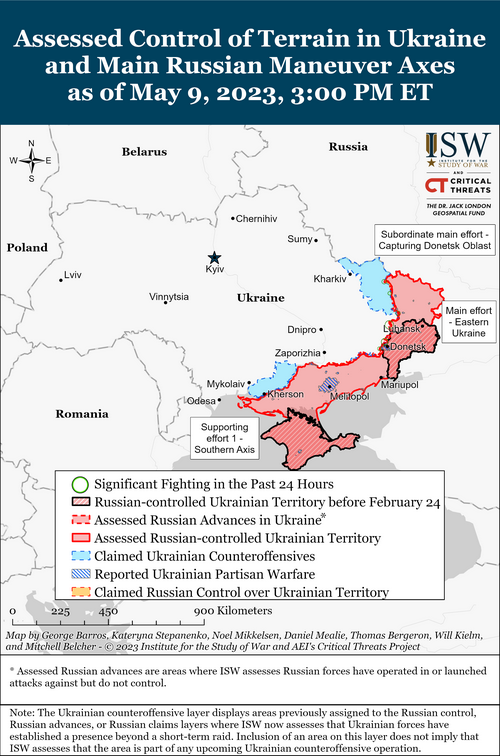
From The Institute For The Study of War:
Russian Offensive Campaign Assessment, May 9, 2023
Kateryna Stepanenko, Riley Bailey, Nicole Wolkov, and Mason Clark
May 9, 2023, 7:15pm ET
Click here to see ISW’s interactive map of the Russian invasion of Ukraine. This map is updated daily alongside the static maps present in this report.
Click here to access ISW’s archive of interactive time-lapse maps of the Russian invasion of Ukraine. These maps complement the static control-of-terrain map that ISW produces daily by showing a dynamic frontline. ISW will update this time-lapse map archive monthly.
Russian President Vladimir Putin declined to use his Victory Day address to make any significant rhetorical changes and reiterated existing narratives, preparing for a protracted war and framing Russia as successfully resisting the entire West. Putin stated in his annual address marking the Soviet victory over Nazi Germany on May 9 that “a real war has been unleashed against Russia” and that Russia has repelled international terrorism and will continue to “defend” residents in Donbas.[1] Putin has previously claimed the West is waging a global “war” against Russia.”[2] Putin has previously referred to the Russian military campaign in Ukraine as a ”war” but this rhetoric, whether an intentional acknowledgment of the scale of the fighting or not, has not corresponded with any changes in the Kremlin’s approach to the “special military operation.”[3] Putin similarly declined to use recent notable events such as his annual New Year’s Eve address or his February 2023 address to the Federal Assembly to offer any concrete vision on how to reverse the Russian military’s setbacks in Ukraine or reframe the war.[4] Putin has instead used these events to reinforce long-standing rhetorical lines aimed at preparing the Russian public for a protracted war in Ukraine by evoking the memory of World War Two without calling on Russian society to support full mobilization.[5]
Putin additionally attempted to use Victory Day celebrations to rally Commonwealth of Independent States (CIS) partners, many of which have sought to reduce their reliance on the Kremlin since February 2022. Armenian Prime Minister Nikol Pashinyan, Belarusian President Alexander Lukashenko, Kazakh President Kassym-Jomart Tokayev, Kyrgyz President Sadyr Japarov, Tajik President Emomali Rahmon, Turkmen President Serdar Berdimuhamedov, and Uzbek President Shavkat Mirziyoyev joined Putin at the Moscow Victory Day parade in Red Square.[6] Putin emphasized the importance of CIS leaders attending the event and repeated boilerplate Kremlin rhetoric that Russia is pursuing a multi-polar world order.[7] Putin’s latest efforts to rally CIS countries were muted by the reluctance of several Central Asian leaders initially expressed towards attending the Victory Day event, and Lukashenko did not join the rest of the leaders at an earlier wreath-laying ceremony.[8] Lukashenko also did not deliver his traditional Victory Day address in Minsk, Belarus, although it is not immediately clear why.[9] Other non-Western states have largely rebuffed the Kremlin’s attempts to coalesce a potential anti-Western coalition, most notably China through its increasing rhetorical distancing from Russia.[10] ISW has previously assessed that the degradation of Russian military power in Ukraine has likely made this Russian effort even less attractive to other states.[11]The Victory Day events showcased far less military equipment than usual (including only a single World War Two–era T-34/85 and no modern tanks, which Russia badly needs in Ukraine) and demonstrated the further degradation of the Russian military, despite the Kremlin’s attempts in previous weeks to downplay Victory Day by downsizing parades and outright canceling events.[12]
Wagner Group financier Yevgeny Prigozhin seized the Victory Day holiday as an opportunity to mock Putin and question his judgment. Prigozhin referred to a “happy grandfather” figure who “thinks that he is good” during a discussion of ammunition shortages and Russia’s future prospects in Ukraine.[13]Prigozhin then rhetorically asked what Russia and future generations should do and how Russia can win if the “grandfather” turns out to be a “complete asshole.” Prigozhin also noted that unnamed figures (likely referring to Putin and the senior Russian MoD figures) should stop showing off on Red Square. Prigozhin is likely referring to Putin, who is often referred to as “grandfather” (or more specifically “Bunkernyi ded” or “bunker grandfather”), and Prigozhin has previously attacked other senior Russian officials and officers by name — but has not done so against Putin. Prigozhin has previously attempted to upstage Putin’s authority through similar rhetorical stunts.[14] Prigozhin’s escalating attacks on Putin may — if the Kremlin does not respond to Prigozhin’s thinly veiled criticism of Putin on Victory Day — further erode the norm in Putin’s system in which individual actors can jockey for position and influence (and drop in and out of Putin’s favor) but cannot directly criticize Putin.
Prigozhin announced that Wagner forces will not withdraw from Bakhmut by his previously stated deadline of May 10, despite the Russian Ministry of Defense (MoD) failing to provide Wagner with additional shells. Prigozhin stated on May 9 that Wagner will continue to fight for Bakhmut and will continue to uphold its demands in the next few days.[15] Prigozhin stated that Wagner did not receive the total ammunition the Russian MoD allegedly promised in a May 7 order, and claimed Wagner only received 10 percent of the requested ammunition on May 8. Prigozhin added that the Russian MoD order threatened Wagner with treason if Prigozhin withdrew his forces from Bakhmut, likely one of the reasons why Prigozhin is not following through on his May 5 threat to withdraw from Bakhmut if the Russian MoD failed to fully supply Wagner with ammunition by May 10, a threat he dropped on May 7.[16] Prigozhin also noted that he has not been able to contact the deputy theater commander in Ukraine and the intermediary between the Russian MoD and Wagner, Army General Sergey Surovikin.
Prigozhin’s failure to follow through on his May 5 withdrawal threat indicates that he is cognizant of his dependence on the Russian MoD. Prigozhin attempted to blackmail the Russian MoD into reprioritizing the Bakhmut offensive so he could independently claim victory in the city at the expense of the Russian military’s likely preparations ahead of the planned Ukrainian counteroffensive.[17] Prigozhin criticized officials in charge of allocating ammunition of pointlessly conserving shells and allowing Russian servicemen to die in battle, though the Russian MoD is likely (smartly) conserving limited ammunition to repel a Ukrainian counteroffensive.[18] Prigozhin likely expected the Russian MoD to entirely cave to his demands at the risk of abandoning their own objectives for regular Russian forces but likely realized he cannot follow through with his ultimatum at this time. Prigozhin also likely anticipated that Surovikin would be able to coerce the Russian MoD into satisfying Wagner’s demands; but his inability to reach Surovikin, if true, indicates that Prigozhin does not have as much leverage within the Russian MoD as he imagined.
Prigozhin continued to blame high casualties and the slow pace of advances in Bakhmut on other Russian irregular formations to frame Wagner as the only competent force operating in the area. Prigozhin accused the 72nd Motorized Rifle Brigade of the 3rd Army Corps of abandoning a strategic position in Bakhmut which resulted in 500 Wagner casualties on May 9.[19] Prigozhin accused the Russian MoD (which he nicknamed “the Russian Ministry of Drama”) of focusing on internal conflicts instead of fighting, which he claimed led forces to “run away.” Prigozhin also criticized the Russian “Potok” battalion — which is affiliated with Russian state energy company Gazprom — for fleeing. Wagner-affiliated Telegram channels previously accused “Potok” of abandoning Wagner’s flanks in Bakhmut, and ISW assessed that Prigozhin launched a campaign to undermine Russian state-affiliated private military companies (PMCs).[20]
Russian forces conducted another large-scale series of missile strikes against Ukraine on the night of May 8 to 9. The Ukrainian General Staff reported on May 9 that Ukrainian air defenses shot down all 8 Kalibr cruise missiles and 15 of the 17 Kh-101/Kh-555 missiles that Russian forces launched.[21] The Ukrainian General Staff reported that three S-300 missiles struck civilian infrastructure in Kramatorsk and Kostyantynivka in Donetsk Oblast.[22] The Russian Ministry of Defense (MoD) claimed that Russian forces conducted a concentrated strike on Ukrainian temporary deployment points and ammunition depots, successfully striking all targets.[23] The continuation of Russian missile strikes at a smaller scale than the daily strikes during the failed Russian campaign against Ukrainian critical infrastructure likely indicates that Russian forces are more focused on sustaining a regular series of missile strikes than the actual effectiveness of the strikes.[24]Russian forces may be attempting to conduct an almost daily series of missile strikes in order to portray themselves as constraining potential upcoming Ukrainian counteroffensive operations, although the diminished effectiveness of the strikes is likely not significantly constraining Ukrainian actions.
Key Takeaways
- Russian President Vladimir Putin declined to use his Victory Day address to make any significant rhetorical changes and reiterated existing narratives, preparing for a protracted war and framing Russia as successfully resisting the entire West.
- Putin additionally attempted to use Victory Day celebrations to rally Commonwealth of Independent States (CIS) partners, many of which have sought to reduce their reliance on the Kremlin since February 2022.
- Wagner Group financier Yevgeny Prigozhin likely seized the Victory Day holiday as an opportunity to mock Putin and question his judgment in one of his most direct challenges of Putin to date.
- Prigozhin announced that Wagner forces will not withdraw from Bakhmut by the previously stated deadline of May 10 despite the Russian Ministry of Defense (MoD) failing to resolve the claimed “shell hunger.”
- Prigozhin’s failure to abide by the withdrawal threat he made on May 5 indicates that he is cognizant of his dependence on the Russian MoD.
- Prigozhin continued to blame high casualties and the slow pace of advance in Bakhmut on other Russian irregular formations to frame Wagner as the only competent force operating in the area.
- Russian forces conducted another large-scale series of missile strikes against Ukraine on the night of May 8 to 9.
- Russian forces conducted limited ground attacks northeast of Kupyansk and along the Svatove-Kreminna line.
- Russian forces continued to make marginal gains within Bakhmut and continued limited offensive operations along the Avdiivka–Donetsk front.
- Russian forces targeted Ukrainian positions west of Hulyaipole and in Kherson Oblast.
- Chechen leader Ramzan Kadyrov opened a new military camp for the “Sever Akhmat” Special Purpose Regiment in the Republic of Chechnya.
- Russian occupation officials continue to deport civilians deeper into Russian-occupied territory.
Go here to read the rest. The Russians have built long defensive lines stretching from the south to the center of Ukraine, as if we were back a century ago to a period right after World War I. We shall likely soon seen how these trenchers fare against the Ukrainian offensive.


Putin just re-established commercial air ties with Georgia. Sounds like he’s going deep in search of support even from foes.