
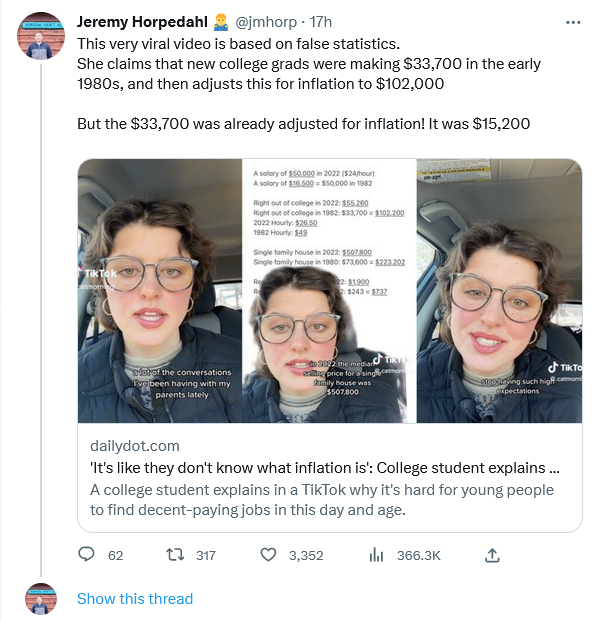
At my first job as a newly minted attorney in 1982 I was making 16,000 a year. This was at a time when judges and law professors with decades of experience were making in the low forties. By 85 I was making 23k a year and I thought I was doing pretty well. What strange effects inflation over time produces. In 1982 the median family income was 23,400. Contra the young lady above, new job seekers in the early eighties did not have windfalls of cash handed to them. Jobs were hard to get until the economy improved in 83 and most employers took full advantage of that fact.


I had a base salary of 27-29k plus a percentage of contingent fees as an associate from 1996-2001.
The best and brightest of the next generation are reminding me of Wells’ Eloi.
Graduated from law school in 1979 and joined a St. Louis law firm at $19,000. No bonus, no pension fund, no savings plan, no health insurance. In 1983 when I left private practice for the corporate world I got a nice raise to $30K plus all the aforesaid benefits. Thought I had reached the pearly gates. Today’s first year associates in the biggest firms make more than I was making in salary when I retired from that same company nine years ago.
Total employee compensation paid in 1982 was $1.891 tn. The number of employed persons that year (it was a recession year with an injured labor market) was 99.5 million. That amounts to a mean of $19,000 in compensation per worker. The median would have been ~20% lower, or about $15,000 per year. At the time, about 16% of employee compensation was in the form of benefits, on average. The median age of a working adult would have been about 40 at the time. About 22% of the 1959 birth cohort received a baccalaureate degree (nowadays, about 45% of youth cohorts receive a devalued baccalaureate degree).
I’ll say this, people under 40 had no idea what inflation meant until recently. For those of us who still raise an eyebrow whenever we hear about a home mortgage rate in the single digits, this all feels bad but familiar. But the young’uns had nothing to prepare them for wealth and earnings getting eaten up forever.
So it’s dawned on her that the cost of living is high and most of her wages will go to her daily living expenses. And she has also just worked out that she probably won’t have as much disposable income now that she has no excuse but to grow up and be an adult and pay her way in life. Looks like she will have to give up those daily $10 nitro cold brew soy vanilla lattes and $20 avocado gluten-free sourdough toast with scrambled tofu for breakfast every morning.
One thing that’s going on is that the wage premium you might expect from a college degree (which was always on average, not guaranteed) has declined as the degree holders expanded from 22% of each cohort to 45%. Also, the body of degree recipients come, on average, from less affluent segments of the population than was the case 40-odd years ago. The price of a college education has expanded pari passu with nominal incomes (and perhaps more) due to baumol effects and dog-chasing-its-tail subsidies. The families availing themselves of it are (on average) less able to pay out of pocket, so you have proportionately more debt financing. The debts are born by young people receiving these lower wage premiums. It’s a crappy situation. Our political class lack the imagination to even ponder repairing matters and true repair would mean breaking a lot of rice bowls.
I was getting $28k per annum in the early 80s, but I was working at a nuclear power plant and wages were much better for trained Navy nukes coming into the commercial nuclear power industry. When I got qualified at the commercial nuke plant, my pay went up to $32k per annum. I am blessed in being a nuke because generally nuke pay is higher. That said, we get called in the middle of the night, in snowstorms, in all kinds of conditions to come in on off hours to fix problems to keep your lights on and A/Cs running. Working 60 to 72 hour weeks is the norm. Nowadays I finally have a desk job and normal working hours, but that happened only after 30 years of hell. Pay is great, but we earned every penny, from fixing security perimeter defense systems in freezing cold blizzards on the fence outside in winter to replacing core exit thermocouple connectors in 120 F heat and 95% humidity in reactor containment.
Her mother was not paid $36,000 a year as a bank teller in 1980. At today’s prices, the median value of wages for bank tellers working 2,000 hours per year is $36,400.
Wage rates and their buying power can vary greatly based on the cost of living where the worker lives and works. What kind of expectations are we creating for the the future workforce? I clearly remember that the drill when I was growing up was to get a good education to get a good job, which usually meant a four year college degree. Many jobs require degrees in the job listings. “Dirty Jobs” Mike Rowe is trying to get people interested in the trades so that people can get good paying jobs without the crushing debt loads that academia currently imposes on their graduates. Doesn’t academia bear some responsibility for exaggerated expectations? Where do kids growing up get honest information about the financial realities of the world of work devoid of the marketing spin and hype?
Where do kids growing up get honest information about the financial realities of the world of work devoid of the marketing spin and hype?
The Bureau of Labor Statistics issues publications with data from which you can benefit. Also, they have a website, albeit a disorganized one. I believe there are a couple of librarians in clan McClarey who might help you.
There is more waste than accomplishment in the educational sector.