
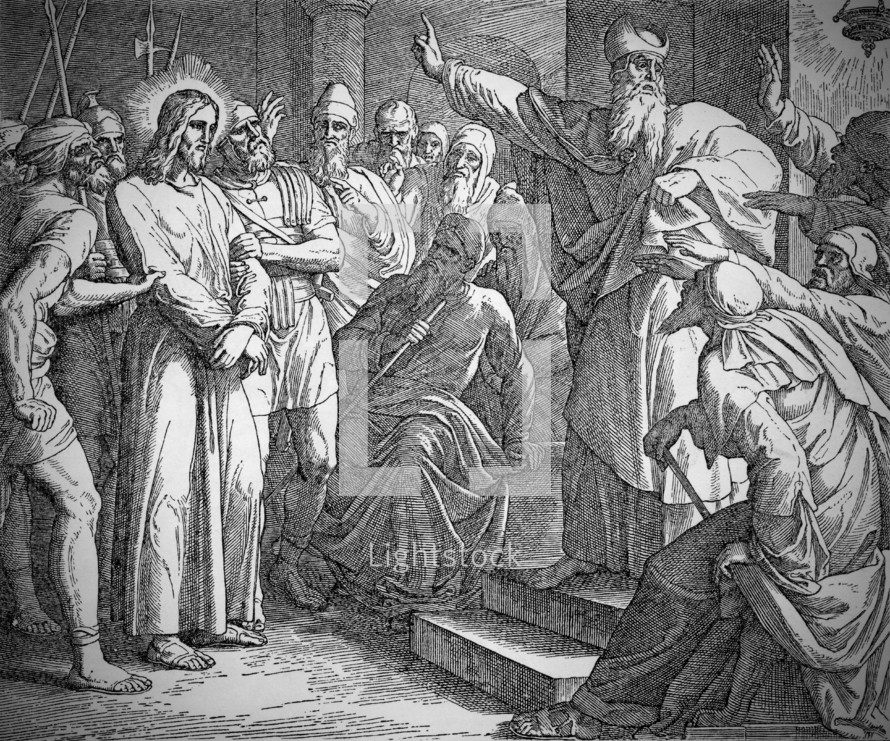
An interesting interpretation from Jesus of Nazareth (1977). The performance of Anthony Quinn as Caiaphas is truly arresting. As described in the Gospels the trial before the Sanhedrin was replete with procedural errors under Jewish law. Some of them are:
- It occurred during the night, while such trials had to take place during the day.
- Only a portion of the Sanhedrin was summoned.
- A trial could not occur on one of the High Holy Days.
- A capital trial could not take place over the course of one day.
- A capital case had to have the evidence to establish it of two male witnesses, and at the time the accused had to be warned before he committed the crime of the consequences of his action.
- No mention is made of the accusers of Jesus receiving the usual injunction to witnesses to not bear false witness.
Our knowledge of the Sanhedrin as a court at the time of Jesus is lacking in many details, and it is possible that the Sanhedrin was operating as an emergency authority. Caiaphas had already predicted as High Priest that Jesus had to die to save the nation. Caiaphas of course was thinking of the Roman reaction to a Jewish Messiah attempting to free the Jews from the Roman yoke, but the correspondence with the death of Jesus being for the salvation of Man in Christian theology is striking.
The Sanhedrin, probably thinking of the triumphal entry of Jesus into Jerusalem, meeting at night was a sign of fear of the followers of Jesus. Bringing Jesus immediately before Pilate was a confession of weakness. Fear as an adjunct of judicial proceedings is ever the handmaiden of injustice and so it was in the case of Jesus.


Good into Don. Thanks.
Correct me: but I read that another irregularity was the alleged unanimous conviction. If that really happened, it was taken a sign that the prisoner had received an inadequate defense and the decision was set aside.
Eerily similar to what’s going down today in the NY County Court House.
I read somewhere that the rending of priestly garments was also a highly sacrilegious act.