
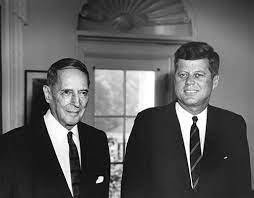
Ten Things You Don’t Know About President MacArthur
Readers of The American Catholic normally have a greater depth of historical knowledge than the average American, so I present some items that even they may not be aware of.
- MacArthur and Traffic-On April 16, 1952 on his way to address the Joint Session of Congress, General MacArthur instructed the driver to drive carefully. MacArthur was sensitive to the hazards of traffic since his Chief of Staff, Major Dwight D. Eisenhower, had been killed in an auto crash in Manila in 1937.
- Back With Mac-Although popularly supposed to be devised by MacArthur, the campaign slogan was actually thought up by Vice-Presidential nominee Richard M. Nixon. MacArthur privately loathed the slogan, thinking it made light of his I Shall Return pledge to the Philippines. Besides, he hated being called Mac.
- Square Deal-Although a very conservative man in most ways, MacArthur was unwilling to spend his time as President trying to undo most of the New Deal, a fair amount of which he either supported, or realized had become a permanent fixture in America. He devised the idea of calling his economic policies a Square Deal, hearkening back to the slogan of Theodore Roosevelt.
- Nuclear War-It is generally thought that President MacArthur ended the Korean War by threatening nuclear war. Actually he had a message passed by Tito, the Yugoslavian strong man, to Mao saying that the choice was a quick peace, so that no more American and Chinese boys died in Korea, or all out war, MacArthur hoping that Mao agreed with him that peace, and hopefully better relations between their two nations, was preferable. With Stalin’s death on March 5, 1953 and the risk of no more Soviet support, Mao decided that a negotiated truce was better than World War III.
- MacArthur and Civil Rights-For a man of his generation MacArthur was remarkably free of race prejudice as he demonstrated in the Philippines. His strong advocacy of civil rights for blacks was therefore no surprise. His speech to Congress in which he stated that the country could no longer afford the evil luxury of race prejudice was instrumental in passage of the Civil Rights Act of 1955. Less well known is his role as commander in chief in letting commanders in the military know that the days in which black troops were to be treated as inherently inferior were over and that he expected the military to lead the way in treating whites and blacks as equals.
- Vietnam-An ardent anti-Communist it surprised many that MacArthur failed to send combat troops to aid the government of South Vietnam. Secretary of Defense Patton explained the President’s decision in his feisty memoir Straight Talk: Doug was terrified after Korea of a land war in Asia. I told him I didn’t see the problem. We would do an amphibious invasion of Hanoi and Haiphong, kill as many North Vietnamese commies as we could and inflict so much damage that North Vietnam would be decades crawling out. Doug asked me about China: Nuke them if they attempted to intervene. He shook his head and moved on to other subjects. I decided then and there that this administration was no place for me and I resigned the next day.
- Holy See-MacArthur was an Episcopalian who rarely went to church. However he had a strong faith in God, mentioned Him frequently in his speeches and orders, and read a chapter from the Bible each night. He viewed religion as having an all important role in bringing peace to this world. MacArthur had long admired Pope Pius XII and had aided Catholic missionaries in Japan during his term as Supreme Commander-Allied Powers in Japan. His appointment of Billy Graham as the first Ambassador to the Holy See was inspired, disarming much Protestant criticism. Graham was very reluctant and eventually only agreed after the President appealed to him as a patriot and MacArthur agreed that the appointment would be for one year. The old Pope and the young evangelical became quite close, both agreeing that it was necessary for all Christians to stand together against the forces of darkness.
- MacArthur and Nixon-MacArthur liked his Vice President who he used as a very efficient staff officer. MacArthur included him in reunions with his Bataan Gang from the War, the ultimate accolade from MacArthur. However MacArthur doubted that Nixon had the personality to win in 1960. MacArthur suggested that Nixon take acting lessons, keeping it quiet from the public. What Nixon thought we shall never know due to his assassination in Caracas on May 13, 1958.
- MacArthur and JFK-After Nelson Rockefeller was defeated by John Kennedy in 1960, MacArthur held an Oval Office meeting with Kennedy. Kennedy made a good impression by hoping that MacArthur would allow him to call on him for advice in the years to come. MacArthur said that whatever small wisdom he possessed was at the disposal of the President Elect. MacArthur cemented the relationship when he had the Pentagon award Kennedy the Medal of Honor for his courage and leadership after the sinking of PT 109. Small wonder that Jacqueline Kennedy asked the ailing MacArthur to deliver her husband’s eulogy after his assassination.
- Best bio of MacArthur-Probably the best is by General Carl Sandburg. After serving under MacArthur in the Rainbow Division, Sandburg became one of the bright young officers who formed MacArthur’s inner circle. During his service in World War II with the Filipino guerillas, Sandburg began work on the multi-volume biography. MacArthur gave it his endorsement and after Sandburg’s retirement from the Army in 45 it, and his biography of Lincoln, became Sandburg’s life work. His poem on MacArthur makes a fitting ending for this post:
MacArthur?
He was a majesty in smoke and flags
Saying yes to the smoke, yes to the flags,
Yes to the paradoxes of democracy,
Yes to the hopes of government
Of the people by the people for the people,
No to debauchery of the public mind,
No to personal malice nursed and fed,
Yes to the Constitution when a help,
No to the Constitution when a hindrance
Yes to man as a struggler amid illusions,
Each man fated to answer for himself:
Which of the faiths and illusions of mankind
Must I choose for my own sustaining light
To bring me beyond the present wilderness?
Death was in the air.
So was birth.


Mac was definitely a mixed bag. Oddly enough, his greatest “victory” was creating and integrating modern Japan into the post war world.
I’m a big fan of alternative histories, and yours was well constructed. Thanks, Don.
Very interesting, Donald.
Thank you LQC and Bob. Crafting alternate histories I find to be an amusing diversion.
Mac was definitely a mixed bag. Oddly enough, his greatest “victory” was creating and integrating modern Japan into the post war world.
Disagree. Japan’s pretty much its own work. If I’m not mistaken the MacArthur regency instituted an agrarian reform that may have had a salutary effect. We won the war, and that discredited the Japanese military and projects of imperial conquest generally. One great thing about post-war Japan is that its political culture hasn’t been the least bit revanchist. Not sure what brought that about. The sorriest thing about post-war Japan is that its men and women have lost interest in each other, and produce few children. (This last has happened to a menu of countries in the Far East).
One curio about MacArthur. He had one child, born when he was pushing 60. The son never lived in the U.S. until he was 13 years old. He cadged a degree from Columbia University in 1960. He never entered the military, though a discrete run of years in the service was common if not modal for his cohort. He’s never married and never fathered any children. For about 35 years (1969-2004), he lived in a Manhattan hotel which has some residential apartments on the upper floors, making use of the name ‘David Jordan’. (He was bought out when the hotel was being prepared for demolition, and supposedly found new digs in Greenwich Village). Supposedly his employment over the years has been in some aspect of the music business – performer, producer, technician, not sure.
Agree, Donald Link, MacArthur transformed the Japanese government. He was not a martinet; he included the Japanese in framing a constitution. It was made clear by him that the Emperor was not a god but a human being. Made in Japan post war meant cheap, shoddy junk. Then in the late 1960s and 1970s Japan became known for quality cameras, cars and electronics. Unfortunately Japan does have a low birth rate problem like many western countries. Not sure if they can reverse it.
Agree, Donald Link, MacArthur transformed the Japanese government. He was not a martinet; he included the Japanese in framing a constitution.
Japan’s first constitution was enacted in 1889, and parliamentary institutions were the order of the day for 40-odd years. It was not until 1931 that the Japanese military established itself as a law unto itself. (The electoral roll enveloped 3-4% of the adult male population initially, then expanded to shy of 10% after about 15 years, then expanded to north of 10% after the 1st World War, then expanded to envelop the majority in 1928. European countries followed this pattern after the Napoleonic wars).