
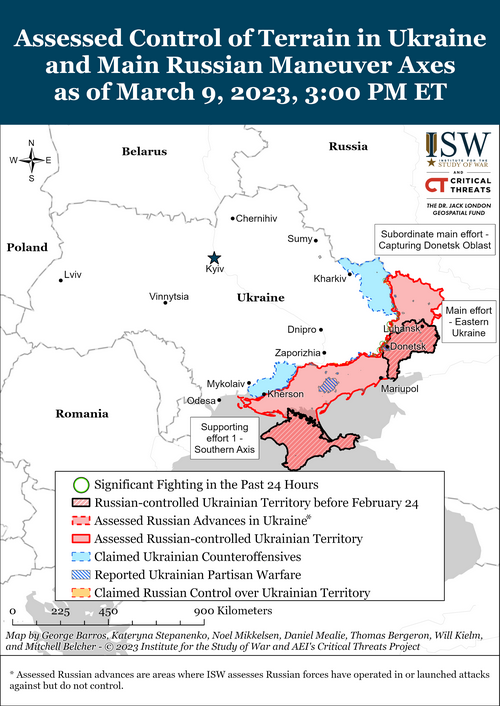
From The Institute For The Study of War:
Riley Bailey, Kateryna Stepanenko, Grace Mappes, Angela Howard, George Barros, Layne Philipson, and Frederick W. Kagan
March 9, 8:00 pm ET
Click here to see ISW’s interactive map of the Russian invasion of Ukraine. This map is updated daily alongside the static maps present in this report.
Click here to access ISW’s archive of interactive time-lapse maps of the Russian invasion of Ukraine. These maps complement the static control-of-terrain maps that ISW produces daily by showing a dynamic frontline. ISW will update this time-lapse map archive monthly.
Russian forces conducted the largest missile strike across Ukraine of 2023 so far on March 9, but the attack likely only served Russian state propaganda objectives. Ukrainian military officials reported that Russian forces targeted Ukrainian critical infrastructure with 84 different missiles including 28 Kh-101/Kh-555 and 20 Kalibr cruise missiles, six Kh-22 anti-ship missiles, six Kh-47 Kinzhal hypersonic missiles, two Kh-31P supersonic anti-ship missiles, six Kh-59 guided missiles, and at least 13 S-300 air-defense missiles.[1] Russian forces also attacked Ukraine with eight Iranian-made Shahed–136 drones, which Ukrainian officials noted likely sought to distract Ukrainian air defense systems before the missile strikes.[2] Ukrainian forces reportedly shot down 34 of the 48 Kalibr and Kh-101/Kh-555 cruise missiles and four Shahed-136 drones.[3] Ukrainian officials also noted that all eight of the Kh-31P and Kh-59 missiles did not reach their intended targets. Ukrainian Air Force Spokesperson Yuriy Ihnat noted that Ukrainian forces did not have the capacity to shoot down some of the Russian missiles—likely referring to Kinzhal and S-300 missiles.[4] The Russian Ministry of Defense (MoD) claimed that Russian forces conducted “high precision long range air, sea, and land-based missile strikes” targeting Ukrainian military infrastructure, military-industrial complexes, and energy infrastructure supporting the Ukrainian military as retaliation for the alleged incursion into Bryansk Oblast on March 2.[5]
Ukrainian officials, Russian milbloggers, and social media footage indicate that Russian forces overwhelmingly targeted energy infrastructure across Ukraine. The head of the Ukrainian state electricity transmission operator Ukrenergo, Volodymyr Kudrynskyi, stated that Russian missile strikes once again targeted Ukrainian energy infrastructure, but yet again failed to achieve Russia’s ongoing goal of destroying Ukrainian power supplies.[6] Ukrainian Prime Minister Denys Shmyhal stated that Russian strikes hit eight energy sites resulting in power outages in some areas of the country.[7] The Kyiv City Military Administration reported that preliminary data showed that Russian forces may have used Kinzhal missiles to strike unspecified infrastructure, while social media footage showed smoke rising from one of Kyiv’s thermo-electric power plants.[8] Russian milbloggers amplified footage and reports of the aftermath of strikes on energy facilities in the cities of Kyiv, Dnipro, Vinnytsia, Odesa, Kirovohrad, and Kharkiv among others.[9] ISW continues to assess that these missile strikes will not undermine Ukraine’s will or improve Russia’s positions on the frontlines.
The Kremlin likely deliberately launched missiles that Ukrainian air defenses cannot intercept to achieve results within the Russian information space despite the dwindling supplies of such missiles. Ihnat noted that Russia has up to 50 Kinzhal missiles and had used some missiles that it cannot replace. Russian President Vladimir Putin likely used these scarce missiles in fruitless attacks to appease the Russian pro-war and ultranationalist communities, which have overwhelmingly called on him to retaliate for the Bryansk Oblast incident on March 2.[10] Russian milbloggers and propagandists have also criticized the Russian missile campaign for failing to make Ukraine “freeze” over the winter in late February and early March before the spring season.[11] Putin likely attempted to offset these narratives with another missile attack similar to the ones that Russia conducted in the fall of 2022, using advanced missiles to guarantee some damage in Ukraine. Russian milbloggers did not overwhelmingly support today‘s strikes, however, noting that the Kremlin needs to fundamentally change its targeting approach given that Ukraine has adapted to the established attack pattern against its energy infrastructure.[12]
Russian forces likely advanced northwest of Bakhmut on March 9 amidst a likely increased tempo of Russian offensive operations in the area. Wagner Group financier Yevgeny Prigozhin claimed that Wagner Group fighters completely captured Dubovo-Vasylivka (6km northwest of Bakhmut), and geolocated footage published on March 9 indicates that Wagner forces likely captured the settlement.[13]The likely capture of Dubovo-Vasylivka corresponds with the potentially increased tempo of Russian offensive operations northwest of Bakhmut in recent days.[14] The Ukrainian General Staff reported that Russian forces conducted at least 30 percent of their assaults in Ukraine northwest of Bakhmut on March 8.[15] The Ukrainian General Staff has not reported Russian assaults near Khromove since March 1, and Ukrainian forces have reportedly reestablished river crossings in the area after Russian forces reportedly destroyed a bridge in the area on March 4.[16] ISW has assessed that Ukrainian forces have likely pushed Russian forces back from Khromove since the Ukrainian General Staff’s reporting of the March 1 assaults, and the reported establishment of pontoon bridges suggests that Ukrainian forces are strengthening their positions around the critical ground lines of communications (GLOCs) near Khromove. Russian forces may be temporarily focusing their operational efforts northwest of Bakhmut to set conditions for future offensive operations aimed against these strengthened Ukrainian positions around Khromove or intended to bypass them in a larger envelopment.
The Wagner Group’s offensive operation in eastern Bakhmut appears to have entered a temporary tactical pause and it remains unclear if Wagner fighters will retain their operational preponderance in future Russian offensives in the city. There have been no reports of Wagner fighters conducting offensive operations from eastern Bakhmut into central parts of the city since Russian forces captured all of eastern Bakhmut located east of the Bakhmutka River on March 7.[17] Wagner fighters have been conducting highly attritional frontal assaults on eastern Bakhmut for nine months and are likely not prepared to conduct a crossing of the Bakhmutka River to the Bakhmut city center at this time. The frontal offensive on eastern Bakhmut likely consumed a significant amount of Wagner personnel and resources, although it is not yet evident whether this effort has caused Wagner’s offensive within Bakhmut itself to culminate. Ukrainian Eastern Grouping of Forces Spokesperson Serhiy Cherevaty stated on March 9 that an increasing number of unspecified Russian airborne and mechanized reinforcements have recently arrived at Bakhmut.[18] The arrival of an increased number of conventional Russian forces to the area may suggest that Russian forces intend to offset the possible culmination of Wagner’s offensive operations in Bakhmut with new conventional troops. Wagner Group fighters may also be conducting a temporary tactical pause to wait for these conventional Russian reinforcements and replenish themselves in preparation for costly operations within central Bakhmut.
Russian forces may be preparing to resume offensive operations around Vuhledar, although persistent personnel and ammunition issues will likely continue to constrain Russian forces from advancing. Social media footage published on March 8 reportedly shows personnel of the 136th Motorized Rifle Brigade of the 58th Combined Arms Army of the Southern Military District appealing to the Russian military command for more artillery ammunition before they replace the 155th Naval Infantry Brigade of the Pacific Fleet near Vuhledar and conduct ground attacks in the area.[19] The 155th Naval Infantry Brigade bore a significant proportion of the catastrophic losses that Russian forces suffered in their culminated three-week February offensive to capture Vuheldar and has reportedly been reconstituted at least seven times since the start of Russia’s invasion of Ukraine.[20] Russian forces may be rotating in the 136th Motorized Rifle Brigade to replace a severely degraded formation in hopes of renewing offensives near Vuhledar, although this one-for-one replacement does not represent a Russian reinforcement of this effort. Personnel of the 136th Motorized Rifle Brigade detailed that they need to conserve their artillery ammunition as Russian forces send the majority of artillery shells to forces fighting around Bakhmut.[21] The 136th Motorized Rifle Brigade is unlikely to achieve tactical advances near Vuhledar that the 155th Naval Infantry Brigade, 40th Naval Infantry Brigade, and other Russian formations failed to make following months of preparation to start offensives in this direction. The likely degradation of other units in the area, significant equipment losses, and the reported continued artillery constraints will likely prevent Russian forces from securing significant tactical gains if they decide to resume offensives in the area.
Internal dynamics within the Russian military may be driving the potential resumption of costly offensives near Vuhledar that promise little operational benefit. Russian Defense Minister Sergei Shoigu reportedly ordered Eastern Military District (EMD) commander Colonel General Rustam Muradov to take Vuhledar at any cost to settle widespread criticism within the Russian Ministry of Defense (MoD) about the lack of progress and significant losses in the Vuhledar area.[22] Shoigu recently visited Muradov in western Donetsk Oblast likely to assess the viability of the Vuhledar offensive as well as Muradov’s continued role as EMD commander.[23] ISW previously assessed that Muradov would need new manpower and equipment reserves to follow through on Shoigu’s reported instructions, and the one-for-one replacement of the 155th Naval Infantry Brigade by the 136th Motorized Rifle Brigade does not represent a notable fraction of the reinforcements likely required.[24] It is still not clear if Shoigu has decided to provide Muradov with the necessary resources to resume offensives, but Muradov may decide that he needs to resume offensive operations regardless to demonstrate his competence as EMD commander. ISW assesses that Russian forces would need to advance upwards of 24km from the current frontlines around Vuhledar for this offensive to support operations elsewhere in Donetsk Oblast, a rate of advance that Russian forces have not achieved since the first months of the full-scale invasion of Ukraine.[25] The resumption of costly offensives around Vuhledar would be a misallocation of already degraded forces to an increasingly nonsensical operational effort, but Muradov’s personal motivations may cause Russian forces in the area to resume these operations nonetheless.
Russian authorities are likely establishing volunteer-based military formations under Russian state-owned energy companies in order to distribute responsibility and accountability for managing units, alleviate burdens on the national budget and regional budgets, and draw on the financial resources of those entities. The BBC reported on March 9 that the Russian Tax Service entered the Zaporizhia-based Sudoplatov volunteer battalion into the register of Russian legal entities—making the battalion a state unitary enterprise.[26] The BBC added that the Russian Tax Service registered the battalion under the same address as state-owned enterprises Tavria-Energo and State Grain Operator.[27] The registration may be connected to the emerging Kremlin effort to establish a state-controlled armed formation analogous to the Russian Combat Army Reserve (BARS) units under Gazprom subsidiary Gazprom Neft.[28] The creation of state-controlled military formations legally nested under energy companies could allow the Kremlin to reduce logistical burdens on the Russian Ministry of Defense (MoD) and regional administrations, delegate clear responsibility for recruitment, recruit volunteers without committing additional federal funding, and provide a hedge against the limitations of the Wagner Group private military company (PMC). The decision to register the Sudoplatov battalion in proximity with Tavria-Energo, an organization that, unlike Gazprom, is not included in the US Treasury Department’s sanctions lists, may provide additional financial incentives, as Tavria-Energo may aid the Sudoplatov battalion in circumventing financial hurdles that a Gazprom Neft-affiliated volunteer formation would face.[29]
The Transnistrian occupation government accused the Ukrainian government of plotting to kill Transnistria’s president, likely as part of the ongoing Russian information operations to undermine Ukrainian credibility and destabilize Moldova. The Transnistrian occupation Ministry of Security Services accused six people, including Ukrainian nationals and Ukrainian Security Service (SBU) personnel, on March 9 of plotting to assassinate senior Transnistrian occupation officials and the occupation head Vadim Krasnoselsky.[30] The SBU stated that the Transnistrian authorities’ accusation is a Kremlin information provocation.[31] ISW has previously reported on increasing Russian information efforts to destabilize Moldova and even draw Transnistria into the war.[32] The Kremlin also tried to undermine Ukraine’s credibility through the recent claimed border incursions in Bryansk Oblast.[33]
Key Takeaways
- Russian forces conducted the largest missile strike across Ukraine of 2023 likely only to advance Russian state propaganda objectives.
- Russian forces likely advanced northwest of Bakhmut amid a likely increased tempo of Russian offensive operations in the area.
- The Wagner Group’s offensive operation in eastern Bakhmut appears to have entered a temporary tactical pause and it remains unclear if Wagner fighters will retain their operational preponderance in future Russian offensives in the city.
- Russian forces may be preparing to resume offensive operations around Vuhledar, although persistent personnel and ammunition issues will likely continue to constrain Russian forces from advancing.
- Internal dynamics within the Russian military may be driving the potential resumption of costly offensives near Vuhledar that offer little prospect of operational benefit.
- Russian authorities are likely formalizing structures to create and coopt volunteer-based military formations under state-owned energy companies in order to distribute accountability, reduce burdens on the national budget, and avoid sanctions.
- The Transnistrian occupation government accused the Ukrainian government of involvement in a claimed terrorist plot, likely as part of the Russian information operations to undermine Ukrainian credibility and destabilize Moldova.
- Russian forces continued to conduct ground attacks throughout the Kupyansk-Svatove-Kreminna line.
- Russian forces continued offensive operations in and around Bakhmut but have not completed a turning movement or enveloped or encircled the city.
- Russian forces continued offensive operations along the outskirts of Donetsk City and near Vuhledar.
- Russian strikes completely disconnected the Zaporizhzhia Nuclear Power Plant (ZNPP) in Enerhodar, Zaporizhia Oblast, from all external power sources for 10 hours.
- Ukrainian officials reported that Russian occupation authorities are preparing for a spring 2023 mobilization wave in occupied areas of Donetsk and Luhansk oblasts that may include male teenagers born in 2006.
- Russian officials and occupation authorities are continuing efforts to integrate occupied territories into the Russian political and bureaucratic systems.
Go here to read the rest.
From Strategy Page:
March 9, 2023: The war in Ukraine continues to be a series of battles with different types of weapons where quantity often counts as much as quality and who has the most ammunition. For the last few months, the Ukrainians have been killing lots of Russians who seek to regain enough lost territory to claim a victory. That Russians strategy has failed so far. The Russians don’t have the ability to carry out a large-scale offensive and rely on smaller battles where large numbers of poorly trained and led Russian troops seek to overwhelm smaller numbers of Ukrainian soldiers. Both sides suffer losses, especially from artillery fire. Satellite photos show numerous dead Russians but few of the dead Ukrainian defenders. Defenders have the advantage and the Ukrainians made the most of that to inflict heavy losses on the Russians while suffering fewer losses and falling back slowly.
This is small-scale attrition warfare where the better trained and led Ukrainians are able to keep most of their forces out of combat so they can prepare for a larger scale offensive using Western tanks and longer range guided missiles, bridge building units and mine-clearing troops to overwhelm Russians defenders on a large scale and take back the 17 percent of Ukraine still occupied by Russia. This large-scale offensive warfare is something Russia has never been able to carry out in Ukraine. In late 2022 the Ukrainians carried out two of these operations. The first one started at the end of August 2022 in the northeast (Kharkiv province). By September the Russians were gone because they were taken by surprise and suffered major losses in terms of troops, equipment and territory. In November Russia lost Kherson City in the south, along with half of Kherson province. After these two Ukrainian victories, Russia has only been able to launch small scale attacks.
Since December the Ukrainians have been organizing offensive forces for another major advance. The Ukrainians will not reveal where this offensive force will be used and that uncertainty makes it difficult for Russia to develop an effective defensive strategy.
Another important factor is the length of the front line in Ukraine. It is enormous at about 2,500 kilometers long and only a relatively small number of Russian and Ukrainian troops are available to monitor, much less defend, the entire front. Russian forces in Ukraine are insufficient to man a World War I style front line defense with continuous trench lines. During World War I, the front line in east (Russia) was straighter (about 1,300 kilometers) and manned by millions of troops. This is ten times the number seen in 2022 Ukraine. Even then there were portions of the World War I east front that were patrolled but not manned by troops in trenches. World War I also saw the first use of aircraft on a large scale to maintain a better idea of who was where on the ground. Observer reports were augmented by aerial photographs. In 2022 Ukraine has an advantage in terms of aerial surveillance because of NATO assistance (satellite observation and some special aircraft),. Because of NATO assistance Russia has not been able to obtain air superiority over Ukraine. Both sides can carry out airstrikes but must beware of air defenses on the ground and in the air.
The NATO nations supporting Ukraine did not anticipate this kind of war with Russia and lacked enough of some types of weapons the Ukrainians needed. Anti-aircraft and anti-missile systems are the best example. NATO countries had lots of Stinger (and other similar models) portable anti-aircraft missiles that can be carried by troops but have limited range and capabilities. NATO expected to have air superiority against a possible Soviet invasion of Western Europe, mainly due to large and very effective American air forces. Ukraine needed longer range air-defense systems as well as some BMD (ballistic missile defense) systems to deal with the Russian use of cruise and ballistic missiles launched from inside Russia. NATO nations discovered that they didn’t have many of these weapons because of the expected air superiority in a major war. NATO had some BMD systems, but not enough to supply the Ukrainian need to deal with cruise missiles and the occasional Russian effort to achieve temporary air superiority.
Another unexpected (by NATO nations) shortage is artillery ammunition. This has been a common problem since World War II because actual combat requires more artillery ammo than NATO nations can afford to stockpile. The problem is that artillery munitions have a relatively short shelf life. After 15-20 years the chemical components degrade to the point where the ammo is unreliable and must be safely disposed of. Having the peacetime forces firing all this ammo each year for training purposes wears out the artillery weapons. In practice, most nations maintain insufficient stockpiles of artillery ammo and do not maintain manufacturing facilities to produce a lot more of it quickly if there is a war. That sort of thing is expensive and no nation can afford to do it. The many nations of the NATO alliance sent Ukraine almost all the artillery ammunition they had, along with artillery to use it. This gave the Ukrainians an advantage against the Russians, who were not expecting a long war and encountered shortages of artillery ammo before Ukraine did. After a year of fighting, both sides have to limit their artillery use because it will take years for ammo stockpiles to be rebuilt.
Russia lacks the manufacturing resources of the NATO alliance and is not able to keep up with the large assortment and quantity of weapons NATO sends Ukraine. The Ukrainians are gradually receiving new weapons and equipment so they can expel the Russians and end the war. There are delays caused by local politics in the NATO nations supplying the weapons and munitions. The United States has always supplied most of the weapons and supporting services like air power and air transport as well as naval forces.
The Ukraine War is the first time NATO has had to supply a battle against a major force, in this case the post-Soviet Russians. For decades the Soviet threat was very real, with dozens of Russian divisions stationed in East Germany and further back in Ukraine (then a part of the Soviet Union). This attack force contained thousands of tanks and even more artillery, backed up by a large air force. When the Soviet Union went bankrupt and dissolved in 1991, all those Soviet divisions withdrew to Russia where most were disbanded. Most of the tanks and other armored vehicles as well as artillery stockpiles of ammunition were abandoned. Since Ukraine was a major staging area for the second wave of the planned Soviet offensive, Ukraine inherited those stockpiles in 1991 when they became an independent nation. Ukraine also inherited some Soviet nuclear weapons, which they agreed to surrender in return for Russian assurances that they would never attack Ukraine. Russia broke that promise, but the surrendered nuclear weapons were disassembled and the nuclear material used for nuclear power plant fuel. Russia agreed to do the same with many of their nuclear weapons. The Americans paid for most of the nuclear weapon disassembly and Russia received a lot of the nuclear material that had been converted into nuclear power plant fuel.
Go here to read the rest. In many ways the Ukrainian War is a poor imitation of the fighting that took place on the East Front in World War II. Neither side has the millions of troops, or the huge stockpiles of shells that both the combatants had eight decades ago. Only the Ukrainians, thus far, have had the ability to launch large scale successful offensives, while the Russians, after their initial failed attempt to take Kiev, have attempted only small offensives in the Don Bas. For the Russians this is not by choice, but rather to their lack of manpower and ordinance, the Russians not having an outside source like Nato supplying them.

