
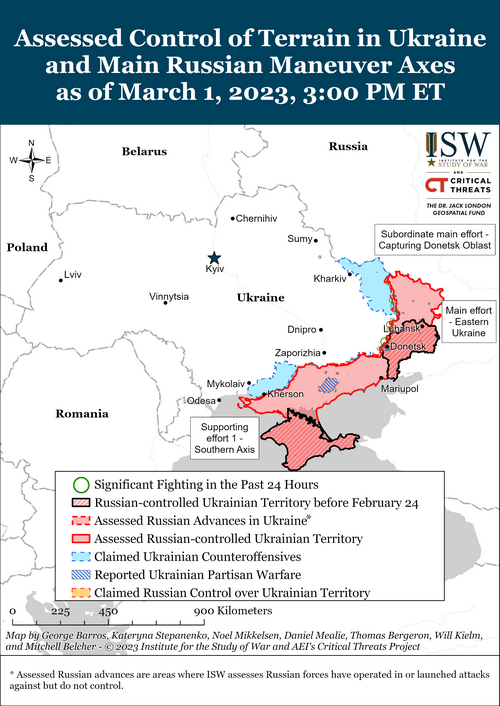
From The Institute For The Study of War:
Kateryna Stepanenko, Karolina Hird, Riley Bailey, Grace Mappes, George Barros, Layne Philipson, and Mason Clark
March 1, 6:00 pm ET
Click here to see ISW’s interactive map of the Russian invasion of Ukraine. This map is updated daily alongside the static maps present in this report.
Click here to access ISW’s archive of interactive time-lapse maps of the Russian invasion of Ukraine. These maps complement the static control-of-terrain maps that ISW produces daily by showing a dynamic frontline. ISW will update this time-lapse map archive monthly.
The Kremlin may leverage an amendment to Russia’s Criminal Code increasing punishments for “discrediting” the war in Ukraine to promote further self-censorship among the critical ultranationalist community, prompting pushback from Wagner Group financier Yevgeny Prigozhin and prominent milbloggers. Chairman of the Russian State Duma Vyacheslav Volodin announced on March 1 that the Duma could ratify amendments to the Russian Criminal Code introducing harsher punishments for discrediting participants of the Russian “special military operation,” including “volunteers,” as soon as March 14.[1] The Russian Ministry of Defense (MoD) labels irregular armed formations fighting in Ukraine—specifically the Wagner Group—as volunteers. Volodin stated punishments would include a fine of up to five million rubles (about $66,450), five years of correctional or forced labor, or a sentence of 15 years in prison.[2] Russian President Vladimir Putin previously stated on February 28 that Russia must “identify and stop illegal activities of those who are trying to weaken [Russian] society” and identify those who “use separatism, nationalism, neo-Nazism as a weapon.”[3] Wagner financier Yevgeny Prigozhin has long called on the Kremlin to punish anyone who spoke poorly of Wagner under the guise of ensuring that all participants of the war are protected under existing laws against discrediting the Russian Armed Forces. However, Prigozhin released a suggested adjustment to the amendments in response to Volodin’s statement, arguing the amendment should not punish criticism of senior Russian MoD and Wagner Group commanders.[4] Prigozhin argued constructive criticism “is necessary” to ensure Russian commanders use their powers “transparently and responsibly.” Prigozhin may be concerned that the Kremlin could use the expanded amendment to crack down on or, at minimum, promote self-censorship practices among ultranationalist milblogger communities who regularly criticize senior Russian commanders, and likely seeks to balance his desired protection of the Wagner Group with retaining the freedom for himself and friendly milbloggers to criticize the Russian military.
ISW assessed on February 26 that Putin has allowed the ultranationalist community to expand its influence at the expense of the Russian MoD so the Kremlin can leverage the community’s pre-established networks to recruit volunteers.[5] The Kremlin likely seeks to mitigate further pushback from the pro-war ultranationalist community, which continues to look up to Putin as the facilitator of the war despite their criticisms of the conduct of the war. The State Duma will likely pass these amendments on March 14, given Volodin’s announcement. The Kremlin could use these amendments to promote self-censorship among select milbloggers whose constituencies are no longer needed for its force generation or crowdfunding campaigns, or whose criticisms have exceeded the Kremlin’s tolerance for open criticism. It is unclear to what extent such measures would scare Russian milbloggers into self-censorship, however. Former Russian officer (and avid critic of Putin) Igor Girkin mocked Volodin’s announcement, stating that he will start apologizing for his previous critiques of Russia’s military failures and sarcastically retracting his criticism.[6] A Kremlin-affiliated milblogger, however, celebrated the amendments, noting that Putin is attempting to prevent divisions in society to improve the war effort.[7]
A New York Times (NYT) investigation into catastrophic Russian losses during the recent Russian offensive near Vuhledar indicates that the Russian military remains unable to rapidly fix the endemic challenges posed by severe personnel and equipment losses. NYT reported on March 1 that Ukrainian officials reported that Russian forces continued to make serious mistakes and advance tank columns into Ukrainian ambushes in the recent three-week Russian offensive near Vuhledar, which Ukrainian sources characterized as the largest tank battle of the war to date.[8] NYT reported that Russian forces lost at least 130 tanks and armored personnel carriers (APCs) during the three-week offensive, forcing them to resort in the last week to frontal infantry attacks.[9] Ukrainian troops outlined their tactics to NYT, stating they lured Russian forces into kill zones before immobilizing Russian columns and channeling them into mine-laden road shoulders, before destroying them with artillery – including HIMARS, typically used against static, rear area targets.[10] The Russian elements deployed to the Vuhledar area, primarily the 155th Naval Infantry Brigade, are mainly staffed with poorly trained mobilized personnel who suffered massive losses in this area in October 2022 and again in February 2023. ISW previously reported on Russian losses near Vuhledar and assessed that they are emblematic of the Russian military‘s inability to learn from its failures.[11] The NYT investigation supports ISW’s assessment that the continued recreation and reinforcement of Russian military failures will impede the Russian military’s ability to conduct effective offensive operations.[12]
Belarusian President Alexander Lukashenko and Chinese President Xi Jinping signed a package of 16 documents on March 1 that may facilitate Russian sanctions evasion by channeling Chinese aid to Russia through Belarus. The documents include a strategy for joint Belarusian-Chinese industrial development, a document on Belarusian-Chinese scientific and technical cooperation for 2023-2024, and a memorandum of understanding on joint projects using Chinese government loans.[13] Lukashenko stated that Belarus is interested in deepening cooperation with China on technological development, including the creation of joint ventures, the modernization of Belarusian enterprises with modern Chinese technologies, and trade in goods and services.[14] Lukashenko stated that Belarusian manufacturers are interested in studying the “competencies and technologies of Chinese companies in the formation of a component base, the production of engines, transmissions, axles, other components, and assemblies.”[15] ISW previously assessed that China may clandestinely transfer military or dual-use equipment to Russia via Belarus.[16]
Lukashenko likely additionally intends these agreements to support his longstanding effort to cultivate Chinese economic influence in Belarus to hedge against Russian integration pressure, although these measures will at most delay Russia’s ongoing campaign to secure full economic control of Belarus. Several of the documents also concern Chinese-Belarusian trade and economic cooperation.[17] Lukashenko previously expressed support to expand China’s economic presence in Belarus in February 2021 when Lukashenko intensified his efforts to delay Russia’s absorption of Belarus through the Union State.[18]
Russian occupation authorities may be attempting to further constrain the International Atomic Energy Agency (IAEA) presence at the Zaporizhzhia Nuclear Power Plant (ZNPP) to compel the de facto recognition of Russian ownership of the plant. The IAEA announced on February 10 that it delayed a planned rotation of personnel to the IAEA mission at the ZNPP due to security concerns.[19] IAEA General Director Rafael Grossi stated on February 20 that the situation remains unstable and on February 28 that 20 detonations occurred near the ZNPP, briefly disconnecting a backup powerline to the ZNPP and underscoring the ZNPP’s “fragile external power situation.”[20] Russian Ministry of Foreign Affairs (MFA) Spokesperson Maria Zakharova claimed on February 22 that the UN Department for Safety and Security indefinitely postponed the IAEA personnel rotation without proper cause, claiming that Russia is committed to ensuring the safe passage of IAEA personnel to the ZNPP.[21] Zaporizhia Oblast occupation official Vladimir Rogov claimed on March 1 that Western intelligence agencies disrupted the routine rotation of the IAEA mission in order to accuse Russia of creating obstacles for the IAEA.[22] Russian and occupation officials have previously criticized the IAEA’s presence at the ZNPP, such as Rogov accusing the IAEA in January of playing a political role at the ZNPP to support Ukraine.[23] Russian and occupation authorities likely intend to use either the possibly trapped IAEA personnel or a reduced IAEA presence at the plant to coerce international recognition of Russian ownership over the plant. Russian and occupation authorities may also be attempting to deter a possible future Ukrainian counteroffensive in southern Ukraine by escalating threats to the ZNPP.
Politico reported that Serbian President Aleksandar Vučić is seemingly reconsidering Serbia’s close ties with Russia, spurred in part by ongoing Wagner Group recruitment and subversion efforts in Serbia and demonstrating the international economic and informational costs imposed on Putin by his invasion of Ukraine. Politico reported on March 1 that Vučić seeks to appeal to both Russia and western institutions by continuing Serbia’s European Union membership bid while refusing to impose sanctions against Russia, but Vučić said that Serbia must make “difficult choices” soon.[24] Vučić condemned the Wagner Group and stated that Serbian authorities will arrest all Serbians who have fought for the Wagner Group in Ukraine. Vučić characterized attendees of a Wagner-backed protest in Belgrade as anti-Serbian and paid off by unspecified foreign actors. Vučić greenlit on February 17 a US-led plan to normalize relations with Kosovo, which Serbia does not officially recognize, and stated that Serbia will remain on the path to EU membership. Politico noted that polls in Serbia suggest that more Serbians support Russia than Western states, suggesting Vučić would struggle to completely divest from ties with Russia – which he likely does not intend to do. A Russian milblogger amplified the Politico article and criticized Russian President Vladimir Putin for turning Russia into a “pariah state” from which even “traditional fraternal states distance themselves.”[25]
Key Takeaways
- The Kremlin may leverage an amendment to Russia’s Criminal Code increasing punishments for “discrediting” the war in Ukraine to promote further self-censorship measures among the critical ultranationalist community, prompting pushback from Wagner financier Yevgeny Prigozhin and prominent milbloggers.
- A New York Times (NYT) investigation into catastrophic Russian losses during the recent Russian offensive near Vuhledar indicates the Russian military remains unable to rapidly fix the endemic challenges posed by severe personnel and equipment losses.
- Belarusian President Alexander Lukashenko and Chinese President Xi Jinping signed a package of 16 documents that may facilitate Russian sanctions evasion by channeling Chinese aid to Russia through Belarus.
- US officials continue to report that Ukrainian forces are properly using Western-provided weapons in Ukraine.
- Russian and occupation authorities may be attempting to further limit the International Atomic Energy Agency (IAEA) presence at the Zaporizhzhia Nuclear Power Plant (ZNPP) to compel the de facto recognition of Russian ownership of the plant.
- Politico reported that Serbian President Aleksandar Vučić is seemingly reconsidering Serbia’s close ties to Russia during the war in Ukraine, spurred in part by ongoing Wagner Group recruitment and subversion efforts in Serbia.
- Russian forces are fortifying positions on the international border in Belgorod Oblast.
- Russian forces advanced within Bakhmut and continued ground attacks around Bakhmut and in the Avdiivka-Donetsk City area.
- Russian forces continued to conduct offensive operations on the Kupyansk-Svatove-Kreminna line.
- Russian forces continue defensive operations in southern Ukraine.
- Russian occupation authorities continue to struggle with the administrative management of occupied areas.
Go here to read the rest. The vaunted Russian offensive comes down to endless talk and Russia incurring immense casualties attempting to take obscure villages in the Don Bas.


Belarus is an economic and political basket case. Its economy will likely collapse if it tries to assist China/Russia and it exerts much effort.
Belarus is an economic and political basket case. Its economy will likely collapse if it tries to assist China/Russia and it exerts much effort.
It isn’t a basket case. Its current autocrat is abusive and has ruined the country’s public life in important respects, but he’s made passable if suboptimal decisions in the economic realm.
Art Deco: I believe you have accurately described the situation and most observers would consider the country to be a basket case by most measures, even by the rather loose EU definition.
and most observers would consider the country to be a basket case by most measures, even by the rather loose EU definition.
The GDP per capita according to purchasing power parity has increased by 3.4x in real terms since 1995. Right now, it’s about 30% of that of the United States, or similar to that of our own country in 1955. The share of their nominal GDP which is accounted for by fuel and mineral exports bounces around 10%. Among those over the age of 15, literacy is universal. Life expectancy at birth is 74 years, lagging behind the rest of Europe but nevertheless at a level not reached in the United States until about 1980. Public sector debt is currently about 33% of GDP, which is satisfactory. The country has been running balance of payments deficits for some time, so external debt is now about 67% of gross domestic product. About 55% of the population over the age of 15 is currently employed (60% is about normal for an occidental country). The total fertility rate at 1.38 is quite deficient; it’s just as bad in a menu of European countries.
IOW, room for improvement, not a basket case.