
From The Institute For The Study of War:
Russian Offensive Campaign Assessment, February 23, 2023
Riley Bailey, Grace Mappes, Nicole Wolkov, Karolina Hird, Kateryna Stepanenko, and Frederick W. Kagan
February 23, 7 pm ET
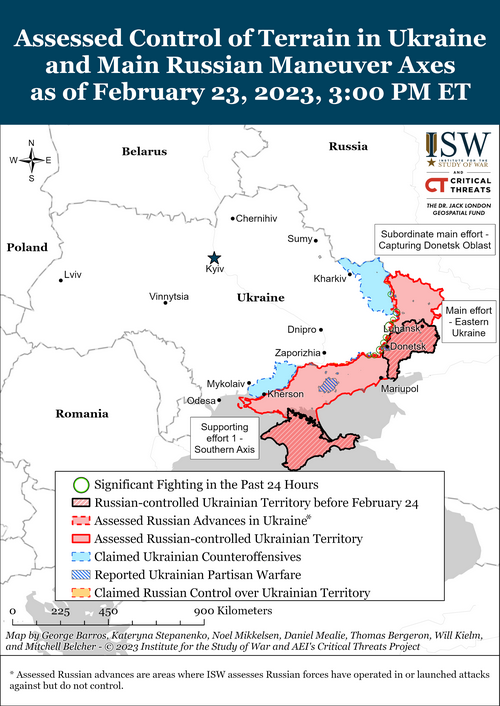
Click here to see ISW’s interactive map of the Russian invasion of Ukraine. This map is updated daily alongside the static maps present in this report.
The Kremlin appears to be setting conditions for false flag operations on the Chernihiv Oblast international border and in Moldova ahead of the one-year anniversary of Russia’s full-scale invasion of Ukraine. Ukrainian Northern Operational Command reported on February 23 that Russian forces are preparing possible false flag operations in the international border areas of Chernihiv Oblast.[1] The Ukrainian Northern Operational Command stated that Ukrainian intelligence has already observed Russian convoys with unmarked military equipment and personnel dressed in uniforms resembling those worn by the Ukrainian military move to areas near the Chernihiv Oblast border. The Ukrainian Northern Operational Command stated that the purpose of these false flag operations would be to accuse Ukrainian forces of violating the territorial integrity of an unspecified country, very likely referring to Belarus. The Kremlin may be preparing false flag attacks to coerce Belarus into the war following Belarusian President Alexander Lukashenko’s February 16 statement that Belarus would only enter the war if attacked by Ukraine.[2] The Belarusian Ministry of Defense also notably claimed on February 21 that Belarusian forces observed a buildup of Ukrainian forces at its borders.[3] ISW continues to assess that Belarusian or Russian attack on northern Ukrainian regions is highly unlikely, but Russia seeks to force Lukashenko’s hand or blame Ukraine for expanding the war to undermine support for Kyiv. Such a false flag operation could also aim to fix Ukrainian forces at the northern border in an effort to weaken Ukrainian defenses in eastern Ukraine and preparations for counter-offensive operations.
The Kremlin also appears to be setting information conditions to stage a false flag operation in occupied Transnistria, Moldova. The Russian Ministry of Defense (MoD) claimed on February 23 that Ukrainian forces are planning to conduct an armed provocation against Transnistria in the near future.[4] The MoD claimed that Ukrainian forces would dress as Russian military personnel and stage an alleged Russian offensive from positions in Transnistria.[5] The Moldovan government denied the Russian MoD’s allegations.[6] The MoD likely sought to foster this false narrative to twist Ukrainian President Volodymyr Zelensky‘s warning to Moldovan President Maia Sandu that the Kremlin was preparing provocations in Moldova and his offer to help Moldova if Russian forces in Transnistria threaten the territorial integrity of Ukraine.[7] The MoD’s dissemination of this false narrative does not indicate that Putin intends to attack Moldova—an undertaking for which he lacks military capability—although it points toward an escalation in his ongoing efforts to undermine the Moldovan state.
Russian President Vladimir Putin continues to deliver boilerplate rhetoric in public addresses that offered him opportunities he did not take to shape the Russian information space ahead of the one-year anniversary of Russia’s invasion of Ukraine. Putin marked Defenders of the Fatherland Day on February 23 with a video address in which he reiterated tired Kremlin talking points arguing that the Russian military is fighting neo-Nazism in Ukraine and protecting “our people in our historical lands.”[8] Putin delivered vague remarks that the Russian military is improving the training of its units and continuing to supply advanced equipment to its forces.[9] Putin also asserted that Russian industry is quickly increasing the production of a broad range of conventional weapons and preparing for the mass production of advanced models of military equipment, although ISW assesses that Russia continues to gradually prepare its defense industrial base (DIB) for a protracted war instead of engaging in wider rapid economic mobilization.[10] Putin’s speech did not offer specific goals or objectives for the war on Ukraine but instead continued generic rhetorical lines of effort aiming to prepare the Russian public for a protracted war in Ukraine. Putin’s refusal to use the public address to issue specific goals or policies ahead of the one-year anniversary of Russia’s invasion of Ukraine suggests that Putin remains uncertain of his ability to shape the Russian information space through a dramatic speech that represents a significant inflection in his rhetoric.[11]
Putin likely attempted to downplay recent surges of criticism regarding the integration of the Donetsk and Luhansk People’s Republics (DNR/LNR) into the Russian Armed Forces. Putin attended a wreath-laying ceremony to mark Defenders of the Fatherland Day, during which a Russian Airborne Forces (VDV) Lieutenant Colonel Roman Cheremukhin asked him questions concerning the status of DNR and LNR militias and their inability to access state benefits for combat veterans.[12] Putin responded that the Russian government will include DNR and LNR militia personnel who served from 2014 onward to the list of those eligible for combat veteran benefits, in what was likely an orchestrated performance similar to past exchanges between Putin and servicemembers.[13] Deputy Chairman of the Federation Council Andrey Turchak’s announcement that DNR and LNR personnel who fought in Ukraine since 2014 would receive the status of combat participant further suggests that the incident was staged.[14] The Kremlin is likely attempting to gain favor with the newly-integrated DNR and LNR militias – who have expressed concern over the Russian Ministry of Defense (MoD) imposing military command changes within their units – by offering them the prospect of having state benefits.
Putin seems more concerned with appealing to ultranationalist pro-war ideologues and tired rhetorical gestures than with presenting any new approach to achieving the Kremlin’s objectives in Ukraine. Putin’s only specific remark in his public address concerned the operation of the Borei-A nuclear-powered submarine and how it would allow the Russian Navy’s strategic nuclear forces to operate at 100 percent capacity.[15] Putin’s remarks concerning the Russian Navy‘s strategic nuclear forces were likely meant to support ongoing Russian information operations aimed at discouraging Western support to Ukraine by fueling hyperbolic concerns about nuclear escalation, as well as to display Russian military might to a domestic audience by highlighting capabilities that are not involved with Russian military failures in Ukraine.[16] Putin also engaged in a likely staged interaction with a representative from the Russian Orthodox Church in which he stated that he would do everything to address the concerns of the Orthodox clergy serving with Russian forces in Ukraine.[17] Putin’s appeals to nuclear armaments, DNR and LNR proxy forces, and Orthodoxy indicate that he is continuing to rely on rhetoric that he knows appeals to the Russian ultranationalist pro-war community.
Russian President Vladimir Putin likely continues to suffer from confirmation bias in his belief that Russia’s will to fight will outlast the West’s will to support Ukraine. The Financial Times (FT) cited unnamed officials close to the Kremlin stating that Putin assesses that “Russia is more committed to the war than the West is to Ukraine and [is] resilient enough to see out the economic pain.”[18] Unnamed Kremlin sources also told FT that Putin’s demands for loyalty over competence among elites is forcing them to refrain from being honest with him about the progress of the war, and noted that Putin gets information of “poor” quality as a result. Sources also revealed that most of Putin’s presidential administration and economic cabinet expressed that they do not support this war but use lies as a survival tactic, with only a small number of officials resigning since the start of the invasion. One longtime insider also observed that Putin is of “sound mind” and is “reasonable,” which supports ISW’s February 5 assessment that he is a highly calculated actor who places considerable emphasis on eliminating risks.[19] Insiders also revealed that Putin also withheld his plans to launch a full-scale invasion in February 2022 and his plans to occupy Crimea in 2014 from his closest advisors, with his circle of advisors recently tightening even more. The insider information indicates that Putin is prepared for Russia to suffer through a costly and exhausting protracted war under the conviction that the war will tire out Western support. Putin is also likely misinformed about the effectiveness of the Western equipment on the frontlines and its ability to impede his plans for a protracted war of attrition. The combination of Putin’s beliefs about Russian staying power and expectations of the collapse of Western will with the shrinking circle of advisors and the apparent unwillingness of insiders to contradict him likely create a strong confirmation bias in Putin’s observations of Western statements and outreach. Putin is likely to prioritize any indications of waning Western support or hesitancy over statements or indications of Western toughness or determination if this hypothesis is correct. Western leaders would do well to consider the likelihood that confirmation bias of this sort is shaping Putin’s perceptions in their own public and private statements and actions.
A Russian source attempted to preempt Western discussions about releasing classified information regarding China’s considerations to provide lethal aid to Russia. A prominent Russian milblogger responded to Chinese Foreign Minister Yi Wang’s denial that China intends to supply weapons to Russia and stated that China provides Russia the opportunity to purchase various types of ammunition, industrial drones, field medicine, and protective gear on a commercial basis.[20] The Russian milblogger claimed that Chinese-made equipment is abundantly available in Russia and is present throughout the front in Ukraine.[21] The milblogger is likely referring to commercially available dual-use technology from China, which ISW has observed various Russian volunteer groups purchase and send to the Russian military as part of crowdfunding efforts. ISW has not observed any evidence of Russian forces using lethal aid from China in Ukraine. US officials are reportedly considering releasing intelligence that they believe shows that China is weighing whether to supply weapons to support Russia’s war in Ukraine.[22] NATO Secretary Jens Stoltenberg stated on February 23 that NATO has seen signs that Chinese officials may be planning to send lethal aid to Russia.[23]
Wagner Group financier Yevgeny Prigozhin announced that the Russian Ministry of Defense (MoD) fulfilled Wagner Group’s complete artillery ammunition request on February 23 following immense support for Prigozhin in the Russian information space.[24] Prigozhin thanked many unspecified figures for helping to solve Wagner’s ammunition shortage problems, including unspecified individuals in positions of power who “exerted pressure and made decisions” in favor of Wagner, and claimed these individuals helped save hundreds of Wagner personnel from dying in combat operations. Prigozhin likely aimed to further undermine the Russian MoD by thanking individuals rather than the MoD itself for providing Wagner with all its requested ammunition. Prigozhin’s February 23 resolution did not generate significant discussion within the information space, unlike Prigozhin’s escalation on February 22.[25] Deputy Chief of the Main Operational Department of Ukrainian General Staff, Brigadier General Oleksiy Hromov stated on February 23 that the Russian military command is trying to oust Prigozhin from the information space after his continuous resistance to subordinate to the Russian MoD.[26] Prigozhin’s claims about Wagner receiving ammunition, if true, may suggest that the Kremlin fears Prigozhin’s influence over the information space and might have attempted to appease him before he exposed more inner workings of the Kremlin and the Russian MoD. The provision of ammunition to Wagner would also indicate that the Russian MoD continues to suffer significant resistance when attempting to subordinate and integrate irregular forces into its structure despite their reliance on the Russian MoD. It is also possible, however, that Prigozhin was pressured by the Kremlin or the MoD to make this statement defusing the informational crisis he had created.
Key Takeaways
- The Kremlin appears to be setting conditions for false flag operations in Chernihiv Oblast and Moldova ahead of the one-year anniversary of Russia’s full-scale invasion of Ukraine.
- Russian President Vladimir Putin continues to deliver boilerplate rhetoric in public events that present him opportunities to shape the Russian information space ahead of the year anniversary of Russia’s invasion of Ukraine.
- Putin likely attempted to downplay recent surges of criticism regarding the integration of the Donetsk and Luhansk People’s Republics (DNR/LNR) into the Russian Armed Forces.
- Putin seems more concerned with appealing to ultranationalist pro-war ideologues with meaningless gestures than with presenting any new approach to achieving the Kremlin’s objectives in Ukraine.
- Putin likely continues to suffer from confirmation bias in his belief that Russia’s will to fight will outlast the West’s will to support Ukraine.
- A Russian source attempted to preempt Western discussions of releasing classified information regarding China’s considerations to provide lethal aid to Russia.
- Wagner Group financier Yevgeny Prigozhin announced that the Russian Ministry of Defense (MoD) fulfilled Wagner Group’s complete artillery ammunition request on February 23 following immense support for Prigozhin in the Russian information space.
- Russian forces conducted ground attacks near Svatove and Kreminna.
- Russian forces continued ground attacks around Bakhmut, in the Avdiivka-Donetsk City area, and in western Donetsk Oblast.
- Russian authorities announced that they completed the repair of the Kerch Strait Bridge road spans ahead of schedule.
- Russian officials continue to offer incremental and insufficient benefits to support Russian military personnel and defense manufacturers.
- Russian occupation officials continue efforts to militarize Ukrainian children through the installation of military-patriotic educational programs in occupied areas.
Go here to read the rest. Putin can talk, but talk ultimately is a poor substitute in war for effective action, and on that score Putin is a flat failure as a war leader.

