
From The Institute For The Study of War:
Russian Offensive Campaign Assessment, February 11, 2023
Riley Bailey, Kateryna Stepanenko, Grace Mappes, Angela Howard, and Frederick W. Kagan
February 11, 9 pm ET
Click here to see ISW’s interactive map of the Russian invasion of Ukraine. This map is updated daily alongside the static maps present in this report.
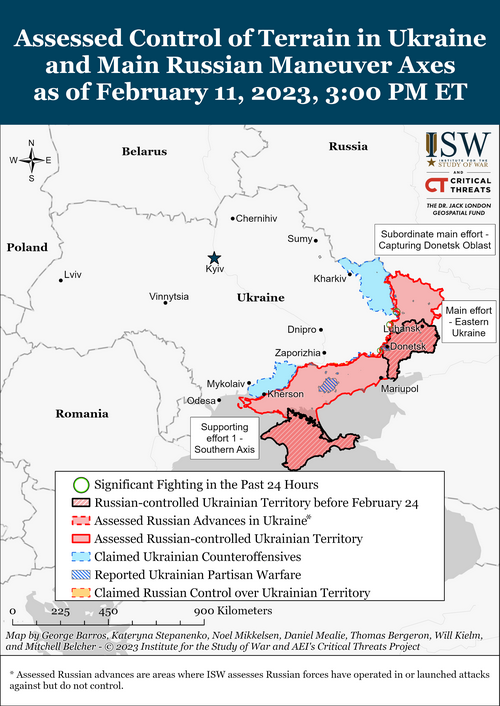
Ukrainian military officials and Russian pro-war nationalist voices are downplaying Russia’s ability to launch a sweeping large-scale offensive in Donetsk Oblast in the current circumstances of the Russian Armed Forces. Representative of the Ukrainian Main Military Intelligence Directorate (GUR), Andriy Chernyak, stated that Russia does not have the resources necessary to launch a large-scale offensive operation on February 24 to coincide with the anniversary of Russia’s 2022 invasion.[1] Chernyak noted that Russians are preparing to intensify their attacks in eastern Ukraine in the next few weeks and are currently searching for weak spots in Ukrainian defenses. ISW has previously assessed that Russian forces have regained the initiative on the Svatove-Kreminna line but that the offensive has not yet reached its full tempo.[2] Ukrainian Eastern Grouping of Forces Spokesperson, Colonel Serhiy Cherevaty, also noted that the Russian leadership had ordered the capture of Luhansk and Donetsk oblasts’ administrative borders and said that the grinding Russian operations in Bakhmut are a “symbol” of Russia’s inability to conduct rapid and powerful offensive operations.”[3]
Russian milbloggers continue to appear demoralized at the Kremlin’s prospects for executing a major offensive. Donetsk People’s Republic (DNR) commander Alexander Khodakovsky questioned why Russian forces are wasting their limited resources on small-scale grinding advances rather than accumulating combat force to launch larger-scale offensives.[4] Another milblogger amplified Khodakovsky’s concern, accusing Russian presidential administration officials of creating unattainable expectations for Russian offensives.[5]
Russian forces’ reported culmination and tactical failures around Vuhledar, Donetsk Oblast, have likely further weakened the Russian ultranationalist community’s belief that Russian forces are able to launch a decisive offensive operation. A prominent Kremlin-affiliated milblogger claimed that Russian forces failed to quickly advance in the first days of their offensive to capture Vuhledar and that Russian forces had lost the initiative by the end of January due to Ukrainian forces’ rapid transfer of reserves to the area.[6] The milblogger made his assessment that the Russian offensive to capture Vuhledar has likely culminated in response to viral footage showing Ukrainian forces destroying a disorderly column of Russian mechanized forces in the Vuhledar area.[7] Russian milbloggers seized on the footage to criticize the Russian military command for repeating the same failures that have plagued the Russian military throughout the war in Ukraine, with one prominent milblogger arguing that such incidents illustrate that the Russian army is unable to conduct an offensive along the entire Donetsk front.[8]
The disparity between the limited but significant Russian advances in the Bakhmut area and the lack of meaningful advances elsewhere in Ukraine may support milblogger and Ukrainian observations that Russian forces are unable to secure rapid advances through traditional mechanized maneuver warfare. The Russian military command is deploying its most elite units to the Bakhmut area in smaller formations using urban infiltration tactics, according to the limited footage of Russian tactics in the area that ISW has observed.[9] These tactics seem to be resulting in significant tactical Russian advances in the Bakhmut area that could lead to operational gains if Ukrainian forces choose to withdraw from Bakhmut. Russian offensive operations elsewhere in Donetsk Oblast and along the Svatove-Kreminna line have resulted in marginal advances without operational significance thus far. ISW has observed limited footage of Russian tactics in areas separate from the Bakhmut effort that suggests that Russian forces are engaging in more traditional mechanized maneuver warfare tactics with regular, not elite, motorized rifle, naval infantry, and tank elements.[10] All the formations so far observed were rendered combat-ineffective in earlier phases of the war and have very likely been reconstituted with mobilized personnel. The Russian military appears to have been unable to prepare its mobilized personnel to conduct effective mechanized offensive operations in the short period of time since their call-ups, as ISW forecasted.[11] The lack of adequate vehicles, ammunition, and other materiel is likely contributing to the ineffectiveness of Russian mechanized maneuver tactics thus far. The Russian military is unlikely to be able to scale its approach from the Bakhmut area to the wider theater because the tactics it is using in Bakhmut are more suited to dense urban environments and because Russian forces lack the number of elite formations needed to conduct a larger offensive in eastern Ukraine in the same fashion. ISW‘s assessment regarding the prospects for future Russian mechanized offensive operations is offered with low confidence due to the limited available footage depicting Russian military tactics across the entire front line.
Wagner Group financier Yevgeny Prigozhin is trying to salvage his declining influence in Russia as the Kremlin continues to sideline him and his mercenaries. Prigozhin attempted to improve the declining reputation of his Wagner mercenaries in an interview with a prominent Kremlin-affiliated milblogger Semyon Pegov (known under the alias Wargonzo) on February 10. Prigozhin responded to a series of questions about Wagner controversies such as high casualties and ineffectiveness of recruited convicts, execution of deserters, treatment of recruited forces as cannon fodder, Prigozhin’s harsh criticism of the Russian Ministry of Defense (MoD) and his supposed political aspirations, and Wagner mercenaries bearing “symbols of the Third Reich” despite fighting to “denazify” Ukraine.[12] Prigozhin notably confirmed that Wagner has stopped recruitment in prisons because of the expiration of an agreement permitting such recruitment with an unspecified agency – likely the Russian MoD. Prigozhin falsely denied ever criticizing the Russian conventional military and inaccurately presented his critiques as similar to the commonly expressed frustrations among Russian milbloggers regarding poor communications between the Russian military command and Russian units, as well as professionalization efforts that have been widely criticized. Prigozhin also denied having political aspirations and attacked his long-standing enemy St. Petersburg Governor Alexander Beglov.
The Kremlin is continuing to dim Prigozhin’s star by depriving him of the right to recruit in prisons and by targeting his influence in the information space. In addition to the Wargonzo interview, a Wagner-affiliated milblogger obtained a document that outlines rules for covering the war in Ukraine with explicit requirements to refrain from mentioning Wagner and Prigozhin in the media.[13] The document also calls on media officials and milbloggers to refrain from praising Deputy Commander of the Russian Joint Grouping of Forces in Ukraine, Army General Sergei Surovikin, who is reportedly affiliated with Wagner.[14] The milblogger noted that he is not sure about the authenticity of the document, but the Russian MoD and the Kremlin had already been deliberately avoiding mentioning Wagner and Prigozhin as ISW has previously observed.[15]
Prigozhin likely attempted to deflect attention from his controversies by undercutting the Kremlin’s unrealistic goals for the war in Ukraine. Prigozhin forecasted that it would take Russian forces up to two years to reach the Donetsk Oblast administrative borders and three years to advance to the Dnipro River from the east. Prigozhin added that Russian society would need to be drastically militarized for the Kremlin to reach the English Channel, likely either hyperbolizing Russia’s aims of destroying NATO or referring to the Cold War-era Soviet war plans aimed at conducting a rapid blitzkrieg to the Channel coast. Prigozhin likely sought to contribute to the current concern within the Russian information space about the Russian military command’s ability to sustain a major offensive in Donetsk Oblast to reestablish his reputation relative to that of the Russian MoD. The Wargonzo interview itself was likely a Kremlin ambush of Prigozhin aimed at calling public attention to Wagner controversies. Prigozhin likely saw this interview as an opportunity to elevate his name but instead found himself on the defensive throughout.
Prigozhin’s criticism of the Kremlin’s military campaign resembles the rhetorical approach of the former Russian militant Igor Girkin. Girkin had previously assisted the Kremlin by leading proxy armed formations in Crimea and Donbas in 2014 until the Kremlin deprived him of any influence following his surrender of Slovyansk in July 2014. Girkin became an embittered critic of the Kremlin and the Russian military command while seeking to rehabilitate his reputation in extremist Russian nationalist circles. Prigozhin’s uncharacteristically nihilistic forecast about Russian offensive prospects closely mirrors Girkin’s forecasts, and it is possible that Prigozhin is also turning into a bitter zealot who is losing his ability to leverage his parallel military to obtain political influence.[16] If the current Russian offensive stalls rapidly, on the other hand, the star of the conventional Russian military may once again wane, possibly re-opening a path for Prigozhin to regain significance and opportunities.
Russian forces targeted southern Ukraine with air, missile, and aerial and maritime drone strikes overnight on February 10-11. Ukrainian officials reported that Ukrainian forces intercepted 20 of 24 Russian UAVs and one Kh-101 missile overnight.[17] Russian forces chiefly targeted energy infrastructure in Zaporizhzhia, Mykolaiv, Dnipro, Kryryi Rih, and Khmelnytskyi cities.[18] Geolocated footage shows that Russian forces used a naval drone to strike the Zatoka road and rail bridge in Odesa Oblast (28km south of Odesa City on the Black Sea coast), the first observed instance of Russian forces operating unmanned naval drones.[19] The footage suggests that the bridge may have sustained severe damage, but the true degree of damage is currently unknown. Russian forces also conducted airstrikes against Snake Island, and Head of the Ukrainian Joint Coordination Press Center of the Southern Forces Nataliya Humenyuk suggested that Russian forces conducted these strikes to demonstrate that Russian forces have not forgotten about offensive actions in southern Ukraine.[20] ISW continues to assess that Russian forces currently lack the ability to threaten southern Ukraine with a full-scale offensive. The Ukrainian Operational Command South stated that Russian forces are trying to incite panic in the areas bordering Moldova.[21]
Key Takeaways
- Ukrainian military officials and Russian pro-war nationalist voices are downplaying Russia’s ability to launch a sweeping large-scale offensive in Donetsk Oblast in the current circumstances of the Russian Armed Forces.
- Russian forces’ reported culmination and tactical failures around Vuhledar, Donetsk Oblast, have likely further weakened the Russian ultranationalist community’s belief that Russian forces are able to launch a decisive military effort.
- The disparity between the limited but significant Russian advances in the Bakhmut area and the lack of meaningful advances elsewhere in Ukraine may support milblogger and Ukrainian observations that Russian forces are unable to secure rapid advances through traditional mechanized maneuver warfare.
- Wagner Group financier Yevgeny Prigozhin is trying to salvage his declining influence in Russia as the Kremlin continues to sideline him and his mercenaries.
- Russian forces targeted southern Ukraine with air, missile, and aerial and maritime drone strikes overnight on February 10-11.
- Russian forces continued offensive operations near Svatove and Kreminna.
- Russian forces continue to prioritize offensive operations in Donetsk Oblast.
- Russian occupation authorities are likely draining the Kakhovka Reservoir north of occupied Zaporizhia Oblast.
- Wagner Group financier Yevgeny Prigozhin confirmed that the Wagner Group stopped recruiting inside Russian prisons due to the expiration of an agreement between the Wagner Group and the Russian Ministry of Defense (MoD).
Go here to read the rest. It looks like the latest Russian offensive is already coming apart at the seams. Successful offensives are not the product of wish casting. They are the product of a disparity in quantity or quality between forces confronting each other. The Russians have neither qualitative nor quantitative disparities working in their favor in the Ukraine.

