
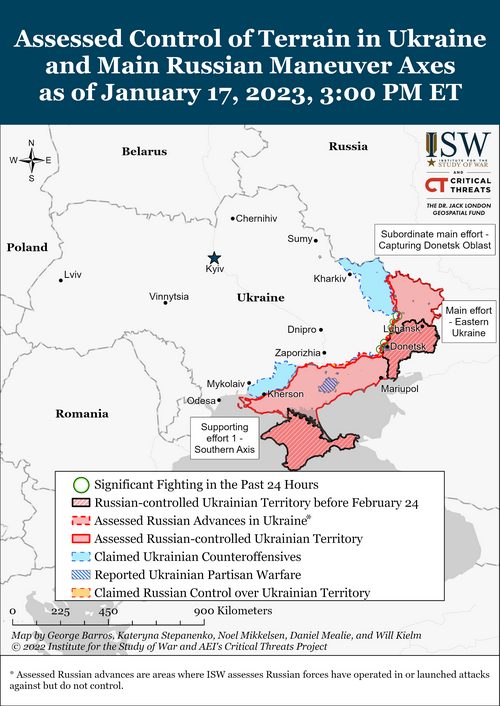
From The Institute For The Study of War:
Kateryna Stepanenko, Karolina Hird, Riley Bailey, Madison Williams, Layne Philipson, George Barros, and Frederick W. Kagan
January 17, 8:00 pm ET
Click here to see ISW’s interactive map of the Russian invasion of Ukraine. This map is updated daily alongside the static maps present in this report.
Russian Defense Minister Sergey Shoigu announced on January 17 that he will implement Russian President Vladimir Putin’s directive to conduct large-scale military reforms between 2023-2026 to expand Russia’s conventional armed forces, likely in preparation for a protracted war in Ukraine and also to set conditions to build a significantly stronger Russian military quickly. Shoigu stated that Putin ordered Russian authorities to increase the number of Russian military personnel to 1.5 million (from the current 1.35 million). Shoigu outlined that the Russian Ministry of Defense (MoD) will institute unspecified “large-scale changes” in the composition, complement, and administrative divisions of the Russian Armed Forces between 2023-2026.[1] Shoigu noted that Russia also needs to strengthen the key structural components of the Russian Armed Forces. Shoigu announced that Russia will reestablish the Moscow and Leningrad military districts, form a new army corps in Karelia (on the Finnish border), form new self-sufficient force groupings in occupied Ukraine, and form 12 new maneuver divisions.[2] Shoigu added that Russia needs to increase its capabilities to adequately prepare its forces by developing more training grounds and increasing the number of trainers and specialists. Shoigu first foreshadowed aspects of this reform at the Russian MoD Collegium meeting on December 21 when he proposed that Russia form two new airborne assault divisions, three new motorized rifle divisions, and reform seven existing brigades of the Northern Fleet and Western, Central, and Eastern Military districts into seven new motorized rifle divisions while expanding five existing naval infantry brigades into five naval infantry divisions.[3] It appears that Shoigu did not include the reformation of five naval infantry brigades into divisions in his January 17 statement. It is unclear if that part of the plan has been dropped.
These reforms demonstrate Russia’s intent to reform the Russian military to conduct large-scale conventional warfighting in general and not just for the current war against Ukraine, as ISW has previously assessed.[4] It is unclear if the Russian military will be able to grow as Shoigu described within three years.[5] Russia can nominally form new divisions but it remains unclear if Russia can generate enough forces to fully staff them to their doctrinal end strengths amid an ongoing war. Shoigu made previous announcements about Russian military reforms that never came to fruition, such as in May 2022 when he called for the formation of 12 new Western Military District (WMD) units of unspecified echelon by the end of 2022 and for the Russian MoD to recruit 100,000 reservists in August 2021.[6] Russia has previously faced challenges with fully staffing existing brigades and regiments, lacking sufficient trainers, and fully forming one new division it announced in 2020 before the start of the 2022 invasion of Ukraine.[7] The restructuring of the 150th Motorized Rifle Division (8th Combined Arms Army) took over a year.[8] Russia will also continue to face economic problems, which may continue to strain the Russian military command’s ability to supply its forces.
Russia’s ability to generate large-scale rapid change in its military capacity depends on President Vladimir Putin’s willingness to redirect large portions of the federal budget to a military buildup and putting Russia on something like a war footing for several years. There are signs that Putin might be willing to do so. Reform and expansion on the scale Shoigu outlined will not happen in time to affect the war in Ukraine materially for many months, but it could change the correlation of forces going into 2024, and it could establish conditions for a much more formidable Russian military threat to its neighbors, including NATO, in the coming years. Ukraine likely continues to have a window of opportunity into and through the summer if the West provides it the support it needs.[9]
Putin may announce a second mobilization wave to expand his army in the coming days—possibly as early as January 18. Kremlin Spokesperson Dmitry Peskov announced on January 17 that Putin will deliver a speech in St. Petersburg on January 18 in commemoration of the 80th anniversary of Soviet forces breaking the Nazi siege of Leningrad, Putin’s hometown.[10] Putin is fond of using symbolic dates to address the Russian people, and some Russian pro-war milbloggers noted that he will seize this opportunity to either declare mobilization or war with Ukraine.[11] Ukrainian and Western intelligence also repeatedly warned of Putin’s mobilization preparations scheduled for mid-January.[12]
The Russian Ministry of Defense (MoD) is trying to improve professionalism within the Russian armed forces and likely test and improve the effectiveness of its chains of command down to the small unit level. Several milbloggers commented on a reported list of guidelines for Russian troops in Ukraine that restricts the use of personal vehicles and certain personal electronic devices in the combat zone and sets stricter guidelines for the grooming standards of men on the frontlines.[13] The Russian MoD is likely attempting to institute these measures to instill greater professionalism in Russian troops and potentially gauge the ability of lower-level commanders to execute orders to standard, two issues that were brought to light in the wake of the December 31 Ukrainian strike on a Russian concentration area in Makiivka that killed up to 400 mobilized Russian servicemen. Following the Makiivka strike, the Russian MoD highlighted the lack of sound operational security (OPSEC) practices among Russian servicemen and blamed personal cellphone use—among other factors—for enabling the strike.[14] These guidelines likely are part of the ongoing Russian MoD line of effort to conduct widespread military reforms and bolster the overall professionalism of the Russian armed forces in order to avoid further failures such as the Makiivka strike.
The Russian MoD may have additionally issued these guidelines in an attempt to gauge the effectiveness of Russian commanders in executing orders. The issue of grooming on the frontlines, as ISW previously reported on January 16, has been a sticking point between lower-level commanders and undisciplined troops who refuse to obey orders to shave.[15] While the basic presentation of frontline troops may seem like a trivial matter, in reality, adherence to or disregard for such standards can indicate the professionalism or lack thereof of conventional forces. In poorly performing and demoralized units, failure to adhere to such standards can fuel demoralization and poor performance. Attempting to enforce those standards even in the circumstances facing the Russian military in Ukraine today, therefore, makes sense. The order to enforce such standards is also a way for higher echelons of the Russian command to test the ability of lower-level commanders to execute a relatively straightforward order on the individual soldier level.
Several prominent voices in the pro-war information space, including Russian and Donetsk People’s Republic (DNR) officials, seized on these guidelines to support further criticisms of the Russian MoD, suggesting that the Russian MoD will likely face stiff resistance in continued attempts at professionalization and modernization. Moscow City Duma Deputy Andrei Medvedev complained that the Russian MoD is ignoring real issues on the front and instead banning the movement of personal vehicles in combat zones, which, Medvedev noted, restricts the ability of volunteers to provide servicemen on the frontline with crowdfunded vehicles and supplies that the MoD has failed to procure for them.[16] Medvedev and Deputy DNR Information Minister Daniil Bezsonov both noted that the prohibition of certain personal electronics will impede soldiers’ ability to control quadcopters and store terrain maps offline.[17] These responses suggest that Russian military leadership will struggle to institute meaningful and sustainable reforms as long as they continue to place the onus for change on an individual basis. While these suggested changes are sound and prudent decisions in principle, the Russian MoD will likely struggle to effectively implement them due to continued fragmentations in the information space that skew strongly against the conventional MoD apparatus. The MoD faces a challenge using improved enforcement of standards to raise the quality of the Russian Armed Forces with such a significant trust deficit.
Serbian President Alexander Vucic called on the Wagner Group to cease recruitment in Serbia on January 16. Vucic posed a rhetorical question, asking why Wagner is violating Serbia’s laws.[18] Wagner Group financier Yevgeny Prigozhin stated that Wagner does not operate in Serbia and claimed that no Serbian nationals are enlisted in Wagner detachments because “Serbs themselves are doing an excellent job at handling their problems.”[19] Prigozhin’s statement may be a form of sarcasm, given recent tensions between Kosovo and Serbia.[20] Russian sources posted footage on January 17 purporting to show Serbian volunteers serving in a Russian volunteer battalion deployed to Zaporizhia Oblast, although ISW has not observed any Serbian nationals serving in Ukraine as a part of the Wagner Group.[21]
Key Takeaways
- Russian Defense Minister Sergey Shoigu announced on January 17 that he will implement Russian President Vladimir Putin’s directive to conduct large-scale military reforms between 2023-2026 to expand Russia’s conventional armed forces, likely in preparation for a protracted war in Ukraine and also to set conditions to build a significantly stronger Russian military quickly.
- Putin may announce a second mobilization wave in the coming days, possibly as soon as January 18.
- The Russian Ministry of Defense (MoD) is trying to improve professionalism within the Russian armed forces and likely test and improve the effectiveness of its chains of command down to the small unit level.
- Several prominent voices in the pro-war information space seized on these guidelines to support further criticisms of the Russian MoD, suggesting that the MoD will likely face stiff resistance.
- Serbian President Alexander Vucic called on the Wagner Group to cease recruitment in Serbia.
- Russian forces continued to conduct limited counterattacks near Kreminna as Ukrainian officials continued to suggest that Russian forces may be preparing for a decisive effort in Luhansk Oblast.
- Russian forces continued offensive actions across the Donetsk Oblast front line.
- The Russian information space is struggling to portray tactical Russian gains around Soledar as operationally significant.
- Russian forces in Kherson Oblast continue to struggle to maintain their logistics efforts in east (left) bank Kherson Oblast due to Ukrainian strikes.
- A Russian occupation official claimed that Putin will make an “important statement” pertaining to the war in Ukraine on January 18.
- Wagner Group financier Yevgeny Prigozhin may be attempting to establish the Wagner Group as a legal entity in Russia.
Go here to read the rest.
From Strategy Page:
January 17, 2023: Vladimir Putin has again reshuffled Russia’s senior leadership controlling operations in Ukraine, but the new guys are not expected to change much as the same sort of leadership replacement occurred several times since the war began 11 months ago without improving troop training or tactics. The only known exceptions are the private armies like the Wagner Group and Chechen volunteers who are recruited, trained and led by Chechen leaders that Putin trusts. Wagner has had some success because they are allowed to recruit from prisons. Putin quietly allowed Wagner to give pardons to such volunteers, which meant they were free if they survived six months of combat. Most don’t, but over 30,000 volunteered anyway. Wagner and the Chechens were also allowed to recruit Russian veterans, especially those with combat experience, and pay them more than Russian troops receive.
These two mercenary forces report to Putin, who must personally approve what operations they take part in. Russian generals in charge of the forces in Ukraine must accept this and make the most of it. Despite all this, the two mercenary forces have not achieved any notable victories but have made progress in areas where they are involved. Most other Russian troops in Ukraine are on the defensive and taking heavy casualties doing that. Putin is trying to create a new force of Russian troops who are well trained and equipped. This takes time, and it may be months before these new forces are ready and sent to Ukraine. Ukrainian intelligence regularly reports on the progress of Russian forces in action or in training. Such reports can be independently verified with commercial satellite photos. The Ukrainians supply details to explain why things are happening and use a network of informants in Russian controlled territory to help with that. NATO supplied the Ukrainians with the results of more detailed air and satellite photos as well as radio intercepts. Ukraine continues to obtain useful information by monitoring Russian troops using their cell phones freely. Officially, Russia bans such use of cell phones but the Russian officers are unwilling to actively crack down on cell phone use.
Differences That Matter
Few in Russia or the rest of the world believed that Russia would invade Ukraine in February 2022. Some Ukrainian intel and staff officers thought it was a possibility. Russia did invade and suddenly the word had its first “near-peer” war between nations armed with similar weapons. This did not go well for Russia and by the end of 2022 Russia faced an ongoing Ukrainian counteroffensive that was pushing Russian forces out of Ukraine. Russia responded by threatening to use nuclear weapons if Ukraine continued its counteroffensive. Russia wants to keep some of the Ukrainian territory it seized in 2014. Russia blames NATO for supporting Ukraine, a non-member, whose efforts to join NATO triggered the 2022 invasion. That resulted in crippling economic sanctions by NATO nations.
To Russia, the sanctions and aid to Ukraine justified the nuclear threat. Ukraine and NATO refused to back down and Russia’s remaining major trading partners China and India, advised Russia to drop the nuclear threat. Most other nations did the same. The implication was that if Russia went ahead and used nukes they would become an international outlaw and much worse off. The Russian invasion was unjustified and violated an agreement Russia signed in the 1990s to get Soviet-era nuclear weapons removed from Ukraine in return for Russian assurances that they would never try to seize Ukrainian territory. Russian leader Vladimir Putin ordered the invasion despite advice from his military, diplomatic and economic advisors that it was a bad idea. The advisors were right, and before the end of 2022 that advice was made public and a growing number of Russians, who initially believed state-controlled media justifying the war, no longer support Putin’s war.
No nuclear weapons have been used since 1945 when two American nukes dropped on Japanese cities finally got Japan to surrender after starting the war and losing. Until the nukes were used, Japan was ready to resist a land invasion while a naval blockade was causing hunger and starvation in Japan. Since then, there has been an understanding among the growing number of countries with nuclear weapons that no one would be the first to use nukes and then only to defend their own territory or in response to a nuclear attack. Russian leader Putin threatens to violate that understanding and it remains to be seen if Putin will actually break this 77-year-old nuclear understanding.
Putin and his generals also missed what happened when NATO personnel served in Ukraine between 2014 and 2021 when they taught Ukrainian officers how to become a NATO-compatible force. This turned out to be a major advantage because the Russians were still using their rigid Soviet-era command and troops control procedures. By 2021 the Ukrainians had adopted more flexible Western methods where junior commanders were trained to improvise when necessary. The only Russian troops who did any of that were spetsnaz (special operations) forces. Most Russian troops follow detailed orders and, when they encounter something not covered in their orders, they halt and wait for further instructions. Ukrainian forces regularly exploited this. After nearly a year of fighting the Russians have not changed, even though the more flexible Ukrainians constantly win battles because of their initiative.
Ukrainians appreciate this training effort and it makes a difference on the battlefield. This is especially true because Russia is sending more troops to Ukraine with little or no training. That means the Russians suffer higher casualties and the Ukrainians lose far fewer men. After a few months of fighting in 2022, Russia had lost many of its veteran soldiers and officers. Since then, most of the new Russian troops have little training or advanced tech and suffer from low morale and poor leadership. That sort of thing makes a big difference in combat but is often discounted during peacetime.
Ukrainians could find out how this came to be, because the current NATO tactics began emerging in the late 1970s when NATO’s most powerful member (the U.S.) sought a new combat doctrine to make the best use of new weapons, an all-volunteer force and growing air superiority. West Germany was urging the United States to adopt tactics that would mean losing less German territory in the opening stages of a war. In 1982 this led to AirLand Battle doctrine, which emphasized meeting a Warsaw Pact (mainly Russian) invasion by attacking as well as defending. West Germany was reassured and those who had studied the 1972 Arab-Israeli war, which began with a surprise attack by Egypt and Syria, was quickly defeated by an Israeli “active defense” that emphasized attacking as well as defending. The Americans had already adopted an “active defense” doctrine in 1978 but AirLand Battle was a refinement of that, and evolved to the present with improved versions of these tactics.
The Russians believed interpreted AirLand Battle as the result of how much post-Vietnam military reforms had turned NATO defense plans into an offensive opportunity for NATO that made any Russian attack less likely to succeed and vulnerable to a NATO invasion of East Europe. The 1991 Iraq war certainly confirmed it, but Russians attributed that to poor quality Iraqi officers and troops.
After the East European Soviet satellite governments collapsed in 1989, it was revealed that the Soviets had become less confident of the ability and willingness of East European Warsaw Pact armies to assist Russian forces in attack or defense. Part of this was due to the aftereffects of the crackdown in East Europe after the uprisings of the 1950s and 60s. Western intel officials interviewed many of East European civilians getting out and thought the refugees were exaggerating. They weren’t and that became obvious in 1989 plus two years later when the USSR itself collapsed. Once the Ukraine War has ended, the Russian military may accept that the NATO tactics were a major reason for their failure in Ukraine. Russia would have a difficult, but not impossible time implementing a version of the NATO tactics for their forces. It would mean changing how their officers are trained and finally getting serious about reviving the use of NCOs, something the communists eliminated in the 1920s to prevent a counter-revolution against communist rule.
Production Problems
Another endemic problem Russia suffers from is their inability to develop and produce weapons and equipment that match or surpass what the West has. From 2015 to early 2022 Russian defense production has been crippled by detailed and regularly updated sanctions based on continuing searches for smuggled Western parts. An example of this was Orlan-10 UAV, whose production should have been shut down by 2016 sanctions but wasn’t. Oran-10s required several Western electronic boards and chips that were not manufactured in Russia, and had to be imported. By 2017 it was clear that Russia was not simply using existing stockpiles of now banned components to build new Oran-10s. This was a major problem because Orlan-10 was a key observation asset as it could spot targets for Russian artillery or rocket fire. Oran-10 can operate high enough to be safe from rifle or machine-gun fire and it is difficult for a lightweight anti-aircraft missile like Stinger to hit. At night it is even less vulnerable to ground fire.
In Ukraine some Orlan-10s continued to be shot down or crashed because of equipment failure. Their wreckage was examined for the presence of banned components and these items were still there. The banned items were common, not custom-manufactured for Orlan-10s. There were dozens of distributors you could order from. Government efforts to sort out which distributors were selling the Oran parts to a firm with a link to Russia had come up empty. In late 2022 three media organizations, RUSI, Reuters and iStories, pooled their resources and soon found out how the banned components were getting to Russia.
The key to this effort was iStories, a Russian investigative media organization that was created in early 2020 to investigate and report corruption and misbehavior in general inside Russia. The “i” stands for important and iStories output was often very important if you were Russian and angry at the rampant corruption inside Russia and the war in Ukraine. iStories is a non-profit news gathering operation created in response to the growing government repression of Russian media. Two years after it was founded, the Russian government banned iStories and arrested some of its staff. By then most of the iStories staff was operating from outside Russia. The iStories website moved after the 2022 ban but could still communicate with sources inside Russia because iStories had distributed techniques on how to get around Russian restrictions on the use of the Internet. The iStories staff and their many informants inside Russia made it easier to take the material RUSI and Reuters had on the smuggled Orlan components and track down the missing link that was funneling the parts into Russia. Russia considers iStories an enemy of the state and the feeling is mutual. If there are more efforts like the Oran smuggling operation Russia may decide to escalate and add some members of the iStories staff to the kill list maintained by the FSB and GRU overseas assassination programs. FSB (the former KGB) and GRU (Russian overseas military intelligence) handle foreign espionage and dirty tricks. Going after high-profile news organization personnel is rare because it causes such a huge blowback.
After the Cold War ended in 1991 Russia was a democracy (until Putin showed up in 1999) and was able to import Western components as well as weapons. This was intended to provide Russian manufacturers help in improving their development management capabilities. That ended in 2014 when Putin decided to absorb ports of Ukraine and then all of Ukraine in 2022. Many in the Russian defense industries understood this but Putin had outlawed open discussion about it. Putin believed Russia had an obligation to rebuild its empire but that could not happen if Russia remained a democracy with a free press. In contrast, Ukrainians kept their democracy and free press and it made a difference in combat which Putin still refuses to accept. Meanwhile Ukraine declares that it is an unofficial NATO member and that membership will be formalized once the war is over.
Lost access to Western components is not the only problem Russian defense manufacturers are having. Russia’s enormous pre-war artillery munitions stocks are now depleted, while its production facilities are unable to expand. Before 1991 a lot of Soviet-era 122m and 152mm ammunition was produced outside post-1991 Russia. That includes Ukraine, Belarus and other former Soviet republics which likewise halted artillery munitions production and dismantled production facilities. Russia did not expect a long war in Ukraine and did not have the artillery munitions available to fire all the shells their forces in Ukraine wanted in the past year. On the front lines Ukrainian troops have noted far fewer Russian shells fired at them recently, estimated as down to 5,000 rounds daily from highs of 75,000. Ukrainian artillery, a combination of old Soviet 152mm and new NATO 155mm guns, are adequately supplied with shells and use more effective tactics than the Russians.
January 14, 2023: Britain announced that it will send Ukraine fourteen Challenger tanks immediately. These will arrive in Ukraine by early February. Challenger 2 is similar to the more numerous Leopard 2s and M1 tanks. Poland is also sending some of the Leopard 2s as well. Ukraine believes that with 300 Western tanks they finish off the Russians in Ukraine and end the war. The Americans have the most such tanks available because they produced over 10,000 M1 tanks from the 1980s until 2014. The plant that made M1s is still open to fill upgrade orders. The army only needs about 25 percent of those for its current forces. About 3,5oo M1s are in storage in case of an emergency. Many Ukrainians and Americans point out that the Ukraine War qualifies as an emergency but the current American government does not want to upset the Russians that much. European NATO members see the Russian threat differently and the closer these NATO nations are to the Russian or Ukrainian border, the more threatened they feel by Russia.
Russia used 30 of its dwindling supplies of missiles to carry airstrikes on Ukraine. Twenty of the missiles were intercepted but the other ten damaged electricity production and distribution systems in several cities and forced temporary cutbacks in electricity supplies until the damage can be repaired.
January 13, 2023: In eastern Ukraine (Donetsk province) Russia claims to have captured the much fought over town of Soledar but is denied by Ukraine, which, despite Russian gains in the last few days, still controls areas outside Soledar. Since August 2022 Russia has become obsessed with taking the nearby town of Bakhmut and key satellite towns like Soledar. According to Russia, Bakhmut, and nearby towns like Soledar control key supply roads needed for another Ukrainian offensive in Donetsk province. The Ukrainians never announce in advance where their next offensive will be but the Russians are certain it is Donetsk and not the south (Crimea) or the rest of Kherson province and other areas south of Donetsk. Russian forces in Ukraine are poorly trained, led and equipped. A major exception if a special force (the Wagner Group) that was created by Vladimir Putin in 2014 as his private army for “special operations” in Ukraine and elsewhere. Until 2022, most Wagner personnel were experienced Russian military veterans.
For 2022 operations in Ukraine Wagner recruited over 30,000 convicts to supplement the core force of veterans. Russia has been using Wagner Group mercenaries for most of the attacks in Donetsk because these troops are more effectively led and willing to continue making seemingly suicidal attacks on Ukrainian forces. The Ukrainian defenders include some special operations troops and members of the foreign legion volunteers whose orders are to inflict maximum casualties on the attackers while minimizing enemy advances and Ukrainian casualties. The Wagner forces did advance, but slowly and at great cost in terms of dead Wagner personnel. Ignoring the small distances of these advances and the huge number of troop losses, the Russians can regularly issue press releases announcing continued advances by their troops without revealing that these advances often consist of a few meters in the general direction of the Ukrainian positions. The Russian attacks are supposed to tie down a lot of Ukrainian troops but that does not happen and it is Russia that is losing lots of its most effective troops every week without any useful gains. Some Russian pro-war Internet reporters can get away with mentioning how the “Donetsk Offensive” really works as long as they don’t describe it too vividly or frequently. Ukrainian leaders offer more effusive and frequent praise for the Ukrainian defenders. No official casualty figures have been released but commercial satellite photos and reports from Ukrainian civilians in the area indicate that the Russian losses are much larger. The satellite photos show lots of dead Russians in front of Ukrainian positions. The Ukrainian troops have prepared lots of alternative defense positions so that they can abandon one that is under heavy attack after inflicting heavy losses on the Russians. Russian gains are largely illusions which their huge personnel losses are not.
Russia has been suffering major personnel and territorial losses since August 2022 when the Ukrainians went on the offensive. Officially, Russia did not expect this. The reality was that within months of the invasion beginning eleven months ago, Russia forces were retreating in the north and on the defensive elsewhere in Ukraine. The Ukrainian offensive started in the northeast (Kharkiv province) and by September the Russians withdrew. Russian troops were taken by surprise and suffered major losses in terms of troops, equipment and territory. In November Russia lost Kherson City in the south (Kherson province). During the series of defeats Russia had only one offensive going in Donbas, which Russia believed would be the target of the next major Ukrainian attack. Since December the Ukrainians have been organizing an offensive force with more and better weapons along with better trained and led troops than Russia has. The Ukrainians will not reveal where this offensive force will be used.
The front line in Ukraine is about 2,500 kilometers long and except in Donetsk, most of the combat is in the form of artillery fire and the use of machine-guns or sniper rifles. On most days only about half the front-line experiences any of this artillery, gunfire or air strikes. Russian forces in Ukraine are insufficient to man a World War I style front line of continuous trench lines. During World War I, the front line in east (Russia) was straighter (about 1,300 kilometers) and manned by millions of troops. This is ten times the number seen in 2022 Ukraine. Even then there were portions of the World War I east front that were patrolled but not manned by troops in trenches. World War I saw the first use of aircraft on a large scale to maintain a better idea of who was where on the ground. Observer reports were augmented by aerial photographs. In 2022 Ukraine has an advantage in terms of aerial surveillance because of NATO assistance (satellite observation and some special aircraft),. Because of NATO assistance Russia has not been able to obtain air superiority over Ukraine. Both sides can carry out airstrikes but must beware of air defenses on the ground and in the air.
January 12, 2023: The Russian legislature announced that starting in 2023 all men aged 18-30 were subject t0 conscription. This replaces the previous policy of only conscripting qualified 18-year-old men. Putin can veto or, more likely modify this proposal but he needs more troops and this is one way to get them is depending on the current process of “special mobilization” that leaves it up to the provincial governments to meet a quota any way they could. This resulted in a lot of unqualified men sent off to war with little or no training. The new proposal is supposed to solve the problem of more and more Russian men avoiding conscription. Putin has already enacted regulations that make it more difficult for military age men to leave the country for any reason. The new conscription policy is opposed by universities and many businesses that will lose essential workers. Russia recently raised the maximum size of the Russian military from 1,013,628 to 1,150,628 and plans to reach that goal with more mobilizations using the lower standards for new troops. Russia also plans to increase the number of volunteer contract troops who are paid more and serve longer. Russia expects to have 521,000 by the end of 2023 and 695,000 a year or two after that. That is optimistic considering the number of existing contract troops who are not renewing their contracts. There is no information from Russia about how so many new conscripts or contract troops will be obtained to increase the size of the armed forces to 1.15 million. Russia may extend conscription service from one to two years and keep existing conscripts and contract troops in uniform longer because of the war. That is not popular with most Russians, which is how that attitude forced the government to reduce conscript service to one year in the first place.
Russian armed forces are supposed to have over a million men but that goal has never been met and at the end of 2021 the total was about 750,000. That is now about 400,000, including the air force and navy. Heavy combat losses reduced military personnel strength so sharply because the Russian army has far fewer soldiers providing logistic and transportation services. These are provided by government or private contractors to assemble and move supplies close to the combat zone, where military trucks and drivers move the supplies to army-maintained collection points or the combat units. This works inside Russia where the state-controlled railroads are equipped for operation by civilians who are trained for such support. For a major war against Russia, civilian trucks and drivers are mobilized for this. Such a mobilization disrupts the economy but that is seen as necessary t0 defend Russia. This is why the Ukrainian invasion was not called a war but an “internal operation” in what Russia declared was Russian territory controlled by rebels. Russia did not expect the massive resistance by Ukrainians or the destruction of trucks and supply collection points. This weakened their supple capabilities inside Ukraine and greatly reduced the size of the military.
Mobilizations of new conscripts and men who had served the one year of conscript service failed to replace all the losses, in part because the mobilized men knew that the war in Ukraine was not going well and most men sent there had little training, equipment or leadership.
January 11, 2023: Poland announced it is sending twelve of its 242 Leopard 2 tanks to Ukraine. Poland purchased these Cold War surplus tanks in 2002 These were A4 and A5 versions introduced in the mid-1992. Poland is in the process of upgrading all its Leopard 2A4/5s to the Leopard 2PL standard. Poland can send a lot more (nearly a hundred) Leopard 2s because in 2022 Poland ordered 250 of the latest version of the American M1 tank, the M1A2SEP3. These will begin to arrive in 2025. Ukrainian forces have already destroyed most of the modern tanks available and Russian production of new tanks is stalled by the sanctions. At this point the quickest way to get the Russians out of Ukraine is to send them the Western tanks they requested. In several wars since 1991 the M1 demonstrated its dominance over Russian tanks, No T-72 has ever destroyed an M1 while the M1 had destroyed many T-72s. Russia would rather not get another reminder of that.
January 10, 2023: Russian media recently described the new T-72B3M tank. Officially, the most modern Russian tank is the T-90M. This tank is not what Russian crews prefer. The favorite is the T-72B3, which is as effective as the T-90 and lacks a lot of the additional features on the T-90 that don’t work, complicate operation of the tanks and the crews must maintain. The T-90 is for export customers and no Russian troops use the T-90 in peacetime. The new B3M model was described as having a lot more ERA (Explosive Reactive Armor) blocks and other forms of protection. No mention was made of a solution to the T-72 vulnerability to top attack ATGMs (Anti-Tank Guided Missiles) that have caused the loss of nearly a thousand T-72s and T-90s in Ukraine. This vulnerability has existed since the auto-loader was introduced in the 1960s. While the auto-loader increased rate of fire for the 125mm main gun, and reduced crew size by one man, it also put a lot more munitions in the crew compartment where the propellent charges and shells were vulnerable to any fire because it could cause the turret to explode, killing the entire crew. New T-90M tanks are still being produced and sent to Ukraine, but the T-72 is still the most widely used Russian tank.
Top attack ATGM warheads were introduced in 1988 by Sweden. The concept caught on with ATGM manufacturers and even the Russians eventually adopted it. For the Russians, top-attack ATGMs were not a wonder weapon because Western tanks did not use autoloaders and stored tank gun ammo in a special compartment at the rear of the turret. This ammo storage space has a “blowout” panel that directs an explosion in the ammo compartment towards the rear of the tank, not the crew compartment. Moreover, Western tanks had more effective turret top protection which usually defeats Russian top-attack ATGMs.
In Ukraine, the Russian tank top-attack vulnerability came as a surprise to Russian crews and soon the senior Russian commanders were equally dismayed at this revelation. Some Ukrainian troops, who had used Western top-attack ATGMS against Russian tanks in Donbas before 2022, suspected that this vulnerability was widespread. No one believed the vulnerability was universal until all those invading Russian tanks had their turrets explode. This phenomenon soon caused many Russian tank crews to abandon undamaged T-72s and T-90s that were then captured by the Ukrainians who used them. Used against the Russians, the captured tanks were much less vulnerable to top attack because Russian forces did not have top-attack ATGMs as effective as the Western models. Despite that Ukrainian troops used their tanks, which all had autoloaders, for long distance (behind the troops) fire support. Ukraine would still like to obtain Western tanks like the Leopard 2 and M1 but so far none of these have been sent to Ukraine. Britain recently sent ten of the Challenger 2 tanks, which are similar in protection and firepower to the Leopard 2s and M1s. Poland is also planning to send some of its Leopard 2s to Ukraine. Poland is buying hundreds of American M1 tanks to augment its Leopard 2s. The United States still refuses to send Ukraine M1 tanks, despite continued Ukrainian requests.
January 9, 2023: NATO is moving several of its AWACs and other surveillance aircraft from Germany to bases in Romania. This means the aircraft will spend more time in the air monitoring activity in Russian controlled portions of Ukraine. Before the move these aircraft had to fly to Romania before beginning their surveillance. The move means less wear on the aircraft because much less time is spent flying to the patrol area.
January 8, 2023: Ukraine and Russia carried out their first prisoner exchange of 2023, with each side sending 50 enemy soldiers back. These exchanges involved the only regular communication between the Ukrainian and Russian army. Each side still holds thousands of enemy POWs (prisoners of war). The exchanges are increasing because both sides see benefits in the program. Over a thousand POWs have been exchanged so far that number is expected to grow considerably in 2023.
January 7, 2023: The Ukraine War has done enormous damage to both Ukraine and Russia. Ukrainian GDP declined 30 percent in 2022 while Russia’s declined about three percent. Russia was hit hard by economic sanctions in 2014 for taking Crimea and parts of eastern Ukraine, and sanctions for its 2022 invasion made it even more isolated from the global economy. Russia’s only arms imports now come from equally poor North Korea (artillery ammo) and Iran (nearly 2,000 cheap Shahed 131/136 cruise missiles). Payment is by barter. North Korea gets badly needed food and oil supplies while Iran receives modern jet fighters and other military tech. China and India help with the funding by purchasing heavily discounted Russian oil and natural gas.
Russian government debt issuance costs a lot more now because of higher interest rates for what lenders call “high risk” (of default) debt. That has forced Russia to be selective in what military equipment it purchases. For example, the government won’t buy many new rifles for their combat troops because there are still lots of older weapons in storage. Those were so poorly maintained as to be often obviously rusty and barely operational. The newly mobilized troops complain but the federal government recognizes that most of these poorly trained and equipped soldiers won’t last long in combat. Local governments suffer most of the blowback for this and often organize efforts to raise money locally to buy new weapons and other equipment for local troops.
Russia depends a lot on its Iranian cruise missiles and North Korea artillery ammo to keep the fighting going. The Iranian missiles are not as useful as predicted because the Ukrainians now shoot down nearly all of them. There is still damage, because the wreckage of the downed missiles often still has its explosives on board and these frequently go off when they hit the ground. If Russia uses a lot of cruise missiles in an attack, more will be downed inside an urban area, where the wreckage does some damage to the Ukrainian infrastructure.
January 6, 2023: Popular support for the war is declining in Russia as the economy grows weaker and losses grow in Ukraine. Vladimir Putin has outlawed open criticism of the war but it happens anyway and is particularly harmful when it comes from senior Russian officials who have left Russia and can speak freely. Despite all this, Putin has declared he will fight in Ukraine for as long as it takes. The question is, how many other Russians will continue to do the fighting.
Russia rarely reports on the growing Ukrainian partisan movement in Russian occupied areas. The Ukrainian government does not say anything specific about the partisans because that could endanger the partisans and their operations. Some proof of government support comes from commercial satellite photos or rare reports from the Russians. Known support techniques include low night-flying helicopters and, if coastline is available, small boats used at night. Currently partisan violence is most widespread and frequent in Kherson province, which is due north of Crimea. Russia has less than 200,000 Russian troops in Ukraine, few of whom have much training beyond a few days with assault rifles some were never allowed to fire, and pretty much uniform desire to be anywhere but Ukraine. About ten percent of the Russians are local militia recruited or conscripted from civilians in Russian occupied territory. A growing number of those civilians support or belong to the partisans. Partisan groups are usually led by someone with military experience and months of operating as a partisan. Most partisans are local and operate in areas where they grew up. That means lots of local support for the partisans and little help for the Russian soldiers. The Russian response to this is more Ukrainians are being sent to Russia in a form of exile. Russia also continues to take young Ukrainian children and send them to Russia, where they are adopted and raised as Russian. Now larger groups of Ukrainian civilians are being exiled to Russia to reduce support for the growing number of partisans in Russian occupied Ukraine. These practices have angered more than intimidated Ukrainians and increased support for the partisans.
Go here to read the rest. Putin is fighting a Potemkin war in which he makes noises to convince the Russian people that he is taking steps to win his war. However, he is fooling no one. His words and his lack of serious action indicate that he lacks the power and resources to commit the Russians to change their military and to vastly expand it. Instead we have a Kabuki theater of as much significance as a cat raising the hair on its back to appear to be a larger beast. So why does he persist in this sham? Because he has convinced himself that when he loses this war he will likely lose his dictatorship and perhaps his life. Better to cover the losing process with idle plans to build a New Model Russian military, that to admit that this is a lost war.

